This is the content of the pop-over!

ILTS Learning Behavior Specialist I (290) Practice Tests & Test Prep by Exam Edge


ILTS Learning Behavior Specialist I  product image
(4.9)
Based on 22 Reviews

  • Real Exam Simulation: Timed questions and matching content build comfort for your ILTS Learning Behavior Specialist I test day.
  • Instant, 24/7 Access: Web-based ILTS Learning Behavior Specialist I practice exams with no software needed.
  • Clear Explanations: Step-by-step answers and explanations for your ILTS exam to strengthen understanding.
  • Boosted Confidence: Reduces anxiety and improves test-taking skills to ace your ILTS Learning Behavior Specialist I (290).

Featured on

ILTS Learning Behavior Specialist I Online Practice Test Bundles

BEST VALUE
20 practice tests

$174.00

$799.00

SAVE $625

Only $8.70 per test!

  • 100% Pass Guarantee
  • 20 online practice tests
  • 100 questions per test
  • Bonus: 100 Flash Cards + Study Guide
  • Instant access
  • Detailed Explanations
  • Practice tests never expire
  • Timed, untimed, or study guide mode
MOST POPULAR
10 practice tests

$99.50

$399.50

SAVE $300

Only $9.95 per test!

  • 10 online practice tests
  • 100 questions per test
  • Bonus: 100 Flash Cards + Study Guide
  • Instant access
  • Detailed Explanations
  • Practice tests never expire
  • Timed, untimed, or study guide mode
5 practice tests

$69.75

$199.75

SAVE $130

Only $13.95 per test!

  • 5 online practice tests
  • 100 questions per test
  • Bonus: 100 Flash Cards
  • Instant access
  • Detailed Explanations
  • Practice tests never expire
  • Timed, untimed, or study guide mode
1 practice test

$39.95

  • 1 online practice test
  • 100 questions per test
  • Instant access
  • Detailed Explanations
  • Practice tests never expire
  • Timed, untimed, or study guide mode
Quick Select
Tap to choose a bundle

** All Prices are in US Dollars (USD) **


ILTS Learning Behavior Specialist I (290) Resources

Jump to the section you need most.

Understanding the exact breakdown of the ILTS Learning Behavior Specialist I test will help you know what to expect and how to most effectively prepare. The ILTS Learning Behavior Specialist I has 100 multiple-choice questions . The exam will be broken down into the sections below:

ILTS Learning Behavior Specialist I Exam Blueprint
Domain Name % Number of
Questions
Understanding Students with Disabilities 16% 16
Assessing Students and Developing Individualized Programs 23% 23
Supporting Development and Learning 31% 31
Working in a Collaborative Learning Community 15% 15
Foundations and Professional Practice 15% 15

ILTS Learning Behavior Specialist I Study Tips by Domain

  • Differentiate IDEA disability categories from medical diagnoses and focus on educational impact; red flag: eligibility decisions based solely on a clinician’s report without school-based data.
  • Recognize key characteristics and learning implications of high-incidence disabilities (SLD, EBD, ID, ADHD) and match supports to needs; common trap: assuming “behavior problem” equals EBD without pattern, duration, and intensity evidence.
  • Identify features of low-incidence disabilities (ASD, sensory impairments, orthopedic/other health impairments, TBI) and anticipate access needs; priority rule: consider assistive technology and communication supports early when access to instruction is compromised.
  • Understand how culture, language, trauma, and poverty can mimic disability-related symptoms; red flag: disproportionate referral when instruction quality and language proficiency have not been ruled out.
  • Interpret evaluation information (academic, cognitive, adaptive, behavior, health, observations) to describe strengths and needs; common trap: overreliance on a single score or setting when making disability-related conclusions.
  • Apply principles of least restrictive environment (LRE) and continuum of services based on student needs; contraindication: recommending a more restrictive placement before documenting appropriate supports attempted in general education.
  • Use multiple data sources (records review, observations, CBM, interviews, standardized measures) to make eligibility and programming decisions—red flag: relying on a single test score or one setting.
  • Verify assessment selection and administration match the referral question and student characteristics (language, culture, sensory/motor needs); common trap: invalid results from nonstandardized conditions without documenting impact.
  • Write present levels (PLAAFP) that quantify baseline performance and link directly to identified needs; priority rule: if you can’t measure it now, you can’t credibly set a goal.
  • Develop annual goals that are specific, measurable, and aligned to grade-level standards while targeting the skill deficit; red flag: goals that describe activities/services (e.g., “will receive OT”) instead of outcomes.
  • Select accommodations/modifications and assistive technology based on documented need and data; contraindication: providing supports that change the construct on assessments without IEP documentation and team rationale.
  • Plan progress monitoring with clear methods, frequency, and decision rules for instructional changes; common trap: collecting data but not specifying what triggers an adjustment (e.g., lack of growth over 3–4 data points).
  • Use a strengths-based developmental profile (cognitive, language, motor, social-emotional, adaptive) to set IEP goals; red flag: selecting goals that don’t match the student’s present levels of performance (PLAAFP).
  • Design instruction with explicit teaching and systematic prompting (e.g., least-to-most, most-to-least, time delay) and plan for prompt fading; common trap: leaving prompts in place and unintentionally creating prompt dependence.
  • Apply principles of ABA (clear antecedent-behavior-consequence, reinforcement, shaping, chaining) to build skills; priority rule: reinforce the target behavior immediately and consistently before thinning schedules.
  • Support communication development with AAC matched to the student’s needs and contexts; red flag: restricting AAC until speech improves—AAC should be available across settings to reduce frustration and increase access.
  • Promote social-emotional and behavioral competence using proactive supports (teach expectations, self-management, coping skills) and data-based adjustments; common trap: relying on punitive consequences without teaching a replacement behavior.
  • Plan generalization and maintenance from the start (multiple exemplars, varied settings/people, natural cues and reinforcers); red flag: mastery in one setting only—if it doesn’t generalize, reteach with programming for generalization.
  • Use a structured problem-solving cycle with families and teams (define concern → analyze data → select intervention → monitor) and document decisions; red flag: making placement or service changes based on opinion rather than multiple data sources.
  • Clarify roles/responsibilities across general education, special education, related services, and paraprofessionals with written plans (e.g., who teaches, who collects which data); common trap: assigning paraprofessionals primary instruction without teacher-designed, supervised supports.
  • Run meetings (IEP/504/MTSS) with clear agendas, norms, and time-bound action items, ensuring parent participation and language access; priority rule: provide interpreters/translated materials when needed—do not rely on a student or sibling to interpret.
  • Collaborate to implement behavior supports consistently across settings (classroom, specials, transportation) and align reinforcement/consequences; red flag: staff using inconsistent responses that inadvertently reinforce the target behavior.
  • Maintain confidentiality and appropriate information-sharing (need-to-know) while collaborating; common trap: discussing a student’s disability, services, or behavior plan in hallways, emails, or shared documents without proper safeguards.
  • Build co-teaching/co-planning routines that protect access to grade-level curriculum with appropriate accommodations/modifications; contraindication: lowering expectations or replacing core instruction with isolated skill drills not tied to IEP goals and standards.
  • Apply IDEA/Illinois special education requirements to IEP timelines and service delivery; red flag: missing a due date (e.g., initial evaluation/annual review/reevaluation) can create noncompliance even if services are appropriate.
  • Use ethical decision-making around confidentiality and records access (FERPA/HIPAA boundaries in schools); common trap: sharing disability-related details with staff who lack a legitimate educational interest.
  • Anchor instructional decisions in evidence-based practices and data rather than preference; priority rule: if progress-monitoring data do not show adequate growth over multiple data points, adjust intensity before waiting for the next formal review.
  • Understand least restrictive environment (LRE) and placement decision rules; red flag: deciding placement before identifying supports, accommodations, and supplementary aids/services needed in the general education setting.
  • Implement behavior support within legal/ethical limits; contraindication: using seclusion/restraint as a planned intervention or for convenience rather than as an emergency safety measure with required documentation and parent notification.
  • Maintain professional practice through accurate documentation and ongoing learning; common trap: informal notes that omit dates, objective descriptions, and antecedent–behavior–consequence details can undermine defensibility and team decision-making.


Built to Fit Into Your Busy Life

Everything you need to prepare with confidence—without wasting a minute.

Three Study Modes

Timed, No Time Limit, or Explanation mode.

Actionable Analytics

Heatmaps and scaled scores highlight weak areas.

High-Yield Rationales

Concise explanations emphasize key concepts.

Realistic Interface

Matches the feel of the actual exam environment.

Accessible by Design

Clean layout reduces cognitive load.

Anytime, Anywhere

Web-based access 24/7 on any device.
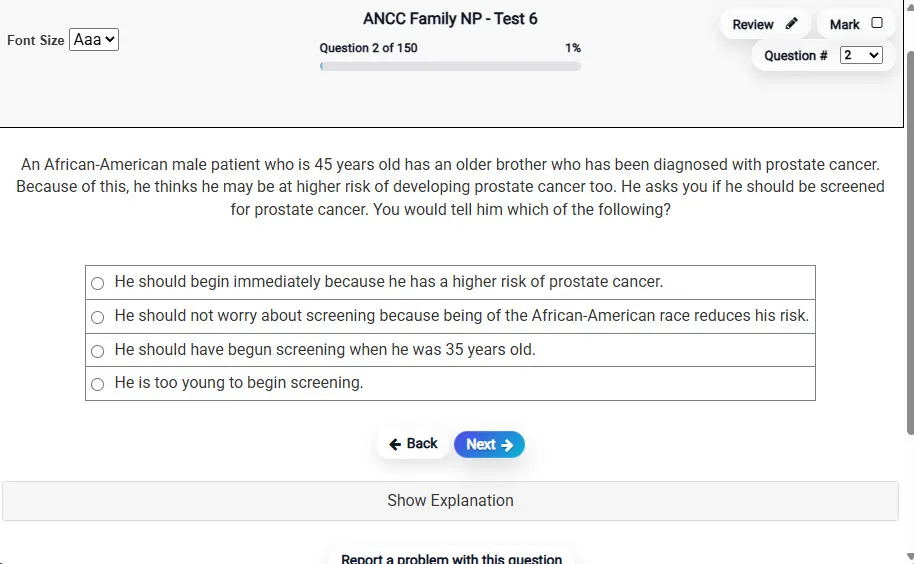
Answering a Question screen – Multiple-choice item view with navigation controls and progress tracker.
Answering a Question Multiple-choice item view with navigation controls and progress tracker.

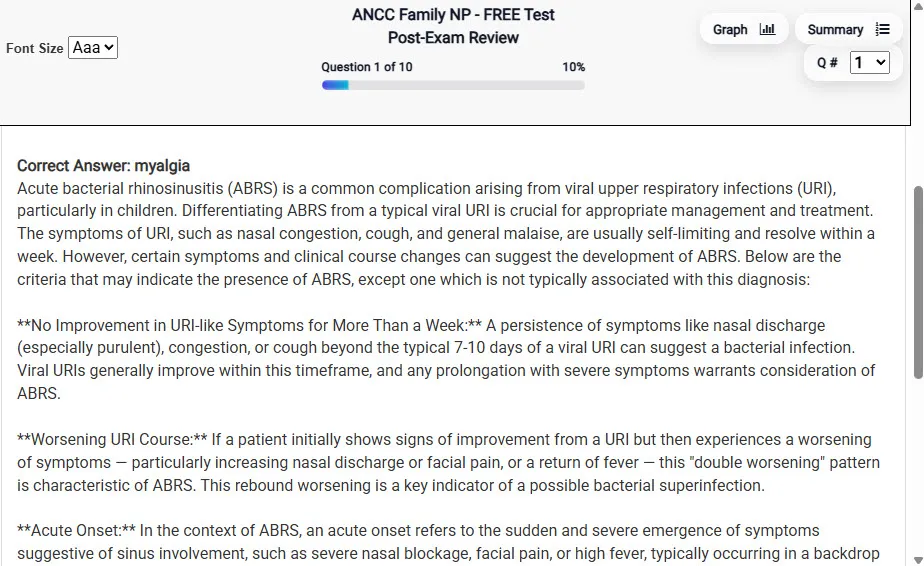
                           Detailed Explanation screen – 
                         Review mode showing chosen answer and rationale and references.
Detailed Explanation Review mode showing chosen answer and rationale and references.

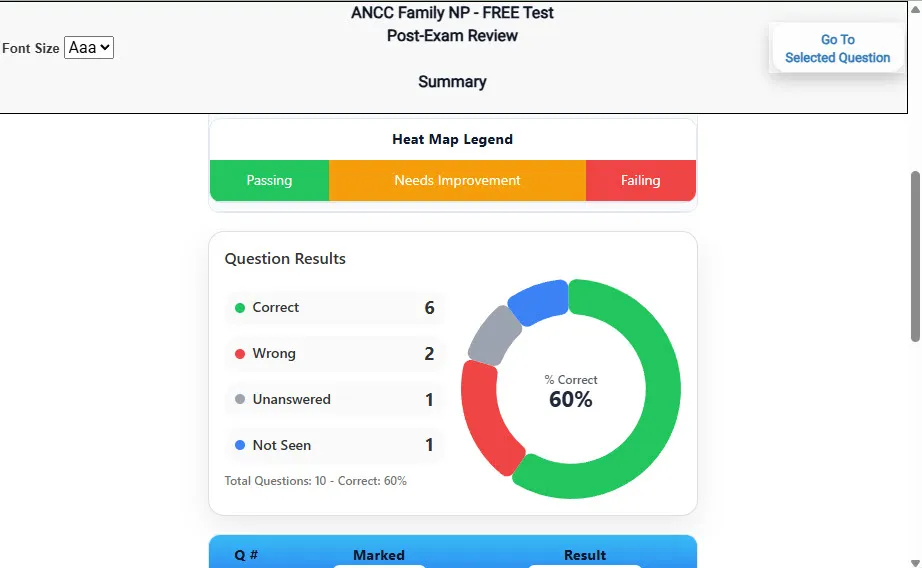
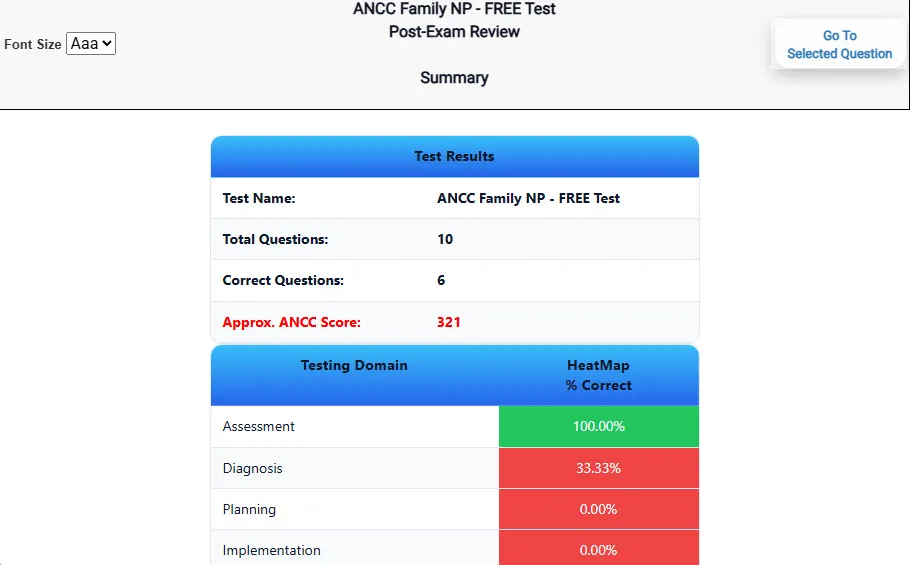
                           Review Summary 1 screen – 
                         Summary with counts for correct/wrong/unanswered and not seen items.
Review Summary 1 Summary with counts for correct/wrong/unanswered and not seen items.

                           Review Summary 2 screen – 
                         Advanced summary with category/domain breakdown and performance insights.
Review Summary 2 Advanced summary with category/domain breakdown and performance insights.

What Each Screen Shows

Answer Question Screen

  • Clean multiple-choice interface with progress bar.
  • Mark for review feature.
  • Matches real test pacing.

Detailed Explanation

  • Correct answer plus rationale.
  • Key concepts and guidelines highlighted.
  • Move between questions to fill knowledge gaps.

Review Summary 1

  • Overall results with total questions and scaled score.
  • Domain heatmap shows strengths and weaknesses.
  • Quick visual feedback on study priorities.

Review Summary 2

  • Chart of correct, wrong, unanswered, not seen.
  • Color-coded results for easy review.
  • Links back to missed items.

Top 10 Reasons to Use Exam Edge for your ILTS Learning Behavior Specialist I Exam Prep

  1. Focused on the ILTS Learning Behavior Specialist I Exam

    Our practice tests are built specifically for the ILTS Learning Behavior Specialist I exam — every question mirrors the real topics, format, and difficulty so you're studying exactly what matters.

  2. Real Exam Simulation

    We match the per-question time limits and pressure of the actual ILTS exam, so test day feels familiar and stress-free.

  3. 20 Full Practice Tests & 2,000 Unique Questions

    You'll have more than enough material to master every ILTS Learning Behavior Specialist I concept — no repeats, no fluff.

  4. Lower Cost Than a Retake

    Ordering 5 practice exams costs less than retaking the ILTS Learning Behavior Specialist I exam after a failure. One low fee could save you both time and money.

  5. Flexible Testing

    Need to step away mid-exam? Pick up right where you left off — with your remaining time intact.

  6. Instant Scoring & Feedback

    See your raw score and an estimated ILTS Learning Behavior Specialist I score immediately after finishing each practice test.

  7. Detailed Explanations for Every Question

    Review correct and incorrect answers with clear, step-by-step explanations so you truly understand each topic.

  8. Trusted & Accredited

    We're fully accredited by the Better Business Bureau and uphold the highest standards of trust and transparency.

  9. Web-Based & Always Available

    No software to install. Access your ILTS Learning Behavior Specialist I practice exams 24/7 from any computer or mobile device.

  10. Expert Support When You Need It

    Need extra help? Our specialized tutors are highly qualified and ready to support your ILTS exam prep.


Pass the ILTS Learning Behavior Specialist I Exam with Realistic Practice Tests from Exam Edge

Preparing for your upcoming ILTS Learning Behavior Specialist I (290) Certification Exam can feel overwhelming — but the right practice makes all the difference. Exam Edge gives you the tools, structure, and confidence to pass on your first try. Our online practice exams are built to match the real ILTS Learning Behavior Specialist I exam in content, format, and difficulty.

  • 📝 20 ILTS Learning Behavior Specialist I Practice Tests: Access 20 full-length exams with 100 questions each, covering every major ILTS Learning Behavior Specialist I topic in depth.
  • Instant Online Access: Start practicing right away — no software, no waiting.
  • 🧠 Step-by-Step Explanations: Understand the reasoning behind every correct answer so you can master ILTS Learning Behavior Specialist I exam concepts.
  • 🔄 Retake Each Exam Up to 4 Times: Build knowledge through repetition and track your improvement over time.
  • 🌐 Web-Based & Available 24/7: Study anywhere, anytime, on any device.
  • 🧘 Boost Your Test-Day Confidence: Familiarity with the ILTS format reduces anxiety and helps you perform under pressure.

These ILTS Learning Behavior Specialist I practice exams are designed to simulate the real testing experience by matching question types, timing, and difficulty level. This approach helps you get comfortable not just with the exam content, but also with the testing environment, so you walk into your exam day focused and confident.


Exam Edge ILTS Reviews


I used Exam Edge to help me pass my Science 4-8 TExES exam on my first try! The practice exams look exactly how the real test looked and the timer helped me be a little less nervous. Now I’m using their practice exams to help me prepare to take my Science 7-12 TExES exam. Wish me luck! :)

Shamai , TX

Dear Exam Edge, I recently ordered a five-pack of tests and successfully passed the ILTS Mathematics content area test with a score of 280/300. I found your tests a very effective way of testing my knowledge of the content material on the real test and seeing explanations of each problem. I scored b ...
Read More
Alistair, IL

The practice tests were EXACTLY what I needed! The test explanations for answers were the teaching points I needed to help understand certain subjects. Thank you for your help!

Arnita , South Holland, Illinois

These practice exams really put my mind at ease! I feel confident about taking my test when the current situation is over. EDIT: Yep. Nailed it.

Sean , Silver Spring , MD

Navigating this site is excellent. Thank you

dwaina , chicago, Illinois

These are great exams to help prepare you for the exams. I passed my ILTS Learning Behavior Specialist I (155) exam on the first attempt. The question structure readily prepares you for how the structure will be on the test, multiple choice questions that are relevant to what is needed to know for t ...
Read More
Jugoslav, Cook County, Illinois


ILTS Learning Behavior Specialist I Aliases Test Name

Here is a list of alternative names used for this exam.

  • ILTS Learning Behavior Specialist I
  • ILTS Learning Behavior Specialist I test
  • ILTS Learning Behavior Specialist I Certification Test
  • ILTS
  • ILTS 290
  • 290 test
  • ILTS Learning Behavior Specialist I (290)
  • Learning Behavior Specialist I certification