This is the content of the pop-over!

MTEL Foundations of Reading (90) Practice Tests & Test Prep by Exam Edge


MTEL Foundations of Reading  product image
(4.6)
Based on 34 Reviews

  • Real Exam Simulation: Timed questions and matching content build comfort for your MTEL Foundations of Reading test day.
  • Instant, 24/7 Access: Web-based MTEL Foundations of Reading practice exams with no software needed.
  • Clear Explanations: Step-by-step answers and explanations for your MTEL exam to strengthen understanding.
  • Boosted Confidence: Reduces anxiety and improves test-taking skills to ace your MTEL Foundations of Reading (190).

Featured on

MTEL Foundations of Reading Online Practice Test Bundles

BEST VALUE
15 practice tests

$149.25

$599.25

SAVE $450

Only $9.95 per test!

  • 100% Pass Guarantee
  • 15 online practice tests
  • 100 questions + 2 essays per test
  • Bonus: 100 Flash Cards + Study Guide
  • Instant access
  • Detailed Explanations
  • Practice tests never expire
  • Timed, untimed, or study guide mode
MOST POPULAR
10 practice tests

$99.50

$399.50

SAVE $300

Only $9.95 per test!

  • 10 online practice tests
  • 100 questions + 2 essays per test
  • Bonus: 100 Flash Cards + Study Guide
  • Instant access
  • Detailed Explanations
  • Practice tests never expire
  • Timed, untimed, or study guide mode
5 practice tests

$69.75

$199.75

SAVE $130

Only $13.95 per test!

  • 5 online practice tests
  • 100 questions + 2 essays per test
  • Bonus: 100 Flash Cards
  • Instant access
  • Detailed Explanations
  • Practice tests never expire
  • Timed, untimed, or study guide mode
1 practice test

$39.95

  • 1 online practice test
  • 100 questions + 2 essays per test
  • Instant access
  • Detailed Explanations
  • Practice tests never expire
  • Timed, untimed, or study guide mode
Quick Select
Tap to choose a bundle

** All Prices are in US Dollars (USD) **


MTEL Foundations of Reading (190) Resources

Jump to the section you need most.

Understanding the exact breakdown of the MTEL Foundations of Reading test will help you know what to expect and how to most effectively prepare. The MTEL Foundations of Reading has 100 multiple-choice questions and 2 essay questions. The exam will be broken down into the sections below:

MTEL Foundations of Reading Exam Blueprint
Domain Name % Number of
Questions
Foundations of Reading Development 35% 35
Development of Reading Comprehension 27% 27
Reading Assessment and Instruction 18% 18
Foundational Reading Skills 10% 10
Reading Comprehension 10% 10

MTEL Foundations of Reading Study Tips by Domain

  • Know major components of reading development (phonological awareness, phonics, fluency, vocabulary, comprehension) and the typical progression; red flag: treating phonics or fluency as optional once students can “sound out” words.
  • Distinguish the simple view of reading (decoding × language comprehension) and how deficits show up; common trap: blaming “comprehension” when weak decoding is the primary limiter.
  • Track developmental milestones from emergent literacy (print concepts, phonological awareness) to conventional reading and spelling; priority rule: address phonemic awareness before expecting reliable alphabetic decoding.
  • Understand orthographic development (prealphabetic → partial alphabetic → full alphabetic → consolidated) and what student errors indicate; red flag: guessing from first letter and pictures suggests partial alphabetic processing.
  • Connect oral language development (syntax, morphology, semantics) to later reading and writing; common trap: overlooking morphology instruction (prefixes/suffixes/roots) when multisyllabic decoding and vocabulary growth stall.
  • Recognize risk factors and early warning signs (limited phonological awareness, poor letter-name/letter-sound knowledge, weak rapid naming, family history) and respond early; threshold cue: persistent difficulty with blending/segmenting by mid-kindergarten warrants targeted intervention.
  • Teach comprehension as an active process—preview, set a purpose, monitor, and repair; red flag: students read fluently but cannot retell because they were never taught to stop and check understanding.
  • Build background knowledge and vocabulary before and during reading using brief, text-aligned instruction; common trap: spending time on unrelated “fun facts” that don’t support the text’s concepts.
  • Explicitly model and practice comprehension strategies (e.g., predicting, questioning, summarizing, clarifying, visualizing) with gradual release; priority rule: don’t ask for independent strategy use before students can explain when and why to use it.
  • Teach text structures (story grammar; compare/contrast, cause/effect, problem/solution) and use graphic organizers accordingly; red flag: students give disorganized summaries that ignore sequence or key relationships.
  • Develop inferencing by requiring evidence-based responses and distinguishing literal vs. inferential questions; common trap: accepting answers without quoting or paraphrasing supporting details from the text.
  • Strengthen comprehension through purposeful oral language routines (think-alouds, accountable talk, retellings) that match developmental level; contraindication: over-reliance on round-robin reading, which reduces engagement and hides comprehension breakdowns.
  • Use screening data to flag risk early (e.g., scores below benchmark or slow growth) and match intensity to need; red flag: waiting for failure before providing targeted intervention.
  • When diagnosing, separate skill deficit from performance issues by checking accuracy vs. rate (e.g., decoding errors vs. slow but accurate reading); common trap: treating fluency as only speed and ignoring prosody and accuracy.
  • Apply a decision rule for progress monitoring (e.g., if data points fall below the aimline in multiple consecutive checks, adjust instruction); red flag: keeping the same plan despite flat trend data.
  • Select assessments that fit the purpose—screening, diagnostic, progress monitoring, or outcome—and interpret within what the tool measures; common trap: using a broad comprehension test to diagnose phonics weaknesses.
  • Provide explicit, systematic instruction with cumulative review and immediate corrective feedback; priority rule: reteach to mastery before moving on when error patterns persist.
  • Differentiate instruction by grouping students based on current data and increasing opportunities to respond (e.g., more guided practice and shorter tasks for weaker skills); red flag: grouping that never changes despite new assessment results.
  • Phonological awareness is oral (no print)—ensure students can segment/blend phonemes before expecting decoding; red flag: confusing rhyme/alliteration proficiency with phoneme-level skills.
  • Phonics instruction should be explicit, systematic, and cumulative from simple to complex spellings; common trap: teaching “sight words” as whole shapes instead of mapping phonemes to graphemes for irregular words.
  • Teach common syllable types (closed, VCe, open, r-controlled, vowel team, consonant-le) to support multisyllabic decoding; cue: if a student guesses based on the first letter, require syllable-by-syllable decoding with division strategies.
  • Build automatic recognition of high-frequency words through orthographic mapping (sound-to-spelling connections); red flag: repeated flashcards without attention to phoneme-grapheme patterns yields fragile “memorization.”
  • Fluency includes accuracy, rate, and prosody and should be practiced with controlled text aligned to taught patterns; priority rule: if accuracy is low, slow down and revisit decoding rather than pushing speed.
  • Spelling (encoding) reinforces decoding and should target the same phonics patterns in dictation; common trap: correcting only the final word instead of analyzing the error pattern (e.g., short vowel confusion, missing blends, incorrect digraph).
  • Teach students to distinguish literal understanding from inferential and evaluative comprehension; red flag: answers that merely restate a detail when a why/how inference is required.
  • Use explicit instruction in text structure (e.g., cause–effect, compare–contrast, problem–solution) to support summarizing; common trap: students list events instead of stating the central idea with key supporting details.
  • Build vocabulary and background knowledge as a comprehension lever (multiple exposures, morphology, context); priority rule: preteach only high-utility, text-critical words—overpreteaching too many terms reduces comprehension focus.
  • Strengthen comprehension monitoring with fix-up strategies (reread, clarify pronouns, ask questions, adjust rate); red flag: students read fluently but cannot paraphrase the last sentence or section.
  • Teach students to cite and evaluate evidence from text (quotations/paraphrase, relevance, credibility for informational text); common trap: opinions not anchored to specific textual evidence.
  • Differentiate comprehension supports by text type and learner need (think-alouds, graphic organizers, sentence frames) while protecting text complexity; contraindication: replacing grade-level text with oversimplified text instead of scaffolding access.


Built to Fit Into Your Busy Life

Everything you need to prepare with confidence—without wasting a minute.

Three Study Modes

Timed, No Time Limit, or Explanation mode.

Actionable Analytics

Heatmaps and scaled scores highlight weak areas.

High-Yield Rationales

Concise explanations emphasize key concepts.

Realistic Interface

Matches the feel of the actual exam environment.

Accessible by Design

Clean layout reduces cognitive load.

Anytime, Anywhere

Web-based access 24/7 on any device.
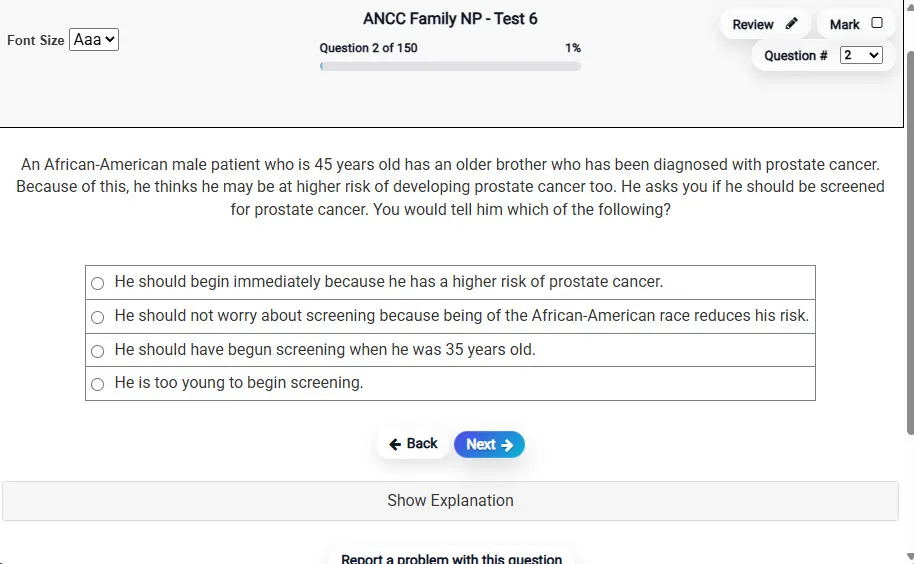
Answering a Question screen – Multiple-choice item view with navigation controls and progress tracker.
Answering a Question Multiple-choice item view with navigation controls and progress tracker.

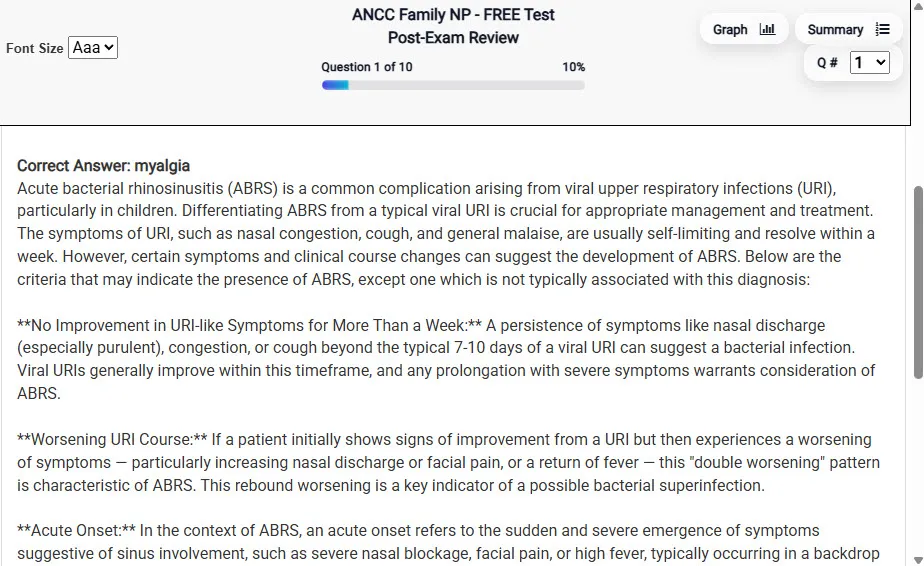
                           Detailed Explanation screen – 
                         Review mode showing chosen answer and rationale and references.
Detailed Explanation Review mode showing chosen answer and rationale and references.

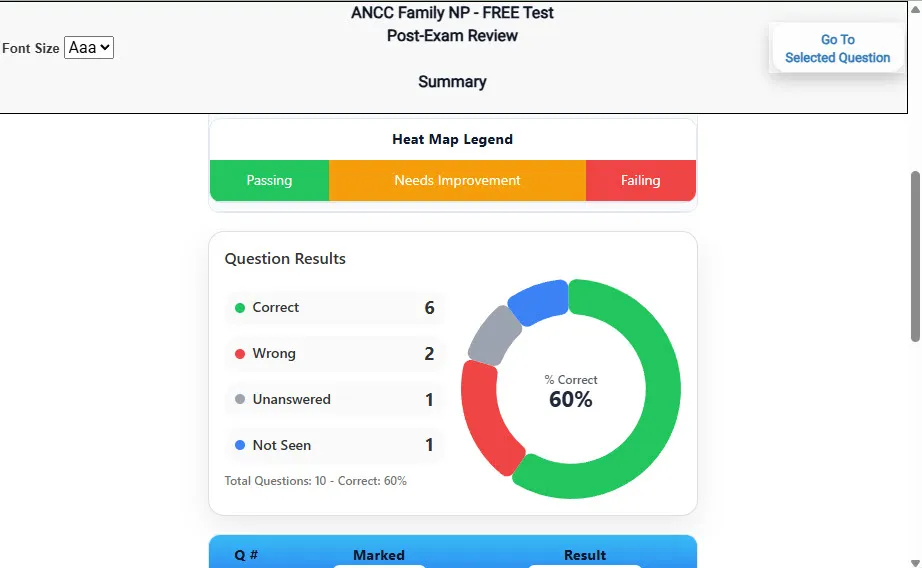
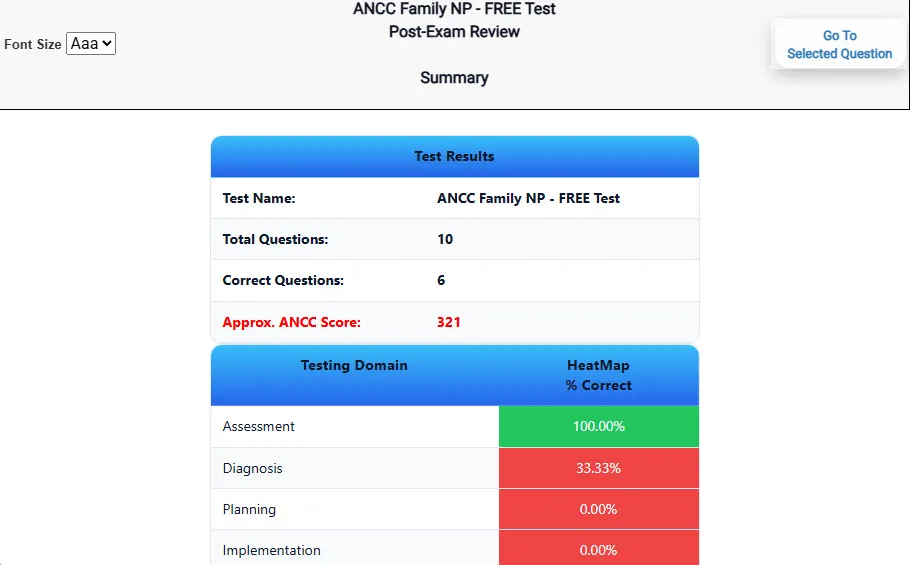
                           Review Summary 1 screen – 
                         Summary with counts for correct/wrong/unanswered and not seen items.
Review Summary 1 Summary with counts for correct/wrong/unanswered and not seen items.

                           Review Summary 2 screen – 
                         Advanced summary with category/domain breakdown and performance insights.
Review Summary 2 Advanced summary with category/domain breakdown and performance insights.

What Each Screen Shows

Answer Question Screen

  • Clean multiple-choice interface with progress bar.
  • Mark for review feature.
  • Matches real test pacing.

Detailed Explanation

  • Correct answer plus rationale.
  • Key concepts and guidelines highlighted.
  • Move between questions to fill knowledge gaps.

Review Summary 1

  • Overall results with total questions and scaled score.
  • Domain heatmap shows strengths and weaknesses.
  • Quick visual feedback on study priorities.

Review Summary 2

  • Chart of correct, wrong, unanswered, not seen.
  • Color-coded results for easy review.
  • Links back to missed items.

Top 10 Reasons to Use Exam Edge for your MTEL Foundations of Reading Exam Prep

  1. Focused on the MTEL Foundations of Reading Exam

    Our practice tests are built specifically for the MTEL Foundations of Reading exam — every question mirrors the real topics, format, and difficulty so you're studying exactly what matters.

  2. Real Exam Simulation

    We match the per-question time limits and pressure of the actual MTEL exam, so test day feels familiar and stress-free.

  3. 15 Full Practice Tests & 1,530 Unique Questions

    You'll have more than enough material to master every MTEL Foundations of Reading concept — no repeats, no fluff.

  4. Lower Cost Than a Retake

    Ordering 5 practice exams costs less than retaking the MTEL Foundations of Reading exam after a failure. One low fee could save you both time and money.

  5. Flexible Testing

    Need to step away mid-exam? Pick up right where you left off — with your remaining time intact.

  6. Instant Scoring & Feedback

    See your raw score and an estimated MTEL Foundations of Reading score immediately after finishing each practice test.

  7. Detailed Explanations for Every Question

    Review correct and incorrect answers with clear, step-by-step explanations so you truly understand each topic.

  8. Trusted & Accredited

    We're fully accredited by the Better Business Bureau and uphold the highest standards of trust and transparency.

  9. Web-Based & Always Available

    No software to install. Access your MTEL Foundations of Reading practice exams 24/7 from any computer or mobile device.

  10. Expert Support When You Need It

    Need extra help? Our specialized tutors are highly qualified and ready to support your MTEL exam prep.


Pass the MTEL Foundations of Reading Exam with Realistic Practice Tests from Exam Edge

Preparing for your upcoming MTEL Foundations of Reading (190) Certification Exam can feel overwhelming — but the right practice makes all the difference. Exam Edge gives you the tools, structure, and confidence to pass on your first try. Our online practice exams are built to match the real MTEL Foundations of Reading exam in content, format, and difficulty.

  • 📝 15 MTEL Foundations of Reading Practice Tests: Access 15 full-length exams with 102 questions each, covering every major MTEL Foundations of Reading topic in depth.
  • Instant Online Access: Start practicing right away — no software, no waiting.
  • 🧠 Step-by-Step Explanations: Understand the reasoning behind every correct answer so you can master MTEL Foundations of Reading exam concepts.
  • 🔄 Retake Each Exam Up to 4 Times: Build knowledge through repetition and track your improvement over time.
  • 🌐 Web-Based & Available 24/7: Study anywhere, anytime, on any device.
  • 🧘 Boost Your Test-Day Confidence: Familiarity with the MTEL format reduces anxiety and helps you perform under pressure.

These MTEL Foundations of Reading practice exams are designed to simulate the real testing experience by matching question types, timing, and difficulty level. This approach helps you get comfortable not just with the exam content, but also with the testing environment, so you walk into your exam day focused and confident.


Exam Edge MTEL Reviews


I would like to commend your site in assisting me in passing the high school math test MTEL. I used your tests for practice and review and passed the test the first time. I was a little worried going into the test because the online tests were at such a high level. I found that I was very well prepa ...
Read More
Julie, MA

I wanted to thank ExamEdge for helping me pass this teacher test the  first time. I had a lot of material to absorb in a short space of time and so I purchased the 15 practice tests and by test 15 I was so much more confident due to getting consistent passing scores. Thank you again, in my ...
Read More
Paul, Quincy, MA


MTEL Foundations of Reading Aliases Test Name

Here is a list of alternative names used for this exam.

  • MTEL Foundations of Reading
  • MTEL Foundations of Reading test
  • MTEL Foundations of Reading Certification Test
  • MTEL
  • MTEL 190
  • 190 test
  • MTEL Foundations of Reading (190)
  • Foundations of Reading certification