This is the content of the pop-over!

Lightning Deal Alert – 12% Off Ends at Midnight!

Strike while the savings are hot! Use promo code FlashSale at checkout for 12% off any Exam Edge test or bundle. Hurry—the clock is ticking!

DANB's ORB (ORB) Practice Tests & Test Prep by Exam Edge


DANB's Oregon Basic Dental Assisting   product image
(4.5)
Based on 37 Reviews

  • Real Exam Simulation: Timed questions and matching content build comfort for your DANB's ORB test day.
  • Instant, 24/7 Access: Web-based DANB's Oregon Basic Dental Assisting practice exams with no software needed.
  • Clear Explanations: Step-by-step answers and explanations for your DANB's exam to strengthen understanding.
  • Boosted Confidence: Reduces anxiety and improves test-taking skills to ace your DANB's Oregon Basic Dental Assisting (ORB).

Featured on

DANB's Oregon Basic Dental Assisting Online Practice Test Bundles

BEST VALUE
20 practice tests

$174.00

$799.00

SAVE $625

Only $8.70 per test!

  • 100% Pass Guarantee
  • 20 online practice tests
  • 100 questions per test
  • Bonus: 100 Flash Cards + Study Guide
  • Instant access
  • Detailed Explanations
  • Practice tests never expire
  • Timed, untimed, or study guide mode
MOST POPULAR
10 practice tests

$99.50

$399.50

SAVE $300

Only $9.95 per test!

  • 10 online practice tests
  • 100 questions per test
  • Bonus: 100 Flash Cards + Study Guide
  • Instant access
  • Detailed Explanations
  • Practice tests never expire
  • Timed, untimed, or study guide mode
5 practice tests

$69.75

$199.75

SAVE $130

Only $13.95 per test!

  • 5 online practice tests
  • 100 questions per test
  • Bonus: 100 Flash Cards
  • Instant access
  • Detailed Explanations
  • Practice tests never expire
  • Timed, untimed, or study guide mode
1 practice test

$39.95

  • 1 online practice test
  • 100 questions per test
  • Instant access
  • Detailed Explanations
  • Practice tests never expire
  • Timed, untimed, or study guide mode
Quick Select
Tap to choose a bundle

** All Prices are in US Dollars (USD) **


DANB's ORB (ORB) Resources

Jump to the section you need most.

Understanding the exact breakdown of the DANB's Oregon Basic Dental Assisting test will help you know what to expect and how to most effectively prepare. The DANB's Oregon Basic Dental Assisting has 100 multiple-choice questions . The exam will be broken down into the sections below:

DANB's Oregon Basic Dental Assisting Exam Blueprint
Domain Name % Number of
Questions
Infection control and microbiology 20 - 25 % 24
Collection of clinical data 10- 15 % 12
Management of emergencies 20 - 25 % 24
Occupational safety 10- 15 % 12
Legal issues 10- 15 % 12
Anatomy 10- 15 % 12
General procedures 5-10 % 6

DANB's Oregon Basic Dental Assisting Study Tips by Domain

  • Use standard precautions for every patient; red flag: treating “healthy” patients differently is a common compliance failure DANB tests.
  • Differentiate sterilization vs disinfection vs antisepsis; trap: using a surface disinfectant as if it can sterilize instruments.
  • Instrument processing must follow the flow from dirty to clean to sterile; red flag: crossing zones (e.g., clean packaging on the contaminated side) can invalidate the cycle.
  • Confirm autoclave effectiveness with mechanical/chemical indicators every load and biological (spore) testing on the required schedule; priority rule: a failed indicator means instruments are not usable until resolved.
  • Manage sharps and bloodborne pathogens correctly; trap: recapping needles two-handed or overfilling sharps containers (follow the fill line, typically around 3/4 full).
  • Know basic microbiology of transmission (contact, droplet, aerosol) and how PPE interrupts it; red flag: wearing the same gloves to touch keyboards, pens, or phones spreads contamination beyond the operatory.
  • Record vitals consistently (BP, pulse, respirations, temperature) and flag hypertensive readings (e.g., ≥180/120) as a must-notify-dentist threshold before elective care.
  • Verify and document chief complaint, onset, provocation/palliation, quality, radiation, severity, timing (OPQRST) — a common trap is writing vague notes like “tooth hurts” without duration or triggers.
  • Update medical history every visit and reconcile medications/allergies; red flag: no known allergies (NKA) recorded without asking specifically about latex, antibiotics, and local anesthetics.
  • Chart hard/soft tissue findings using standard notation and include negative findings when relevant; common trap: failing to document mobility, bleeding on probing, or missing teeth, which compromises baseline comparisons.
  • Take and label radiographs correctly (patient ID, date, type, right/left marker) and repeat exposures only when diagnostically necessary — red flag is retaking for “perfect” images rather than diagnostic acceptability.
  • Document all clinical data in real time with objective language; priority rule: if it wasn’t documented (including who was notified and when), it is treated as not done.
  • Activate the office emergency plan immediately: stop treatment, position the patient safely, and assign roles (call 911, bring AED/O2, document)—red flag is any unresponsiveness or abnormal breathing.
  • For syncope, place the patient supine with legs elevated, maintain airway, and administer oxygen if ordered; common trap is sitting the patient upright too soon, which can trigger repeat fainting.
  • Recognize anaphylaxis early (wheezing, facial/tongue swelling, hives, hypotension) and call 911 while preparing emergency meds per standing orders; priority rule: airway and breathing come before all dental procedures.
  • For angina vs. suspected myocardial infarction, stop treatment and monitor vitals; if chest pain persists beyond 3–5 minutes or doesn’t respond to prescribed nitroglycerin, treat as MI and call 911 immediately.
  • Manage seizures by clearing instruments, protecting the patient from injury, and not placing anything in the mouth; red flag is a seizure lasting >5 minutes or repeated seizures without recovery—call 911.
  • With choking, encourage coughing if effective; if unable to speak/breathe, initiate abdominal thrusts (or chest thrusts for pregnant/obese patients) and call 911—common trap is delaying action while searching for suction.
  • Use OSHA-required PPE based on exposure risk (gloves, mask, eye/face protection) and change it between patients; red flag: touching charts/phones with contaminated gloves.
  • Follow the hazard communication program (SDS access, container labels, staff training) for all chemicals; common trap: using an unmarked spray bottle or storing chemicals in food/drink containers.
  • Apply ergonomics to prevent musculoskeletal injury (neutral posture, proper operator/stool positioning, frequent microbreaks); red flag: persistent wrist/neck pain ignored until it becomes a reportable injury.
  • Prevent needlestick/sharps injuries by using engineering controls and never recapping with two hands; priority rule: if recapping is necessary, use a one-handed scoop or a recapping device.
  • Maintain radiation safety with ALARA (time, distance, shielding) and proper barriers; common trap: holding the sensor/film or standing in the primary beam path instead of using a positioning device.
  • Keep walkways and treatment areas free of hazards (cord management, dry floors, proper lifting technique for supplies/equipment); red flag: a cluttered sterilization area that forces unsafe reaching or creates slip/trip risks.
  • Identify tooth surfaces and numbering systems quickly (Universal, Palmer, FDI)—common trap: mixing #8 with #9 or reversing quadrants when charting.
  • Know eruption and exfoliation timelines for primary vs permanent dentition; red flag: assuming a 6-year molar replaces a primary tooth (it does not).
  • Differentiate periodontal structures (gingiva, PDL, cementum, alveolar bone) and their functions—priority rule: attachment loss refers to connective tissue attachment, not just gingival recession.
  • Recognize head/neck landmarks and major nerves/vessels relevant to dentistry (e.g., trigeminal branches); contraindication cue: persistent numbness or tingling after procedures warrants prompt provider notification.
  • Understand TMJ anatomy and muscles of mastication (masseter, temporalis, medial/lateral pterygoids); red flag: clicking with limited opening may signal dysfunction requiring documentation and referral.
  • Identify oral cavity structures (tongue papillae, salivary glands, ducts) and normal vs abnormal findings; common trap: confusing Stensen’s duct (parotid) with Wharton’s duct (submandibular) during intraoral exam.
  • Maintain correct chair position and operator ergonomics before starting — red flag: reaching across the patient or twisting repeatedly increases error risk and is often noted in practical evaluations.
  • Prepare and verify the tray setup against the planned procedure (mirror, explorer, cotton pliers, evacuation tips, anesthetic supplies as indicated) — common trap: missing an item leads to breaking asepsis mid-procedure to retrieve it.
  • Use four-handed dentistry with clear instrument transfer zones and secure grasps — red flag: passing instruments over the patient’s face or with sharp ends exposed risks injury and will be flagged as unsafe technique.
  • Manage isolation and moisture control (HVE, saliva ejector, cotton rolls, dry angles, rubber dam when ordered) — priority rule: always confirm the dentist’s preference and patient tolerance before placing clamps or retractors.
  • Handle dental materials exactly per manufacturer instructions (mixing time, ratios, working/setting time, temperature) — common trap: “eyeballing” powder/liquid or over-spatulating causes poor outcomes and may require remakes.
  • Perform post-procedure steps consistently (remove isolation, check for debris, give written/verbally confirmed post-op instructions, schedule follow-up) — red flag: dismissing without confirming hemostasis or patient understanding can lead to complications and documentation issues.


Built to Fit Into Your Busy Life

Everything you need to prepare with confidence—without wasting a minute.

Three Study Modes

Timed, No Time Limit, or Explanation mode.

Actionable Analytics

Heatmaps and scaled scores highlight weak areas.

High-Yield Rationales

Concise explanations emphasize key concepts.

Realistic Interface

Matches the feel of the actual exam environment.

Accessible by Design

Clean layout reduces cognitive load.

Anytime, Anywhere

Web-based access 24/7 on any device.
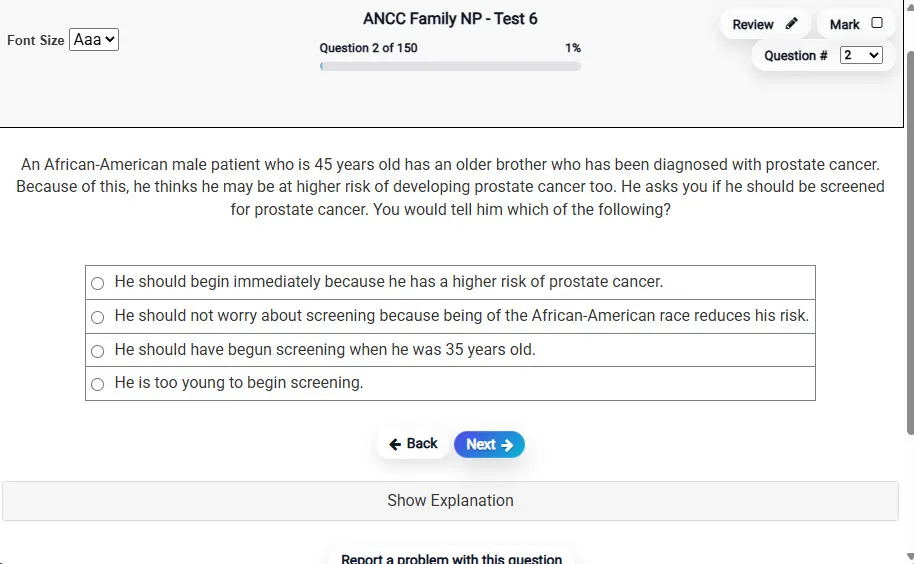
Answering a Question screen – Multiple-choice item view with navigation controls and progress tracker.
Answering a Question Multiple-choice item view with navigation controls and progress tracker.

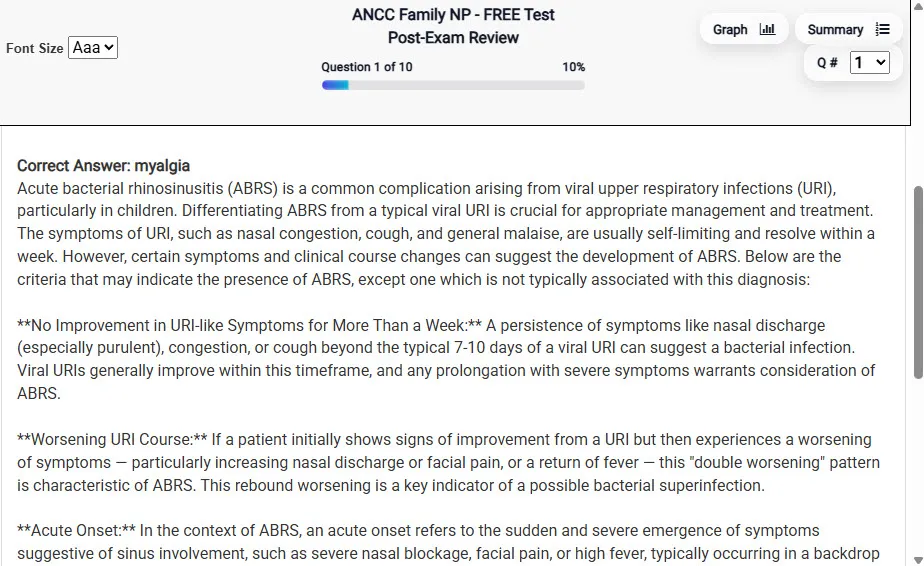
                           Detailed Explanation screen – 
                         Review mode showing chosen answer and rationale and references.
Detailed Explanation Review mode showing chosen answer and rationale and references.

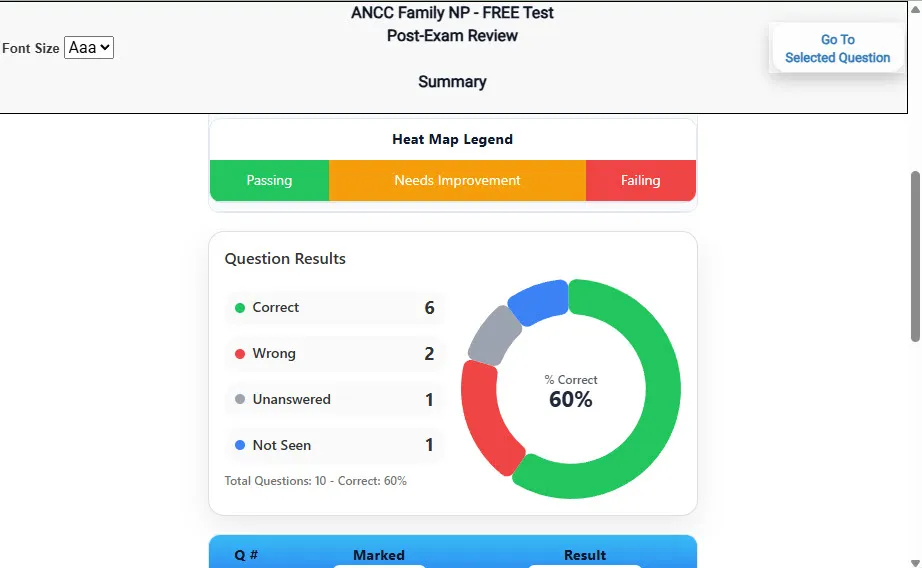
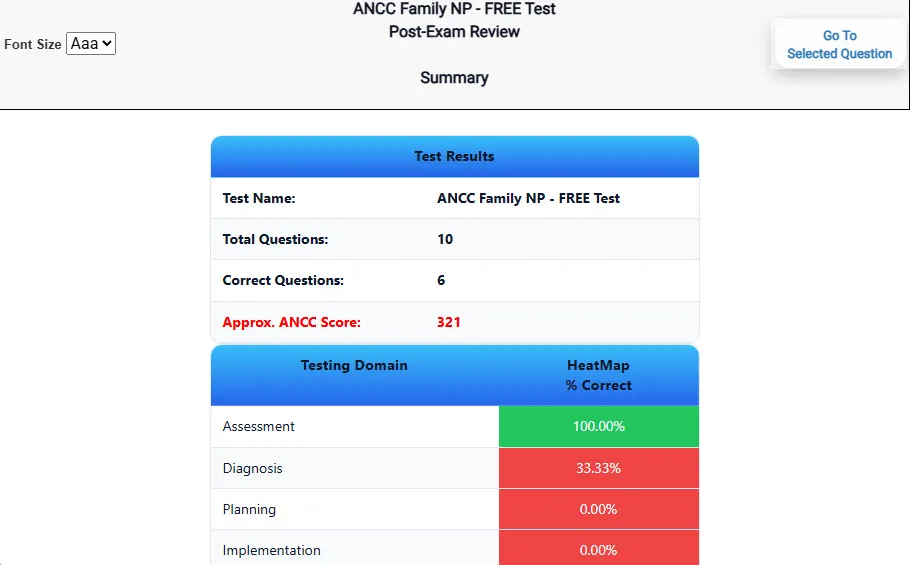
                           Review Summary 1 screen – 
                         Summary with counts for correct/wrong/unanswered and not seen items.
Review Summary 1 Summary with counts for correct/wrong/unanswered and not seen items.

                           Review Summary 2 screen – 
                         Advanced summary with category/domain breakdown and performance insights.
Review Summary 2 Advanced summary with category/domain breakdown and performance insights.

What Each Screen Shows

Answer Question Screen

  • Clean multiple-choice interface with progress bar.
  • Mark for review feature.
  • Matches real test pacing.

Detailed Explanation

  • Correct answer plus rationale.
  • Key concepts and guidelines highlighted.
  • Move between questions to fill knowledge gaps.

Review Summary 1

  • Overall results with total questions and scaled score.
  • Domain heatmap shows strengths and weaknesses.
  • Quick visual feedback on study priorities.

Review Summary 2

  • Chart of correct, wrong, unanswered, not seen.
  • Color-coded results for easy review.
  • Links back to missed items.

Top 10 Reasons to Use Exam Edge for your DANB's Oregon Basic Dental Assisting Exam Prep

  1. Focused on the DANB's Oregon Basic Dental Assisting Exam

    Our practice tests are built specifically for the DANB's ORB exam — every question mirrors the real topics, format, and difficulty so you're studying exactly what matters.

  2. Real Exam Simulation

    We match the per-question time limits and pressure of the actual DANB's exam, so test day feels familiar and stress-free.

  3. 20 Full Practice Tests & 2,000 Unique Questions

    You'll have more than enough material to master every DANB's ORB concept — no repeats, no fluff.

  4. Lower Cost Than a Retake

    Ordering 5 practice exams costs less than retaking the DANB's Oregon Basic Dental Assisting exam after a failure. One low fee could save you both time and money.

  5. Flexible Testing

    Need to step away mid-exam? Pick up right where you left off — with your remaining time intact.

  6. Instant Scoring & Feedback

    See your raw score and an estimated DANB's Oregon Basic Dental Assisting score immediately after finishing each practice test.

  7. Detailed Explanations for Every Question

    Review correct and incorrect answers with clear, step-by-step explanations so you truly understand each topic.

  8. Trusted & Accredited

    We're fully accredited by the Better Business Bureau and uphold the highest standards of trust and transparency.

  9. Web-Based & Always Available

    No software to install. Access your DANB's ORB practice exams 24/7 from any computer or mobile device.

  10. Expert Support When You Need It

    Need extra help? Our specialized tutors are highly qualified and ready to support your DANB's exam prep.


Pass the DANB's Oregon Basic Dental Assisting Exam with Realistic Practice Tests from Exam Edge

Preparing for your upcoming DANB's Oregon Basic Dental Assisting (ORB) Certification Exam can feel overwhelming — but the right practice makes all the difference. Exam Edge gives you the tools, structure, and confidence to pass on your first try. Our online practice exams are built to match the real DANB's ORB exam in content, format, and difficulty.

  • 📝 20 DANB's Oregon Basic Dental Assisting Practice Tests: Access 20 full-length exams with 100 questions each, covering every major DANB's Oregon Basic Dental Assisting topic in depth.
  • Instant Online Access: Start practicing right away — no software, no waiting.
  • 🧠 Step-by-Step Explanations: Understand the reasoning behind every correct answer so you can master DANB's ORB exam concepts.
  • 🔄 Retake Each Exam Up to 4 Times: Build knowledge through repetition and track your improvement over time.
  • 🌐 Web-Based & Available 24/7: Study anywhere, anytime, on any device.
  • 🧘 Boost Your Test-Day Confidence: Familiarity with the DANB's format reduces anxiety and helps you perform under pressure.

These DANB's Oregon Basic Dental Assisting practice exams are designed to simulate the real testing experience by matching question types, timing, and difficulty level. This approach helps you get comfortable not just with the exam content, but also with the testing environment, so you walk into your exam day focused and confident.


Exam Edge DANB Reviews


Yesterday I passed my CDA test. Your test really helped me and I just wanted to say thank you.

Charisse, NY

I found the practice tests extremely helpful. I passed the DANB RHS exam and felt that the subject matter was thoroughly covered by your practice tests. The viewing of films and answering questions on them was especially helpful. Thank you very much for the assistance in preparing for the DANB RHS e ...
Read More
Rofiah, Turnersville NJ

Easy to purchase & easily accessible. Great tool to use

Kay , Milton, Indiana


DANB's Oregon Basic Dental Assisting Aliases Test Name

Here is a list of alternative names used for this exam.

  • DANB's Oregon Basic Dental Assisting
  • DANB's Oregon Basic Dental Assisting test
  • DANB's Oregon Basic Dental Assisting Certification Test
  • DANB's ORB test
  • DANB
  • DANB ORB
  • ORB test
  • DANB's Oregon Basic Dental Assisting (ORB)
  • 's Oregon Basic Dental Assisting certification