This is the content of the pop-over!

HESI PN exit (HesiPN) Practice Tests & Test Prep by Exam Edge


HESI PN exit  product image
(4.6)
Based on 28 Reviews

  • Real Exam Simulation: Timed questions and matching content build comfort for your HESI PN exit test day.
  • Instant, 24/7 Access: Web-based HESI PN exit practice exams with no software needed.
  • Clear Explanations: Step-by-step answers and explanations for your HESI exam to strengthen understanding.
  • Boosted Confidence: Reduces anxiety and improves test-taking skills to ace your HESI PN exit (HesiPN).

Featured on

HESI PN exit Online Practice Test Bundles

BEST VALUE
45 practice tests

$297.75

$1,797.75

SAVE $1500

Only $6.62 per test!

  • 100% Pass Guarantee
  • 45 online practice tests
  • 100 questions per test
  • Bonus: 100 Flash Cards + Study Guide
  • Instant access
  • Detailed Explanations
  • Practice tests never expire
  • Timed, untimed, or study guide mode
MOST POPULAR
20 practice tests

$174.00

$799.00

SAVE $625

Only $8.70 per test!

  • 20 online practice tests
  • 100 questions per test
  • Bonus: 100 Flash Cards + Study Guide
  • Instant access
  • Detailed Explanations
  • Practice tests never expire
  • Timed, untimed, or study guide mode
10 practice tests

$99.50

$399.50

SAVE $300

Only $9.95 per test!

  • 10 online practice tests
  • 100 questions per test
  • Bonus: 100 Flash Cards
  • Instant access
  • Detailed Explanations
  • Practice tests never expire
  • Timed, untimed, or study guide mode
5 practice tests

$69.75

$199.75

SAVE $130

Only $13.95 per test!

  • 5 online practice tests
  • 100 questions per test
  • Instant access
  • Detailed Explanations
  • Practice tests never expire
  • Timed, untimed, or study guide mode
1 practice test

$39.95

  • 1 online practice test
  • 100 questions per test
  • Instant access
  • Detailed Explanations
  • Practice tests never expire
  • Timed, untimed, or study guide mode
Quick Select
Tap to choose a bundle

** All Prices are in US Dollars (USD) **


HESI PN exit (HesiPN) Resources

Jump to the section you need most.

Understanding the exact breakdown of the HESI PN exit test will help you know what to expect and how to most effectively prepare. The HESI PN exit has multiple-choice questions . The exam will be broken down into the sections below:

HESI PN exit Exam Blueprint
Domain Name % Number of
Questions
Safe Effective Care Environment
- Coordinated Care
12-18% 16
     - Safety and Infection Control 8-14% 11
Health Promotion and Maintenance 7-13% 9
Physiological Integrity
- Basic Care and Comfort
11-17% 15
     - Pharmacological Therapies 9-15% 12
     - Reduction of Risk Potential 10-16% 13
     - Physiological Adaptation 11-17% 15
Psychosocial Integrity 7-13% 9

HESI PN exit Study Tips by Domain

  • Prioritize care using ABCs, then safety, then pain; a red flag is a “normal” SpO2 with increasing work of breathing or new confusion.
  • Delegate appropriately: LPN/LVN can do predictable tasks (e.g., routine meds, sterile dressings) while RN must assess, teach, and handle unstable changes; common trap is delegating initial assessment or discharge teaching.
  • Use SBAR for provider calls and handoffs, and report critical changes immediately; red flag is waiting to “see if it improves” after an acute neuro, respiratory, or chest-pain change.
  • Verify orders with read-back for telephone/critical values and clarify unclear prescriptions; priority rule is “when in doubt, hold and question” especially for high-alert meds (insulin, opioids, anticoagulants).
  • Coordinate transitions of care with accurate medication reconciliation and follow-up needs; common trap is omitting OTC/herbal agents or duplicating home meds and new prescriptions.
  • Advocate and escalate using chain of command when patient safety is at risk; red flag is a provider or team member dismissing a significant change in condition without reassessment.
  • Use Standard Precautions for all patients; red flag: skipping hand hygiene before/after glove use because gloves are “clean.”
  • Implement Transmission-Based Precautions correctly—airborne (N95, negative pressure), droplet (surgical mask), contact (gown/gloves); common trap: wearing an N95 for droplet-only infections like influenza.
  • Prioritize sterile technique for invasive procedures and wound care; red flag: reaching over a sterile field or turning your back (field is considered contaminated).
  • Prevent falls with risk screening, non-skid footwear, bed low/locked, and call light in reach; priority rule: a confused patient on opioids is a high-fall-risk even if they “walked fine earlier.”
  • Medication safety: verify the 6 rights and allergies and use two identifiers; common trap: holding meds for NPO status when NPO is only for a procedure (clarify which meds to give).
  • Prevent device-related infections by removing lines/catheters ASAP and using aseptic access; threshold cue: report fever, cloudy urine, or new confusion in a catheterized older adult as possible CAUTI.
  • Prioritize age-appropriate screenings and immunizations (e.g., Tdap in every pregnancy, influenza annually) — red flag: live vaccines are generally contraindicated in pregnancy and for severely immunocompromised clients.
  • Teach prenatal warning signs (vaginal bleeding, severe headache/visual changes, epigastric pain, decreased fetal movement) — priority rule: these require immediate evaluation, not routine follow-up.
  • Use growth-and-development milestones to guide teaching and safety (e.g., separation anxiety in infants, stranger anxiety) — common trap: confusing expected toddler negativism with pathologic behavior.
  • Promote nutrition and activity using measurable targets (e.g., balanced diet, adequate fluids, gradual weight goals) — red flag: unintended weight loss, dysphagia, or dehydration signs warrant provider notification.
  • Support sexual and reproductive health (contraception adherence, STI prevention, breast/testicular self-awareness) — contraindication cue: do not use combined hormonal contraception with history of thromboembolism or uncontrolled hypertension.
  • Provide client-centered education using teach-back and health literacy principles — common trap: assuming understanding after a nod; require the client to restate the plan and demonstrate key skills.
  • Prioritize comfort measures first for uncomplicated pain (reposition, heat/cold, splinting, distraction) before escalating analgesics; red flag: new severe pain with vital-sign changes suggests a complication, not “normal” discomfort.
  • Maintain skin integrity with turning/repositioning at least q2h and offloading bony prominences; trap: massaging reddened nonblanchable areas can worsen tissue injury.
  • Prevent constipation from immobility/opioids with fluids, fiber, and early ambulation as tolerated; red flag: no bowel movement with abdominal distention/vomiting may indicate ileus or obstruction.
  • Support mobility and ROM with assistive devices and gait belt; priority rule: assess orthostatic hypotension risk before first ambulation after bedrest.
  • Promote rest by clustering care and reducing nighttime interruptions; trap: giving diuretics late in the day increases nocturia and sleep disruption.
  • Provide basic hygiene and oral care to prevent breakdown and infection; red flag: dry mucosa, cracked lips, or concentrated urine indicates possible dehydration needing prompt follow-up.
  • Perform the “rights” every time (right patient, drug, dose, route, time, documentation) and verify allergies first—red flag: giving a med when the allergy band/chart lists a related class (e.g., penicillin/cephalosporin).
  • Calculate doses carefully and use leading zeros but no trailing zeros (0.5 mg, not .5 mg or 5.0 mg)—common trap: misplacing decimals on pediatric/weight-based meds.
  • Hold and notify the provider for unsafe pre-assessment findings (e.g., apical pulse <60 before digoxin, systolic BP <90 before antihypertensives)—priority rule: assess first, then administer.
  • For insulin, match the type to onset/peak and prevent hypoglycemia—red flag: giving rapid-acting insulin without confirming the meal tray is present and the patient can eat.
  • Monitor for high-risk adverse effects requiring immediate action (e.g., opioids causing respiratory depression, anticoagulants causing bleeding)—priority cue: treat ABCs first and have reversal agents available (naloxone, vitamin K per order/protocol).
  • Use safe administration techniques: don’t crush extended-release/enteric-coated meds, rotate injection sites, and flush IV lines per policy—common trap: mixing incompatible IV meds without checking compatibility.
  • Monitor for subtle deterioration—new confusion, restlessness, or a rising pulse can signal hypoxia or shock before BP drops; red flag: acute change in mental status.
  • Prevent aspiration: keep HOB ≥ 30–45° for tube feedings and check placement per policy; common trap: giving meds/feeding with the patient supine.
  • Trend labs and act on criticals—K+ < 3.5 or > 5.0 mEq/L and INR/PTT out of range require prompt provider notification; priority rule: treat life-threatening electrolyte/bleeding risk first.
  • Recognize and respond to transfusion reactions—stop the blood, keep IV open with NS, and notify the provider; red flag: fever, chills, back pain, dyspnea, or hypotension during transfusion.
  • Reduce DVT/PE risk with early ambulation, SCDs, and hydration as ordered; common trap: massaging a painful swollen calf (contraindicated).
  • Watch for post-op/acute complications—report increasing incision drainage, rigid abdomen, absent bowel sounds, or sudden severe pain; red flag: signs of internal bleeding or peritonitis.
  • Shock priorities: recognize early (restlessness, tachycardia, narrowed pulse pressure) and treat with airway/oxygen then isotonic fluids; red flag—urine output <30 mL/hr suggests poor perfusion.
  • Respiratory deterioration: assess RR, work of breathing, SpO2, and lung sounds, then position High Fowler’s and apply O2; common trap—giving opioids/sedatives to a hypoventilating patient without close monitoring.
  • Fluid/electrolyte imbalance: watch for K+ changes (peaked T waves with hyperkalemia; U waves/weakness with hypokalemia); priority rule—hold potassium and notify provider if K+ is high or renal output is low.
  • Acid–base compensation: interpret ABGs by pH then PaCO2/HCO3; red flag—pH <7.35 with rising PaCO2 needs ventilation support, not just oxygen.
  • Neurologic changes: sudden confusion, unilateral weakness, or severe headache requires rapid stroke/ICP screening; priority rule—do not give anything by mouth until swallow is evaluated.
  • Glycemic emergencies: treat symptomatic hypoglycemia immediately with 15 g rapid carb (or IV dextrose if unable to swallow); contraindication—avoid giving oral carbs to a patient with decreased LOC (aspiration risk).
  • Prioritize therapeutic communication: use open-ended questions and reflection; red flag—giving false reassurance (e.g., “Everything will be fine”) shuts down sharing.
  • Know key defense mechanisms (denial, projection, regression) and respond without confrontation; common trap—arguing with denial instead of acknowledging feelings and offering facts gently.
  • Suicide risk: assess plan, means, and intent and implement safety precautions immediately; priority rule—do not leave a high-risk client alone and remove potentially harmful objects.
  • Recognize hallucinations/delusions and focus on reality-based support; red flag—validating a delusion (agreeing it’s true) increases distress, so say you don’t see/hear it and redirect to safety.
  • Manage agitation/violence with least restrictive measures first; contraindication—do not approach a threatening client alone or block exits—maintain space, call for help, and use de-escalation.
  • Support grief, loss, and coping using stage-appropriate interventions; common trap—rushing “acceptance” or offering advice, instead prioritize presence, listening, and identifying support systems.


Built to Fit Into Your Busy Life

Everything you need to prepare with confidence—without wasting a minute.

Three Study Modes

Timed, No Time Limit, or Explanation mode.

Actionable Analytics

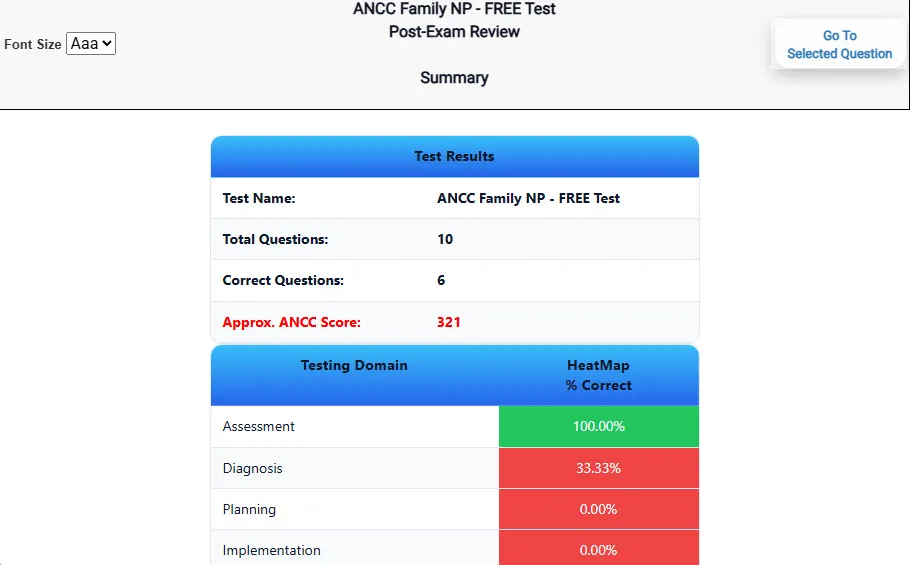
Heatmaps and scaled scores highlight weak areas.

High-Yield Rationales

Concise explanations emphasize key concepts.

Realistic Interface

Matches the feel of the actual exam environment.

Accessible by Design

Clean layout reduces cognitive load.

Anytime, Anywhere

Web-based access 24/7 on any device.
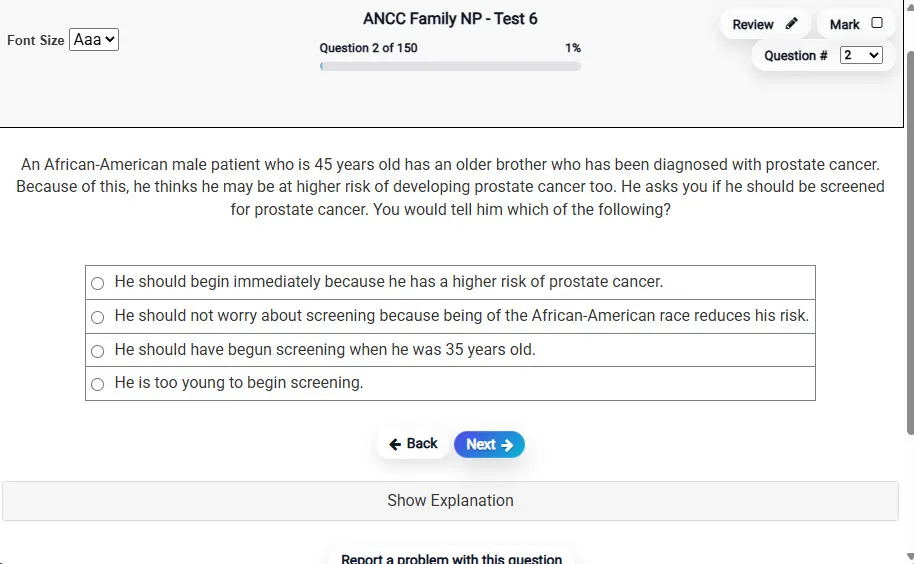
Answering a Question screen – Multiple-choice item view with navigation controls and progress tracker.
Answering a Question Multiple-choice item view with navigation controls and progress tracker.

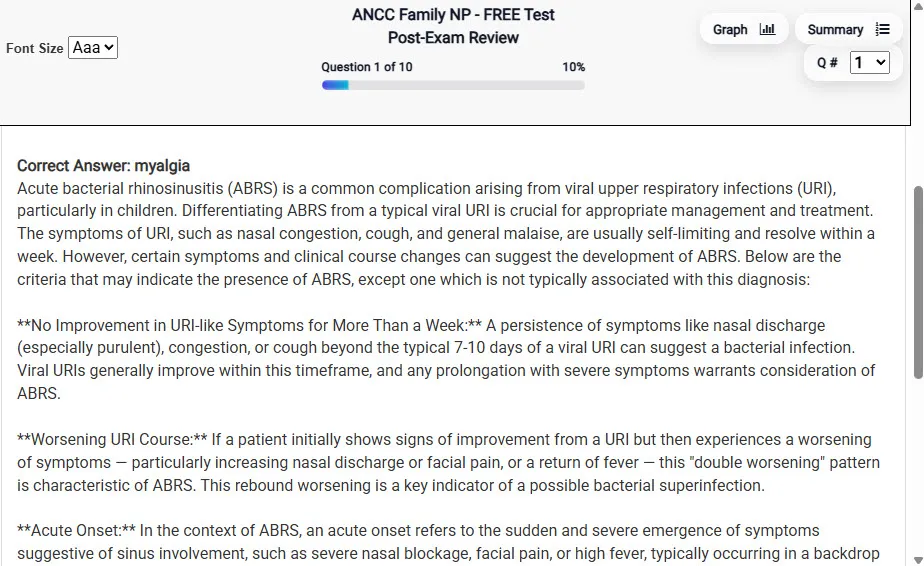
                           Detailed Explanation screen – 
                         Review mode showing chosen answer and rationale and references.
Detailed Explanation Review mode showing chosen answer and rationale and references.

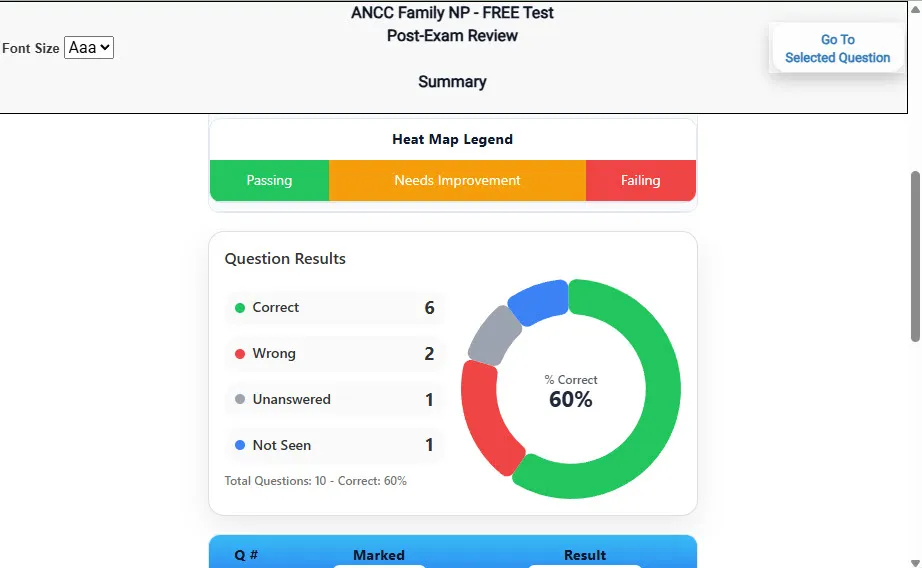
                           Review Summary 1 screen – 
                         Summary with counts for correct/wrong/unanswered and not seen items.
Review Summary 1 Summary with counts for correct/wrong/unanswered and not seen items.

                           Review Summary 2 screen – 
                         Advanced summary with category/domain breakdown and performance insights.
Review Summary 2 Advanced summary with category/domain breakdown and performance insights.

What Each Screen Shows

Answer Question Screen

  • Clean multiple-choice interface with progress bar.
  • Mark for review feature.
  • Matches real test pacing.

Detailed Explanation

  • Correct answer plus rationale.
  • Key concepts and guidelines highlighted.
  • Move between questions to fill knowledge gaps.

Review Summary 1

  • Overall results with total questions and scaled score.
  • Domain heatmap shows strengths and weaknesses.
  • Quick visual feedback on study priorities.

Review Summary 2

  • Chart of correct, wrong, unanswered, not seen.
  • Color-coded results for easy review.
  • Links back to missed items.

Top 10 Reasons to Use Exam Edge for your HESI PN exit Exam Prep

  1. Focused on the HESI PN exit Exam

    Our practice tests are built specifically for the HESI PN exit exam — every question mirrors the real topics, format, and difficulty so you're studying exactly what matters.

  2. Real Exam Simulation

    We match the per-question time limits and pressure of the actual HESI exam, so test day feels familiar and stress-free.

  3. 45 Full Practice Tests & 4,500 Unique Questions

    You'll have more than enough material to master every HESI PN exit concept — no repeats, no fluff.

  4. Lower Cost Than a Retake

    Ordering 5 practice exams costs less than retaking the HESI PN exit exam after a failure. One low fee could save you both time and money.

  5. Flexible Testing

    Need to step away mid-exam? Pick up right where you left off — with your remaining time intact.

  6. Instant Scoring & Feedback

    See your raw score and an estimated HESI PN exit score immediately after finishing each practice test.

  7. Detailed Explanations for Every Question

    Review correct and incorrect answers with clear, step-by-step explanations so you truly understand each topic.

  8. Trusted & Accredited

    We're fully accredited by the Better Business Bureau and uphold the highest standards of trust and transparency.

  9. Web-Based & Always Available

    No software to install. Access your HESI PN exit practice exams 24/7 from any computer or mobile device.

  10. Expert Support When You Need It

    Need extra help? Our specialized tutors are highly qualified and ready to support your HESI exam prep.


Pass the HESI PN exit Exam with Realistic Practice Tests from Exam Edge

Preparing for your upcoming HESI PN exit (HesiPN) Certification Exam can feel overwhelming — but the right practice makes all the difference. Exam Edge gives you the tools, structure, and confidence to pass on your first try. Our online practice exams are built to match the real HESI PN exit exam in content, format, and difficulty.

  • 📝 45 HESI PN exit Practice Tests: Access 45 full-length exams with 100 questions each, covering every major HESI PN exit topic in depth.
  • Instant Online Access: Start practicing right away — no software, no waiting.
  • 🧠 Step-by-Step Explanations: Understand the reasoning behind every correct answer so you can master HESI PN exit exam concepts.
  • 🔄 Retake Each Exam Up to 4 Times: Build knowledge through repetition and track your improvement over time.
  • 🌐 Web-Based & Available 24/7: Study anywhere, anytime, on any device.
  • 🧘 Boost Your Test-Day Confidence: Familiarity with the HESI format reduces anxiety and helps you perform under pressure.

These HESI PN exit practice exams are designed to simulate the real testing experience by matching question types, timing, and difficulty level. This approach helps you get comfortable not just with the exam content, but also with the testing environment, so you walk into your exam day focused and confident.

Exam Edge HESI Reviews


I just took my Hesi exit PN today and got a Hesi score of 1205 and a conversion score of 99.99%. Thanks for the help. Doing all those tests helped so much. Not because I saw the same questions but because I learned so much from the answer reasoning section. Hope to fly through my boards in a couple ...
Read More
Sharon, Texas

I recently had to test out of my school with an 850 on the Hesi PN, so I purchased the exams from you guys, about 5 to 7 exams, and passed the exit HesiPn with a 988! First time around! Then I purchased the NclexPN exam tests from you guys and I passed my nclex the first time around! These tests rea ...
Read More
Welsh, NC

I can't believe this website doesn't have a high following status. I bought 40 practice questions, and I did 20 practice questions and took my Hesi exit. I scored 1070. I completed all 40 practice exams and passed my boards for the first time. Exam Edge introduced me to a bunch of topics and boosted ...
Read More
Juliet M., Tarpon Springs, Florida

I want to thank you. The tests are really helpful. I took them three times and after using your exams, I finally passed. The tests helped me especially in the math section, in which I got a 90.

DIANA , Texas


HESI PN exit Aliases Test Name

Here is a list of alternative names used for this exam.

  • HESI PN exit
  • HESI PN exit test
  • HESI PN exit Certification Test
  • HESI
  • HESI HesiPN
  • HesiPN test
  • HESI PN exit (HesiPN)
  • PN exit certification