This is the content of the pop-over!

Lightning Deal Alert – 12% Off Ends at Midnight!

Strike while the savings are hot! Use promo code FlashSale at checkout for 12% off any Exam Edge test or bundle. Hurry—the clock is ticking!

ANCC Community Health Nursing Certification Practice Tests & Test Prep by Exam Edge


ANCC Community Health Nursing  product image
(4.8)
Based on 37 Reviews

  • Real Exam Simulation: Timed questions and matching content build comfort for your ANCC Community Health Nursing Certification test day.
  • Instant, 24/7 Access: Web-based ANCC Community Health Nursing practice exams with no software needed.
  • Clear Explanations: Step-by-step answers and explanations for your ANCC exam to strengthen understanding.
  • Boosted Confidence: Reduces anxiety and improves test-taking skills to ace your ANCC Community Health Nursing .

Featured on

ANCC Community Health Nursing Online Practice Test Bundles

BEST VALUE
5 practice tests

$69.75

$199.75

SAVE $130

Only $13.95 per test!

  • 100% Pass Guarantee
  • 5 online practice tests
  • 100 questions per test
  • Bonus: 100 Flash Cards + Study Guide
  • Instant access
  • Detailed Explanations
  • Practice tests never expire
  • Timed, untimed, or study guide mode
1 practice test

$39.95

  • 1 online practice test
  • 100 questions per test
  • Instant access
  • Detailed Explanations
  • Practice tests never expire
  • Timed, untimed, or study guide mode
Quick Select
Tap to choose a bundle

** All Prices are in US Dollars (USD) **


ANCC Community Health Nursing Certification () Resources

Jump to the section you need most.

Understanding the exact breakdown of the ANCC Community Health Nursing test will help you know what to expect and how to most effectively prepare. The ANCC Community Health Nursing has 175 multiple-choice questions . The exam will be broken down into the sections below:

ANCC Community Health Nursing Exam Blueprint
Domain Name % Number of
Questions
Foundations of Advanced Public/Community Health Nursing 17.33% 30
Theories and Concepts of Human Development 4.00% 7
Theories and Concepts of Epidemiology and Biostatistics 10.00% 18
Evaluation and Research 5.33% 9
Assessment of Public and Community Health 10.67% 19
Strategies to Improve Public and Community Health 17.33% 30
Health Promotion - Disease Prevention Risk Reduction 10.00% 18
Education for Populations and Communities 8.00% 14
Health Systems - Organizations Networks 12.67% 22
Leadership 4.67% 8

ANCC Community Health Nursing Study Tips by Domain

  • Differentiate public health nursing (population-focused, prevention-oriented) from community-based nursing (individual/family care in the community)—common ANCC trap is choosing an individual intervention when the stem asks for a population outcome.
  • Apply the three core public health functions (assessment, policy development, assurance) and 10 Essential Public Health Services—priority rule: if access or quality is failing, select an assurance action (e.g., linkage to services, workforce, evaluation).
  • Use the nursing process at a population level (community diagnosis, planning, implementation, evaluation)—red flag is writing a “risk for” diagnosis without specifying the population, place, and measurable indicators.
  • Recognize ethical and legal foundations (autonomy, beneficence, justice; duty to protect the public)—contraindication cue: individual confidentiality may be overridden for mandated reporting of certain communicable diseases or abuse.
  • Incorporate cultural humility and health equity principles—common trap is attributing disparities to “noncompliance” instead of addressing structural barriers (transportation, language access, cost, trust).
  • Identify core competencies for advanced public/community health nursing (systems thinking, policy advocacy, interprofessional collaboration)—priority cue: when a problem is upstream (housing, food access, violence), choose policy or systems-level advocacy over one-time education.
  • Differentiate major development theories (e.g., Erikson, Piaget, Kohlberg) and match expected milestones to age—red flag: a milestone gap beyond expected range without environmental explanation warrants referral.
  • Use a life-course perspective: early exposures (ACEs, poverty, lead) accumulate and alter adult outcomes—common trap: treating adult chronic disease without assessing childhood risk history.
  • Recognize gene–environment interaction (epigenetics, toxic stress) and protective factors (stable caregiver, routines)—priority rule: screen for safety and caregiver capacity before recommending behavior plans.
  • Apply cultural and social determinants to development (family structure, migration, language) without stereotyping—red flag: attributing delays solely to culture and missing hearing/vision or learning disorders.
  • Identify atypical trajectories across the lifespan (neurodiversity, disability, serious mental illness) and support functional goals—common trap: focusing only on diagnosis labels instead of ADLs/IADLs and participation.
  • In older adults, distinguish normal aging from pathology (mild cognitive change vs delirium/dementia) and assess decision-making capacity—red flag: acute confusion is delirium until proven otherwise and needs urgent evaluation.
  • Distinguish incidence vs prevalence: incidence tracks new cases (risk), while prevalence reflects existing burden; red flag—don’t use prevalence to infer causality or short-term program impact.
  • Interpret association measures correctly: relative risk (cohort) vs odds ratio (case-control); common trap—treating an OR as an RR when the outcome is common (>10%).
  • Apply test characteristics: sensitivity rules out (SnNout) and specificity rules in (SpPin); practical cue—screening prioritizes high sensitivity, confirmatory testing prioritizes high specificity.
  • Use predictive values in context: PPV/NPV shift with prevalence; priority rule—in low-prevalence communities, expect more false positives even with a good test.
  • Read confidence intervals and p-values: a 95% CI crossing 1.0 (RR/OR) or 0 (mean difference) suggests no statistically significant effect; red flag—statistical significance does not equal clinical or community significance.
  • Identify bias and confounding: selection bias, information (misclassification) bias, and confounding can distort results; common trap—calling a confounder a mediator and adjusting it away without a clear causal model.
  • Differentiate program evaluation (improving a local intervention) from research (generating generalizable knowledge)—ANCC-style trap: assuming QI/evaluation never needs IRB; verify policy when data will be disseminated externally.
  • Choose evaluation type to match timing: formative (during planning/implementation) vs process (fidelity/reach) vs outcome/impact (short- vs long-term)—red flag is measuring only end outcomes when implementation fidelity is unknown.
  • Use appropriate measures and data sources (e.g., surveillance, EHRs, registries, surveys) and ensure reliability/validity—common pitfall is changing instruments midstream, making pre/post comparisons uninterpretable.
  • Apply basic study design logic (randomization, comparison groups, pre/post) and recognize bias/confounding—priority rule: correlation does not imply causation, especially with convenience samples.
  • Interpret statistics at a practice level: p-values vs confidence intervals, effect size, rates (incidence/prevalence) and risk ratios/odds ratios—red flag is focusing on statistical significance while ignoring clinically or community meaningful effect.
  • Protect human subjects and community partners: informed consent when required, privacy (HIPAA), and data security plans—contraindication is using identifiable data for secondary analysis without appropriate permission/data-use agreements.
  • Use a systematic community assessment framework (e.g., windshield survey + key informant interviews + secondary data) and triangulate findings; red flag: relying on a single data source to set priorities.
  • Differentiate incidence vs prevalence and apply correctly to acute vs chronic problems; common trap: using prevalence to evaluate a new outbreak’s current spread.
  • Identify sentinel events, reportable diseases, and unusual clusters and follow jurisdictional reporting timelines; priority rule: potential outbreak signals require immediate notification and isolation guidance per protocol.
  • Stratify risk and outcomes by person, place, and time (including SDOH variables like housing, transportation, language) to detect disparities; red flag: aggregated averages that mask high-risk subpopulations.
  • Assess environmental and occupational exposures (water/air quality, lead, pesticides, heat, workplace hazards) and link them to symptoms and geography; common trap: overlooking seasonal patterns and exposure windows.
  • Conduct culturally responsive, trauma-informed assessment with confidentiality protections, especially for stigmatized conditions; contraindication: collecting identifiable data without a clear purpose, minimum necessary scope, and secure handling plan.
  • Prioritize upstream interventions (policy, systems, environment) before individual counseling when a problem is population-wide; red flag: repeatedly “educating” without removing structural barriers (e.g., access, housing, transportation).
  • Use data-driven prioritization (magnitude, severity, feasibility, and community readiness) to select targets; common trap: choosing a visible issue over one with higher morbidity/mortality impact.
  • Build partnerships across sectors (schools, faith groups, housing, employers) with clear roles and shared metrics; red flag: duplicating services because MOUs and referral pathways were never formalized.
  • Apply culturally responsive, trauma-informed approaches and include community members in planning; common trap: assuming language translation alone addresses cultural beliefs, trust, and historical harms.
  • Plan implementation with concrete logistics (resources, staffing, timeline, communication, and contingency plans); priority rule: start with interventions that can be sustained after initial funding ends.
  • Address equity explicitly by identifying who benefits and who is left out, then tailor outreach accordingly; red flag: average outcomes improve while disparities widen (a key ANCC-style quality/safety pitfall).
  • Prioritize primary prevention at the population level (immunizations, fluoridation, smoke-free policies) before downstream screening/treatment—a common trap is defaulting to individual counseling when upstream risk-reduction is feasible.
  • Apply evidence-based screening intervals (e.g., BP routinely for adults; colorectal cancer starting at age 45 for average risk) and flag red flags that require earlier/more frequent screening (family history, immunosuppression, prior abnormal results).
  • Use health literacy and cultural/linguistic tailoring (plain language, teach-back, interpreter use) because a key ANCC priority is safety and equity—red flag: consent/education done without verifying comprehension.
  • Implement harm-reduction when abstinence is unrealistic (naloxone distribution, syringe services, safer-sex supplies) and watch for contraindications/eligibility rules (e.g., PrEP requires HIV-negative status and ongoing renal monitoring).
  • Target high-impact chronic disease risks (tobacco, obesity, inactivity, uncontrolled HTN/DM) with SMART goals and follow-up; common trap: setting goals without a concrete plan for barriers like food insecurity or transportation.
  • Integrate infection prevention and outbreak-ready practices (vaccination review, isolation guidance, reporting requirements) and treat missed immunizations as a priority cue—red flag: assuming “up to date” without documenting dates/series completion.
  • Perform a quick learning-needs assessment (health literacy, language, culture, readiness) before teaching; red flag: using a one-size-fits-all handout when the audience can’t read it.
  • Choose population-appropriate teaching methods (e.g., brief visuals, teach-back, demonstrations) and document comprehension; common trap: asking “Do you understand?” instead of requiring a return demonstration/teach-back.
  • Prioritize risk communication that is accurate and actionable (what to do, when, where to get help); red flag: using relative risk only without absolute risk or clear next steps.
  • Design education with cultural humility and community partner input; common trap: assuming beliefs or norms and inadvertently creating mistrust that reduces participation.
  • Ensure ADA accessibility and language access (qualified interpreters, plain language, accessible formats); red flag: relying on family members to interpret for clinical or sensitive content.
  • Build evaluation into education (process + outcome measures like attendance, pre/post knowledge, behavior change) and revise based on data; common trap: reporting satisfaction alone as evidence of effectiveness.
  • Map the care continuum across public health, primary care, behavioral health, and social services to reduce duplication; red flag: no clear referral pathway or handoff for high-risk clients.
  • Prioritize interprofessional collaboration agreements (MOUs, standing orders, shared protocols) to formalize roles; common trap: assuming informal relationships are sufficient during outbreaks or surges.
  • Apply systems thinking to identify bottlenecks (access, staffing, transportation, language services) and target the highest-leverage fix first; priority rule: address barriers that affect the largest population segment before niche optimizations.
  • Use network-based resource coordination (211, coalitions, faith-based and community-based organizations) while protecting privacy; red flag: sharing client identifiers without a clear legal basis or consent process.
  • Recognize how financing and coverage (Medicaid, Medicare, managed care, uncompensated care) drive eligibility and service availability; common trap: planning an intervention without confirming reimbursement or sustainable funding.
  • In emergencies, align with incident command and local/state health department structures for unified operations; contraindication: bypassing established command channels, which can delay supplies, messaging, and reporting.
  • Prioritize population outcomes over individual preferences when they conflict, documenting the ethical rationale and stakeholder input as a risk-control step for ANCC-style scenarios.
  • Use a clear incident-command chain (who is in charge, who communicates, who documents) during outbreaks/disasters; red flag: parallel messaging from multiple leaders creating contradictory public guidance.
  • Delegate based on scope of practice and competence, not convenience; common trap: assigning assessment/triage decisions to unlicensed personnel without supervision.
  • Address staff performance and safety issues promptly using objective data and progressive discipline; red flag: tolerating repeated policy deviations because the employee is “experienced” or short staffing exists.
  • Lead interprofessional and community partnerships with written roles, deliverables, and timelines; priority rule: align partners to a shared measurable objective before launching activities.
  • Apply quality-improvement methods (e.g., PDSA) with baseline metrics and follow-up measurement; common trap: implementing a new program without defining success thresholds or a feedback loop.


Built to Fit Into Your Busy Life

Everything you need to prepare with confidence—without wasting a minute.

Three Study Modes

Timed, No Time Limit, or Explanation mode.

Actionable Analytics

Heatmaps and scaled scores highlight weak areas.

High-Yield Rationales

Concise explanations emphasize key concepts.

Realistic Interface

Matches the feel of the actual exam environment.

Accessible by Design

Clean layout reduces cognitive load.

Anytime, Anywhere

Web-based access 24/7 on any device.
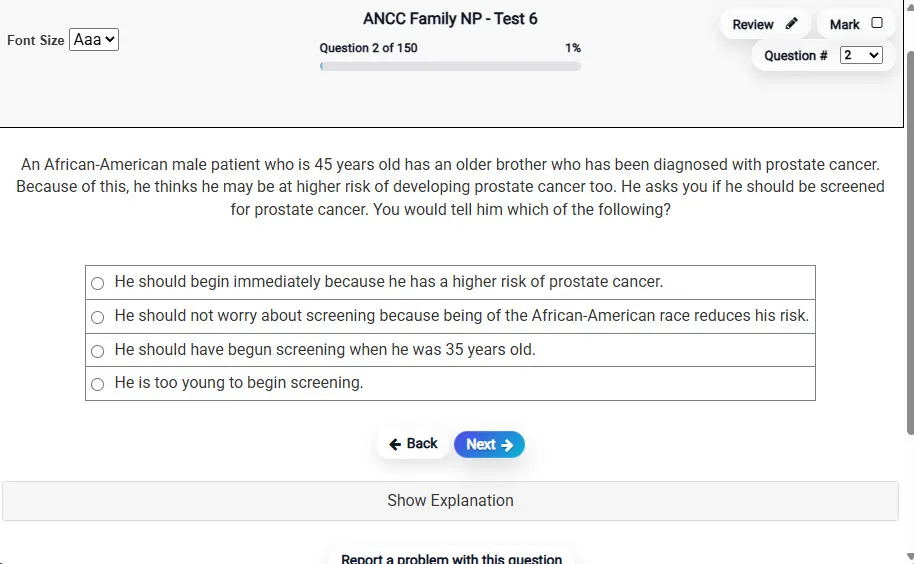
Answering a Question screen – Multiple-choice item view with navigation controls and progress tracker.
Answering a Question Multiple-choice item view with navigation controls and progress tracker.

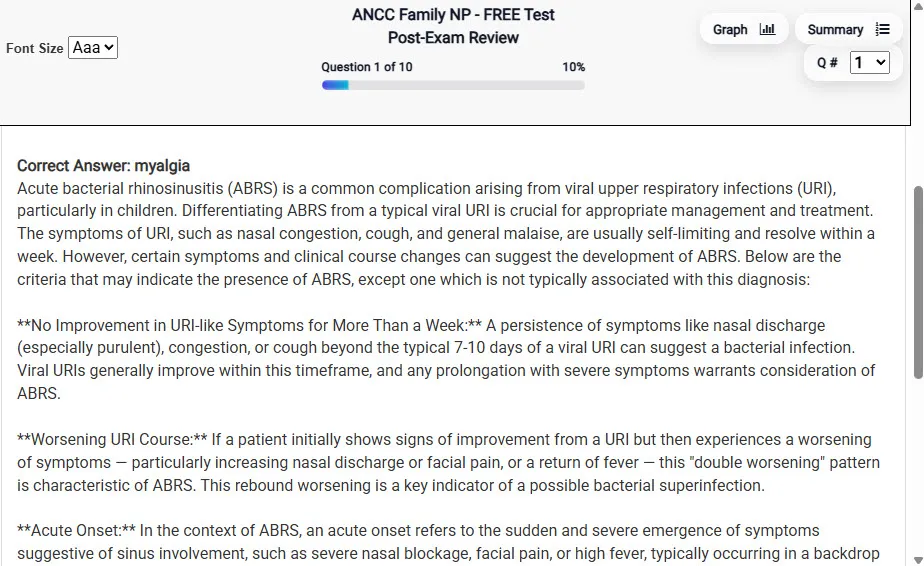
                           Detailed Explanation screen – 
                         Review mode showing chosen answer and rationale and references.
Detailed Explanation Review mode showing chosen answer and rationale and references.

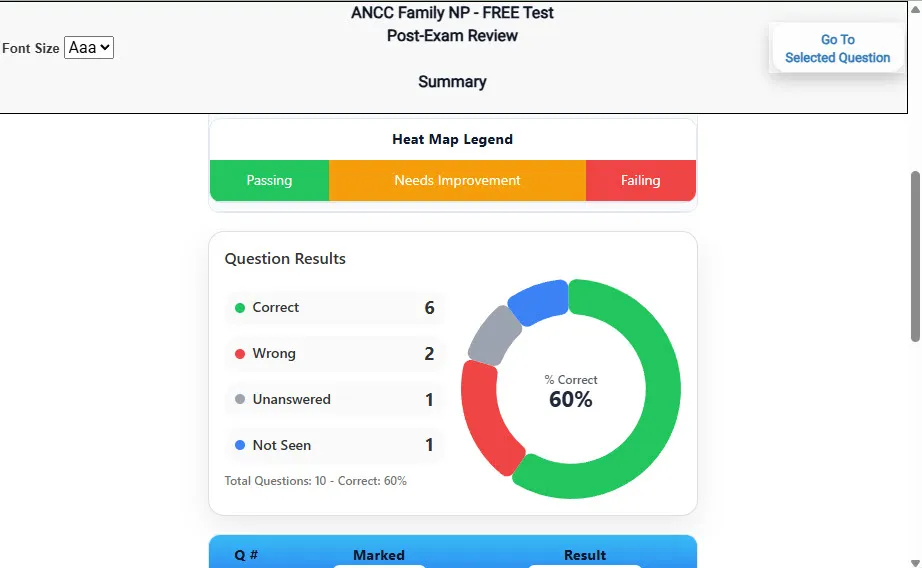
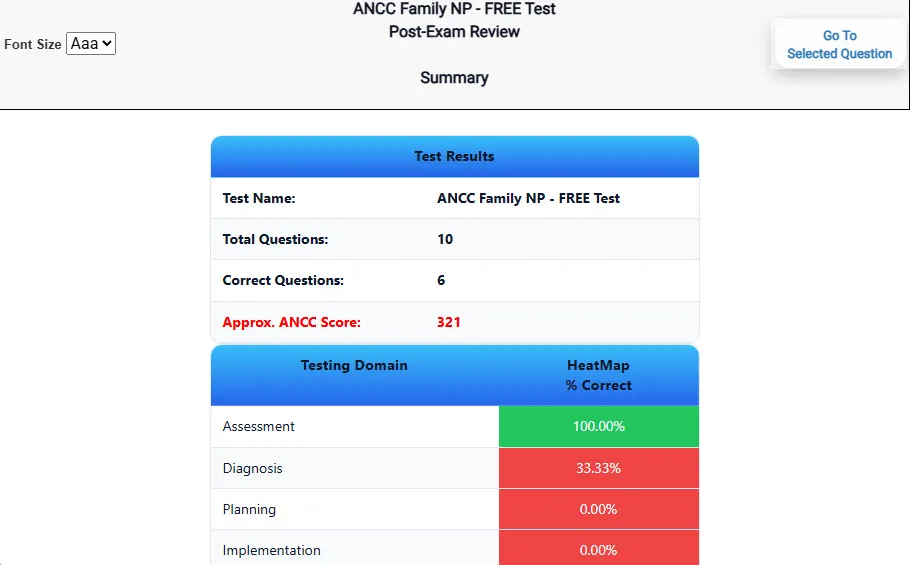
                           Review Summary 1 screen – 
                         Summary with counts for correct/wrong/unanswered and not seen items.
Review Summary 1 Summary with counts for correct/wrong/unanswered and not seen items.

                           Review Summary 2 screen – 
                         Advanced summary with category/domain breakdown and performance insights.
Review Summary 2 Advanced summary with category/domain breakdown and performance insights.

What Each Screen Shows

Answer Question Screen

  • Clean multiple-choice interface with progress bar.
  • Mark for review feature.
  • Matches real test pacing.

Detailed Explanation

  • Correct answer plus rationale.
  • Key concepts and guidelines highlighted.
  • Move between questions to fill knowledge gaps.

Review Summary 1

  • Overall results with total questions and scaled score.
  • Domain heatmap shows strengths and weaknesses.
  • Quick visual feedback on study priorities.

Review Summary 2

  • Chart of correct, wrong, unanswered, not seen.
  • Color-coded results for easy review.
  • Links back to missed items.

Top 10 Reasons to Use Exam Edge for your ANCC Community Health Nursing Exam Prep

  1. Focused on the ANCC Community Health Nursing Exam

    Our practice tests are built specifically for the ANCC Community Health Nursing Certification exam — every question mirrors the real topics, format, and difficulty so you're studying exactly what matters.

  2. Real Exam Simulation

    We match the per-question time limits and pressure of the actual ANCC exam, so test day feels familiar and stress-free.

  3. 5 Full Practice Tests & 500 Unique Questions

    You'll have more than enough material to master every ANCC Community Health Nursing Certification concept — no repeats, no fluff.

  4. Lower Cost Than a Retake

    Ordering 5 practice exams costs less than retaking the ANCC Community Health Nursing exam after a failure. One low fee could save you both time and money.

  5. Flexible Testing

    Need to step away mid-exam? Pick up right where you left off — with your remaining time intact.

  6. Instant Scoring & Feedback

    See your raw score and an estimated ANCC Community Health Nursing score immediately after finishing each practice test.

  7. Detailed Explanations for Every Question

    Review correct and incorrect answers with clear, step-by-step explanations so you truly understand each topic.

  8. Trusted & Accredited

    We're fully accredited by the Better Business Bureau and uphold the highest standards of trust and transparency.

  9. Web-Based & Always Available

    No software to install. Access your ANCC Community Health Nursing Certification practice exams 24/7 from any computer or mobile device.

  10. Expert Support When You Need It

    Need extra help? Our specialized tutors are highly qualified and ready to support your ANCC exam prep.


Pass the ANCC Community Health Nursing Exam with Realistic Practice Tests from Exam Edge

Preparing for your upcoming ANCC Community Health Nursing () Certification Exam can feel overwhelming — but the right practice makes all the difference. Exam Edge gives you the tools, structure, and confidence to pass on your first try. Our online practice exams are built to match the real ANCC Community Health Nursing Certification exam in content, format, and difficulty.

  • 📝 5 ANCC Community Health Nursing Practice Tests: Access 5 full-length exams with 100 questions each, covering every major ANCC Community Health Nursing topic in depth.
  • Instant Online Access: Start practicing right away — no software, no waiting.
  • 🧠 Step-by-Step Explanations: Understand the reasoning behind every correct answer so you can master ANCC Community Health Nursing Certification exam concepts.
  • 🔄 Retake Each Exam Up to 4 Times: Build knowledge through repetition and track your improvement over time.
  • 🌐 Web-Based & Available 24/7: Study anywhere, anytime, on any device.
  • 🧘 Boost Your Test-Day Confidence: Familiarity with the ANCC format reduces anxiety and helps you perform under pressure.

These ANCC Community Health Nursing practice exams are designed to simulate the real testing experience by matching question types, timing, and difficulty level. This approach helps you get comfortable not just with the exam content, but also with the testing environment, so you walk into your exam day focused and confident.


Exam Edge ANCC Reviews


I'm afraid the questions may not be as advanced as they will be on the licensure exam. We will see. I had one question that I knew was incorrect and I had two questions that were repeated. Good content to help focus review for the exam. Also, I am not aware of any other kind of practice tests availa ...
Read More
Sarah , POCAHONTAS, Arkansas

Great Exams, really helped me prepare for my exam

Greg, Atlanta, Georgia

Thank you for the information, your tests probably resemble what the real test will be. Gibson

Delfia , bronx, NY

I just received my Family Nurse Practitioner exam score and I passed with a 440! Your tests definitely made the difference for me! The questions on the real test were so similar that I felt very comfortable taking it. I will recommend your site to everyone I know that’s preparing for the ...
Read More
Wendy H., Pennsylvania

Every new graduate from an FNP program knows that your degree is relatively inactive until you pass the national certification exam. The stress is overwhelming, especially if you do not have the finances to take an expensive review course. Well, I am so glad I stumbled upon the Family NP prep websit ...
Read More
Jennifer , NC

I purchased over 20 exams and truly am so thankful I did. My studying prior was patchy and frustrating. Through the exams I was able to review the content I incorrectly answered and am proud to say I passed on my first go round. Not an easy feat with a family and job! Thanks

Lissette, Virginia


ANCC Community Health Nursing Aliases Test Name

Here is a list of alternative names used for this exam.

  • ANCC Community Health Nursing
  • ANCC Community Health Nursing test
  • ANCC Community Health Nursing Certification Test
  • ANCC Community Health Nursing Certification test
  • ANCC
  • ANCC
  • test
  • ANCC Community Health Nursing ()
  • Community Health Nursing certification
  • ANA Community Health Nursing
  • ANA Community Health Nursing certification
  • ANA