This is the content of the pop-over!

FTCE Elem Ed - LA (601) Practice Tests & Test Prep by Exam Edge


FTCE Elementary Education K-6 - Language Arts and Reading   product image
(4.6)
Based on 34 Reviews

  • Real Exam Simulation: Timed questions and matching content build comfort for your FTCE Elem Ed - LA test day.
  • Instant, 24/7 Access: Web-based FTCE Elementary Education K-6 - Language Arts and Reading practice exams with no software needed.
  • Clear Explanations: Step-by-step answers and explanations for your FTCE exam to strengthen understanding.
  • Boosted Confidence: Reduces anxiety and improves test-taking skills to ace your FTCE Elementary Education K-6 - Language Arts and Reading (601).

Featured on

FTCE Elementary Education K-6 - Language Arts and Reading Online Practice Test Bundles

BEST VALUE
15 practice tests

$149.25

$599.25

SAVE $450

Only $9.95 per test!

  • 100% Pass Guarantee
  • 15 online practice tests
  • 55 questions per test
  • Bonus: 100 Flash Cards + Study Guide
  • Instant access
  • Detailed Explanations
  • Practice tests never expire
  • Timed, untimed, or study guide mode
MOST POPULAR
10 practice tests

$99.50

$399.50

SAVE $300

Only $9.95 per test!

  • 10 online practice tests
  • 55 questions per test
  • Bonus: 100 Flash Cards + Study Guide
  • Instant access
  • Detailed Explanations
  • Practice tests never expire
  • Timed, untimed, or study guide mode
5 practice tests

$69.75

$199.75

SAVE $130

Only $13.95 per test!

  • 5 online practice tests
  • 55 questions per test
  • Bonus: 100 Flash Cards
  • Instant access
  • Detailed Explanations
  • Practice tests never expire
  • Timed, untimed, or study guide mode
1 practice test

$39.95

  • 1 online practice test
  • 55 questions per test
  • Instant access
  • Detailed Explanations
  • Practice tests never expire
  • Timed, untimed, or study guide mode
Quick Select
Tap to choose a bundle

** All Prices are in US Dollars (USD) **


FTCE Elem Ed - LA (601) Resources

Jump to the section you need most.

Understanding the exact breakdown of the FTCE Elementary Education K-6 - Language Arts and Reading test will help you know what to expect and how to most effectively prepare. The FTCE Elementary Education K-6 - Language Arts and Reading has 55 multiple-choice questions . The exam will be broken down into the sections below:

FTCE Elementary Education K-6 - Language Arts and Reading Exam Blueprint
Domain Name % Number of
Questions
LANGUAGE ARTS AND READING  
     Knowledge of the reading process 29% 16
     Knowledge of literary analysis and genres 16% 9
     Knowledge of language and the writing process 18% 10
     Knowledge of literacy instruction and assessments 23% 12
     Knowledge of communication and media literacy 16% 9

FTCE Elementary Education K-6 - Language Arts and Reading Study Tips by Domain

  • Align instruction to Florida B.E.S.T. Standards and make the learning target measurable (e.g., “cite two text details”)—red flag: activities that don’t clearly assess the stated standard.
  • Use a gradual release model (I do–We do–You do) with explicit modeling and checks for understanding—common trap: assigning independent work before guided practice confirms mastery.
  • Differentiate with flexible groups based on data (phonics, fluency, vocabulary, comprehension, writing)—priority rule: reteach the highest-leverage deficit first (often phonemic awareness/phonics in K–2, comprehension/vocabulary in 3–6).
  • Balance literature and informational text and teach text features (headings, captions, graphs) explicitly—red flag: students answering without referencing features or evidence from the text.
  • Integrate vocabulary instruction (morphology, context clues, academic language) and require use in speaking/writing—common trap: only copying definitions without application in sentences or discussion.
  • Use formative assessment cycles (exit tickets, running records, rubrics) to adjust instruction immediately—threshold cue: if most of the class misses the same skill, reteach whole-group rather than only intervening individually.
  • Teach phonological awareness (rhyme, blending, segmenting) before phonics; red flag: having students memorize whole words when they can’t manipulate sounds.
  • Use systematic, explicit phonics (sound–symbol, decoding, syllable types) and connect it to reading text; common trap: assigning “read more” as the fix for weak decoding instead of targeted word-work.
  • Build fluency (accuracy, rate, prosody) with repeated reading and modeling; priority rule: don’t push speed goals when accuracy is below a solid threshold (e.g., frequent miscues change meaning).
  • Strengthen vocabulary through morphology (prefixes/suffixes/roots) and context, not just definitions; red flag: students can define words in isolation but fail to comprehend them in connected text.
  • Teach comprehension with explicit strategies (predict, question, clarify, summarize) tied to text evidence; common trap: asking only literal questions and calling it comprehension instruction.
  • Diagnose breakdowns using running records/miscue patterns and adjust instruction (meaning vs structure vs visual cues); priority rule: if errors are mostly visual/phonics-based, intervene with decoding rather than higher-level comprehension tasks.
  • Identify and cite text evidence for theme, central message, and moral; red flag: confusing theme (universal) with plot summary (what happened).
  • Analyze story elements (character, setting, conflict, plot structure) and how they drive meaning; common trap: mixing up internal conflict (within a character) vs. external conflict (outside forces).
  • Distinguish genres and their defining features (e.g., folktale, myth, fable, fantasy, realistic fiction, historical fiction, poetry, drama); priority rule: match the text to genre by purpose and structure, not by illustrations or length.
  • Interpret figurative language and sound devices (simile, metaphor, personification, alliteration, onomatopoeia, rhyme); red flag: taking figurative language literally instead of explaining the implied meaning.
  • Compare/contrast narrator and point of view (1st person, 3rd limited, 3rd omniscient) and how perspective shapes reliability; common trap: assuming all first-person narrators are trustworthy.
  • Use text structure and craft to analyze informational and literary texts (cause/effect, sequence, problem/solution; tone, mood, imagery); cue: distinguish tone (author’s attitude) from mood (reader’s feeling).
  • Teach sentence structure explicitly (simple, compound, complex) and require correct end punctuation; red flag: run-ons and comma splices signal a need to reteach independent clauses and conjunctions.
  • Address grammar in context (parts of speech, subject–verb agreement, pronoun case) during revision, not as isolated drills; common trap: correcting every error in a draft at once overwhelms K–6 writers.
  • Plan instruction around the writing process (prewrite → draft → revise → edit → publish) and distinguish revise (ideas/organization) from edit (conventions); cue: if feedback is only spelling/grammar, revision is being skipped.
  • Teach organization and purpose by matching mode to task (narrative, informative/explanatory, opinion) with clear introductions and conclusions; red flag: summaries that include opinions (or opinions without reasons) indicate mode confusion.
  • Build word choice and clarity using precise vocabulary, domain-specific terms, and varied sentence beginnings; common trap: overusing vague words (e.g., “thing,” “nice,” “good”) signals a need for mentor texts and word banks.
  • Use grade-appropriate spelling patterns and morphology (prefixes, suffixes, roots) to support encoding and meaning; cue: repeated errors with inflectional endings (e.g., -ed, -s) suggest targeted mini-lessons and dictation practice.
  • Match instruction to assessment data using a simple rule: if ≥80% of students miss the same skill, reteach whole-group; if errors cluster by need, pull small groups—red flag is reteaching the same way without changing the scaffold.
  • Use running records (accuracy, fluency, miscues) to target decoding vs. comprehension—common trap is equating high oral reading fluency with strong understanding.
  • For phonics/word study, assess with brief skill checks (phonemic awareness, phonics patterns, irregular words) and teach systematically from easier to harder patterns—red flag is giving multi-cue prompts (picture/context) when the goal is decoding.
  • Choose text complexity intentionally (quantitative + qualitative + reader/task) and provide access supports without lowering the standard—common trap is replacing grade-level text with only easier texts.
  • Teach comprehension explicitly (model/think-aloud, guided practice, gradual release) and verify with text-dependent questions and written responses—red flag is asking mostly opinion or personal-connection questions that don’t require evidence.
  • Use formative assessments (exit tickets, quick writes, conferencing checklists) to adjust instruction immediately and document progress—priority rule is to monitor interventions on a set schedule (e.g., weekly) rather than waiting for end-of-unit tests.
  • Differentiate purposes and audiences for oral, written, and digital communication (inform, persuade, entertain)—red flag: using an informal register or slang in a formal task.
  • Teach active listening and speaking conventions (turn-taking, eye contact, volume, pacing)—common trap: grading presentations only on content and ignoring delivery and audience awareness.
  • Identify how media techniques (music, camera angles, loaded language, selective images) shape meaning—priority rule: always ask, “What is the source trying to make me think or do?”
  • Evaluate credibility and bias by checking author, date, evidence, and domain/source reputation—red flag: claims with no verifiable evidence or only anonymous citations.
  • Compare information across multiple texts/media formats (article, infographic, video) for consistency—common trap: treating a visually appealing infographic as inherently more accurate than a text source.
  • Model ethical communication (copyright, fair use, plagiarism, appropriate online behavior)—threshold: students should paraphrase and cite sources when using others’ ideas, even in slide decks or videos.


Built to Fit Into Your Busy Life

Everything you need to prepare with confidence—without wasting a minute.

Three Study Modes

Timed, No Time Limit, or Explanation mode.

Actionable Analytics

Heatmaps and scaled scores highlight weak areas.

High-Yield Rationales

Concise explanations emphasize key concepts.

Realistic Interface

Matches the feel of the actual exam environment.

Accessible by Design

Clean layout reduces cognitive load.

Anytime, Anywhere

Web-based access 24/7 on any device.
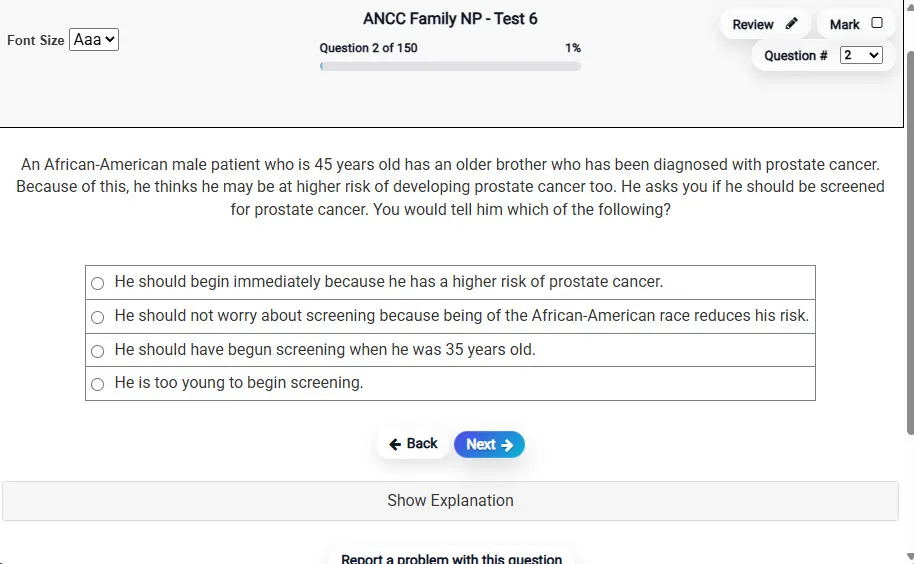
Answering a Question screen – Multiple-choice item view with navigation controls and progress tracker.
Answering a Question Multiple-choice item view with navigation controls and progress tracker.

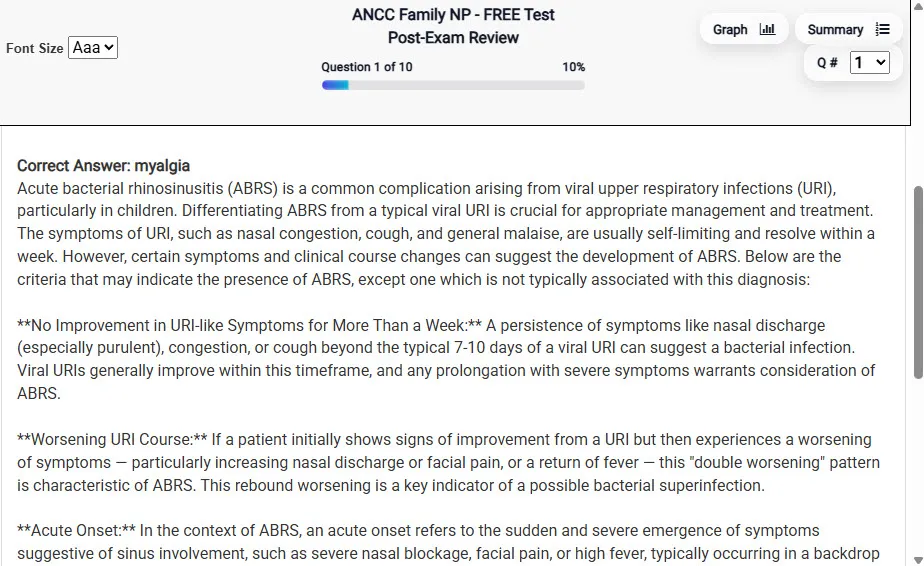
                           Detailed Explanation screen – 
                         Review mode showing chosen answer and rationale and references.
Detailed Explanation Review mode showing chosen answer and rationale and references.

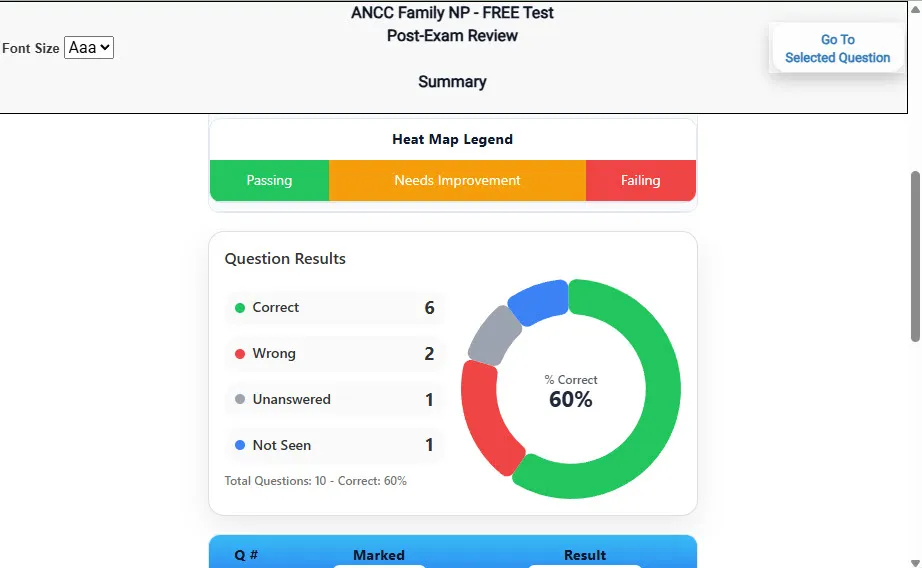
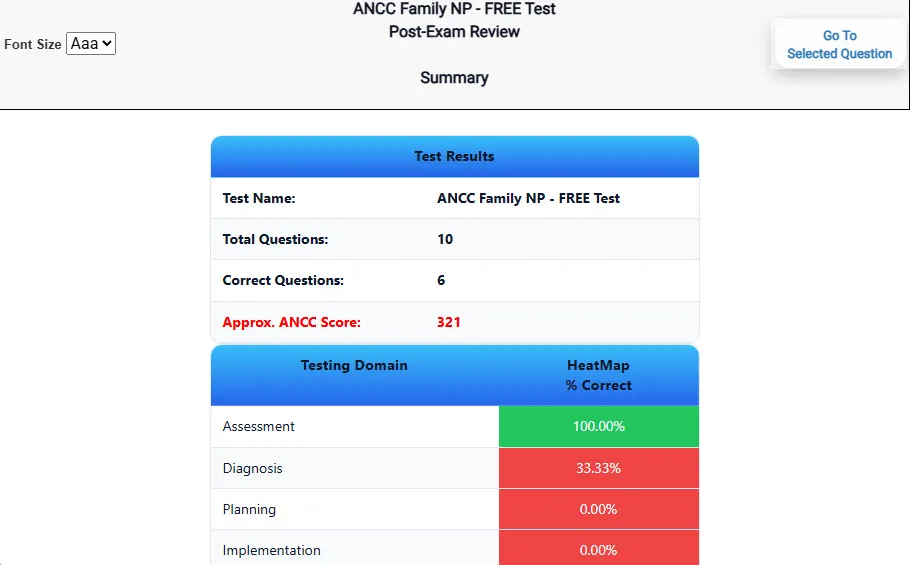
                           Review Summary 1 screen – 
                         Summary with counts for correct/wrong/unanswered and not seen items.
Review Summary 1 Summary with counts for correct/wrong/unanswered and not seen items.

                           Review Summary 2 screen – 
                         Advanced summary with category/domain breakdown and performance insights.
Review Summary 2 Advanced summary with category/domain breakdown and performance insights.

What Each Screen Shows

Answer Question Screen

  • Clean multiple-choice interface with progress bar.
  • Mark for review feature.
  • Matches real test pacing.

Detailed Explanation

  • Correct answer plus rationale.
  • Key concepts and guidelines highlighted.
  • Move between questions to fill knowledge gaps.

Review Summary 1

  • Overall results with total questions and scaled score.
  • Domain heatmap shows strengths and weaknesses.
  • Quick visual feedback on study priorities.

Review Summary 2

  • Chart of correct, wrong, unanswered, not seen.
  • Color-coded results for easy review.
  • Links back to missed items.

Top 10 Reasons to Use Exam Edge for your FTCE Elementary Education K-6 - Language Arts and Reading Exam Prep

  1. Focused on the FTCE Elementary Education K-6 - Language Arts and Reading Exam

    Our practice tests are built specifically for the FTCE Elem Ed - LA exam — every question mirrors the real topics, format, and difficulty so you're studying exactly what matters.

  2. Real Exam Simulation

    We match the per-question time limits and pressure of the actual FTCE exam, so test day feels familiar and stress-free.

  3. 15 Full Practice Tests & 825 Unique Questions

    You'll have more than enough material to master every FTCE Elem Ed - LA concept — no repeats, no fluff.

  4. Lower Cost Than a Retake

    Ordering 5 practice exams costs less than retaking the FTCE Elementary Education K-6 - Language Arts and Reading exam after a failure. One low fee could save you both time and money.

  5. Flexible Testing

    Need to step away mid-exam? Pick up right where you left off — with your remaining time intact.

  6. Instant Scoring & Feedback

    See your raw score and an estimated FTCE Elementary Education K-6 - Language Arts and Reading score immediately after finishing each practice test.

  7. Detailed Explanations for Every Question

    Review correct and incorrect answers with clear, step-by-step explanations so you truly understand each topic.

  8. Trusted & Accredited

    We're fully accredited by the Better Business Bureau and uphold the highest standards of trust and transparency.

  9. Web-Based & Always Available

    No software to install. Access your FTCE Elem Ed - LA practice exams 24/7 from any computer or mobile device.

  10. Expert Support When You Need It

    Need extra help? Our specialized tutors are highly qualified and ready to support your FTCE exam prep.


Pass the FTCE Elementary Education K-6 - Language Arts and Reading Exam with Realistic Practice Tests from Exam Edge

Preparing for your upcoming FTCE Elementary Education K-6 - Language Arts and Reading (601) Certification Exam can feel overwhelming — but the right practice makes all the difference. Exam Edge gives you the tools, structure, and confidence to pass on your first try. Our online practice exams are built to match the real FTCE Elem Ed - LA exam in content, format, and difficulty.

  • 📝 15 FTCE Elementary Education K-6 - Language Arts and Reading Practice Tests: Access 15 full-length exams with 55 questions each, covering every major FTCE Elementary Education K-6 - Language Arts and Reading topic in depth.
  • Instant Online Access: Start practicing right away — no software, no waiting.
  • 🧠 Step-by-Step Explanations: Understand the reasoning behind every correct answer so you can master FTCE Elem Ed - LA exam concepts.
  • 🔄 Retake Each Exam Up to 4 Times: Build knowledge through repetition and track your improvement over time.
  • 🌐 Web-Based & Available 24/7: Study anywhere, anytime, on any device.
  • 🧘 Boost Your Test-Day Confidence: Familiarity with the FTCE format reduces anxiety and helps you perform under pressure.

These FTCE Elementary Education K-6 - Language Arts and Reading practice exams are designed to simulate the real testing experience by matching question types, timing, and difficulty level. This approach helps you get comfortable not just with the exam content, but also with the testing environment, so you walk into your exam day focused and confident.

Exam Edge FTCE Reviews


Very helpful test, much better than buying any books. Highly recommend

Jessica , Homestead, Florida

I spent $47 and all I was able to get was one sample test. I tried getting another one, but it's charging me.

Lizbeth , clermont , Florida

I bought 5 practice tests for the Engineering and Technology test. I took the actual test today and passed. Just wanted to comment that I thought your tests were a good representation of actual test content and an accurate predictor of my score. Thank you.

Rebecca , FL

I just ordered your test last night, took my Gen. Knowledge exam today and passed it on the first attempt!!! I am sooooo excited!!!! Thank you for this practice!!! I really am glad I found it!!!

Courtney , North Port

For those of you planning to take the FTCE General Knowledge exams, these practice tests are very similar to the actual test with regard to exam content and structure. The practice tests offered a variety of question types in all three content areas, as well as provided varying levels of difficulty ...
Read More
Brittany, Orlando

Great so far.

Miriam , Kissimmee , Florida


FTCE Elementary Education K-6 - Language Arts and Reading Aliases Test Name

Here is a list of alternative names used for this exam.

  • FTCE Elementary Education K-6 - Language Arts and Reading
  • FTCE Elementary Education K-6 - Language Arts and Reading test
  • FTCE Elementary Education K-6 - Language Arts and Reading Certification Test
  • FTCE Elem Ed - LA test
  • FTCE
  • FTCE 601
  • 601 test
  • FTCE Elementary Education K-6 - Language Arts and Reading (601)
  • Elementary Education K-6 - Language Arts and Reading certification