This is the content of the pop-over!

Lightning Deal Alert – 12% Off Ends at Midnight!

Strike while the savings are hot! Use promo code FlashSale at checkout for 12% off any Exam Edge test or bundle. Hurry—the clock is ticking!

CCMC Certified Case Manager (CCM) Practice Tests & Test Prep by Exam Edge


CCMC Certified Case Manager  product image
(4.6)
Based on 37 Reviews

  • Real Exam Simulation: Timed questions and matching content build comfort for your CCMC Certified Case Manager test day.
  • Instant, 24/7 Access: Web-based CCMC Certified Case Manager practice exams with no software needed.
  • Clear Explanations: Step-by-step answers and explanations for your CCMC exam to strengthen understanding.
  • Boosted Confidence: Reduces anxiety and improves test-taking skills to ace your CCMC Certified Case Manager (CCM).

Featured on

CCMC Certified Case Manager Online Practice Test Bundles

BEST VALUE
30 practice tests

$238.50

$1,198.50

SAVE $960

Only $7.95 per test!

  • 100% Pass Guarantee
  • 30 online practice tests
  • 100 questions per test
  • Bonus: 100 Flash Cards + Study Guide
  • Instant access
  • Detailed Explanations
  • Practice tests never expire
  • Timed, untimed, or study guide mode
MOST POPULAR
15 practice tests

$149.25

$599.25

SAVE $450

Only $9.95 per test!

  • 15 online practice tests
  • 100 questions per test
  • Bonus: 100 Flash Cards + Study Guide
  • Instant access
  • Detailed Explanations
  • Practice tests never expire
  • Timed, untimed, or study guide mode
5 practice tests

$69.75

$199.75

SAVE $130

Only $13.95 per test!

  • 5 online practice tests
  • 100 questions per test
  • Bonus: 100 Flash Cards
  • Instant access
  • Detailed Explanations
  • Practice tests never expire
  • Timed, untimed, or study guide mode
1 practice test

$39.95

  • 1 online practice test
  • 100 questions per test
  • Instant access
  • Detailed Explanations
  • Practice tests never expire
  • Timed, untimed, or study guide mode
MOST FLEXIBLE
Question Bank

As low as $59.95

500 Questions

Choose 1, 3, 6, or 12 months
A second login is required.

  • Exam Edge content in a powerful question bank
  • Customize Tests
  • Multiple Test & Flash Card Modes
  • Track performance over time
  • Instant access
  • Detailed Explanations
Quick Select
Tap to choose a bundle

** All Prices are in US Dollars (USD) **


CCMC Certified Case Manager (CCM) Resources

Jump to the section you need most.

Understanding the exact breakdown of the CCMC Certified Case Manager test will help you know what to expect and how to most effectively prepare. The CCMC Certified Case Manager has multiple-choice questions . The exam will be broken down into the sections below:

CCMC Certified Case Manager Exam Blueprint
Domain Name % Number of
Questions
Psychosocial Aspects 20% 20
Healthcare Reimbursement 15% 15
Rehabilitation 5% 5
Healthcare Management and Delivery 20% 20
Principles of Practice 15% 15
Case Management Concepts 25% 25

CCMC Certified Case Manager Study Tips by Domain

  • Screen early for depression, anxiety, substance use, IPV, and suicidality; red flag: any suicidal ideation with plan/means warrants immediate escalation per organizational policy and local law.
  • Assess social determinants (housing, food, transportation, utilities, safety) and convert them into a realistic care plan; common trap: scheduling follow-ups without confirming the patient can physically get to services.
  • Use motivational interviewing and stage-of-change to address nonadherence; priority rule: avoid labeling a patient “noncompliant” until you’ve validated understanding, costs, culture, and capacity.
  • Evaluate cognition, health literacy, and decisional capacity for informed choices; red flag: inconsistent recall or inability to explain risks/benefits should trigger capacity review and possible surrogate involvement.
  • Support family/caregivers with education and respite planning while protecting patient autonomy; common trap: sharing PHI with family without documented permission unless a legally recognized exception applies.
  • Identify grief, adjustment reactions, and role changes after illness/injury and connect to community/behavioral health resources; red flag: caregiver burnout signs (sleep deprivation, escalating conflict, missed meds) call for immediate plan revision.
  • Differentiate major payer types (Medicare, Medicaid, commercial, workers’ comp, auto) and apply the correct coverage rules; red flag: assuming the same benefit limits or authorization process across payers.
  • Use medical necessity and level-of-care criteria to justify services and prevent denials; common trap: documenting goals and progress vaguely (e.g., “improving”) instead of measurable functional change.
  • Manage prior authorization, concurrent review, and appeals with tight timelines; priority rule: submit complete clinical records early because late or partial packets commonly trigger avoidable denials.
  • Coordinate transitions (acute → post-acute) with benefit days/visit limits and network requirements; red flag: discharging without confirming SNF/HH/DME coverage, leading to patient financial liability.
  • Address pharmacy and DME reimbursement (formularies, step therapy, quantity limits, and equipment ownership vs rental); common trap: ordering non-formulary meds or non-covered DME specs without an exception request.
  • Apply cost-containment and value principles ethically (least restrictive, cost-effective setting that meets needs); contraindication: steering decisions primarily by cost when coverage criteria and patient safety indicate a higher level of care.
  • Establish a functional baseline using standardized measures (e.g., FIM, Barthel, 6MWT) and link goals to specific deficits; red flag: vague goals like “improve mobility” without a measurable target and timeframe.
  • Match the level of rehab (acute inpatient rehab vs. SNF vs. home health vs. outpatient) to medical stability, intensity tolerance, and discharge supports; common trap: placing a patient who can’t tolerate 3 hours/day into IRF and triggering an avoidable transfer back to acute care.
  • Coordinate interdisciplinary plans (PT/OT/SLP, nursing, physician, neuropsych) with clear role delineation and handoffs; priority rule: reconcile conflicting recommendations early to prevent duplicated services and missed safety training.
  • Monitor contraindications and precautions (weight-bearing, spinal, cardiac, dysphagia, cognitive/behavioral risks) and ensure they are consistently communicated across settings; red flag: therapy notes that ignore new restrictions or medication changes affecting participation.
  • Address durable medical equipment and home modifications proactively (ordering, training, funding, delivery timing); common trap: discharging before equipment is in place, leading to falls, ER visits, or rapid readmission.
  • Plan for vocational/school reintegration and community resources (driver rehab, work conditioning, ADA accommodations) when applicable; threshold cue: document functional capacity and restrictions clearly to avoid inappropriate “return to work full duty” recommendations.
  • Coordinate care across settings (acute, post-acute, home, community) with clear handoffs—red flag: discharge without confirmed follow-up appointments, meds, and transportation.
  • Apply utilization management using evidence-based criteria (e.g., level-of-care decisions) and document medical necessity—common trap: relying on verbal physician assurances without objective criteria support.
  • Prioritize patient safety and quality measures (readmissions, falls, medication reconciliation) in the plan of care—priority rule: address high-risk transitions within 24–48 hours post-discharge.
  • Use interprofessional communication (SBAR, team huddles, shared care plans) to resolve barriers quickly—red flag: conflicting orders or duplicate services across providers.
  • Integrate population health and care management pathways for chronic disease and high utilizers—common trap: focusing only on the index admission and missing frequent ED use patterns.
  • Ensure culturally and linguistically appropriate services (interpreters, health literacy supports) to improve adherence—contraindication: using family members as interpreters for sensitive clinical information when qualified services are available.
  • Maintain the CCMC Code of Professional Conduct as the primary decision rule—when payer directives conflict with client safety or rights, document rationale and escalate rather than “just following orders” (common trap).
  • Obtain and document informed consent for case management services, including limits of confidentiality and who receives updates; red flag: releasing information to an employer or family member without a valid authorization.
  • Apply privacy standards consistently (HIPAA and stricter state laws)—minimum necessary is the threshold; common trap: oversharing clinical details in routine utilization review notes or emails.
  • Identify and manage conflicts of interest early (e.g., financial incentives, referral relationships, dual loyalty to payer and client); priority rule: disclose, mitigate, and recuse if impartiality can’t be maintained.
  • Use ethical decision-making and documentation as risk control—record options considered, client preferences, and the rationale for actions; red flag: undocumented “verbal approvals” or decisions that can’t be tied to standards or policy.
  • Practice within scope and competence and use supervision/referral when needed; contraindication: independently providing clinical diagnosis/therapy when functioning as a case manager rather than a licensed treating provider.
  • Apply the case management process end-to-end (screening/identification, assessment, planning, implementation, monitoring, and evaluation) and document each transition; red flag: moving to discharge planning without a completed, goal-based plan of care.
  • Use clear, measurable goals tied to the client’s priorities and realistic time frames; common trap: vague goals (e.g., “improve function”) that cannot be evaluated or defended in review.
  • Confirm informed consent and establish scope/roles early (client, caregiver, providers, payer) to prevent duplication and gaps; red flag: coordinating services without verified consent or authorization to release information.
  • Perform risk stratification and prioritize interventions for safety and high-cost/high-risk drivers (e.g., frequent ED use, polypharmacy, poor follow-up); priority rule: address immediate safety/medical stability before resource optimization.
  • Coordinate across settings with a structured transition plan (med reconciliation, follow-up appointments, warning signs, who-to-call); common trap: discharge communication that omits responsibility for follow-up and leads to avoidable readmission.
  • Track outcomes with objective metrics (functional status, symptom control, utilization, adherence) and revise the plan when targets aren’t met; red flag: continued service referrals without reassessment of barriers and effectiveness.


Built to Fit Into Your Busy Life

Everything you need to prepare with confidence—without wasting a minute.

Three Study Modes

Timed, No Time Limit, or Explanation mode.

Actionable Analytics

Heatmaps and scaled scores highlight weak areas.

High-Yield Rationales

Concise explanations emphasize key concepts.

Realistic Interface

Matches the feel of the actual exam environment.

Accessible by Design

Clean layout reduces cognitive load.

Anytime, Anywhere

Web-based access 24/7 on any device.
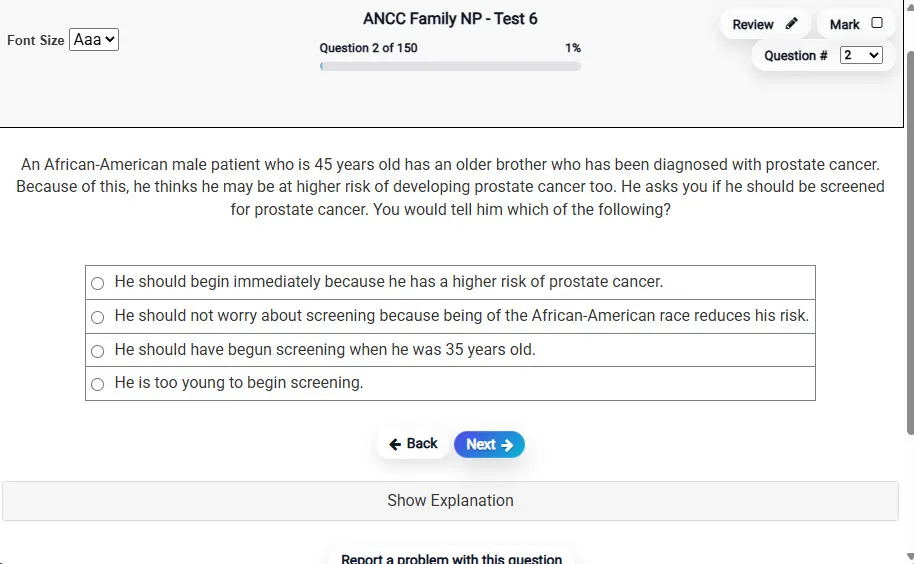
Answering a Question screen – Multiple-choice item view with navigation controls and progress tracker.
Answering a Question Multiple-choice item view with navigation controls and progress tracker.

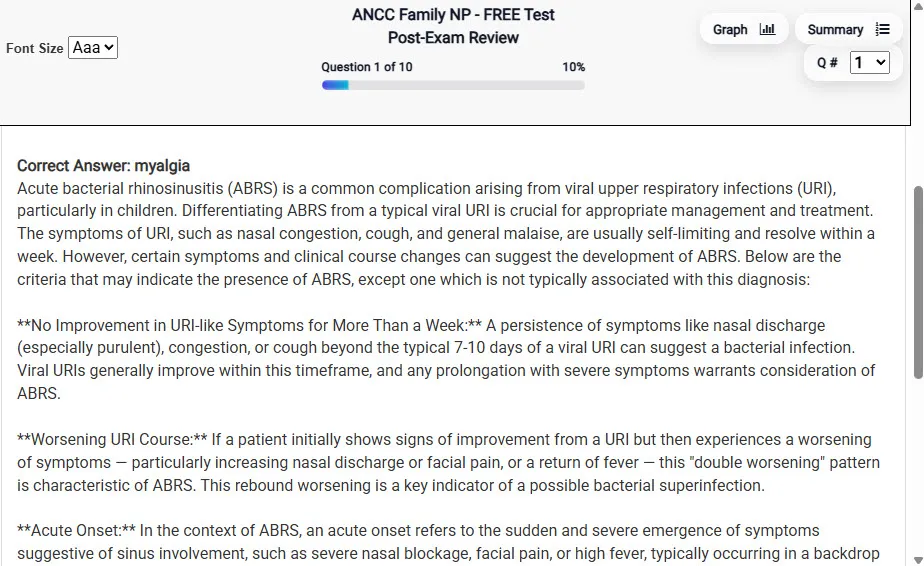
                           Detailed Explanation screen – 
                         Review mode showing chosen answer and rationale and references.
Detailed Explanation Review mode showing chosen answer and rationale and references.

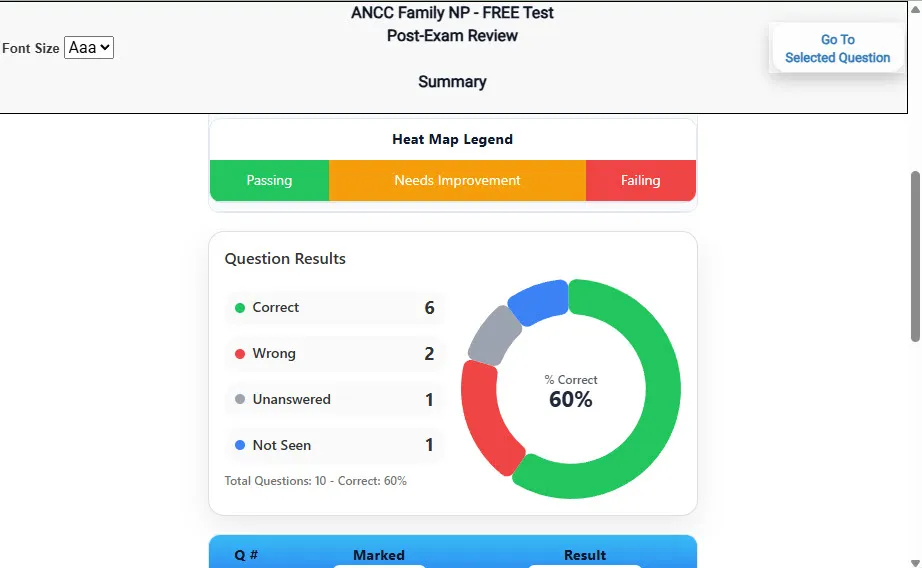
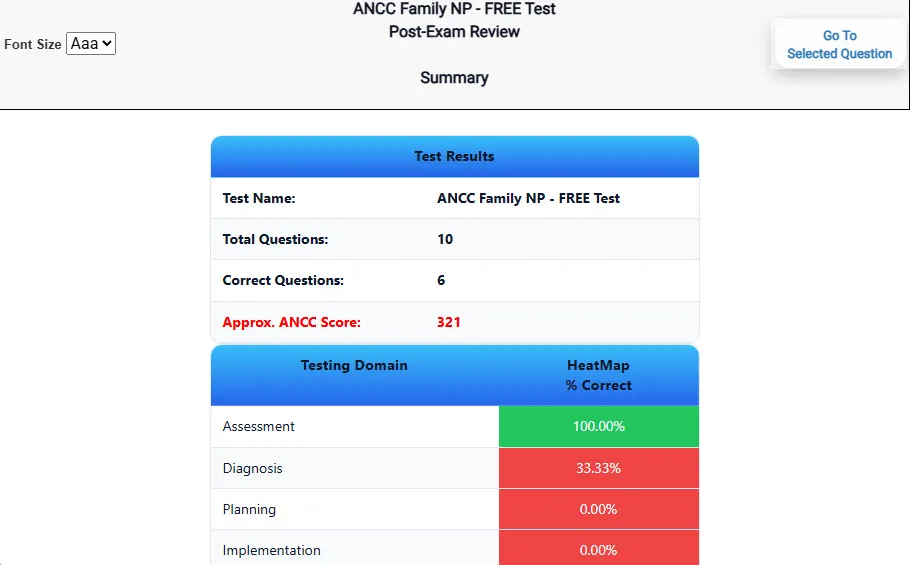
                           Review Summary 1 screen – 
                         Summary with counts for correct/wrong/unanswered and not seen items.
Review Summary 1 Summary with counts for correct/wrong/unanswered and not seen items.

                           Review Summary 2 screen – 
                         Advanced summary with category/domain breakdown and performance insights.
Review Summary 2 Advanced summary with category/domain breakdown and performance insights.

What Each Screen Shows

Answer Question Screen

  • Clean multiple-choice interface with progress bar.
  • Mark for review feature.
  • Matches real test pacing.

Detailed Explanation

  • Correct answer plus rationale.
  • Key concepts and guidelines highlighted.
  • Move between questions to fill knowledge gaps.

Review Summary 1

  • Overall results with total questions and scaled score.
  • Domain heatmap shows strengths and weaknesses.
  • Quick visual feedback on study priorities.

Review Summary 2

  • Chart of correct, wrong, unanswered, not seen.
  • Color-coded results for easy review.
  • Links back to missed items.

Top 10 Reasons to Use Exam Edge for your CCMC Certified Case Manager Exam Prep

  1. Focused on the CCMC Certified Case Manager Exam

    Our practice tests are built specifically for the CCMC Certified Case Manager exam — every question mirrors the real topics, format, and difficulty so you're studying exactly what matters.

  2. Real Exam Simulation

    We match the per-question time limits and pressure of the actual CCMC exam, so test day feels familiar and stress-free.

  3. 30 Full Practice Tests & 3,000 Unique Questions

    You'll have more than enough material to master every CCMC Certified Case Manager concept — no repeats, no fluff.

  4. Lower Cost Than a Retake

    Ordering 5 practice exams costs less than retaking the CCMC Certified Case Manager exam after a failure. One low fee could save you both time and money.

  5. Flexible Testing

    Need to step away mid-exam? Pick up right where you left off — with your remaining time intact.

  6. Instant Scoring & Feedback

    See your raw score and an estimated CCMC Certified Case Manager score immediately after finishing each practice test.

  7. Detailed Explanations for Every Question

    Review correct and incorrect answers with clear, step-by-step explanations so you truly understand each topic.

  8. Trusted & Accredited

    We're fully accredited by the Better Business Bureau and uphold the highest standards of trust and transparency.

  9. Web-Based & Always Available

    No software to install. Access your CCMC Certified Case Manager practice exams 24/7 from any computer or mobile device.

  10. Expert Support When You Need It

    Need extra help? Our specialized tutors are highly qualified and ready to support your CCMC exam prep.


Pass the CCMC Certified Case Manager Exam with Realistic Practice Tests from Exam Edge

Preparing for your upcoming CCMC Certified Case Manager (CCM) Certification Exam can feel overwhelming — but the right practice makes all the difference. Exam Edge gives you the tools, structure, and confidence to pass on your first try. Our online practice exams are built to match the real CCMC Certified Case Manager exam in content, format, and difficulty.

  • 📝 30 CCMC Certified Case Manager Practice Tests: Access 30 full-length exams with 100 questions each, covering every major CCMC Certified Case Manager topic in depth.
  • Instant Online Access: Start practicing right away — no software, no waiting.
  • 🧠 Step-by-Step Explanations: Understand the reasoning behind every correct answer so you can master CCMC Certified Case Manager exam concepts.
  • 🔄 Retake Each Exam Up to 4 Times: Build knowledge through repetition and track your improvement over time.
  • 🌐 Web-Based & Available 24/7: Study anywhere, anytime, on any device.
  • 🧘 Boost Your Test-Day Confidence: Familiarity with the CCMC format reduces anxiety and helps you perform under pressure.

These CCMC Certified Case Manager practice exams are designed to simulate the real testing experience by matching question types, timing, and difficulty level. This approach helps you get comfortable not just with the exam content, but also with the testing environment, so you walk into your exam day focused and confident.


Exam Edge CCMC Reviews


CCMC Certified Case Manager Aliases Test Name

Here is a list of alternative names used for this exam.

  • CCMC Certified Case Manager
  • CCMC Certified Case Manager test
  • CCMC Certified Case Manager Certification Test
  • CCMC
  • CCMC CCM
  • CCM test
  • CCMC Certified Case Manager (CCM)
  • Certified Case Manager certification