This is the content of the pop-over!

Lightning Deal Alert – 12% Off Ends at Midnight!

Strike while the savings are hot! Use promo code FlashSale at checkout for 12% off any Exam Edge test or bundle. Hurry—the clock is ticking!

FTCE Pre-K / Primary - Subtest 4 Science (534) Practice Tests & Test Prep by Exam Edge


FTCE Prekindergarten Primary PK-3 - Subtest 4Science   product image
(4.6)
Based on 28 Reviews

  • Real Exam Simulation: Timed questions and matching content build comfort for your FTCE Pre-K / Primary - Subtest 4 Science test day.
  • Instant, 24/7 Access: Web-based FTCE Prekindergarten Primary PK-3 - Subtest 4Science practice exams with no software needed.
  • Clear Explanations: Step-by-step answers and explanations for your FTCE exam to strengthen understanding.
  • Boosted Confidence: Reduces anxiety and improves test-taking skills to ace your FTCE Prekindergarten Primary PK-3 - Subtest 4Science (534).

Featured on

FTCE Prekindergarten Primary PK-3 - Subtest 4Science Online Practice Test Bundles

BEST VALUE
15 practice tests

$149.25

$599.25

SAVE $450

Only $9.95 per test!

  • 100% Pass Guarantee
  • 15 online practice tests
  • 50 questions per test
  • Bonus: 100 Flash Cards + Study Guide
  • Instant access
  • Detailed Explanations
  • Practice tests never expire
  • Timed, untimed, or study guide mode
MOST POPULAR
10 practice tests

$99.50

$399.50

SAVE $300

Only $9.95 per test!

  • 10 online practice tests
  • 50 questions per test
  • Bonus: 100 Flash Cards + Study Guide
  • Instant access
  • Detailed Explanations
  • Practice tests never expire
  • Timed, untimed, or study guide mode
5 practice tests

$69.75

$199.75

SAVE $130

Only $13.95 per test!

  • 5 online practice tests
  • 50 questions per test
  • Bonus: 100 Flash Cards
  • Instant access
  • Detailed Explanations
  • Practice tests never expire
  • Timed, untimed, or study guide mode
1 practice test

$39.95

  • 1 online practice test
  • 50 questions per test
  • Instant access
  • Detailed Explanations
  • Practice tests never expire
  • Timed, untimed, or study guide mode
Quick Select
Tap to choose a bundle

** All Prices are in US Dollars (USD) **


FTCE Pre-K / Primary - Subtest 4 Science (534) Resources

Jump to the section you need most.

Understanding the exact breakdown of the FTCE Prekindergarten Primary PK-3 - Subtest 4Science test will help you know what to expect and how to most effectively prepare. The FTCE Prekindergarten Primary PK-3 - Subtest 4Science has 50 multiple-choice questions . The exam will be broken down into the sections below:

FTCE Prekindergarten Primary PK-3 - Subtest 4Science Exam Blueprint
Domain Name % Number of
Questions
Knowledge of effective science instruction 19% 10
Knowledge of the nature of science 19% 10
Knowledge of earth and space sciences 20% 10
Knowledge of the physical sciences 17% 9
Knowledge of the life sciences 25% 13

FTCE Prekindergarten Primary PK-3 - Subtest 4Science Study Tips by Domain

  • Plan investigations around a single, testable question and one variable at a time; red flag: changing materials and procedure midstream makes results uninterpretable.
  • Use developmentally appropriate tools (hand lenses, balances, droppers) and model safe handling; priority rule: teach “look, don’t taste” and eye-protection expectations before any lab center opens.
  • Elicit students’ predictions with a “because” statement and revisit after evidence is collected; common trap: treating a prediction as something to grade “right/wrong” instead of a starting idea.
  • Embed formative checks during exploration (quick sorts, thumbs signals, science talk prompts) and adjust instruction; red flag: waiting until a final worksheet to discover misconceptions.
  • Support science vocabulary through concrete experiences, visuals, and sentence frames; common trap: front-loading long word lists (e.g., “evaporation”) before students observe the phenomenon.
  • Differentiate inquiry roles and products (drawings, oral explanations, simple charts) while keeping the science goal constant; priority rule: modify access and scaffolds, not the learning target.
  • Distinguish observation from inference: observations are directly sensed/measured, while inferences explain observations—red flag: calling a guess an “observation.”
  • Know the roles of hypothesis, prediction, and conclusion: hypotheses are testable explanations and predictions are what you expect to observe—common trap: writing a hypothesis as an “if/then” procedure statement.
  • Identify variables and fair tests: only one independent variable should change while controls stay constant—priority rule: if more than one thing changes, you can’t attribute cause.
  • Emphasize evidence and replication: results should be based on data and repeatable by others—red flag: claims based on a single trial or anecdote.
  • Connect models and tools to explanations: models represent ideas and have limits, and tools improve measurement precision—common trap: treating a model (e.g., a diagram) as the real thing.
  • Understand how science changes: explanations can be revised with new evidence and peer review helps reduce bias—red flag: statements like “scientific theories become laws.”
  • Identify landforms and water features (mountains, valleys, rivers, lakes, oceans) and relate them to simple processes; red flag: students often confuse “hill vs. mountain” or “river vs. lake,” so cue sorting by shape and flow.
  • Explain weather vs. climate and basic weather tools (thermometer, rain gauge, wind vane) using daily observations; common trap: calling a single day’s temperature “climate.”
  • Describe the water cycle (evaporation, condensation, precipitation, collection) with age-appropriate models; priority rule: always connect a stage to a visible classroom example (e.g., droplets on a cold cup).
  • Recognize the Sun as a source of light and heat and connect it to shadows and daily patterns; red flag: students may think seasons are caused by Earth being “closer to the Sun,” so emphasize tilt-driven sunlight angle.
  • Compare Earth’s rotation and revolution to day/night and yearly changes using manipulatives; common trap: mixing up rotation (one day) with revolution (one year), so cue “spin vs. orbit.”
  • Differentiate rocks, soil, sand, and clay by observable properties and link to erosion/deposition (wind/water); red flag: “soil = dirt” oversimplification, so cue that soil includes organic matter and supports plant life.
  • Use particle ideas to explain states of matter—solids keep shape, liquids take container shape, gases spread out; red flag: saying gases have “no mass” or “no weight.”
  • Separate physical vs. chemical change with observable evidence—melting and cutting are physical, burning/rusting are chemical; common trap: calling dissolving a chemical change without evidence of a new substance.
  • Teach forces as pushes/pulls and connect to motion (start/stop/speed up/slow down/change direction); priority rule: if an object’s motion changes, a net force is acting (not “force is needed to keep it moving”).
  • Emphasize gravity acts on all objects and pulls toward Earth; red flag: claiming heavier objects fall faster in the absence of air resistance.
  • Cover simple machines (lever, pulley, wheel and axle, inclined plane, screw, wedge) as changing the amount/direction of force; common trap: thinking machines reduce work rather than trading force for distance.
  • Address energy in age-appropriate forms (light, sound, heat, electrical) and basic transfer—vibrations produce sound, light needs a source; safety cue: heat/light activities require clear burn/eye-safety rules (e.g., no staring at bright lights).
  • Know basic needs and life-cycle patterns of plants and animals (birth/growth/reproduction/death); red flag: saying nonliving things (rocks, water) “grow” or “need food.”
  • Use simple structure-and-function links (roots absorb water, leaves make food, lungs breathe); common trap: teaching teleology (“plants have thorns so they can hurt”) instead of observable function.
  • Distinguish habitats and adaptations (camouflage, beaks, fur) and connect them to survival in specific environments; priority rule: always tie adaptations to a particular habitat, not a vague “to survive.”
  • Model food chains/webs with producer → consumer → decomposer roles and energy flow; red flag: arrows shown as “who eats who” rather than energy moving from food to eater.
  • Address heredity with age-appropriate traits (eye color, leaf shape) and variation within a species; common trap: implying acquired traits (e.g., “strong muscles”) are inherited.
  • Teach health and human body basics (hygiene, nutrition groups, major organs) with safety emphasis; contraindication: any classroom activity involving blood/body fluids without strict avoidance and immediate handwashing procedures.


Built to Fit Into Your Busy Life

Everything you need to prepare with confidence—without wasting a minute.

Three Study Modes

Timed, No Time Limit, or Explanation mode.

Actionable Analytics

Heatmaps and scaled scores highlight weak areas.

High-Yield Rationales

Concise explanations emphasize key concepts.

Realistic Interface

Matches the feel of the actual exam environment.

Accessible by Design

Clean layout reduces cognitive load.

Anytime, Anywhere

Web-based access 24/7 on any device.
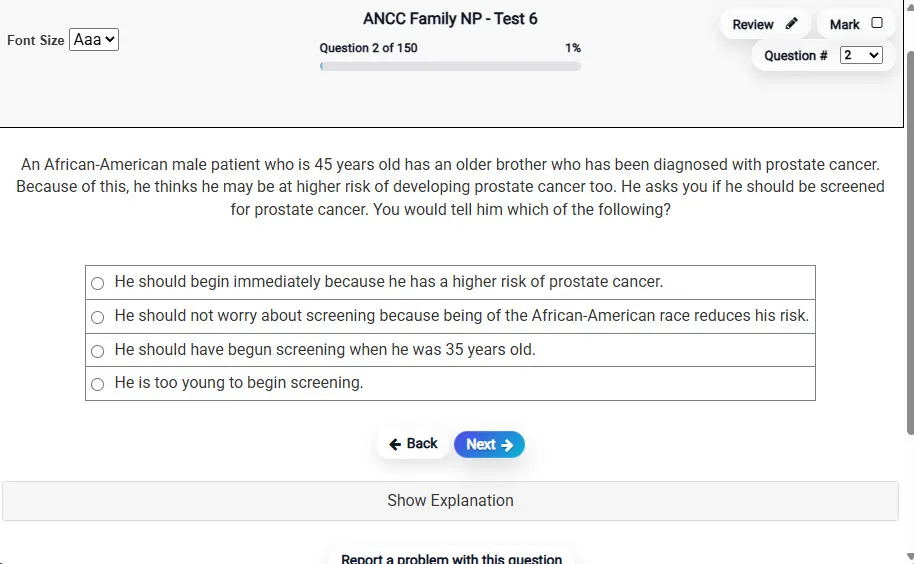
Answering a Question screen – Multiple-choice item view with navigation controls and progress tracker.
Answering a Question Multiple-choice item view with navigation controls and progress tracker.

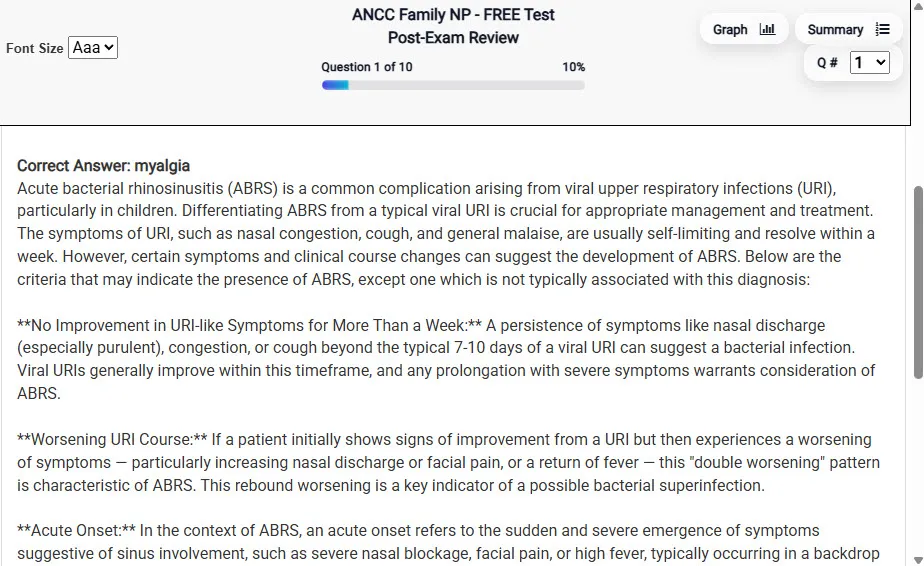
                           Detailed Explanation screen – 
                         Review mode showing chosen answer and rationale and references.
Detailed Explanation Review mode showing chosen answer and rationale and references.

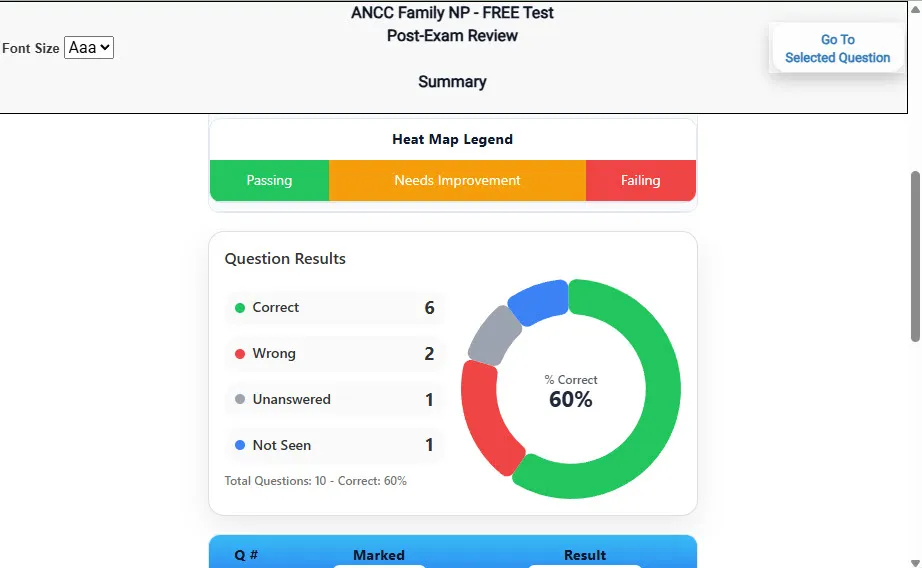
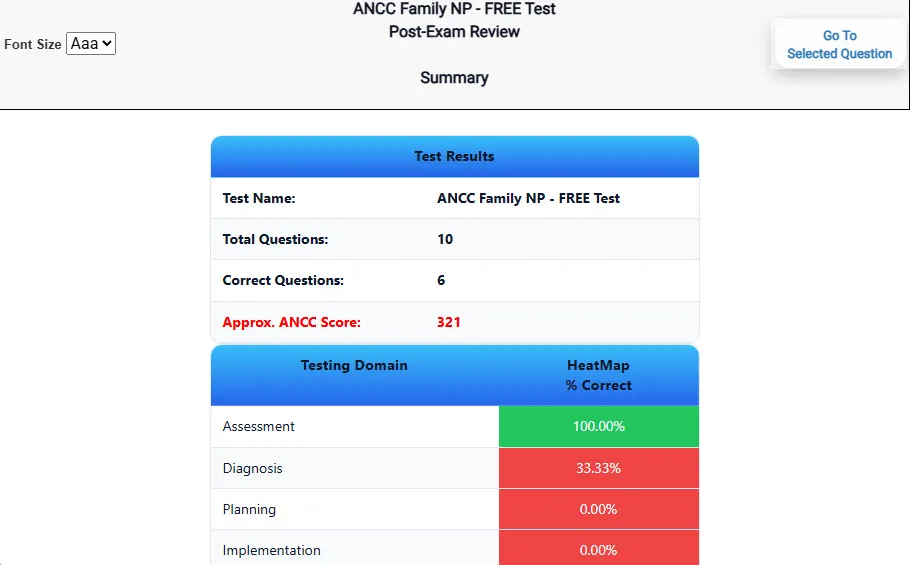
                           Review Summary 1 screen – 
                         Summary with counts for correct/wrong/unanswered and not seen items.
Review Summary 1 Summary with counts for correct/wrong/unanswered and not seen items.

                           Review Summary 2 screen – 
                         Advanced summary with category/domain breakdown and performance insights.
Review Summary 2 Advanced summary with category/domain breakdown and performance insights.

What Each Screen Shows

Answer Question Screen

  • Clean multiple-choice interface with progress bar.
  • Mark for review feature.
  • Matches real test pacing.

Detailed Explanation

  • Correct answer plus rationale.
  • Key concepts and guidelines highlighted.
  • Move between questions to fill knowledge gaps.

Review Summary 1

  • Overall results with total questions and scaled score.
  • Domain heatmap shows strengths and weaknesses.
  • Quick visual feedback on study priorities.

Review Summary 2

  • Chart of correct, wrong, unanswered, not seen.
  • Color-coded results for easy review.
  • Links back to missed items.

Top 10 Reasons to Use Exam Edge for your FTCE Prekindergarten Primary PK-3 - Subtest 4Science Exam Prep

  1. Focused on the FTCE Prekindergarten Primary PK-3 - Subtest 4Science Exam

    Our practice tests are built specifically for the FTCE Pre-K / Primary - Subtest 4 Science exam — every question mirrors the real topics, format, and difficulty so you're studying exactly what matters.

  2. Real Exam Simulation

    We match the per-question time limits and pressure of the actual FTCE exam, so test day feels familiar and stress-free.

  3. 15 Full Practice Tests & 750 Unique Questions

    You'll have more than enough material to master every FTCE Pre-K / Primary - Subtest 4 Science concept — no repeats, no fluff.

  4. Lower Cost Than a Retake

    Ordering 5 practice exams costs less than retaking the FTCE Prekindergarten Primary PK-3 - Subtest 4Science exam after a failure. One low fee could save you both time and money.

  5. Flexible Testing

    Need to step away mid-exam? Pick up right where you left off — with your remaining time intact.

  6. Instant Scoring & Feedback

    See your raw score and an estimated FTCE Prekindergarten Primary PK-3 - Subtest 4Science score immediately after finishing each practice test.

  7. Detailed Explanations for Every Question

    Review correct and incorrect answers with clear, step-by-step explanations so you truly understand each topic.

  8. Trusted & Accredited

    We're fully accredited by the Better Business Bureau and uphold the highest standards of trust and transparency.

  9. Web-Based & Always Available

    No software to install. Access your FTCE Pre-K / Primary - Subtest 4 Science practice exams 24/7 from any computer or mobile device.

  10. Expert Support When You Need It

    Need extra help? Our specialized tutors are highly qualified and ready to support your FTCE exam prep.


Pass the FTCE Prekindergarten Primary PK-3 - Subtest 4Science Exam with Realistic Practice Tests from Exam Edge

Preparing for your upcoming FTCE Prekindergarten Primary PK-3 - Subtest 4Science (534) Certification Exam can feel overwhelming — but the right practice makes all the difference. Exam Edge gives you the tools, structure, and confidence to pass on your first try. Our online practice exams are built to match the real FTCE Pre-K / Primary - Subtest 4 Science exam in content, format, and difficulty.

  • 📝 15 FTCE Prekindergarten Primary PK-3 - Subtest 4Science Practice Tests: Access 15 full-length exams with 50 questions each, covering every major FTCE Prekindergarten Primary PK-3 - Subtest 4Science topic in depth.
  • Instant Online Access: Start practicing right away — no software, no waiting.
  • 🧠 Step-by-Step Explanations: Understand the reasoning behind every correct answer so you can master FTCE Pre-K / Primary - Subtest 4 Science exam concepts.
  • 🔄 Retake Each Exam Up to 4 Times: Build knowledge through repetition and track your improvement over time.
  • 🌐 Web-Based & Available 24/7: Study anywhere, anytime, on any device.
  • 🧘 Boost Your Test-Day Confidence: Familiarity with the FTCE format reduces anxiety and helps you perform under pressure.

These FTCE Prekindergarten Primary PK-3 - Subtest 4Science practice exams are designed to simulate the real testing experience by matching question types, timing, and difficulty level. This approach helps you get comfortable not just with the exam content, but also with the testing environment, so you walk into your exam day focused and confident.


Exam Edge FTCE Reviews


Very helpful test, much better than buying any books. Highly recommend

Jessica , Homestead, Florida

I spent $47 and all I was able to get was one sample test. I tried getting another one, but it's charging me.

Lizbeth , clermont , Florida

I bought 5 practice tests for the Engineering and Technology test. I took the actual test today and passed. Just wanted to comment that I thought your tests were a good representation of actual test content and an accurate predictor of my score. Thank you.

Rebecca , FL

I just ordered your test last night, took my Gen. Knowledge exam today and passed it on the first attempt!!! I am sooooo excited!!!! Thank you for this practice!!! I really am glad I found it!!!

Courtney , North Port

For those of you planning to take the FTCE General Knowledge exams, these practice tests are very similar to the actual test with regard to exam content and structure. The practice tests offered a variety of question types in all three content areas, as well as provided varying levels of difficulty ...
Read More
Brittany, Orlando

Great so far.

Miriam , Kissimmee , Florida


FTCE Prekindergarten Primary PK-3 - Subtest 4Science Aliases Test Name

Here is a list of alternative names used for this exam.

  • FTCE Prekindergarten Primary PK-3 - Subtest 4Science
  • FTCE Prekindergarten Primary PK-3 - Subtest 4Science test
  • FTCE Prekindergarten Primary PK-3 - Subtest 4Science Certification Test
  • FTCE Pre-K / Primary - Subtest 4 Science test
  • FTCE
  • FTCE 534
  • 534 test
  • FTCE Prekindergarten Primary PK-3 - Subtest 4Science (534)
  • Prekindergarten Primary PK-3 - Subtest 4Science certification