This is the content of the pop-over!

FTCE Elem Ed - Social Science (602) Practice Tests & Test Prep by Exam Edge


FTCE Elementary Education K-6 - Social Science  product image
(4.6)
Based on 40 Reviews

  • Real Exam Simulation: Timed questions and matching content build comfort for your FTCE Elem Ed - Social Science test day.
  • Instant, 24/7 Access: Web-based FTCE Elementary Education K-6 - Social Science practice exams with no software needed.
  • Clear Explanations: Step-by-step answers and explanations for your FTCE exam to strengthen understanding.
  • Boosted Confidence: Reduces anxiety and improves test-taking skills to ace your FTCE Elementary Education K-6 - Social Science (602).

Featured on

FTCE Elementary Education K-6 - Social Science Online Practice Test Bundles

BEST VALUE
15 practice tests

$149.25

$599.25

SAVE $450

Only $9.95 per test!

  • 100% Pass Guarantee
  • 15 online practice tests
  • 50 questions per test
  • Bonus: 100 Flash Cards + Study Guide
  • Instant access
  • Detailed Explanations
  • Practice tests never expire
  • Timed, untimed, or study guide mode
MOST POPULAR
10 practice tests

$99.50

$399.50

SAVE $300

Only $9.95 per test!

  • 10 online practice tests
  • 50 questions per test
  • Bonus: 100 Flash Cards + Study Guide
  • Instant access
  • Detailed Explanations
  • Practice tests never expire
  • Timed, untimed, or study guide mode
5 practice tests

$69.75

$199.75

SAVE $130

Only $13.95 per test!

  • 5 online practice tests
  • 50 questions per test
  • Bonus: 100 Flash Cards
  • Instant access
  • Detailed Explanations
  • Practice tests never expire
  • Timed, untimed, or study guide mode
1 practice test

$39.95

  • 1 online practice test
  • 50 questions per test
  • Instant access
  • Detailed Explanations
  • Practice tests never expire
  • Timed, untimed, or study guide mode
Quick Select
Tap to choose a bundle

** All Prices are in US Dollars (USD) **


FTCE Elem Ed - Social Science (602) Resources

Jump to the section you need most.

Understanding the exact breakdown of the FTCE Elementary Education K-6 - Social Science test will help you know what to expect and how to most effectively prepare. The FTCE Elementary Education K-6 - Social Science has 50 multiple-choice questions . The exam will be broken down into the sections below:

FTCE Elementary Education K-6 - Social Science Exam Blueprint
Domain Name % Number of
Questions
SOCIAL SCIENCE  
     Knowledge of effective instructional practices and assessment of the social sciences 19% 10
     Knowledge of time - continuity change (i.e. - history) 26% 13
     Knowledge of people - places environment (i.e. - geography) 18% 9
     Knowledge of government and the citizen (i.e. - government and civics) 20% 10
     Knowledge of production - distribution consumption (i.e. - economics) 17% 9

FTCE Elementary Education K-6 - Social Science Study Tips by Domain

  • Prioritize Florida K–6 Social Studies standards and the inquiry arc (question, investigate sources, use evidence, communicate conclusions); red flag: teaching disconnected facts without a guiding question or evidence-based task.
  • Use primary and secondary sources with explicit sourcing skills (author, purpose, time/place, bias) and require a citation or evidence statement; common trap: treating a textbook summary as a primary source.
  • Align assessments to the skill target (map/graph reading, timelines, civic decision-making) with clear rubrics; red flag: grading projects on neatness rather than content evidence and reasoning.
  • Differentiate for ELLs and diverse learners using visuals, sentence frames, and structured discussion (e.g., think–pair–share) while keeping the same standard; common trap: watering down by giving only coloring or copying tasks.
  • Teach and check vocabulary in context (e.g., “rights” vs. “responsibilities,” “barter” vs. “trade”) and revisit in reading/writing; red flag: front-loading long word lists without application.
  • Maintain neutrality and age-appropriate handling of sensitive topics with multiple perspectives and evidence; common trap: presenting opinion as fact or ignoring classroom discussion norms and civic discourse rules.
  • Align social science lessons to clear learning targets (e.g., civics rights/responsibilities, map skills, timelines) and check for the common trap of “fun activities” that don’t match the assessed benchmark.
  • Use primary and secondary sources with age-appropriate scaffolds (sourcing, context, corroboration) and treat “one document proves it” as a red flag for weak evidence reasoning.
  • Teach disciplinary vocabulary explicitly (e.g., representative, region, scarcity, cause/effect) and watch for the assessment pitfall of confusing general reading comprehension with social science concepts.
  • Choose formative checks that reveal thinking (quick writes with claim–evidence, map labeling with justification, timeline reasoning) and avoid overreliance on recall-only quizzes as a priority rule.
  • Differentiate using visuals, sentence frames, and multiple modalities (maps, graphs, artifacts) while keeping the same standard; a red flag is “simplifying” by lowering the cognitive demand instead of increasing supports.
  • Use fair, transparent rubrics for projects/discussions (accuracy, evidence use, reasoning, civic discourse) and don’t grade behavior/compliance as “participation”—that’s a common assessment trap.
  • Sequence events using timelines and grade-appropriate periodization (decade/century) to show cause-and-effect; red flag: students mixing up “before/after” when BCE/CE or centuries are introduced.
  • Distinguish primary vs. secondary sources and match each to the question being asked (e.g., diaries for perspectives, maps for context); common trap: treating a textbook summary as a primary source.
  • Teach historical thinking skills—cause, consequence, change, continuity, and turning points—using evidence-based claims; priority rule: every claim should cite at least one source detail (“According to…”).
  • Analyze multiple perspectives and bias (who wrote it, why, and for whom) when interpreting events; red flag: presentism—judging past actions only by today’s values without context.
  • Use civics- and Florida-connected exemplars (state symbols, local history, landmark events) to anchor broader U.S. history concepts; common trap: memorizing dates without linking them to impacts on groups or places.
  • Assess understanding with performance tasks (compare sources, explain continuity/change over time) and clear rubrics; threshold cue: if a student can’t support an answer with evidence, reteach sourcing and context before moving on.
  • Use absolute location precisely—latitude measures N/S from the Equator (0°) and longitude measures E/W from the Prime Meridian (0°); red flag: swapping latitude/longitude or confusing degrees with direction.
  • Teach relative location with multiple reference points (e.g., “north of,” “near,” “between”) and verify with a map scale; common trap: students give vague descriptions without measurable distance or direction.
  • Match map projection choice to purpose—Mercator distorts area (especially near poles) while equal-area projections preserve area; red flag: interpreting Greenland/Africa sizes on a Mercator map as true.
  • Connect climate, physical features, and human settlement using cause-and-effect (e.g., rain shadow, river valleys, coasts); priority rule: distinguish weather (daily) from climate (long-term patterns).
  • Use the five themes of geography to structure explanations (location, place, human-environment interaction, movement, region); common trap: treating “place” as only physical features and ignoring human characteristics.
  • Interpret geographic data from multiple sources (maps, globes, graphs, GIS-style layers) and corroborate conclusions; red flag: drawing claims from a single map without checking legend, scale, and orientation.
  • Differentiate levels of government (federal, state, local) and their powers; red flag: confusing reserved powers (states) with delegated powers (federal) under federalism.
  • Know separation of powers and checks and balances (legislative makes laws, executive enforces, judicial interprets); common trap: assuming courts “make” laws rather than rule on constitutionality.
  • Connect constitutional principles (rule of law, limited government, popular sovereignty, individual rights) to classroom scenarios; priority rule: rights often include responsibilities (e.g., speech vs. disruption/safety).
  • Identify key civic processes—voting, petitioning, peaceful assembly, contacting representatives—and barriers; red flag: mixing up voter eligibility (citizenship/age) with residency requirements that vary by state.
  • Explain how laws and policies are made and changed (local ordinances, state laws, federal laws, amendments) and who influences them; common trap: treating an executive order as a law passed by the legislature.
  • Recognize civic virtues and responsibilities (jury duty, paying taxes, obeying laws, informed participation) and how conflict is resolved (courts, mediation, due process); contraindication: skipping due process steps when describing disciplinary or legal actions.
  • Use scarcity & opportunity cost to frame choices; red flag: students saying “free” means no cost (time and alternatives still count).
  • Distinguish needs vs. wants and model trade-offs with real classroom scenarios; common trap: labeling all “important” items as needs.
  • Explain how supply and demand affect prices using simple graphs; priority rule: price tends to rise when demand increases and supply stays the same.
  • Compare market economy, command economy, and mixed economy; red flag: assuming the U.S. is a pure market economy with no government role.
  • Teach roles of producer, consumer, and worker plus specialization/division of labor; common trap: confusing “producer” with only factories (services also produce).
  • Introduce money, saving, and budgeting (income vs. expenses) and basic banking; threshold cue: a budget must balance—if expenses exceed income, something must change (spend less, earn more, or use credit/debt).


Built to Fit Into Your Busy Life

Everything you need to prepare with confidence—without wasting a minute.

Three Study Modes

Timed, No Time Limit, or Explanation mode.

Actionable Analytics

Heatmaps and scaled scores highlight weak areas.

High-Yield Rationales

Concise explanations emphasize key concepts.

Realistic Interface

Matches the feel of the actual exam environment.

Accessible by Design

Clean layout reduces cognitive load.

Anytime, Anywhere

Web-based access 24/7 on any device.
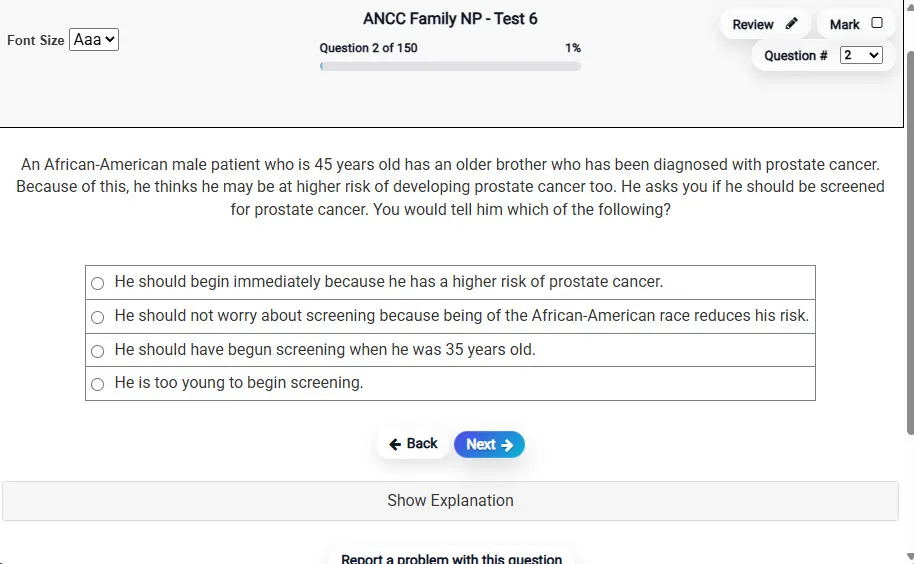
Answering a Question screen – Multiple-choice item view with navigation controls and progress tracker.
Answering a Question Multiple-choice item view with navigation controls and progress tracker.

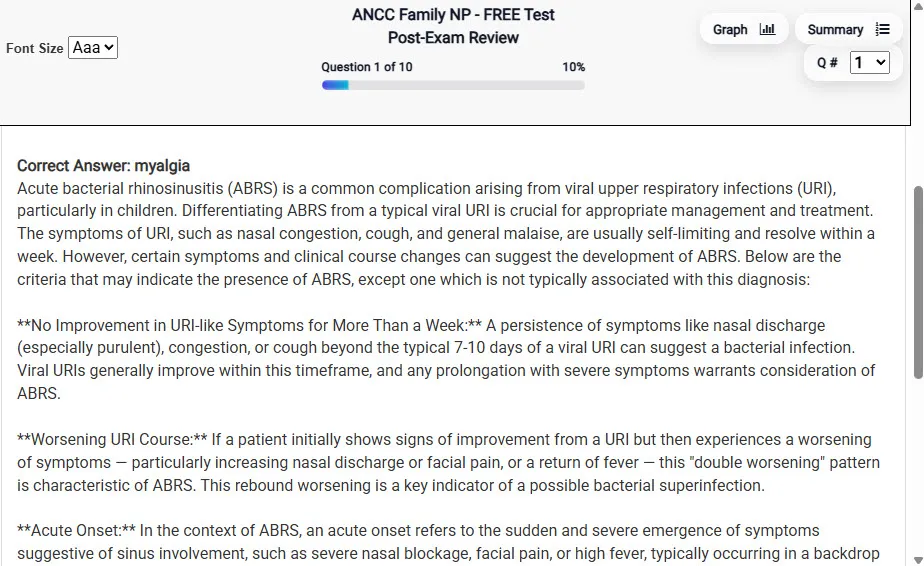
                           Detailed Explanation screen – 
                         Review mode showing chosen answer and rationale and references.
Detailed Explanation Review mode showing chosen answer and rationale and references.

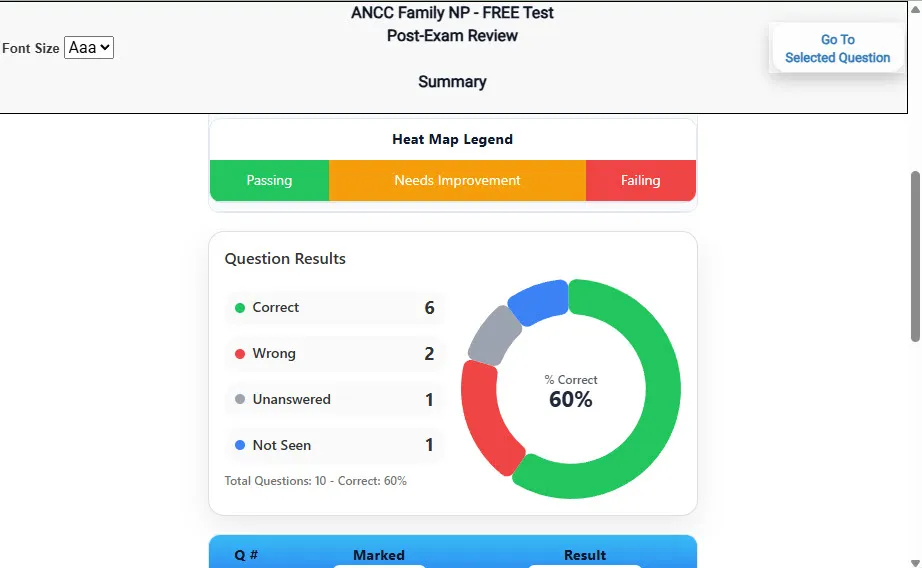
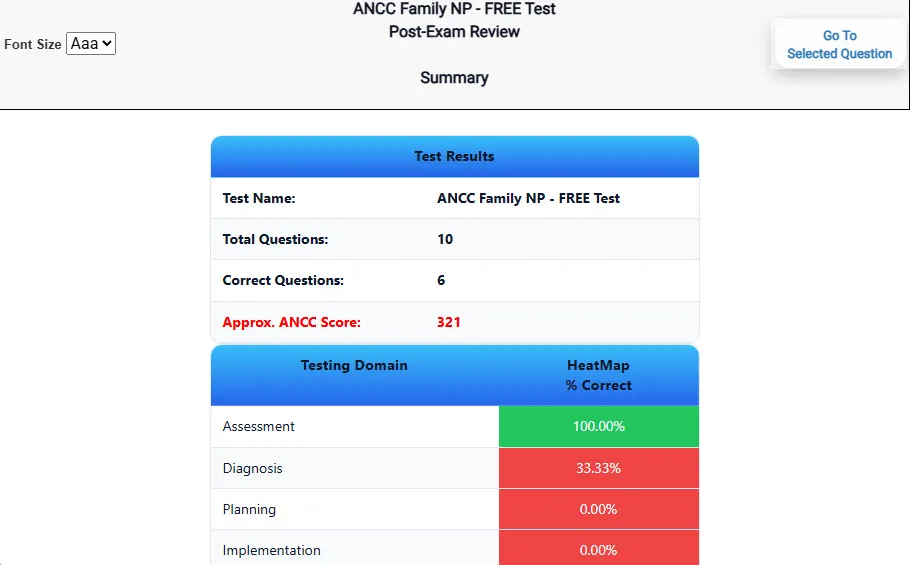
                           Review Summary 1 screen – 
                         Summary with counts for correct/wrong/unanswered and not seen items.
Review Summary 1 Summary with counts for correct/wrong/unanswered and not seen items.

                           Review Summary 2 screen – 
                         Advanced summary with category/domain breakdown and performance insights.
Review Summary 2 Advanced summary with category/domain breakdown and performance insights.

What Each Screen Shows

Answer Question Screen

  • Clean multiple-choice interface with progress bar.
  • Mark for review feature.
  • Matches real test pacing.

Detailed Explanation

  • Correct answer plus rationale.
  • Key concepts and guidelines highlighted.
  • Move between questions to fill knowledge gaps.

Review Summary 1

  • Overall results with total questions and scaled score.
  • Domain heatmap shows strengths and weaknesses.
  • Quick visual feedback on study priorities.

Review Summary 2

  • Chart of correct, wrong, unanswered, not seen.
  • Color-coded results for easy review.
  • Links back to missed items.

Top 10 Reasons to Use Exam Edge for your FTCE Elementary Education K-6 - Social Science Exam Prep

  1. Focused on the FTCE Elementary Education K-6 - Social Science Exam

    Our practice tests are built specifically for the FTCE Elem Ed - Social Science exam — every question mirrors the real topics, format, and difficulty so you're studying exactly what matters.

  2. Real Exam Simulation

    We match the per-question time limits and pressure of the actual FTCE exam, so test day feels familiar and stress-free.

  3. 15 Full Practice Tests & 750 Unique Questions

    You'll have more than enough material to master every FTCE Elem Ed - Social Science concept — no repeats, no fluff.

  4. Lower Cost Than a Retake

    Ordering 5 practice exams costs less than retaking the FTCE Elementary Education K-6 - Social Science exam after a failure. One low fee could save you both time and money.

  5. Flexible Testing

    Need to step away mid-exam? Pick up right where you left off — with your remaining time intact.

  6. Instant Scoring & Feedback

    See your raw score and an estimated FTCE Elementary Education K-6 - Social Science score immediately after finishing each practice test.

  7. Detailed Explanations for Every Question

    Review correct and incorrect answers with clear, step-by-step explanations so you truly understand each topic.

  8. Trusted & Accredited

    We're fully accredited by the Better Business Bureau and uphold the highest standards of trust and transparency.

  9. Web-Based & Always Available

    No software to install. Access your FTCE Elem Ed - Social Science practice exams 24/7 from any computer or mobile device.

  10. Expert Support When You Need It

    Need extra help? Our specialized tutors are highly qualified and ready to support your FTCE exam prep.


Pass the FTCE Elementary Education K-6 - Social Science Exam with Realistic Practice Tests from Exam Edge

Preparing for your upcoming FTCE Elementary Education K-6 - Social Science (602) Certification Exam can feel overwhelming — but the right practice makes all the difference. Exam Edge gives you the tools, structure, and confidence to pass on your first try. Our online practice exams are built to match the real FTCE Elem Ed - Social Science exam in content, format, and difficulty.

  • 📝 15 FTCE Elementary Education K-6 - Social Science Practice Tests: Access 15 full-length exams with 50 questions each, covering every major FTCE Elementary Education K-6 - Social Science topic in depth.
  • Instant Online Access: Start practicing right away — no software, no waiting.
  • 🧠 Step-by-Step Explanations: Understand the reasoning behind every correct answer so you can master FTCE Elem Ed - Social Science exam concepts.
  • 🔄 Retake Each Exam Up to 4 Times: Build knowledge through repetition and track your improvement over time.
  • 🌐 Web-Based & Available 24/7: Study anywhere, anytime, on any device.
  • 🧘 Boost Your Test-Day Confidence: Familiarity with the FTCE format reduces anxiety and helps you perform under pressure.

These FTCE Elementary Education K-6 - Social Science practice exams are designed to simulate the real testing experience by matching question types, timing, and difficulty level. This approach helps you get comfortable not just with the exam content, but also with the testing environment, so you walk into your exam day focused and confident.


Exam Edge FTCE Reviews


Very helpful test, much better than buying any books. Highly recommend

Jessica , Homestead, Florida

I spent $47 and all I was able to get was one sample test. I tried getting another one, but it's charging me.

Lizbeth , clermont , Florida

I bought 5 practice tests for the Engineering and Technology test. I took the actual test today and passed. Just wanted to comment that I thought your tests were a good representation of actual test content and an accurate predictor of my score. Thank you.

Rebecca , FL

I just ordered your test last night, took my Gen. Knowledge exam today and passed it on the first attempt!!! I am sooooo excited!!!! Thank you for this practice!!! I really am glad I found it!!!

Courtney , North Port

For those of you planning to take the FTCE General Knowledge exams, these practice tests are very similar to the actual test with regard to exam content and structure. The practice tests offered a variety of question types in all three content areas, as well as provided varying levels of difficulty ...
Read More
Brittany, Orlando

Great so far.

Miriam , Kissimmee , Florida


FTCE Elementary Education K-6 - Social Science Aliases Test Name

Here is a list of alternative names used for this exam.

  • FTCE Elementary Education K-6 - Social Science
  • FTCE Elementary Education K-6 - Social Science test
  • FTCE Elementary Education K-6 - Social Science Certification Test
  • FTCE Elem Ed - Social Science test
  • FTCE
  • FTCE 602
  • 602 test
  • FTCE Elementary Education K-6 - Social Science (602)
  • Elementary Education K-6 - Social Science certification