This is the content of the pop-over!

Lightning Deal Alert – 12% Off Ends at Midnight!

Strike while the savings are hot! Use promo code FlashSale at checkout for 12% off any Exam Edge test or bundle. Hurry—the clock is ticking!

HESI Medical-Surgical (HesiMedSurg) Practice Tests & Test Prep by Exam Edge


HESI Medical Surgical  product image
(4.5)
Based on 29 Reviews

  • Real Exam Simulation: Timed questions and matching content build comfort for your HESI Medical Surgical test day.
  • Instant, 24/7 Access: Web-based HESI Medical Surgical practice exams with no software needed.
  • Clear Explanations: Step-by-step answers and explanations for your HESI exam to strengthen understanding.
  • Boosted Confidence: Reduces anxiety and improves test-taking skills to ace your HESI Medical Surgical (MedSurg).

Featured on

HESI Medical Surgical Online Practice Test Bundles

BEST VALUE
25 practice tests

$218.75

$998.75

SAVE $780

Only $8.75 per test!

  • 100% Pass Guarantee
  • 25 online practice tests
  • 100 questions per test
  • Bonus: 100 Flash Cards + Study Guide
  • Instant access
  • Detailed Explanations
  • Practice tests never expire
  • Timed, untimed, or study guide mode
MOST POPULAR
10 practice tests

$99.50

$399.50

SAVE $300

Only $9.95 per test!

  • 10 online practice tests
  • 100 questions per test
  • Bonus: 100 Flash Cards + Study Guide
  • Instant access
  • Detailed Explanations
  • Practice tests never expire
  • Timed, untimed, or study guide mode
5 practice tests

$69.75

$199.75

SAVE $130

Only $13.95 per test!

  • 5 online practice tests
  • 100 questions per test
  • Bonus: 100 Flash Cards
  • Instant access
  • Detailed Explanations
  • Practice tests never expire
  • Timed, untimed, or study guide mode
1 practice test

$39.95

  • 1 online practice test
  • 100 questions per test
  • Instant access
  • Detailed Explanations
  • Practice tests never expire
  • Timed, untimed, or study guide mode
Quick Select
Tap to choose a bundle

** All Prices are in US Dollars (USD) **


HESI Medical Surgical (MedSurg) Resources

Jump to the section you need most.

Understanding the exact breakdown of the HESI Medical Surgical test will help you know what to expect and how to most effectively prepare. The HESI Medical Surgical has multiple-choice questions . The exam will be broken down into the sections below:

HESI Medical Surgical Exam Blueprint
Domain Name % Number of
Questions
Diagnostic and patient monitoring function 24-26% 26
Administering/monitoring therapeutic interventions 24-26% 26
Helping role 16-18% 17
Teaching/coaching function 16-18% 17
Effective management of rapidly changing situations 9-11% 10
Monitoring and ensuring quality of health care practices 2-4% 2
Organizational and work-role competencies 2-4% 2

HESI Medical Surgical Study Tips by Domain

  • Trend vital signs and compare to baseline; a red flag is a falling BP with rising HR or RR even if each value is still “within normal limits.”
  • Prioritize oxygenation assessment first (SpO2, breath sounds, work of breathing); a common trap is focusing on pain or BP before airway/respiration when SpO2 is < 92% (or dropping).
  • Interpret labs with clinical context and notify promptly for criticals; a priority rule is K+ < 3.0 or > 6.0 mEq/L with ECG changes — treat/alert before routine tasks.
  • Monitor intake/output and urine characteristics; a red flag is urine output < 30 mL/hr for 2 consecutive hours (possible hypovolemia or AKI) requiring provider notification and reassessment.
  • Use focused neuro checks (LOC, pupils, strength) and recognize subtle deterioration; a common trap is missing early increased ICP signs such as restlessness or decreased LOC before BP/HR changes.
  • Validate abnormal findings before acting (recheck, reposition, check equipment); a practical cue is to confirm a “low” SpO2 by assessing probe placement/perfusion and comparing to patient appearance before escalating.
  • Verify the “rights” of medication administration and two identifiers every time; red flag: giving a med before confirming allergies and last dose time.
  • High-alert meds (e.g., insulin, heparin, opioids) require independent double-checks and weight-based calculations when ordered; common trap: confusing units (U) or mixing up mg/kg with total mg.
  • IV therapy: assess site patency and compatibility before piggybacking; priority rule: stop the infusion for infiltration/extravasation signs (coolness, swelling, pain) and follow protocol.
  • Oxygen and respiratory therapies: titrate to ordered SpO2 goals and reassess after initiation; red flag: COPD patient receiving high-flow O2 without monitoring for CO2 retention.
  • Blood transfusions: obtain baseline vitals, use filtered tubing with normal saline only, and stay with the patient initially; priority rule: stop transfusion and keep IV open with NS if reaction suspected (fever, back pain, dyspnea).
  • Pain management interventions require reassessment within the expected onset window; common trap: administering additional opioid before evaluating sedation level and respiratory rate (hold and notify if RR is low or patient is difficult to arouse).
  • Use therapeutic communication first (open-ended questions, reflection) and avoid “why” questions — red flag: giving advice, false reassurance, or changing the subject.
  • Prioritize patient autonomy and informed choices; common trap: family demands driving decisions when the patient has decision-making capacity.
  • Set and maintain professional boundaries — red flag: accepting expensive gifts, sharing personal problems, or making promises you can’t keep.
  • Advocate using SBAR and chain of command when safety is at risk; priority rule: escalate immediately for suspected abuse/neglect or threats of self-harm.
  • Support coping with illness by identifying the patient’s main concern and strengths; common trap: focusing on teaching/problem-solving before acknowledging emotions.
  • Collaborate with social work/case management for psychosocial and resource needs; red flag: discharging without confirming transportation, home support, or ability to obtain medications.
  • Use teach-back for all key instructions (meds, wound care, devices); red flag: the patient says “yes” but cannot restate steps in their own words.
  • Prioritize safety-critical teaching before discharge (new anticoagulant, insulin, oxygen, ostomy); common trap: overloading with nonessential details while missing when to call the provider.
  • Adapt education to literacy, language, and sensory needs (plain language, interpreter, large print); red flag: using family as interpreter for consent or complex teaching.
  • Provide medication teaching with high-alert focus (name, purpose, timing, major adverse effects); priority rule: include hold parameters and urgent symptoms (e.g., bleeding on anticoagulants, hypoglycemia on insulin).
  • Teach device and procedure skills with return-demonstration (incentive spirometer, inhaler, JP drain, glucometer); common trap: accepting verbal understanding without observing technique.
  • Document teaching clearly (content, method, learner response, barriers, follow-up); red flag: charting “patient verbalizes understanding” with no evidence of teach-back or performance.
  • In suspected shock, prioritize ABCs and intervene early with oxygen, two large-bore IVs, and rapid reassessment—red flag: new confusion, cool clammy skin, and dropping urine output (<30 mL/hr).
  • For acute respiratory distress, sit the patient upright, apply appropriate oxygen delivery, and call Rapid Response when work of breathing increases—common trap: waiting for the next set of vitals when SpO2 stays <90% despite oxygen.
  • With chest pain/possible MI, obtain a 12-lead ECG within 10 minutes and give aspirin if not contraindicated—contraindication cue: allergy or active GI bleeding.
  • Recognize sepsis early and initiate bundle actions promptly (cultures, broad-spectrum antibiotics, fluids) per facility protocol—priority rule: do not delay antibiotics for imaging or noncritical labs.
  • For acute neuro change, perform a focused neuro assessment (LOC, pupils, speech, motor) and treat hypoglycemia immediately if glucose is low—red flag: sudden unilateral weakness or new aphasia.
  • When a patient deteriorates, delegate tasks (vitals, IV access, meds, documentation) and communicate using SBAR—common trap: trying to do everything alone instead of calling for help early.
  • Verify “rights” plus allergies, indication, and compatibility before meds or blood products; red flag: skipping an independent double-check for high-alert meds (insulin, heparin, opioids) is a common HESI safety trap.
  • Use infection-prevention bundles (hand hygiene, aseptic technique, device care) and remove lines/foleys ASAP; priority rule: any fever, redness, drainage, or unexpected pain at a site requires prompt assessment and notification.
  • Trend vital signs, I&O, labs, and mental status rather than reacting to a single value; red flag: acute change from baseline (new confusion, oliguria, SpO2 drop) signals deterioration even if values seem “near normal.”
  • Follow facility policy for falls/pressure injury prevention (risk tools, rounding, off-loading, turns); common trap: documenting interventions without actually implementing or reassessing after a change in condition.
  • Ensure correct patient, procedure, and site with time-out and specimen labeling at bedside; red flag: unlabeled or pre-labeled specimens are never acceptable—stop and relabel per policy.
  • Escalate and document variances, sentinel events, and near-misses using chain of command; priority rule: patient safety comes before hierarchy—address unsafe orders or practices immediately.
  • Prioritize with ABCs, safety, then MASLOW — red flag: don’t delay airway/breathing support to complete routine assessments or paperwork.
  • Use SBAR for all escalations and handoffs; common trap: calling a provider without current vitals, relevant labs, and a clear recommendation.
  • Delegate by task and predictability (RN assesses/teaches/unstable; UAP does routine ADLs/vitals); red flag: delegating first-dose meds, clinical judgment, or unstable patient care.
  • Manage time by clustering care and setting “must-do-now” vs “can-wait”; priority rule: follow up on abnormal results (e.g., critical K+, new chest pain) before routine meds.
  • Maintain chain of command and document objectively (facts, time, notifications); common trap: charting blame/opinions or altering documentation after the fact.
  • Apply infection-control and resource stewardship consistently; red flag: breaking sterile technique or ignoring isolation/PPE requirements because the unit is busy.


Built to Fit Into Your Busy Life

Everything you need to prepare with confidence—without wasting a minute.

Three Study Modes

Timed, No Time Limit, or Explanation mode.

Actionable Analytics

Heatmaps and scaled scores highlight weak areas.

High-Yield Rationales

Concise explanations emphasize key concepts.

Realistic Interface

Matches the feel of the actual exam environment.

Accessible by Design

Clean layout reduces cognitive load.

Anytime, Anywhere

Web-based access 24/7 on any device.
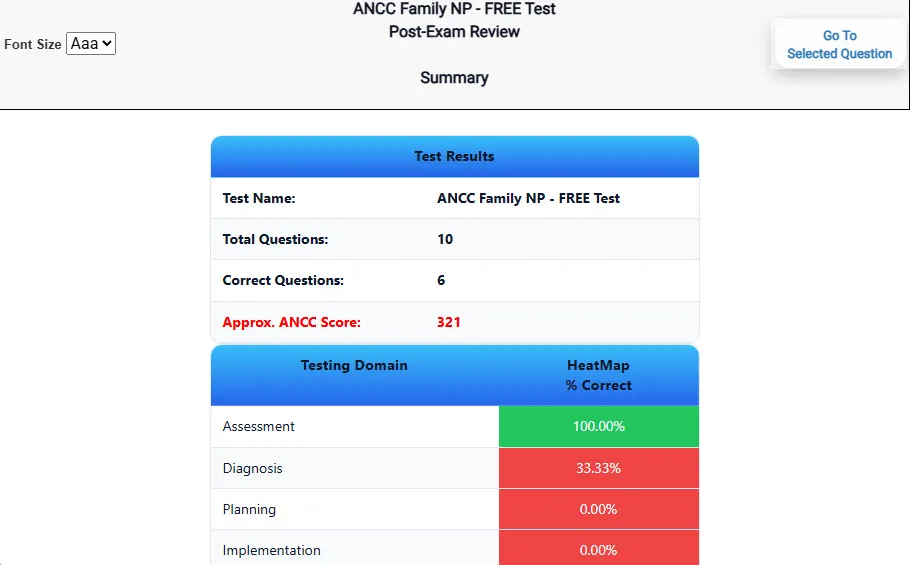
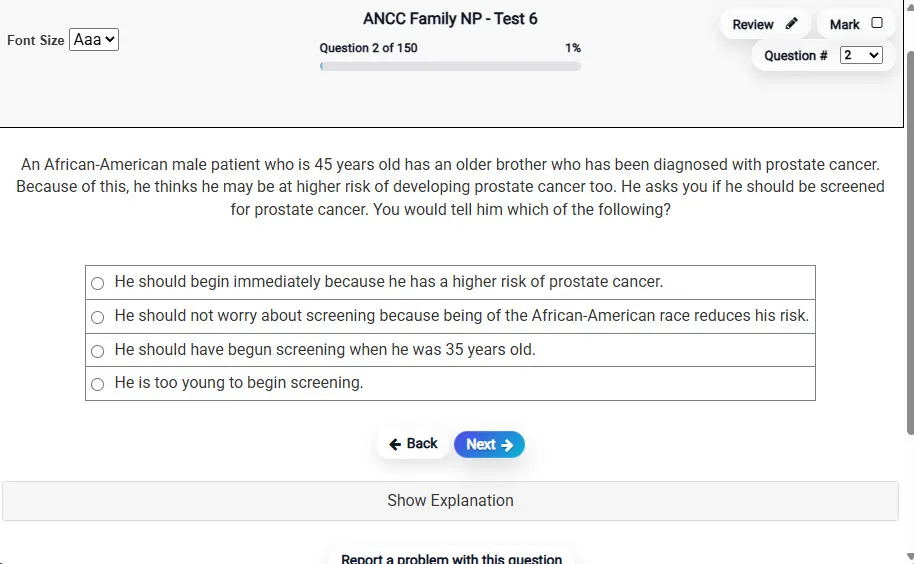
Answering a Question screen – Multiple-choice item view with navigation controls and progress tracker.
Answering a Question Multiple-choice item view with navigation controls and progress tracker.

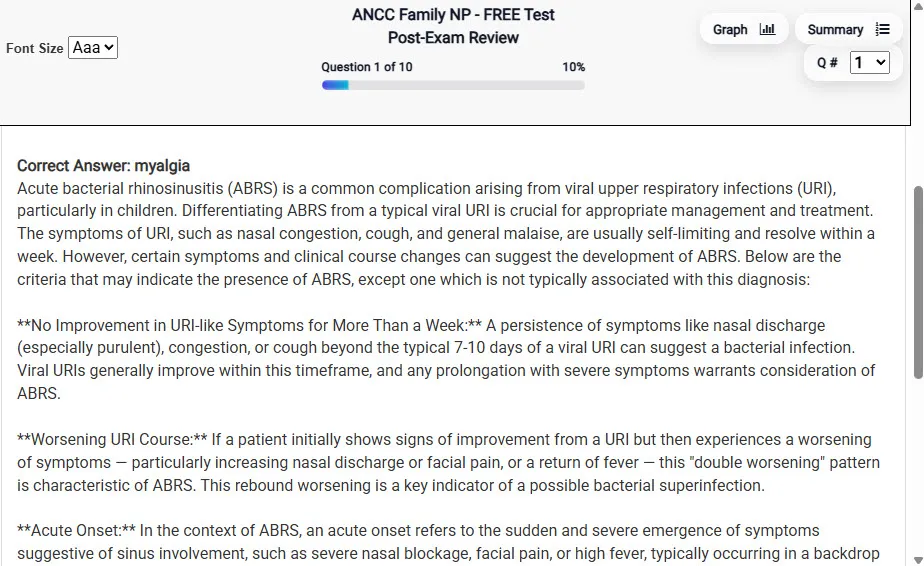
                           Detailed Explanation screen – 
                         Review mode showing chosen answer and rationale and references.
Detailed Explanation Review mode showing chosen answer and rationale and references.

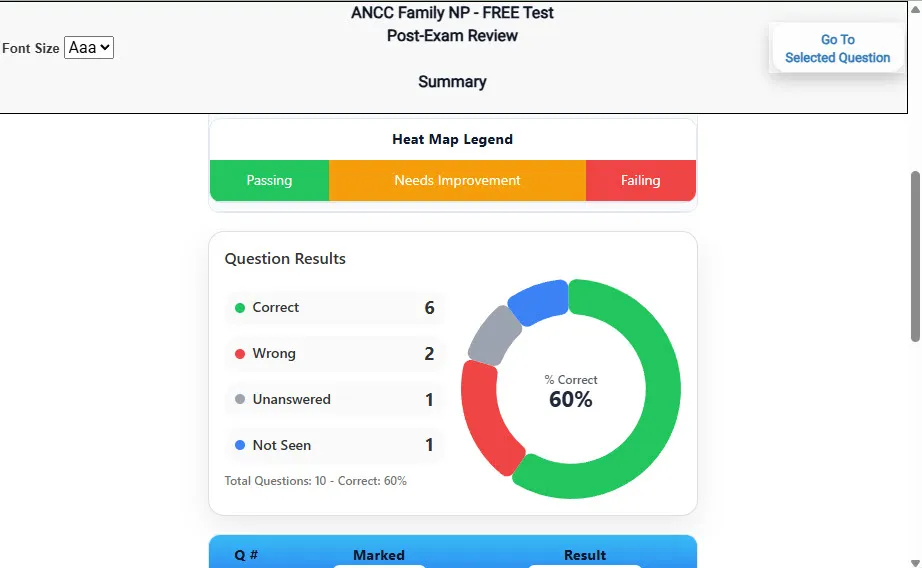
                           Review Summary 1 screen – 
                         Summary with counts for correct/wrong/unanswered and not seen items.
Review Summary 1 Summary with counts for correct/wrong/unanswered and not seen items.

                           Review Summary 2 screen – 
                         Advanced summary with category/domain breakdown and performance insights.
Review Summary 2 Advanced summary with category/domain breakdown and performance insights.

What Each Screen Shows

Answer Question Screen

  • Clean multiple-choice interface with progress bar.
  • Mark for review feature.
  • Matches real test pacing.

Detailed Explanation

  • Correct answer plus rationale.
  • Key concepts and guidelines highlighted.
  • Move between questions to fill knowledge gaps.

Review Summary 1

  • Overall results with total questions and scaled score.
  • Domain heatmap shows strengths and weaknesses.
  • Quick visual feedback on study priorities.

Review Summary 2

  • Chart of correct, wrong, unanswered, not seen.
  • Color-coded results for easy review.
  • Links back to missed items.

Top 10 Reasons to Use Exam Edge for your HESI Medical Surgical Exam Prep

  1. Focused on the HESI Medical Surgical Exam

    Our practice tests are built specifically for the HESI Medical Surgical exam — every question mirrors the real topics, format, and difficulty so you're studying exactly what matters.

  2. Real Exam Simulation

    We match the per-question time limits and pressure of the actual HESI exam, so test day feels familiar and stress-free.

  3. 25 Full Practice Tests & 2,500 Unique Questions

    You'll have more than enough material to master every HESI Medical Surgical concept — no repeats, no fluff.

  4. Lower Cost Than a Retake

    Ordering 5 practice exams costs less than retaking the HESI Medical Surgical exam after a failure. One low fee could save you both time and money.

  5. Flexible Testing

    Need to step away mid-exam? Pick up right where you left off — with your remaining time intact.

  6. Instant Scoring & Feedback

    See your raw score and an estimated HESI Medical Surgical score immediately after finishing each practice test.

  7. Detailed Explanations for Every Question

    Review correct and incorrect answers with clear, step-by-step explanations so you truly understand each topic.

  8. Trusted & Accredited

    We're fully accredited by the Better Business Bureau and uphold the highest standards of trust and transparency.

  9. Web-Based & Always Available

    No software to install. Access your HESI Medical Surgical practice exams 24/7 from any computer or mobile device.

  10. Expert Support When You Need It

    Need extra help? Our specialized tutors are highly qualified and ready to support your HESI exam prep.


Pass the HESI Medical Surgical Exam with Realistic Practice Tests from Exam Edge

Preparing for your upcoming HESI Medical Surgical (MedSurg) Certification Exam can feel overwhelming — but the right practice makes all the difference. Exam Edge gives you the tools, structure, and confidence to pass on your first try. Our online practice exams are built to match the real HESI Medical Surgical exam in content, format, and difficulty.

  • 📝 25 HESI Medical Surgical Practice Tests: Access 25 full-length exams with 100 questions each, covering every major HESI Medical Surgical topic in depth.
  • Instant Online Access: Start practicing right away — no software, no waiting.
  • 🧠 Step-by-Step Explanations: Understand the reasoning behind every correct answer so you can master HESI Medical Surgical exam concepts.
  • 🔄 Retake Each Exam Up to 4 Times: Build knowledge through repetition and track your improvement over time.
  • 🌐 Web-Based & Available 24/7: Study anywhere, anytime, on any device.
  • 🧘 Boost Your Test-Day Confidence: Familiarity with the HESI format reduces anxiety and helps you perform under pressure.

These HESI Medical Surgical practice exams are designed to simulate the real testing experience by matching question types, timing, and difficulty level. This approach helps you get comfortable not just with the exam content, but also with the testing environment, so you walk into your exam day focused and confident.


Exam Edge HESI Reviews


I just took my Hesi exit PN today and got a Hesi score of 1205 and a conversion score of 99.99%. Thanks for the help. Doing all those tests helped so much. Not because I saw the same questions but because I learned so much from the answer reasoning section. Hope to fly through my boards in a couple ...
Read More
Sharon, Texas

I recently had to test out of my school with an 850 on the Hesi PN, so I purchased the exams from you guys, about 5 to 7 exams, and passed the exit HesiPn with a 988! First time around! Then I purchased the NclexPN exam tests from you guys and I passed my nclex the first time around! These tests rea ...
Read More
Welsh, NC

I want to thank you. The tests are really helpful. I took them three times and after using your exams, I finally passed. The tests helped me especially in the math section, in which I got a 90.

DIANA , Texas

I can't believe this website doesn't have a high following status. I bought 40 practice questions, and I did 20 practice questions and took my Hesi exit. I scored 1070. I completed all 40 practice exams and passed my boards for the first time. Exam Edge introduced me to a bunch of topics and boosted ...
Read More
Juliet M., Tarpon Springs, Florida


HESI Medical Surgical Aliases Test Name

Here is a list of alternative names used for this exam.

  • HESI Medical Surgical
  • HESI Medical Surgical test
  • HESI Medical Surgical Certification Test
  • HESI
  • HESI MedSurg
  • MedSurg test
  • HESI Medical Surgical (MedSurg)
  • Medical Surgical certification