This is the content of the pop-over!

NES ESOL (507) Practice Tests & Test Prep by Exam Edge


NES English to Speakers of Other Languages  product image
(5.0)
Based on 22 Reviews

  • Real Exam Simulation: Timed questions and matching content build comfort for your NES ESOL test day.
  • Instant, 24/7 Access: Web-based NES English to Speakers of Other Languages practice exams with no software needed.
  • Clear Explanations: Step-by-step answers and explanations for your NES exam to strengthen understanding.
  • Boosted Confidence: Reduces anxiety and improves test-taking skills to ace your NES English to Speakers of Other Languages (507).

Featured on

NES English to Speakers of Other Languages Online Practice Test Bundles

BEST VALUE
10 practice tests

$99.50

$399.50

SAVE $300

Only $9.95 per test!

  • 100% Pass Guarantee
  • 10 online practice tests
  • 100 questions per test
  • Bonus: 100 Flash Cards + Study Guide
  • Instant access
  • Detailed Explanations
  • Practice tests never expire
  • Timed, untimed, or study guide mode
5 practice tests

$69.75

$199.75

SAVE $130

Only $13.95 per test!

  • 5 online practice tests
  • 100 questions per test
  • Bonus: 100 Flash Cards + Study Guide
  • Instant access
  • Detailed Explanations
  • Practice tests never expire
  • Timed, untimed, or study guide mode
1 practice test

$39.95

  • 1 online practice test
  • 100 questions per test
  • Instant access
  • Detailed Explanations
  • Practice tests never expire
  • Timed, untimed, or study guide mode
Quick Select
Tap to choose a bundle

** All Prices are in US Dollars (USD) **


NES ESOL (507) Resources

Jump to the section you need most.

Understanding the exact breakdown of the NES English to Speakers of Other Languages test will help you know what to expect and how to most effectively prepare. The NES English to Speakers of Other Languages has multiple-choice questions . The exam will be broken down into the sections below:

NES English to Speakers of Other Languages Exam Blueprint
Domain Name % Number of
Questions
Foundations of Language and Language Acquisition 20% 20
Foundations of ESOL Instruction 40% 40
Instruction and Assessment of English Language Learners 40% 40

NES English to Speakers of Other Languages Study Tips by Domain

  • Distinguish core linguistic levels (phonology, morphology, syntax, semantics, pragmatics) and map each to an instructional implication; red flag: treating a pragmatics breakdown (e.g., indirect requests) as a grammar deficit.
  • Analyze English phonology features that affect intelligibility (stress, rhythm, vowel reduction, connected speech) and prioritize high-impact targets; common trap: overcorrecting accent features that don’t impede comprehension.
  • Apply morphology knowledge (inflectional vs. derivational, bound vs. free morphemes) to vocabulary and decoding support; priority rule: teach productive patterns (e.g., -ed, -s, un-, -ment) before low-frequency exceptions.
  • Use syntax concepts (word order, clauses, agreement, subordination) to predict learner errors and scaffold complexity; red flag: expecting accurate tense/aspect marking in advanced sentence structures before clauses are stable.
  • Compare major language acquisition theories (behaviorist, innatist, interactionist, sociocultural) and match classroom practices accordingly; common trap: assuming output practice alone builds proficiency without comprehensible input and feedback.
  • Interpret developmental sequences and learner variability (interlanguage, fossilization, transfer, affective factors) when planning support; threshold cue: persistent error patterns across contexts may signal fossilization and need targeted noticing plus meaningful practice.
  • Plan instruction using an explicit language objective alongside the content objective; red flag: lessons that only name a topic (e.g., “weather”) without specifying the language function or form students must use.
  • Differentiate by proficiency level with targeted supports (sentence frames, word banks, modeled responses) and gradually remove them; common trap: giving the same graphic organizer to all learners without adjusting the linguistic load.
  • Teach vocabulary in depth (meaning, form, pronunciation, collocations) and recycle it across days; priority rule: focus first on high-utility Tier 2 words before low-frequency technical terms unless the unit requires them.
  • Balance comprehensible input with structured output opportunities (turn-and-talk, information gaps, guided writing); red flag: students stay silent because tasks require full accuracy rather than intelligible communication.
  • Use scaffolds aligned to skill and modality (listening/reading support differs from speaking/writing support); contraindication: over-scaffolding that replaces student production (e.g., teacher paraphrases everything and students never process).
  • Provide feedback that targets one or two language features at a time and is tied to a model; common trap: correcting every error, which reduces fluency and risks fossilizing avoidance strategies.
  • Align language objectives with content objectives and WIDA/ELP-style proficiency descriptors; red flag: lessons list only content standards with no explicit language function (e.g., justify, compare) or language forms.
  • Select sheltered strategies (modeling, visuals, sentence frames, structured interaction) based on proficiency level; common trap: giving the same scaffold to all students rather than fading supports as proficiency increases.
  • Use formative checks (quickwrites, exit tickets, oral retells) that separate language demand from content understanding; priority rule: if the task is language-heavy, provide an alternative way to show content knowledge (e.g., labeled diagram) when appropriate.
  • Design assessments with clear rubrics for language domains (listening, speaking, reading, writing); red flag: grading speaking/writing solely for grammar accuracy instead of communicative effectiveness tied to the objective.
  • Interpret ELL assessment data (screening, placement, progress monitoring, accommodations) to make instructional decisions; common trap: confusing accommodations (access) with modifications (changing expectations).
  • Provide feedback that is timely, specific, and targets high-leverage errors (those that impede meaning); threshold cue: focus correction on 1–2 recurring patterns per task rather than marking every error.


Built to Fit Into Your Busy Life

Everything you need to prepare with confidence—without wasting a minute.

Three Study Modes

Timed, No Time Limit, or Explanation mode.

Actionable Analytics

Heatmaps and scaled scores highlight weak areas.

High-Yield Rationales

Concise explanations emphasize key concepts.

Realistic Interface

Matches the feel of the actual exam environment.

Accessible by Design

Clean layout reduces cognitive load.

Anytime, Anywhere

Web-based access 24/7 on any device.
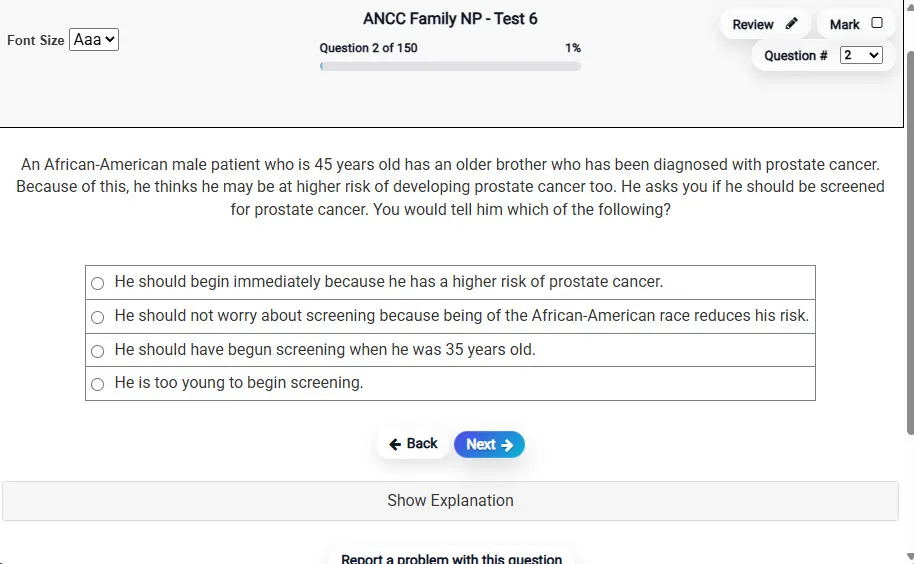
Answering a Question screen – Multiple-choice item view with navigation controls and progress tracker.
Answering a Question Multiple-choice item view with navigation controls and progress tracker.

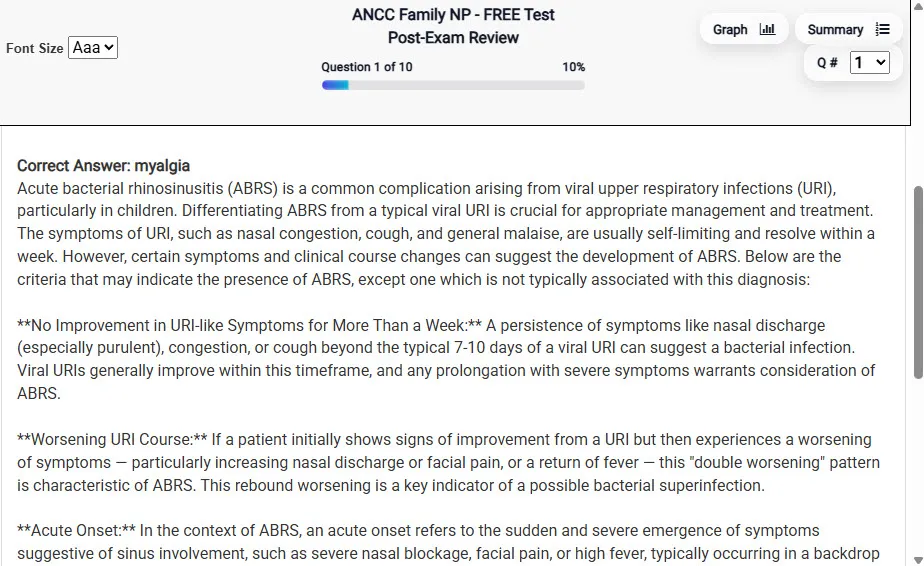
                           Detailed Explanation screen – 
                         Review mode showing chosen answer and rationale and references.
Detailed Explanation Review mode showing chosen answer and rationale and references.

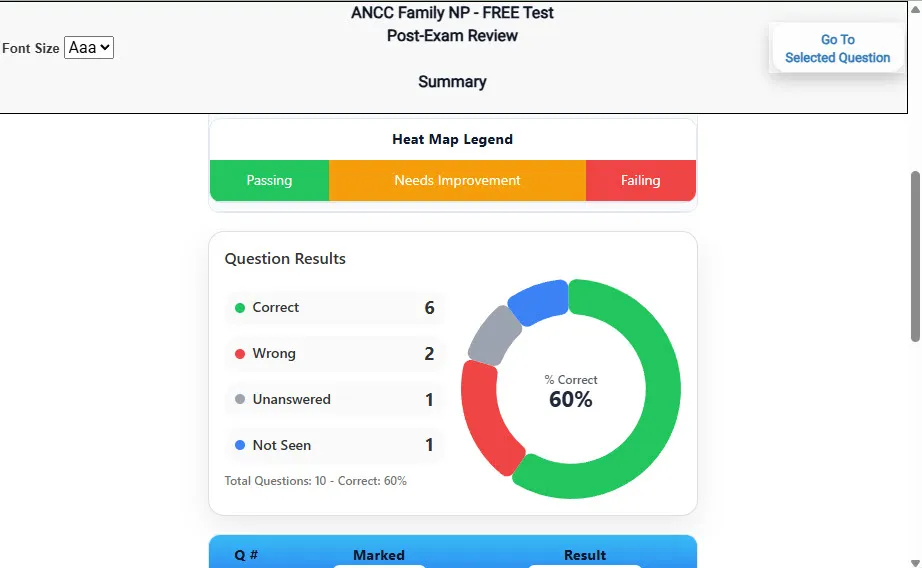
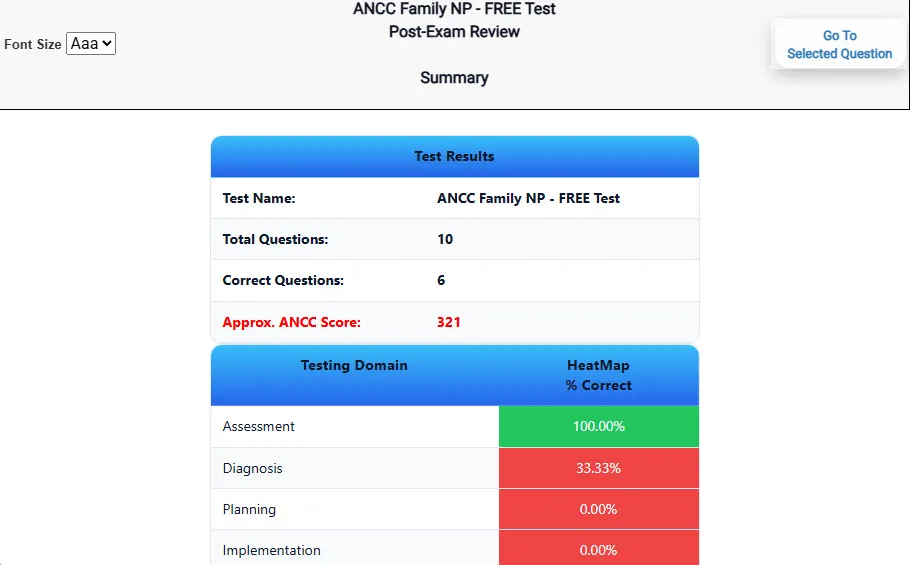
                           Review Summary 1 screen – 
                         Summary with counts for correct/wrong/unanswered and not seen items.
Review Summary 1 Summary with counts for correct/wrong/unanswered and not seen items.

                           Review Summary 2 screen – 
                         Advanced summary with category/domain breakdown and performance insights.
Review Summary 2 Advanced summary with category/domain breakdown and performance insights.

What Each Screen Shows

Answer Question Screen

  • Clean multiple-choice interface with progress bar.
  • Mark for review feature.
  • Matches real test pacing.

Detailed Explanation

  • Correct answer plus rationale.
  • Key concepts and guidelines highlighted.
  • Move between questions to fill knowledge gaps.

Review Summary 1

  • Overall results with total questions and scaled score.
  • Domain heatmap shows strengths and weaknesses.
  • Quick visual feedback on study priorities.

Review Summary 2

  • Chart of correct, wrong, unanswered, not seen.
  • Color-coded results for easy review.
  • Links back to missed items.

Top 10 Reasons to Use Exam Edge for your NES English to Speakers of Other Languages Exam Prep

  1. Focused on the NES English to Speakers of Other Languages Exam

    Our practice tests are built specifically for the NES ESOL exam — every question mirrors the real topics, format, and difficulty so you're studying exactly what matters.

  2. Real Exam Simulation

    We match the per-question time limits and pressure of the actual NES exam, so test day feels familiar and stress-free.

  3. 10 Full Practice Tests & 1,000 Unique Questions

    You'll have more than enough material to master every NES ESOL concept — no repeats, no fluff.

  4. Lower Cost Than a Retake

    Ordering 5 practice exams costs less than retaking the NES English to Speakers of Other Languages exam after a failure. One low fee could save you both time and money.

  5. Flexible Testing

    Need to step away mid-exam? Pick up right where you left off — with your remaining time intact.

  6. Instant Scoring & Feedback

    See your raw score and an estimated NES English to Speakers of Other Languages score immediately after finishing each practice test.

  7. Detailed Explanations for Every Question

    Review correct and incorrect answers with clear, step-by-step explanations so you truly understand each topic.

  8. Trusted & Accredited

    We're fully accredited by the Better Business Bureau and uphold the highest standards of trust and transparency.

  9. Web-Based & Always Available

    No software to install. Access your NES ESOL practice exams 24/7 from any computer or mobile device.

  10. Expert Support When You Need It

    Need extra help? Our specialized tutors are highly qualified and ready to support your NES exam prep.


Pass the NES English to Speakers of Other Languages Exam with Realistic Practice Tests from Exam Edge

Preparing for your upcoming NES English to Speakers of Other Languages (507) Certification Exam can feel overwhelming — but the right practice makes all the difference. Exam Edge gives you the tools, structure, and confidence to pass on your first try. Our online practice exams are built to match the real NES ESOL exam in content, format, and difficulty.

  • 📝 10 NES English to Speakers of Other Languages Practice Tests: Access 10 full-length exams with 100 questions each, covering every major NES English to Speakers of Other Languages topic in depth.
  • Instant Online Access: Start practicing right away — no software, no waiting.
  • 🧠 Step-by-Step Explanations: Understand the reasoning behind every correct answer so you can master NES ESOL exam concepts.
  • 🔄 Retake Each Exam Up to 4 Times: Build knowledge through repetition and track your improvement over time.
  • 🌐 Web-Based & Available 24/7: Study anywhere, anytime, on any device.
  • 🧘 Boost Your Test-Day Confidence: Familiarity with the NES format reduces anxiety and helps you perform under pressure.

These NES English to Speakers of Other Languages practice exams are designed to simulate the real testing experience by matching question types, timing, and difficulty level. This approach helps you get comfortable not just with the exam content, but also with the testing environment, so you walk into your exam day focused and confident.


Exam Edge NES Reviews


Thank you so much. I passed my NES Special Education K–12 test the first time thanks to these practice tests. I will recommend this site to anyone who needs to study for a test. Thank you again!!

Melissa, Phoenix Arizona

I'm glad I found your website. Your practice tests helped immensely! The ability to review answers while taking the test was a great beginning feature. I also liked having the option to take it like a "real" test - being timed and given the results only at the end. The timed component ...
Read More
Heidi, Washington

Thanks - I took the NES History Exam today and scored 262 - 42 pts above passing :)  I could not have done it without your exams!

Dale , Scottsdale, AZ

I passed my test yesterday! Your practice tests made all the difference. Your sample tests helped me prepare for and pass both the NES Elementary Subtest 1 and 2. I feel that your tests helped me spotlight the areas where I needed reinforcement, and the explanations included with the questions were ...
Read More
Penny, Washington State.

Exam Edge is awesome.I bought and used the NES Middle School Science Test series from Exam edge and I scored 271 on the test. Thanks a lot. 

Manish ,

I like to learn using your tests!!!!!

Oksana , Tacoma, Washington


NES English to Speakers of Other Languages Aliases Test Name

Here is a list of alternative names used for this exam.

  • NES English to Speakers of Other Languages
  • NES English to Speakers of Other Languages test
  • NES English to Speakers of Other Languages Certification Test
  • NES ESOL test
  • NES
  • NES 507
  • 507 test
  • NES English to Speakers of Other Languages (507)
  • English to Speakers of Other Languages certification