This is the content of the pop-over!

GACE Chemistry (712 - 214/215/216/217) Practice Tests & Test Prep by Exam Edge


GACE Chemistry (6-12) product image
(5.0)
Based on 29 Reviews

  • Real Exam Simulation: Timed questions and matching content build comfort for your GACE Chemistry (6-12) test day.
  • Instant, 24/7 Access: Web-based GACE Chemistry (6-12) practice exams with no software needed.
  • Clear Explanations: Step-by-step answers and explanations for your GACE exam to strengthen understanding.
  • Boosted Confidence: Reduces anxiety and improves test-taking skills to ace your GACE Chemistry (6-12) (712).

Featured on

GACE Chemistry (6-12) Online Practice Test Bundles

BEST VALUE
15 practice tests

$149.25

$449.25

SAVE $300

Only $9.95 per test!

  • 100% Pass Guarantee
  • 15 online practice tests
  • 100 questions per test
  • Bonus: 100 Flash Cards + Study Guide
  • Instant access
  • Detailed Explanations
  • Practice tests never expire
  • Timed, untimed, or study guide mode
MOST POPULAR
10 practice tests

$99.50

$299.50

SAVE $200

Only $9.95 per test!

  • 10 online practice tests
  • 100 questions per test
  • Bonus: 100 Flash Cards + Study Guide
  • Instant access
  • Detailed Explanations
  • Practice tests never expire
  • Timed, untimed, or study guide mode
5 practice tests

$59.75

$149.75

SAVE $90

Only $11.95 per test!

  • 5 online practice tests
  • 100 questions per test
  • Bonus: 100 Flash Cards
  • Instant access
  • Detailed Explanations
  • Practice tests never expire
  • Timed, untimed, or study guide mode
1 practice test

$29.95

  • 1 online practice test
  • 100 questions per test
  • Instant access
  • Detailed Explanations
  • Practice tests never expire
  • Timed, untimed, or study guide mode
Quick Select
Tap to choose a bundle

** All Prices are in US Dollars (USD) **


GACE Chemistry (6-12) (712) Shortcuts


Understanding the exact breakdown of the GACE Chemistry (6-12) test will help you know what to expect and how to most effectively prepare. The GACE Chemistry (6-12) has 100 multiple-choice questions . The exam will be broken down into the sections below:

GACE Chemistry (6-12) Exam Blueprint
Domain Name % Number of
Questions
Atomic Structures and Properties 20% 20
Multi-Atomic Structures and Properties 30% 30
Chemical Reactions 30% 30
Energy Changes 20% 20

GACE Chemistry (6-12) Study Tips by Domain

  • Interpret electron configurations and orbital diagrams using Aufbau, Pauli, and Hund; red flag: writing 3d before 4s is a common trap, but remember 4s fills before 3d and is typically lost first in transition-metal cations.
  • Use periodic trends (atomic radius, ionization energy, electronegativity, electron affinity) with clear direction rules; priority cue: exceptions like Be/B and N/O often break the “smooth increase” in first ionization energy.
  • Determine isotopic composition, average atomic mass, and nuclear notation (A, Z, charge); threshold cue: if the calculated average mass is outside the range of listed isotope masses, recheck percent-to-decimal conversions.
  • Connect photon energy, frequency, and wavelength (E = h? = hc/?) and interpret line spectra; red flag: longer wavelength means lower energy, and transitions down to lower n emit photons (not absorb).
  • Apply Coulomb’s law and effective nuclear charge (Zeff) to explain attraction and shielding; common trap: assuming higher nuclear charge always means smaller radius—shielding and added shells can dominate down a group.
  • Predict ion formation and relative stability using valence electrons and noble-gas configurations; contraindication cue: don’t force octets for H and He (duet rule) and recognize common stable ions like Al3+, O2-, and halide 1-.
  • Use VSEPR with electron domains first (bonding + lone pairs) to get the correct molecular shape; red flag: using the number of atoms instead of electron domains (e.g., NH3 is trigonal pyramidal, not trigonal planar).
  • Determine polarity by combining bond polarity with molecular geometry; common trap: assuming “polar bonds = polar molecule” even when symmetry cancels dipoles (e.g., CO2, CCl4).
  • Apply hybridization from the steric number (2?sp, 3?sp2, 4?sp3, 5?sp3d, 6?sp3d2); priority rule: count electron groups around the central atom, not “double bonds as two.”
  • Rank intermolecular forces correctly (ionic/ion-dipole > H-bond > dipole-dipole > London); threshold cue: H-bonding requires H directly bonded to N, O, or F (no H-bonding in HCl).
  • Use formal charge to choose the best Lewis structure (minimize charge and place negative charge on more electronegative atoms); contraindication: structures with large formal charges are unlikely unless required by the formula.
  • Connect structure to properties: stronger IMFs and higher molar mass generally raise boiling point/viscosity, while branching lowers boiling point; common trap: comparing boiling points using molar mass alone without checking H-bonding or symmetry.
  • Balance equations by treating polyatomic ions that stay intact (e.g., SO4) as units, and use the red flag “atoms don’t match on both sides” to catch missed coefficients rather than changing subscripts.
  • In aqueous reactions, write complete ionic then net ionic equations and cancel only true spectator ions; common trap: canceling weak electrolytes (e.g., CH3COOH) that should remain mostly molecular.
  • Predict reaction types with a priority rule: for double replacement, proceed only if a precipitate, gas, or weak electrolyte (like H2O) forms; red flag: all products remain soluble strong electrolytes, meaning “no reaction.”
  • Use solubility rules with thresholds: most nitrates and alkali metal salts are soluble, while Ag+, Pb2+, and Hg2^2+ halides are usually insoluble; common trap: forgetting exceptions like AgCl(s) and BaSO4(s).
  • For redox, assign oxidation numbers first and ensure electrons lost = electrons gained; red flag: the same element’s oxidation state changes in opposite directions without recognizing disproportionation.
  • When applying kinetics concepts to reactions, prioritize factors that change collision effectiveness (concentration, temperature, catalysts, surface area) and avoid the trap “catalyst increases yield”—it lowers activation energy but does not change equilibrium position.
  • Use q = m·c·?T for calorimetry and treat q as negative for the substance that cools; red flag: mixing up the sign or using °C instead of K for ?T (?T is the same in both, but absolute T must be K).
  • Apply Hess’s law by adding equations and scaling ?H accordingly; common trap: forgetting to multiply ?H when you multiply a reaction or forgetting to reverse the sign when you flip a reaction.
  • Compute reaction enthalpy from bond energies as ?H ˜ S(bonds broken) - S(bonds formed); priority rule: include only bonds actually changed, not spectator ions or unchanged polyatomic groups.
  • Link spontaneity to ?G = ?H - T?S and remember T must be in Kelvin; threshold cue: at equilibrium ?G = 0, and a negative ?G at given T means the forward direction is thermodynamically favored.
  • Interpret heating/cooling curves by spotting phase-change plateaus where temperature stays constant while energy changes; red flag: using q = m·c·?T during a plateau instead of q = n·?Hfus or n·?Hvap.
  • For electrochemistry, use ?G° = -nF E° and relate to K via ?G° = -RT ln K; common trap: mismatching n with electrons transferred or using the wrong sign for E° when identifying the anode/cathode.

Built to Fit Into Your Busy Life

Everything you need to prepare with confidence—without wasting a minute.

Three Study Modes

Timed, No Time Limit, or Explanation mode.

Actionable Analytics

Heatmaps and scaled scores highlight weak areas.

High-Yield Rationales

Concise explanations emphasize key concepts.

Realistic Interface

Matches the feel of the actual exam environment.

Accessible by Design

Clean layout reduces cognitive load.

Anytime, Anywhere

Web-based access 24/7 on any device.
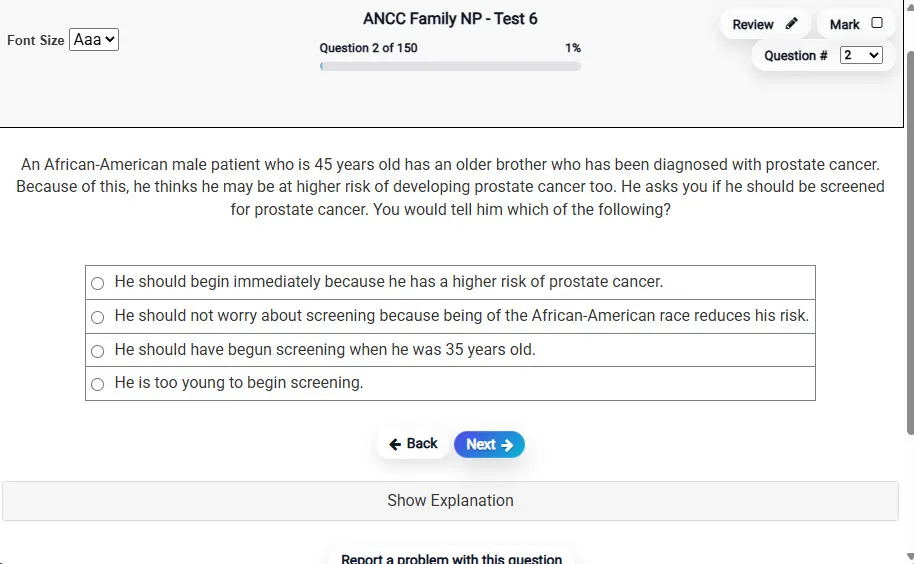
Answering a Question screen – Multiple-choice item view with navigation controls and progress tracker.
Answering a Question Multiple-choice item view with navigation controls and progress tracker.

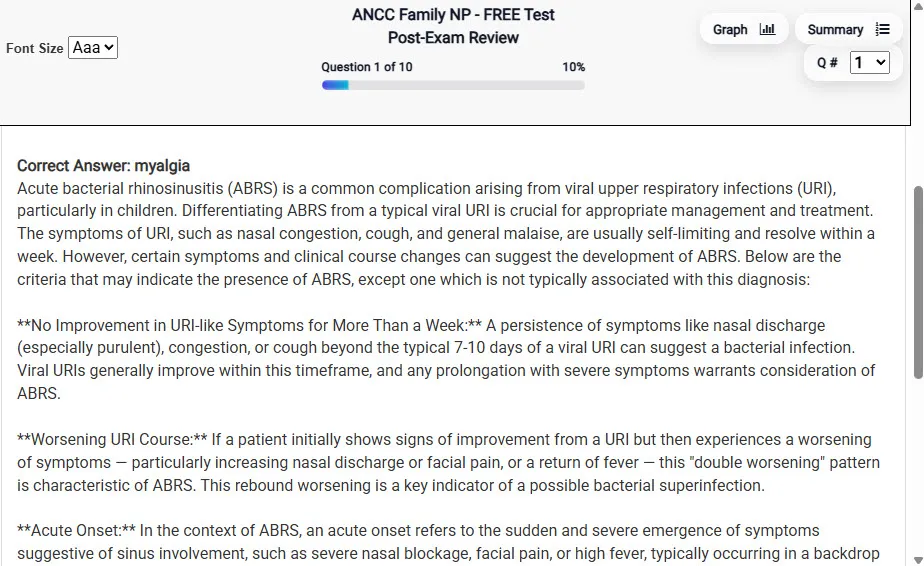
                           Detailed Explanation screen – 
                         Review mode showing chosen answer and rationale and references.
Detailed Explanation Review mode showing chosen answer and rationale and references.

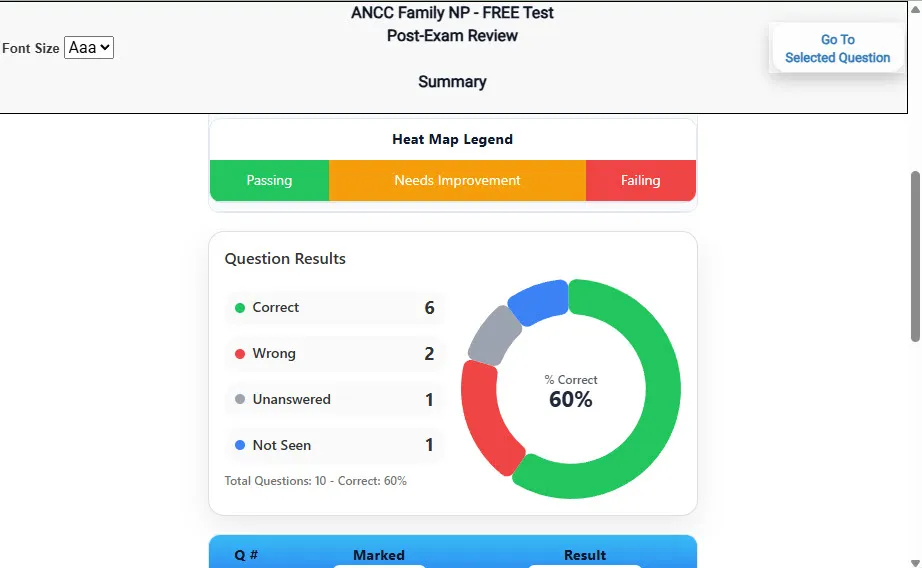
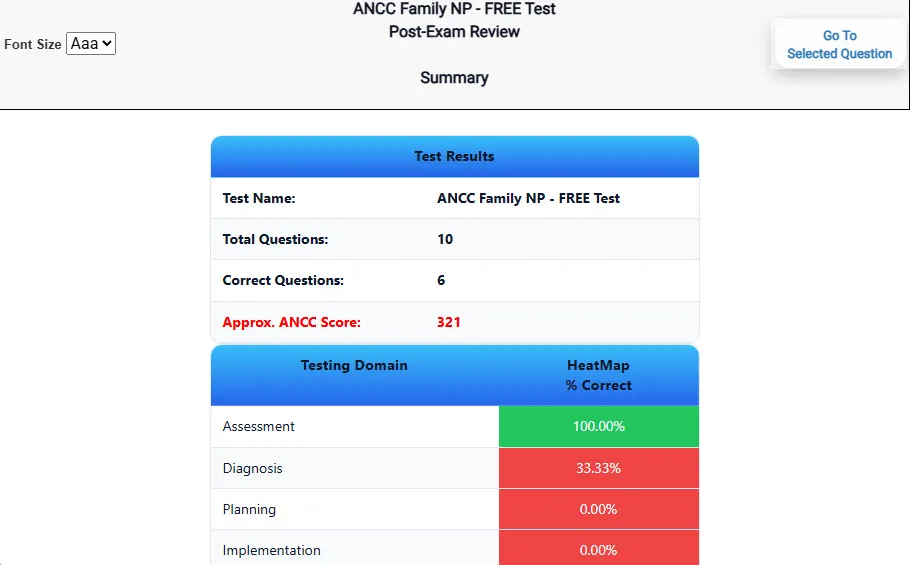
                           Review Summary 1 screen – 
                         Summary with counts for correct/wrong/unanswered and not seen items.
Review Summary 1 Summary with counts for correct/wrong/unanswered and not seen items.

                           Review Summary 2 screen – 
                         Advanced summary with category/domain breakdown and performance insights.
Review Summary 2 Advanced summary with category/domain breakdown and performance insights.

What Each Screen Shows

Answer Question Screen

  • Clean multiple-choice interface with progress bar.
  • Mark for review feature.
  • Matches real test pacing.

Detailed Explanation

  • Correct answer plus rationale.
  • Key concepts and guidelines highlighted.
  • Move between questions to fill knowledge gaps.

Review Summary 1

  • Overall results with total questions and scaled score.
  • Domain heatmap shows strengths and weaknesses.
  • Quick visual feedback on study priorities.

Review Summary 2

  • Chart of correct, wrong, unanswered, not seen.
  • Color-coded results for easy review.
  • Links back to missed items.

Top 10 Reasons to Use Exam Edge for your GACE Chemistry (6-12) Exam Prep

  1. Focused on the GACE Chemistry (6-12) Exam

    Our practice tests are built specifically for the GACE Chemistry (6-12) exam — every question mirrors the real topics, format, and difficulty so you're studying exactly what matters.

  2. Real Exam Simulation

    We match the per-question time limits and pressure of the actual GACE exam, so test day feels familiar and stress-free.

  3. 15 Full Practice Tests & 1,500 Unique Questions

    You'll have more than enough material to master every GACE Chemistry (6-12) concept — no repeats, no fluff.

  4. Lower Cost Than a Retake

    Ordering 5 practice exams costs less than retaking the GACE Chemistry (6-12) exam after a failure. One low fee could save you both time and money.

  5. Flexible Testing

    Need to step away mid-exam? Pick up right where you left off — with your remaining time intact.

  6. Instant Scoring & Feedback

    See your raw score and an estimated GACE Chemistry (6-12) score immediately after finishing each practice test.

  7. Detailed Explanations for Every Question

    Review correct and incorrect answers with clear, step-by-step explanations so you truly understand each topic.

  8. Trusted & Accredited

    We're fully accredited by the Better Business Bureau and uphold the highest standards of trust and transparency.

  9. Web-Based & Always Available

    No software to install. Access your GACE Chemistry (6-12) practice exams 24/7 from any computer or mobile device.

  10. Expert Support When You Need It

    Need extra help? Our specialized tutors are highly qualified and ready to support your GACE exam prep.


Pass the GACE Chemistry (6-12) Exam with Realistic Practice Tests from Exam Edge

Preparing for your upcoming GACE Chemistry (6-12) (712) Certification Exam can feel overwhelming — but the right practice makes all the difference. Exam Edge gives you the tools, structure, and confidence to pass on your first try. Our online practice exams are built to match the real GACE Chemistry (6-12) exam in content, format, and difficulty.

  • 📝 15 GACE Chemistry (6-12) Practice Tests: Access 15 full-length exams with 100 questions each, covering every major GACE Chemistry (6-12) topic in depth.
  • Instant Online Access: Start practicing right away — no software, no waiting.
  • 🧠 Step-by-Step Explanations: Understand the reasoning behind every correct answer so you can master GACE Chemistry (6-12) exam concepts.
  • 🔄 Retake Each Exam Up to 4 Times: Build knowledge through repetition and track your improvement over time.
  • 🌐 Web-Based & Available 24/7: Study anywhere, anytime, on any device.
  • 🧘 Boost Your Test-Day Confidence: Familiarity with the GACE format reduces anxiety and helps you perform under pressure.

These GACE Chemistry (6-12) practice exams are designed to simulate the real testing experience by matching question types, timing, and difficulty level. This approach helps you get comfortable not just with the exam content, but also with the testing environment, so you walk into your exam day focused and confident.


Exam Edge GACE Reviews


Thank you for the update. I took the GACE Reading Test 2 on Sat, Nov 15, and I made a 276! Exam Edge was my only test prep tool. Thanks for offering such a wonderful product.

Diane , GA

I found your website and started reading your testimonials and was immediately sold on creating an account and purchasing the Business Education tests. I practiced with those tests and soon signed up for the Gace test. I graduated three years ago. I took the test yesterday, Feb 11, and.... PASSED BO ...
Read More
Sandra , Quitman, GA

I just NAILED the GACE Special Ed General Curriculum assessments part I & II!!! I also bought practice tests from the GACE website but that was just ONE test per part and it never changed. Your tests challenged me more and gave much better interactive feedback. Thank you so much!!

Phoebe , Atlanta

I took the ESOL GACE yesterday and passed both sections! I hadn't taken a standardized test in ten years, so I was very apprehensive. I must say that if it were not for your practice exams, I would not have passed. The workbook I had ordered from another vendor was insufficient to cover the cont ...
Read More
Amy, GA

I want to thank you for your test reviews. It really helped me a lot. I passed the Birth to Kindergarten GACE exam!!

Angela, Norcross, GA.

Thank you! Thank you! Thank you!!! I always had horrible experiences with the GACE tests when entering and exiting my program and now I passed the SPED on the first try!!! I took each practice test and it was so familiar to the real one! I'm so happy I purchased it!

Mariah, Acworth GA


GACE Chemistry (6-12) Aliases Test Name

Here is a list of alternative names used for this exam.

  • GACE Chemistry (6-12)
  • GACE Chemistry (6-12) test
  • GACE Chemistry (6-12) Certification Test
  • GACE
  • GACE 712
  • 712 test
  • GACE Chemistry (6-12) (712)
  • Chemistry (6-12) certification