This is the content of the pop-over!

Lightning Deal Alert – 12% Off Ends at Midnight!

Strike while the savings are hot! Use promo code FlashSale at checkout for 12% off any Exam Edge test or bundle. Hurry—the clock is ticking!

GACE History (721 - 242/243/244/245) Practice Tests & Test Prep by Exam Edge


GACE History (6-12) product image
(5.0)
Based on 28 Reviews

  • Real Exam Simulation: Timed questions and matching content build comfort for your GACE History (6-12) test day.
  • Instant, 24/7 Access: Web-based GACE History (6-12) practice exams with no software needed.
  • Clear Explanations: Step-by-step answers and explanations for your GACE exam to strengthen understanding.
  • Boosted Confidence: Reduces anxiety and improves test-taking skills to ace your GACE History (6-12) (721).

Featured on

GACE History (6-12) Online Practice Test Bundles

BEST VALUE
20 practice tests

$174.00

$599.00

SAVE $425

Only $8.70 per test!

  • 100% Pass Guarantee
  • 20 online practice tests
  • 100 questions per test
  • Bonus: 100 Flash Cards + Study Guide
  • Instant access
  • Detailed Explanations
  • Practice tests never expire
  • Timed, untimed, or study guide mode
MOST POPULAR
10 practice tests

$99.50

$299.50

SAVE $200

Only $9.95 per test!

  • 10 online practice tests
  • 100 questions per test
  • Bonus: 100 Flash Cards + Study Guide
  • Instant access
  • Detailed Explanations
  • Practice tests never expire
  • Timed, untimed, or study guide mode
5 practice tests

$59.75

$149.75

SAVE $90

Only $11.95 per test!

  • 5 online practice tests
  • 100 questions per test
  • Bonus: 100 Flash Cards
  • Instant access
  • Detailed Explanations
  • Practice tests never expire
  • Timed, untimed, or study guide mode
1 practice test

$29.95

  • 1 online practice test
  • 100 questions per test
  • Instant access
  • Detailed Explanations
  • Practice tests never expire
  • Timed, untimed, or study guide mode
Quick Select
Tap to choose a bundle

** All Prices are in US Dollars (USD) **


GACE History (6-12) (721) Shortcuts


Understanding the exact breakdown of the GACE History (6-12) test will help you know what to expect and how to most effectively prepare. The GACE History (6-12) has 100 multiple-choice questions . The exam will be broken down into the sections below:

GACE History (6-12) Exam Blueprint
Domain Name % Number of
Questions
United States History to 1877 25% 25
United States History from 1877 to the Present 25% 25
World History to 1750 25% 25
World History from 1750 to the Present 25% 25

GACE History (6-12) Study Tips by Domain

  • For colonial regions, match economy to labor: New England = shipping/commerce and small farms, Middle = grain and “breadbasket,” Chesapeake/South = tobacco/rice with enslaved labor; red flag: treating all colonies as plantation economies.
  • When analyzing causes of the American Revolution, prioritize post–French and Indian War taxation/imperial control (Stamp Act, Townshend, Tea Act, Coercive Acts) over “religious freedom”; trap: mixing the First Great Awakening directly into the break with Britain.
  • Compare governments by powers: Articles of Confederation = weak central authority (no tax power, no standing army), Constitution = stronger federal powers; threshold cue: if a question mentions inability to raise revenue or enforce laws, it points to the Articles.
  • For early republic politics, use the Hamilton vs. Jefferson split: Federalists favor a national bank and loose construction, Democratic-Republicans favor agrarianism and strict construction; red flag: assuming “states’ rights” always equals later Confederate ideology.
  • In the market and transportation revolutions, link inventions/infrastructure to regional change (cotton gin boosts slavery’s expansion; canals/railroads integrate markets); contraindication: don’t claim industrialization was primarily Southern before 1860.
  • For slavery and sectional conflict, track the sequence and purpose of compromises (Missouri Compromise, Compromise of 1850, Kansas–Nebraska, Dred Scott) and remember: expansion of slavery into territories is the recurring trigger; priority rule: if “popular sovereignty” or “Bleeding Kansas” appears, tie it to Kansas–Nebraska.
  • For Reconstruction’s end and the “New South,” prioritize the Compromise of 1877 and the withdrawal of federal troops as the turning point; red flag: mixing this up with the 1896 Plessy v. Ferguson decision (which constitutionalized segregation later).
  • In industrialization/Gilded Age questions, use “horizontal vs. vertical integration” as a quick sorting rule (Standard Oil vs. Carnegie Steel); common trap: assuming the Sherman Antitrust Act was aggressively enforced before Theodore Roosevelt.
  • For Progressive Era and reform, treat the 16th–19th Amendments as a must-know cluster and link each to a specific change (income tax, direct election of senators, prohibition, women’s suffrage); red flag: confusing the 18th Amendment with the 21st (repeal).
  • On foreign policy, use the threshold “1898 = U.S. imperial turn” (Spanish-American War, Philippines, Puerto Rico, Guam) and distinguish it from 1917 entry into WWI; common trap: attributing the Open Door Policy to the Roosevelt Corollary instead of China-focused trade access.
  • For the Great Depression/New Deal, a priority rule is “relief, recovery, reform” to classify agencies (FERA/CCC/WPA vs. NRA/AAA vs. FDIC/SEC/SSA); red flag: claiming Social Security provided immediate mass relief to the unemployed (it was not unemployment insurance at first).
  • In the Cold War to present, anchor chronology with 1947 (Truman Doctrine/containment), 1954 (Brown v. Board), 1964–65 (Civil Rights Act/Voting Rights Act), and 1973 (War Powers Act); common trap: treating détente as ending the Cold War rather than a temporary easing before renewed tensions and the USSR’s collapse in 1991.
  • For World History to 1750, use a “core era” check: if the event is after 1750 (Industrial Revolution, French Revolution, Haitian Revolution), it belongs in the later domain—don’t misfile it as “early modern.”
  • Prioritize chronology anchors: classical era (Greece/Rome/Han), postclassical (Islamic caliphates, Tang/Song, Mali), early modern (Renaissance/Reformation, Ottoman/Safavid/Mughal, Atlantic exchange); a common trap is treating these as simultaneous across regions.
  • When analyzing empires, use the rule “administration + legitimacy”: cite a governing method (bureaucracy, tribute, devshirme, merit exams) and a legitimizing idea (Mandate of Heaven, divine right, caliphate) or you’ll lose points for narrative-only answers.
  • For trade networks, distinguish by goods and routes: Silk Roads (luxury/ideas), Indian Ocean (monsoon bulk trade), Trans-Saharan (salt/gold), and Atlantic (plantation crops/slavery); red flag is claiming the Columbian Exchange occurred before 1492.
  • In religion questions, separate belief from institution: doctrine changes (e.g., Protestant critiques) vs political structures (papacy, ulema, sangha); common trap is labeling the Byzantine Church as “Roman Catholic” after 1054.
  • For state-building and warfare, apply the “gunpowder threshold”: if firearms and artillery fundamentally shift conquest/fortification (Ottoman sieges, Tokugawa consolidation), treat it as early modern; contraindication is using industrial-era military terms like “total war.”
  • For World History from 1750 to the Present, link Enlightenment ideas to revolutions with a cause?effect chain (e.g., Rousseau/Locke ? rights language ? Haiti/France/Latin America); red flag: choosing an answer that treats revolutions as purely economic without an ideological trigger.
  • When comparing industrialization, use a priority rule: first identify energy/technology (steam, electricity), then labor systems (factory work, child labor), then social responses (unions, reform); common trap: mixing up first vs. second Industrial Revolution timelines.
  • On imperialism, apply a threshold: if the prompt mentions “Scramble for Africa,” Berlin Conference (1884–85) is usually the key organizing event; red flag: assuming borders reflect ethnic realities rather than colonial negotiations.
  • For World War I and II questions, anchor on alliances and turning points (e.g., U.S. entry 1917; Stalingrad/Midway 1942) and watch a contraindication: don’t cite appeasement as a cause of WWI (it’s tied to WWII).
  • In Cold War items, classify conflicts by type (proxy war, nuclear brinkmanship, détente) and use a cue: if you see “Cuba 1962,” the best answer should mention missile crisis escalation/containment, not Vietnamization or perestroika.
  • For decolonization and globalization, track the sequence nationalism ? independence ? state-building challenges, and use a red flag: any answer that treats postcolonial outcomes as uniform ignores region-specific paths (e.g., partition in South Asia vs. negotiated transitions in parts of Africa).

Built to Fit Into Your Busy Life

Everything you need to prepare with confidence—without wasting a minute.

Three Study Modes

Timed, No Time Limit, or Explanation mode.

Actionable Analytics

Heatmaps and scaled scores highlight weak areas.

High-Yield Rationales

Concise explanations emphasize key concepts.

Realistic Interface

Matches the feel of the actual exam environment.

Accessible by Design

Clean layout reduces cognitive load.

Anytime, Anywhere

Web-based access 24/7 on any device.
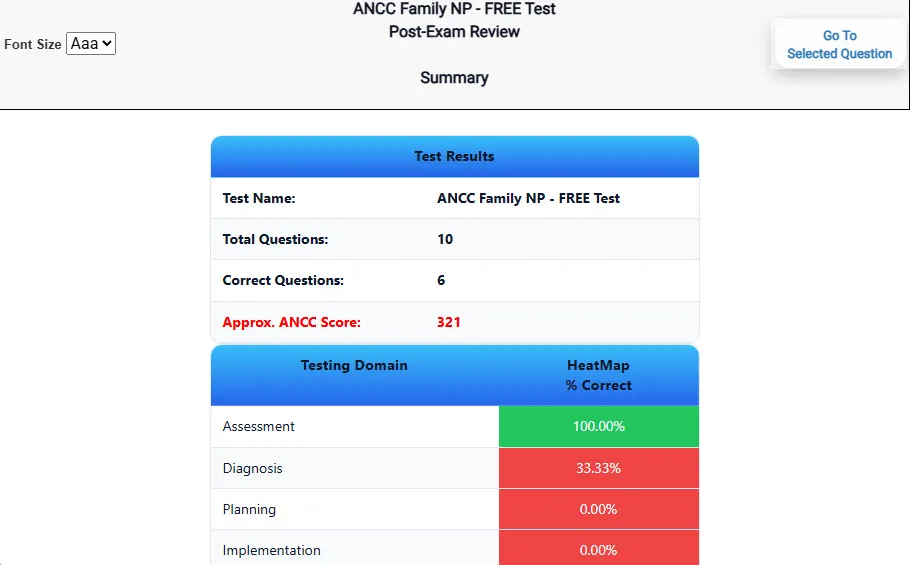
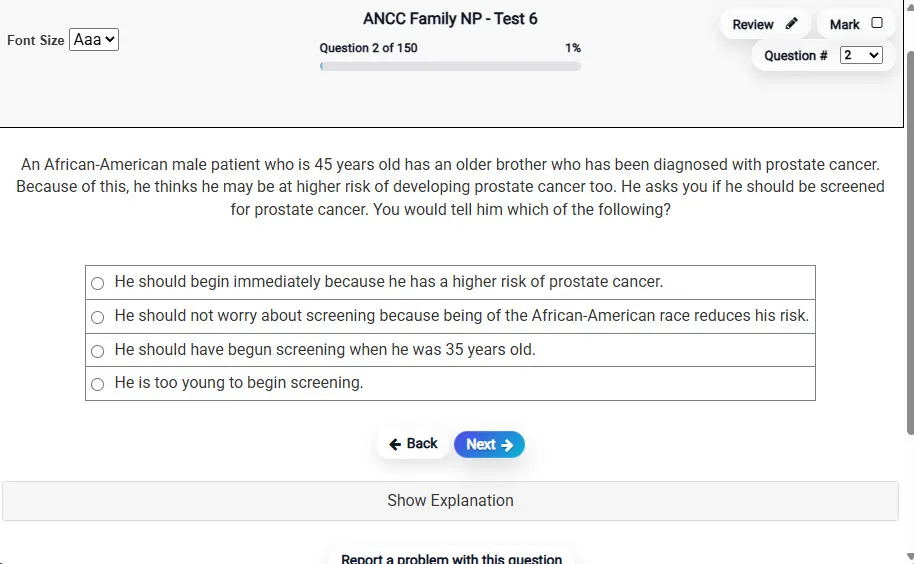
Answering a Question screen – Multiple-choice item view with navigation controls and progress tracker.
Answering a Question Multiple-choice item view with navigation controls and progress tracker.

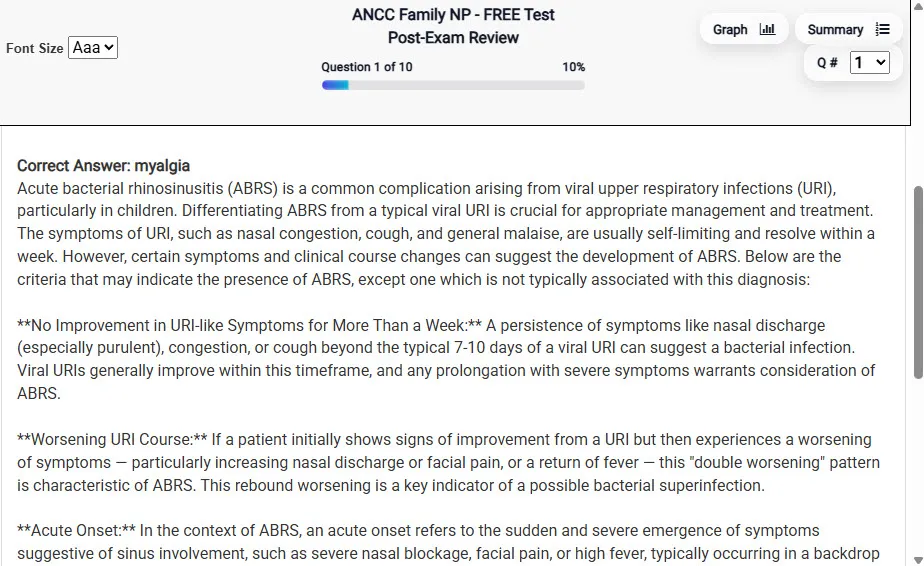
                           Detailed Explanation screen – 
                         Review mode showing chosen answer and rationale and references.
Detailed Explanation Review mode showing chosen answer and rationale and references.

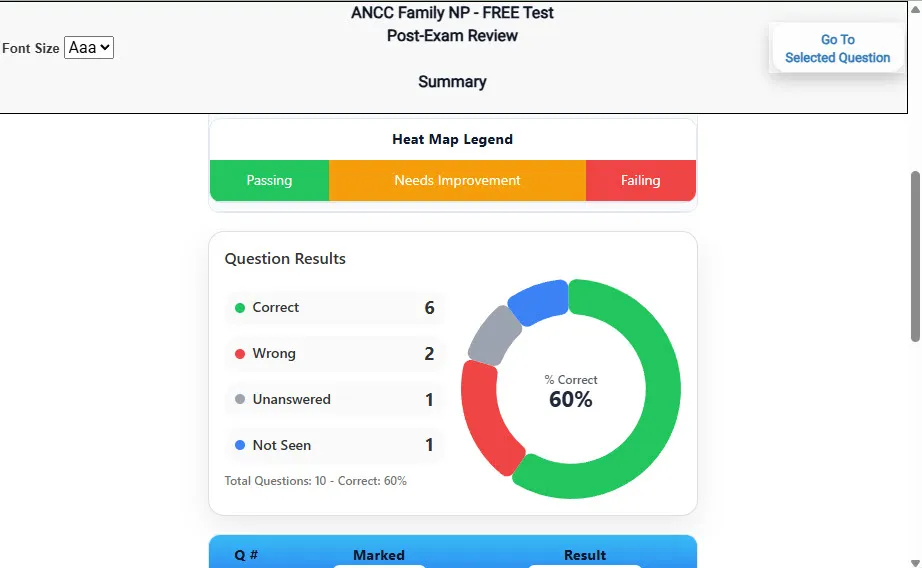
                           Review Summary 1 screen – 
                         Summary with counts for correct/wrong/unanswered and not seen items.
Review Summary 1 Summary with counts for correct/wrong/unanswered and not seen items.

                           Review Summary 2 screen – 
                         Advanced summary with category/domain breakdown and performance insights.
Review Summary 2 Advanced summary with category/domain breakdown and performance insights.

What Each Screen Shows

Answer Question Screen

  • Clean multiple-choice interface with progress bar.
  • Mark for review feature.
  • Matches real test pacing.

Detailed Explanation

  • Correct answer plus rationale.
  • Key concepts and guidelines highlighted.
  • Move between questions to fill knowledge gaps.

Review Summary 1

  • Overall results with total questions and scaled score.
  • Domain heatmap shows strengths and weaknesses.
  • Quick visual feedback on study priorities.

Review Summary 2

  • Chart of correct, wrong, unanswered, not seen.
  • Color-coded results for easy review.
  • Links back to missed items.

Top 10 Reasons to Use Exam Edge for your GACE History (6-12) Exam Prep

  1. Focused on the GACE History (6-12) Exam

    Our practice tests are built specifically for the GACE History (6-12) exam — every question mirrors the real topics, format, and difficulty so you're studying exactly what matters.

  2. Real Exam Simulation

    We match the per-question time limits and pressure of the actual GACE exam, so test day feels familiar and stress-free.

  3. 20 Full Practice Tests & 2,000 Unique Questions

    You'll have more than enough material to master every GACE History (6-12) concept — no repeats, no fluff.

  4. Lower Cost Than a Retake

    Ordering 5 practice exams costs less than retaking the GACE History (6-12) exam after a failure. One low fee could save you both time and money.

  5. Flexible Testing

    Need to step away mid-exam? Pick up right where you left off — with your remaining time intact.

  6. Instant Scoring & Feedback

    See your raw score and an estimated GACE History (6-12) score immediately after finishing each practice test.

  7. Detailed Explanations for Every Question

    Review correct and incorrect answers with clear, step-by-step explanations so you truly understand each topic.

  8. Trusted & Accredited

    We're fully accredited by the Better Business Bureau and uphold the highest standards of trust and transparency.

  9. Web-Based & Always Available

    No software to install. Access your GACE History (6-12) practice exams 24/7 from any computer or mobile device.

  10. Expert Support When You Need It

    Need extra help? Our specialized tutors are highly qualified and ready to support your GACE exam prep.


Pass the GACE History (6-12) Exam with Realistic Practice Tests from Exam Edge

Preparing for your upcoming GACE History (6-12) (721) Certification Exam can feel overwhelming — but the right practice makes all the difference. Exam Edge gives you the tools, structure, and confidence to pass on your first try. Our online practice exams are built to match the real GACE History (6-12) exam in content, format, and difficulty.

  • 📝 20 GACE History (6-12) Practice Tests: Access 20 full-length exams with 100 questions each, covering every major GACE History (6-12) topic in depth.
  • Instant Online Access: Start practicing right away — no software, no waiting.
  • 🧠 Step-by-Step Explanations: Understand the reasoning behind every correct answer so you can master GACE History (6-12) exam concepts.
  • 🔄 Retake Each Exam Up to 4 Times: Build knowledge through repetition and track your improvement over time.
  • 🌐 Web-Based & Available 24/7: Study anywhere, anytime, on any device.
  • 🧘 Boost Your Test-Day Confidence: Familiarity with the GACE format reduces anxiety and helps you perform under pressure.

These GACE History (6-12) practice exams are designed to simulate the real testing experience by matching question types, timing, and difficulty level. This approach helps you get comfortable not just with the exam content, but also with the testing environment, so you walk into your exam day focused and confident.


Exam Edge GACE Reviews


Thank you for the update. I took the GACE Reading Test 2 on Sat, Nov 15, and I made a 276! Exam Edge was my only test prep tool. Thanks for offering such a wonderful product.

Diane , GA

I found your website and started reading your testimonials and was immediately sold on creating an account and purchasing the Business Education tests. I practiced with those tests and soon signed up for the Gace test. I graduated three years ago. I took the test yesterday, Feb 11, and.... PASSED BO ...
Read More
Sandra , Quitman, GA

I just NAILED the GACE Special Ed General Curriculum assessments part I & II!!! I also bought practice tests from the GACE website but that was just ONE test per part and it never changed. Your tests challenged me more and gave much better interactive feedback. Thank you so much!!

Phoebe , Atlanta

I took the ESOL GACE yesterday and passed both sections! I hadn't taken a standardized test in ten years, so I was very apprehensive. I must say that if it were not for your practice exams, I would not have passed. The workbook I had ordered from another vendor was insufficient to cover the cont ...
Read More
Amy, GA

I want to thank you for your test reviews. It really helped me a lot. I passed the Birth to Kindergarten GACE exam!!

Angela, Norcross, GA.

Thank you! Thank you! Thank you!!! I always had horrible experiences with the GACE tests when entering and exiting my program and now I passed the SPED on the first try!!! I took each practice test and it was so familiar to the real one! I'm so happy I purchased it!

Mariah, Acworth GA


GACE History (6-12) Aliases Test Name

Here is a list of alternative names used for this exam.

  • GACE History (6-12)
  • GACE History (6-12) test
  • GACE History (6-12) Certification Test
  • GACE
  • GACE 721
  • 721 test
  • GACE History (6-12) (721)
  • History (6-12) certification