This is the content of the pop-over!

GACE Math (711 - 209/210/211/212/215/501) Practice Tests & Test Prep by Exam Edge


GACE Mathematics (6-12) product image
(5.0)
Based on 34 Reviews

  • Real Exam Simulation: Timed questions and matching content build comfort for your GACE Math (6-12) test day.
  • Instant, 24/7 Access: Web-based GACE Mathematics (6-12) practice exams with no software needed.
  • Clear Explanations: Step-by-step answers and explanations for your GACE exam to strengthen understanding.
  • Boosted Confidence: Reduces anxiety and improves test-taking skills to ace your GACE Mathematics (6-12) (711).

Featured on

GACE Mathematics (6-12) Online Practice Test Bundles

BEST VALUE
20 practice tests

$174.00

$599.00

SAVE $425

Only $8.70 per test!

  • 100% Pass Guarantee
  • 20 online practice tests
  • 145 questions per test
  • Bonus: 100 Flash Cards + Study Guide
  • Instant access
  • Detailed Explanations
  • Practice tests never expire
  • Timed, untimed, or study guide mode
MOST POPULAR
10 practice tests

$99.50

$299.50

SAVE $200

Only $9.95 per test!

  • 10 online practice tests
  • 145 questions per test
  • Bonus: 100 Flash Cards + Study Guide
  • Instant access
  • Detailed Explanations
  • Practice tests never expire
  • Timed, untimed, or study guide mode
5 practice tests

$59.75

$149.75

SAVE $90

Only $11.95 per test!

  • 5 online practice tests
  • 145 questions per test
  • Bonus: 100 Flash Cards
  • Instant access
  • Detailed Explanations
  • Practice tests never expire
  • Timed, untimed, or study guide mode
1 practice test

$29.95

  • 1 online practice test
  • 145 questions per test
  • Instant access
  • Detailed Explanations
  • Practice tests never expire
  • Timed, untimed, or study guide mode
Quick Select
Tap to choose a bundle

** All Prices are in US Dollars (USD) **


GACE Math (6-12) (711) Shortcuts


Understanding the exact breakdown of the GACE Mathematics (6-12) test will help you know what to expect and how to most effectively prepare. The GACE Mathematics (6-12) has 145 multiple-choice questions . The exam will be broken down into the sections below:

GACE Mathematics (6-12) Exam Blueprint
Domain Name % Number of
Questions
Mathematical Processes and Number Sense (6–12) 14% 20
Algebra and Functions (6–12) 20% 29
Measurement and Geometry (6–12) 18% 26
Trigonometry and Calculus (6–12) 14% 20
Statistics and Probability (6–12) 14% 20
Financial Literacy 20% 29

GACE Mathematics (6-12) Study Tips by Domain

  • In mixed operations, apply order of operations and distribute negative signs carefully; red flag: a minus sign outside parentheses changes every term inside.
  • When converting between fractions, decimals, and percents, keep exact values as long as possible; common trap: rounding early (e.g., 0.33 for 1/3) can flip an inequality or final answer.
  • For ratio/proportion problems, write units in each ratio and cross-multiply only after confirming matching quantities; red flag: comparing “miles per hour” to “hours per mile” without inverting.
  • Use properties of exponents and radicals only under their conditions; contraindication: splitting roots over addition (v(a+b) ? va + vb) or canceling terms across a sum.
  • When reasoning with signed numbers and absolute value, check boundary cases and sign changes; priority rule: solve inequalities by tracking when you multiply/divide by a negative (flip the inequality symbol).
  • Interpret word problems by defining variables with constraints and checking reasonableness of the result; common trap: ignoring domain restrictions like “whole number,” “positive,” or “at least 0,” leading to extraneous solutions.
  • Algebra and Functions (6–12): When simplifying rational expressions, factor completely first and state domain restrictions (red flag: canceling terms across addition/subtraction).
  • Algebra and Functions (6–12): For equations with radicals or rational exponents, isolate and square only once at a time, then check all solutions (common trap: extraneous roots after squaring).
  • Algebra and Functions (6–12): In function composition and inverses, track input/output sets explicitly (priority rule: if f°g is asked, apply g first, and verify one-to-one before claiming an inverse).
  • Algebra and Functions (6–12): When solving systems, choose substitution/elimination vs. graphing based on structure (threshold: if one equation is already solved for a variable, substitute to reduce errors).
  • Algebra and Functions (6–12): For quadratics, use discriminant b²-4ac to predict solution types before solving (red flag: forgetting ± in the quadratic formula or misplacing parentheses on -b).
  • Algebra and Functions (6–12): For piecewise and absolute value functions, write boundary points and test intervals (common trap: treating |A|=B as A=B only; require B=0 and use A=±B).
  • Use the correct distance formula based on context: in coordinate geometry, don’t default to slope when the question asks for length—priority rule is to translate a diagram into coordinates before computing.
  • For angle relationships, label given angles and identify parallel/perpendicular lines first; red flag: assuming vertical angles are supplementary (they’re congruent) or mixing up corresponding vs. alternate interior.
  • When proving triangle congruence, check that the criteria is valid; common trap: using SSA as congruence (it’s not, unless additional constraints like right-triangle HL apply).
  • In similarity problems, set up ratios consistently (corresponding sides only) and use scale factor rules; threshold cue: areas scale by k² and volumes by k³, not by k.
  • For circles, distinguish arc length/sector area from circumference/area; red flag: using degrees directly in formulas that require radians (convert: radians = degrees × p/180).
  • In 3D measurement, choose the correct lateral vs. total surface area and volume formula; contraindication: adding areas from overlapping faces or forgetting units (square units for area, cubic for volume).
  • Trigonometry and Calculus (6–12): Convert between degrees and radians correctly—red flag: using trig derivatives/integrals without radians (e.g., d/dx[sin x] assumes x in radians).
  • Trigonometry and Calculus (6–12): When solving trig equations, apply the unit-circle general solutions (add 2pk and include symmetric angles); common trap: reporting only principal solutions in [0,2p).
  • Trigonometry and Calculus (6–12): In limits, rewrite expressions to standard forms (e.g., use sin x / x ? 1 as x?0) before substituting; contraindication: canceling factors that are zero at the limit point without factoring first.
  • Trigonometry and Calculus (6–12): For derivatives, choose the correct rule (chain/product/quotient) and simplify before differentiating when it reduces error; red flag: forgetting the inner derivative in composite trig/exponential functions.
  • Trigonometry and Calculus (6–12): In applications of derivatives (max/min, optimization), use critical points plus endpoints and verify with sign/second-derivative tests; common trap: assuming every critical point is a maximum or minimum.
  • Trigonometry and Calculus (6–12): For integrals, match the technique to the structure (substitution for f(g(x))g'(x), parts for products like x·sin x) and always include +C for indefinite integrals; priority rule: check by differentiating your antiderivative, especially when absolute values arise (e.g., ?sec x tan x dx = sec x + C but ?tan x dx = -ln|cos x| + C).
  • When comparing groups, match the graph to the question: use boxplots for medians/IQR and dotplots/histograms for shape; red flag: concluding “most” from the mean when the distribution is skewed.
  • For center and spread, choose mean/standard deviation only for roughly symmetric data and median/IQR for skewed or outlier-prone data; common trap: reporting a large standard deviation as “more reliable” when it actually indicates more variability.
  • In normal-model problems, standardize with z = (x - µ)/s and interpret z as “how many standard deviations from the mean”; priority rule: if the prompt says “approximately normal,” use the Empirical Rule/standard normal table rather than Chebyshev.
  • For probability with counting, decide first if order matters (permutations) or not (combinations) and whether sampling is with/without replacement; red flag: using independence when events are “without replacement” from a small population.
  • In conditional probability, use P(A|B) = P(AnB)/P(B) and read two-way tables by fixing the condition as the new denominator; common trap: swapping P(A|B) with P(B|A) (base-rate error).
  • For inference (confidence intervals/hypothesis tests), check assumptions: random sample, independence, and (for means/proportions) appropriate normal/large-count conditions; contraindication: using a z-interval for a proportion when np or n(1-p) is less than 10.
  • Convert between simple and compound interest carefully; red flag: using simple-interest formula I=Prt when the problem states “compounded” (use A=P(1+r/n)^(nt)).
  • Match the interest rate period to the payment/compounding period; common trap: treating APR as a monthly rate without dividing by 12 (or using EAR when APR is required).
  • For loans and annuities, identify cash-flow direction and timing; priority rule: “payment at end of period” implies ordinary annuity (shift one period if it’s “at beginning”).
  • When comparing options (e.g., leases, loans, investments), use the same time horizon and same measure; red flag: comparing total dollars paid vs present value without discounting.
  • Apply percent change and markup/discount consistently; common trap: reversing base (e.g., “10% discount then 10% tax” is not net zero because each percent uses a different base).
  • For budgets and constraints, check feasibility with inequalities; threshold cue: if fixed expenses exceed net income, no variable-cutting plan can make the budget balanced without increasing income or reducing fixed costs.

Built to Fit Into Your Busy Life

Everything you need to prepare with confidence—without wasting a minute.

Three Study Modes

Timed, No Time Limit, or Explanation mode.

Actionable Analytics

Heatmaps and scaled scores highlight weak areas.

High-Yield Rationales

Concise explanations emphasize key concepts.

Realistic Interface

Matches the feel of the actual exam environment.

Accessible by Design

Clean layout reduces cognitive load.

Anytime, Anywhere

Web-based access 24/7 on any device.
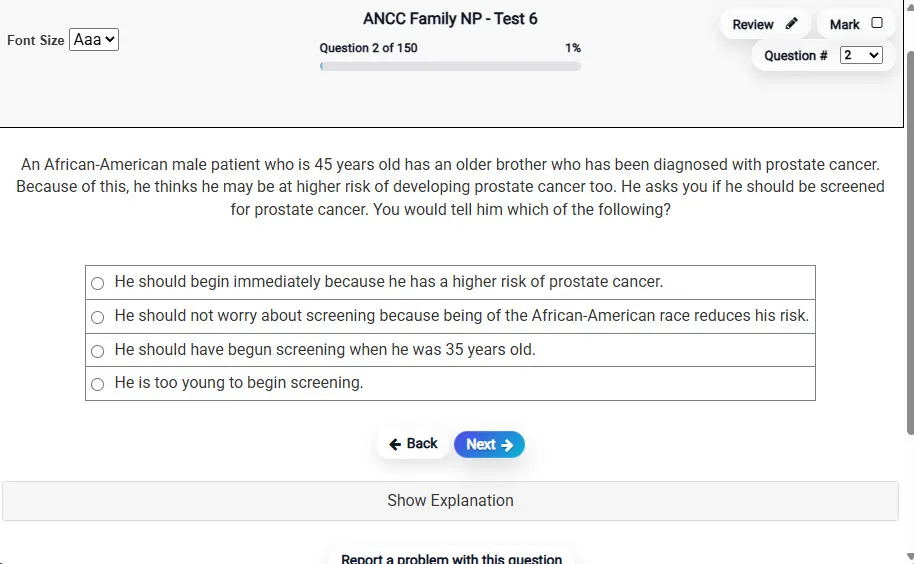
Answering a Question screen – Multiple-choice item view with navigation controls and progress tracker.
Answering a Question Multiple-choice item view with navigation controls and progress tracker.

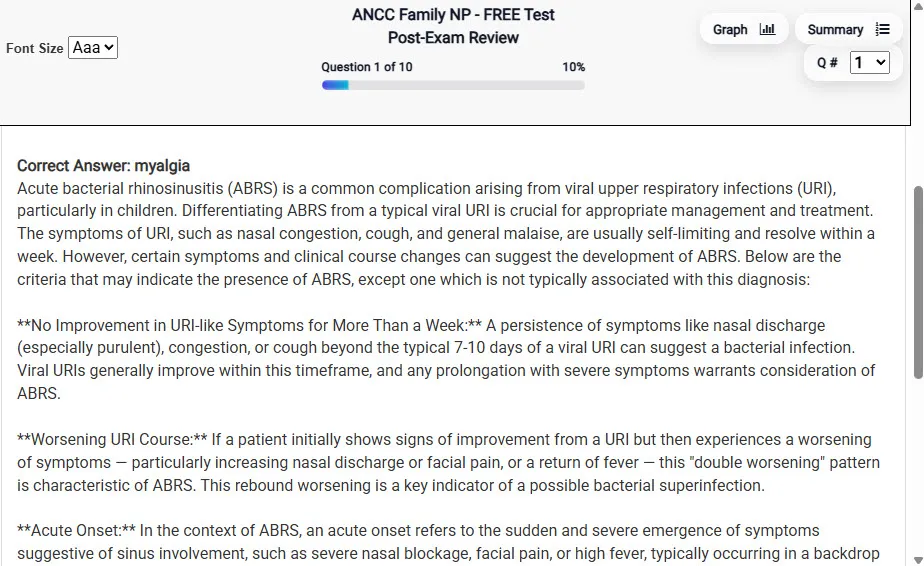
                           Detailed Explanation screen – 
                         Review mode showing chosen answer and rationale and references.
Detailed Explanation Review mode showing chosen answer and rationale and references.

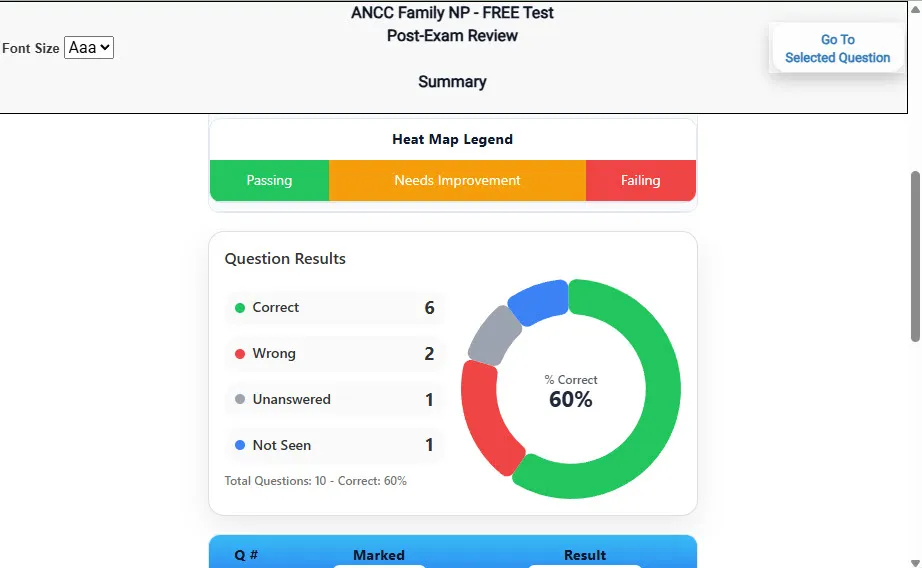
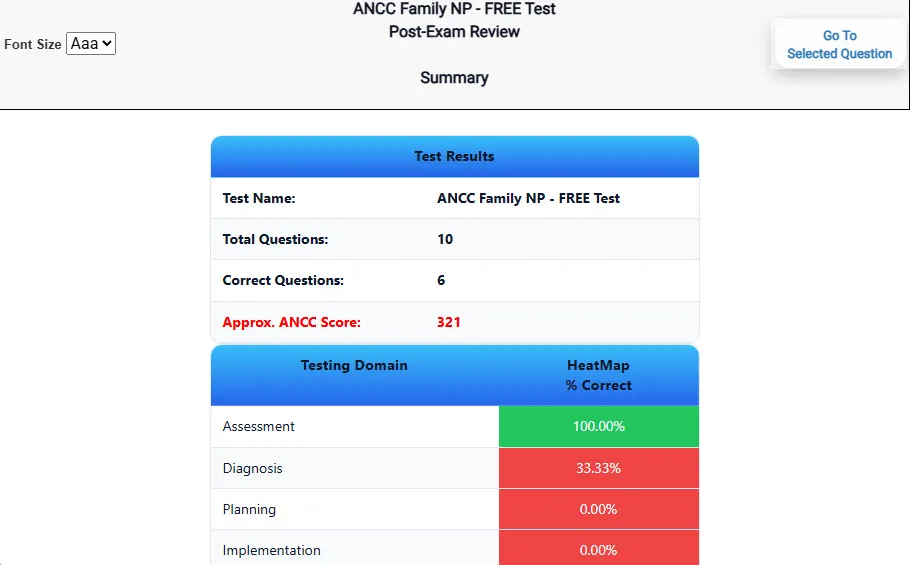
                           Review Summary 1 screen – 
                         Summary with counts for correct/wrong/unanswered and not seen items.
Review Summary 1 Summary with counts for correct/wrong/unanswered and not seen items.

                           Review Summary 2 screen – 
                         Advanced summary with category/domain breakdown and performance insights.
Review Summary 2 Advanced summary with category/domain breakdown and performance insights.

What Each Screen Shows

Answer Question Screen

  • Clean multiple-choice interface with progress bar.
  • Mark for review feature.
  • Matches real test pacing.

Detailed Explanation

  • Correct answer plus rationale.
  • Key concepts and guidelines highlighted.
  • Move between questions to fill knowledge gaps.

Review Summary 1

  • Overall results with total questions and scaled score.
  • Domain heatmap shows strengths and weaknesses.
  • Quick visual feedback on study priorities.

Review Summary 2

  • Chart of correct, wrong, unanswered, not seen.
  • Color-coded results for easy review.
  • Links back to missed items.

Top 10 Reasons to Use Exam Edge for your GACE Mathematics (6-12) Exam Prep

  1. Focused on the GACE Mathematics (6-12) Exam

    Our practice tests are built specifically for the GACE Math (6-12) exam — every question mirrors the real topics, format, and difficulty so you're studying exactly what matters.

  2. Real Exam Simulation

    We match the per-question time limits and pressure of the actual GACE exam, so test day feels familiar and stress-free.

  3. 20 Full Practice Tests & 2,900 Unique Questions

    You'll have more than enough material to master every GACE Math (6-12) concept — no repeats, no fluff.

  4. Lower Cost Than a Retake

    Ordering 5 practice exams costs less than retaking the GACE Mathematics (6-12) exam after a failure. One low fee could save you both time and money.

  5. Flexible Testing

    Need to step away mid-exam? Pick up right where you left off — with your remaining time intact.

  6. Instant Scoring & Feedback

    See your raw score and an estimated GACE Mathematics (6-12) score immediately after finishing each practice test.

  7. Detailed Explanations for Every Question

    Review correct and incorrect answers with clear, step-by-step explanations so you truly understand each topic.

  8. Trusted & Accredited

    We're fully accredited by the Better Business Bureau and uphold the highest standards of trust and transparency.

  9. Web-Based & Always Available

    No software to install. Access your GACE Math (6-12) practice exams 24/7 from any computer or mobile device.

  10. Expert Support When You Need It

    Need extra help? Our specialized tutors are highly qualified and ready to support your GACE exam prep.


Pass the GACE Mathematics (6-12) Exam with Realistic Practice Tests from Exam Edge

Preparing for your upcoming GACE Mathematics (6-12) (711) Certification Exam can feel overwhelming — but the right practice makes all the difference. Exam Edge gives you the tools, structure, and confidence to pass on your first try. Our online practice exams are built to match the real GACE Math (6-12) exam in content, format, and difficulty.

  • 📝 20 GACE Mathematics (6-12) Practice Tests: Access 20 full-length exams with 145 questions each, covering every major GACE Mathematics (6-12) topic in depth.
  • Instant Online Access: Start practicing right away — no software, no waiting.
  • 🧠 Step-by-Step Explanations: Understand the reasoning behind every correct answer so you can master GACE Math (6-12) exam concepts.
  • 🔄 Retake Each Exam Up to 4 Times: Build knowledge through repetition and track your improvement over time.
  • 🌐 Web-Based & Available 24/7: Study anywhere, anytime, on any device.
  • 🧘 Boost Your Test-Day Confidence: Familiarity with the GACE format reduces anxiety and helps you perform under pressure.

These GACE Mathematics (6-12) practice exams are designed to simulate the real testing experience by matching question types, timing, and difficulty level. This approach helps you get comfortable not just with the exam content, but also with the testing environment, so you walk into your exam day focused and confident.


Exam Edge GACE Reviews


Thank you for the update. I took the GACE Reading Test 2 on Sat, Nov 15, and I made a 276! Exam Edge was my only test prep tool. Thanks for offering such a wonderful product.

Diane , GA

I found your website and started reading your testimonials and was immediately sold on creating an account and purchasing the Business Education tests. I practiced with those tests and soon signed up for the Gace test. I graduated three years ago. I took the test yesterday, Feb 11, and.... PASSED BO ...
Read More
Sandra , Quitman, GA

I just NAILED the GACE Special Ed General Curriculum assessments part I & II!!! I also bought practice tests from the GACE website but that was just ONE test per part and it never changed. Your tests challenged me more and gave much better interactive feedback. Thank you so much!!

Phoebe , Atlanta

I took the ESOL GACE yesterday and passed both sections! I hadn't taken a standardized test in ten years, so I was very apprehensive. I must say that if it were not for your practice exams, I would not have passed. The workbook I had ordered from another vendor was insufficient to cover the cont ...
Read More
Amy, GA

I want to thank you for your test reviews. It really helped me a lot. I passed the Birth to Kindergarten GACE exam!!

Angela, Norcross, GA.

Thank you! Thank you! Thank you!!! I always had horrible experiences with the GACE tests when entering and exiting my program and now I passed the SPED on the first try!!! I took each practice test and it was so familiar to the real one! I'm so happy I purchased it!

Mariah, Acworth GA


GACE Mathematics (6-12) Aliases Test Name

Here is a list of alternative names used for this exam.

  • GACE Mathematics (6-12)
  • GACE Mathematics (6-12) test
  • GACE Mathematics (6-12) Certification Test
  • GACE Math (6-12) test
  • GACE
  • GACE 711
  • 711 test
  • GACE Mathematics (6-12) (711)
  • Mathematics (6-12) certification