This is the content of the pop-over!

ARRT® Bone Densitometry (BONE) Practice Tests & Test Prep by Exam Edge


ARRT Bone Densitometry  product image
(4.9)
Based on 37 Reviews

  • Real Exam Simulation: Timed questions and matching content build comfort for your ARRT Bone Densitometry test day.
  • Instant, 24/7 Access: Web-based ARRT Bone Densitometry practice exams with no software needed.
  • Clear Explanations: Step-by-step answers and explanations for your ARRT exam to strengthen understanding.
  • Boosted Confidence: Reduces anxiety and improves test-taking skills to ace your ARRT Bone Densitometry (BONE).

Featured on

ARRT Bone Densitometry Online Practice Test Bundles

BEST VALUE
15 practice tests

$149.25

$599.25

SAVE $450

Only $9.95 per test!

  • 100% Pass Guarantee
  • 15 online practice tests
  • 75 questions per test
  • Bonus: 100 Flash Cards + Study Guide
  • Instant access
  • Detailed Explanations
  • Practice tests never expire
  • Timed, untimed, or study guide mode
MOST POPULAR
10 practice tests

$99.50

$399.50

SAVE $300

Only $9.95 per test!

  • 10 online practice tests
  • 75 questions per test
  • Bonus: 100 Flash Cards + Study Guide
  • Instant access
  • Detailed Explanations
  • Practice tests never expire
  • Timed, untimed, or study guide mode
5 practice tests

$69.75

$199.75

SAVE $130

Only $13.95 per test!

  • 5 online practice tests
  • 75 questions per test
  • Bonus: 100 Flash Cards
  • Instant access
  • Detailed Explanations
  • Practice tests never expire
  • Timed, untimed, or study guide mode
1 practice test

$39.95

  • 1 online practice test
  • 75 questions per test
  • Instant access
  • Detailed Explanations
  • Practice tests never expire
  • Timed, untimed, or study guide mode
Quick Select
Tap to choose a bundle

** All Prices are in US Dollars (USD) **


ARRT Bone Densitometry (BONE) Resources

Jump to the section you need most.

Understanding the exact breakdown of the ARRT Bone Densitometry test will help you know what to expect and how to most effectively prepare. The ARRT Bone Densitometry has multiple-choice questions . The exam will be broken down into the sections below:

ARRT Bone Densitometry Exam Blueprint
Domain Name % Number of
Questions
Patient Care 23% 17
Image Production 27% 20
DXA Scanning of Lumbar Spine 20% 15
DXA Scanning of Proximal Femur 20% 15
DXA Scanning of Forearm 10% 8

ARRT Bone Densitometry Study Tips by Domain

  • Verify patient identity and pregnancy status before scanning; a red flag is any possibility of pregnancy without documented provider clearance.
  • Screen for recent contrast studies (barium/iodinated) and nuclear medicine; priority rule is to reschedule DXA if interfering agents were used recently per site policy.
  • Ask about calcium supplements and timing; common trap is scanning immediately after high-dose calcium intake that can affect attenuation and analysis.
  • Remove external artifacts (buttons, zippers, coins, metal, thick seams) from the scan region; red flag is any radiopaque object overlying L1–L4 or hip ROI.
  • Assess mobility, pain, and ability to position; contraindication is forcing a painful position that increases motion and repeat exposure.
  • Document height/weight accurately and note clinical history (fractures, surgeries, implants); threshold cue is that significant weight changes can alter follow-up comparability and may require technique adjustment.
  • Perform daily QC with the manufacturer phantom and review control charts; red flag is drift beyond the facility’s action limits requiring service before patient exams.
  • Use the correct exam mode (standard/thick/fast) for body habitus; common trap is using too fast a mode on large patients, increasing noise and edge-detection errors.
  • Optimize patient positioning to minimize rotation and motion; priority rule is to repeat only if motion artifact changes bone edges or ROI placement reliability.
  • Check field of view and centering before exposure; red flag is clipped anatomy (e.g., missing lesser trochanter/greater trochanter or part of L1–L4).
  • Review automated bone mapping and edit when necessary; contraindication is accepting obvious segmentation errors (misplaced bone edges) that change BMD.
  • Maintain consistency for serial studies (same scanner, same positioning aids, same analysis protocol); threshold cue is that follow-up comparisons are unreliable if acquisition/analysis differs from baseline.
  • Position supine with hips and knees flexed to reduce lumbar lordosis; red flag is persistent lordosis causing vertebral overlap and inaccurate ROI.
  • Center the spine and include T12 through sacrum to ensure L1–L4 are fully captured; common trap is excluding L1 or L4, which invalidates standard reporting.
  • Ensure minimal rotation (spinous processes midline, symmetric ribs/pedicles); threshold cue is that visible asymmetry suggests rotation and may require repositioning.
  • Exclude vertebrae with focal artifacts (compression fracture, hardware, severe degeneration) per protocol; priority rule is to report with at least two evaluable vertebrae.
  • Watch for aortic calcification or renal stones projecting over the spine; red flag is dense anterior calcification that can falsely elevate BMD.
  • Confirm correct vertebral labeling and ROI placement after analysis; common trap is mislabeling due to transitional anatomy, requiring correlation with landmarks and prior studies.
  • Internally rotate the femur (typically 15–25°) using a positioning device; red flag is a prominent lesser trochanter indicating under-rotation.
  • Include the entire proximal femur with sufficient soft-tissue margin; common trap is cutting off the greater trochanter or femoral head/neck region.
  • Keep the femoral shaft aligned straight without abduction/adduction bias; threshold cue is that pelvic tilt or leg angle changes can shift neck ROI and alter BMD.
  • Select and analyze the correct regions (femoral neck and total hip per protocol); priority rule is to use the same hip and same ROIs for follow-up unless contraindicated.
  • Identify and avoid scanning a hip with hardware or prior arthroplasty for diagnostic BMD; contraindication is using an implanted side when the contralateral side is available.
  • Review edge detection at the neck and trochanter; red flag is the ROI crossing cortical margins or including ischium/pelvis due to poor positioning.
  • Use the non-dominant forearm unless contraindicated; priority rule is to scan the opposite side if there is prior fracture, hardware, or vascular access on the non-dominant arm.
  • Position the forearm flat with the wrist and elbow aligned to minimize rotation; red flag is visible overlap or obliquity that alters the one-third radius site.
  • Ensure the forearm is centered and fully included from wrist to near elbow per system requirement; common trap is truncating the distal radius/ulna landmarks used for ROI placement.
  • Use the correct analysis site (e.g., 33% radius/one-third radius) consistently; threshold cue is that switching sites between visits invalidates serial comparison.
  • Remove jewelry, watches, and splints; contraindication is scanning through external material that creates artifacts and falsely elevates BMD.
  • Consider forearm DXA when hip/spine are not usable (bilateral hip replacements, severe spine artifacts); priority rule is to document why forearm was selected for diagnostic reporting.


Built to Fit Into Your Busy Life

Everything you need to prepare with confidence—without wasting a minute.

Three Study Modes

Timed, No Time Limit, or Explanation mode.

Actionable Analytics

Heatmaps and scaled scores highlight weak areas.

High-Yield Rationales

Concise explanations emphasize key concepts.

Realistic Interface

Matches the feel of the actual exam environment.

Accessible by Design

Clean layout reduces cognitive load.

Anytime, Anywhere

Web-based access 24/7 on any device.
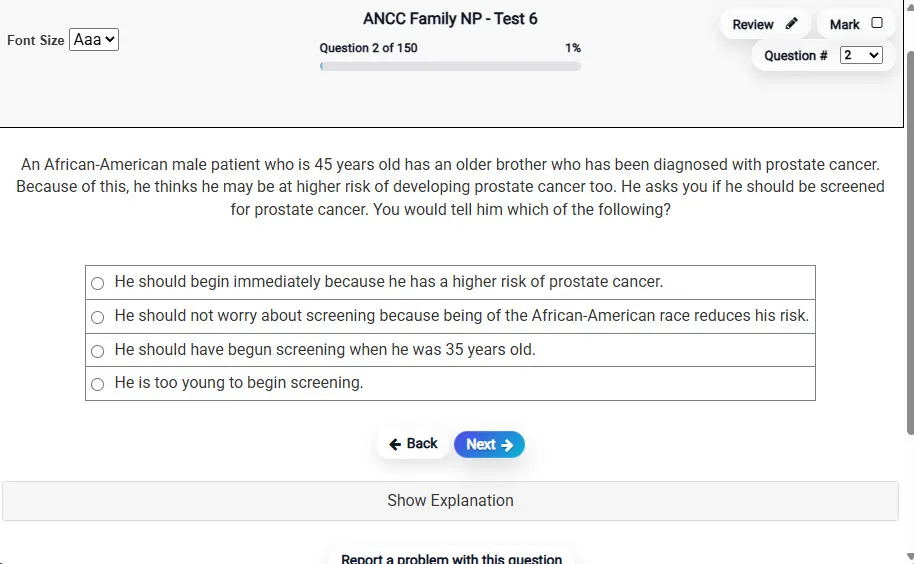
Answering a Question screen – Multiple-choice item view with navigation controls and progress tracker.
Answering a Question Multiple-choice item view with navigation controls and progress tracker.

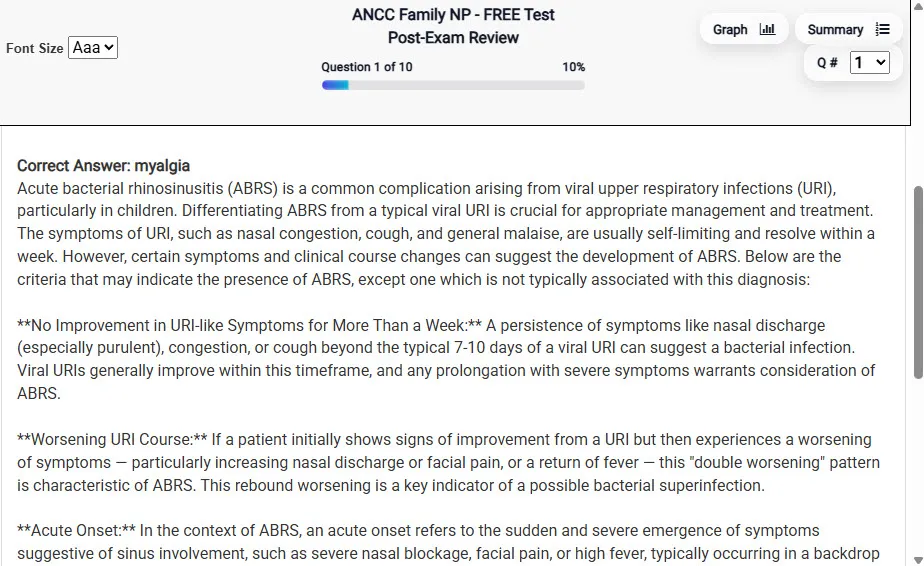
                           Detailed Explanation screen – 
                         Review mode showing chosen answer and rationale and references.
Detailed Explanation Review mode showing chosen answer and rationale and references.

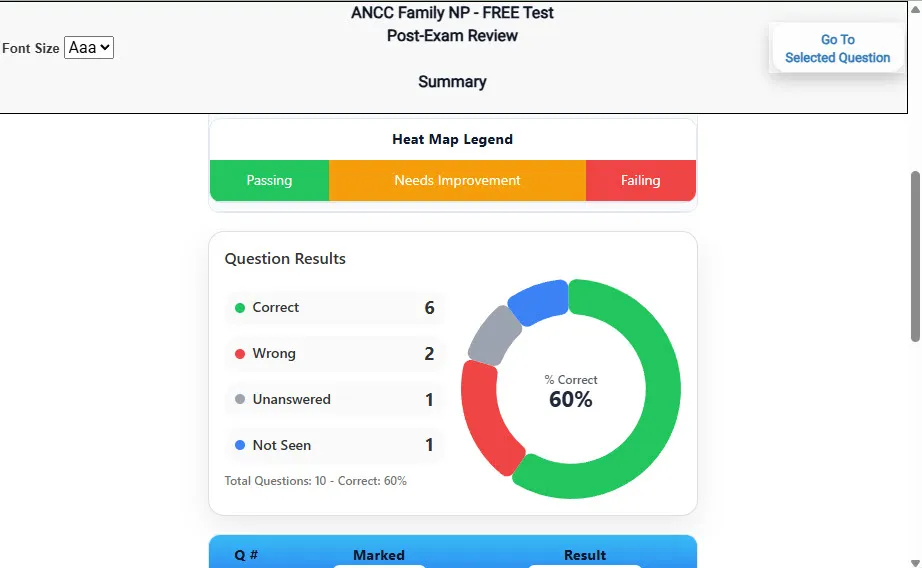
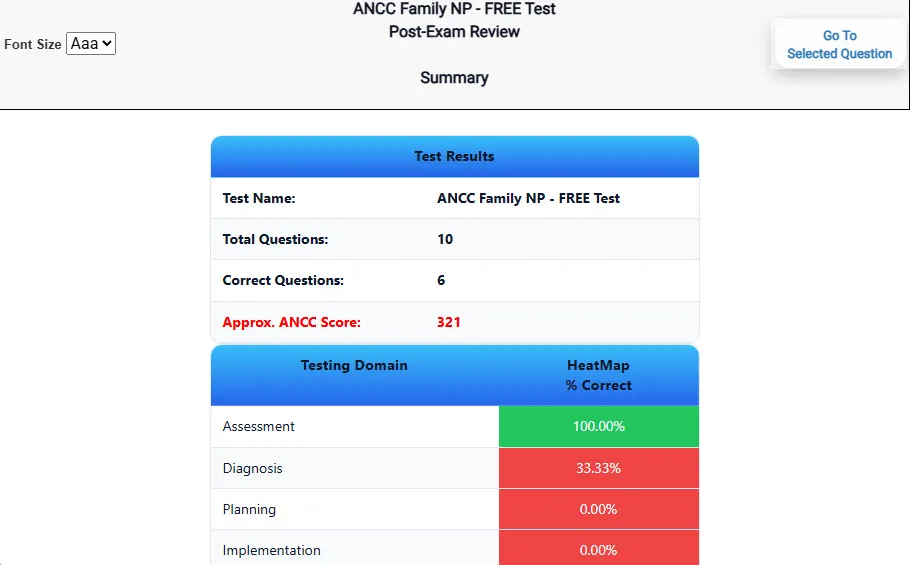
                           Review Summary 1 screen – 
                         Summary with counts for correct/wrong/unanswered and not seen items.
Review Summary 1 Summary with counts for correct/wrong/unanswered and not seen items.

                           Review Summary 2 screen – 
                         Advanced summary with category/domain breakdown and performance insights.
Review Summary 2 Advanced summary with category/domain breakdown and performance insights.

What Each Screen Shows

Answer Question Screen

  • Clean multiple-choice interface with progress bar.
  • Mark for review feature.
  • Matches real test pacing.

Detailed Explanation

  • Correct answer plus rationale.
  • Key concepts and guidelines highlighted.
  • Move between questions to fill knowledge gaps.

Review Summary 1

  • Overall results with total questions and scaled score.
  • Domain heatmap shows strengths and weaknesses.
  • Quick visual feedback on study priorities.

Review Summary 2

  • Chart of correct, wrong, unanswered, not seen.
  • Color-coded results for easy review.
  • Links back to missed items.

Top 10 Reasons to Use Exam Edge for your ARRT Bone Densitometry Exam Prep

  1. Focused on the ARRT Bone Densitometry Exam

    Our practice tests are built specifically for the ARRT Bone Densitometry exam — every question mirrors the real topics, format, and difficulty so you're studying exactly what matters.

  2. Real Exam Simulation

    We match the per-question time limits and pressure of the actual ARRT exam, so test day feels familiar and stress-free.

  3. 15 Full Practice Tests & 1,125 Unique Questions

    You'll have more than enough material to master every ARRT Bone Densitometry concept — no repeats, no fluff.

  4. Lower Cost Than a Retake

    Ordering 5 practice exams costs less than retaking the ARRT Bone Densitometry exam after a failure. One low fee could save you both time and money.

  5. Flexible Testing

    Need to step away mid-exam? Pick up right where you left off — with your remaining time intact.

  6. Instant Scoring & Feedback

    See your raw score and an estimated ARRT Bone Densitometry score immediately after finishing each practice test.

  7. Detailed Explanations for Every Question

    Review correct and incorrect answers with clear, step-by-step explanations so you truly understand each topic.

  8. Trusted & Accredited

    We're fully accredited by the Better Business Bureau and uphold the highest standards of trust and transparency.

  9. Web-Based & Always Available

    No software to install. Access your ARRT Bone Densitometry practice exams 24/7 from any computer or mobile device.

  10. Expert Support When You Need It

    Need extra help? Our specialized tutors are highly qualified and ready to support your ARRT exam prep.


Pass the ARRT Bone Densitometry Exam with Realistic Practice Tests from Exam Edge

Preparing for your upcoming ARRT Bone Densitometry (BONE) Certification Exam can feel overwhelming — but the right practice makes all the difference. Exam Edge gives you the tools, structure, and confidence to pass on your first try. Our online practice exams are built to match the real ARRT Bone Densitometry exam in content, format, and difficulty.

  • 📝 15 ARRT Bone Densitometry Practice Tests: Access 15 full-length exams with 75 questions each, covering every major ARRT Bone Densitometry topic in depth.
  • Instant Online Access: Start practicing right away — no software, no waiting.
  • 🧠 Step-by-Step Explanations: Understand the reasoning behind every correct answer so you can master ARRT Bone Densitometry exam concepts.
  • 🔄 Retake Each Exam Up to 4 Times: Build knowledge through repetition and track your improvement over time.
  • 🌐 Web-Based & Available 24/7: Study anywhere, anytime, on any device.
  • 🧘 Boost Your Test-Day Confidence: Familiarity with the ARRT format reduces anxiety and helps you perform under pressure.

These ARRT Bone Densitometry practice exams are designed to simulate the real testing experience by matching question types, timing, and difficulty level. This approach helps you get comfortable not just with the exam content, but also with the testing environment, so you walk into your exam day focused and confident.


Exam Edge ARRT Reviews


Hi, I just wanted to say thank you ! The tests really helped me prepare for the advanced level MRI ARRT Registry exam. 

Anthony , California

Thank you! I had tried to pass this exam before I found your site and was never able to do it. After your practice exams, I was able to pass on the next attempt!

Jane, PA

Thank you for being a great tool site for my VI certification exam. It helped me prepare for "battle". Practice makes perfect, alright.

Noel , NY

Sorry, but it didn't help me.

MARIA , Austin, Texas

Great practice for taking the MRI registry..the test gave me a baseline on the knowledge I have and the knowledge I need to study more on before taking the exam. It helped with the verbiage used for the questions.

DEBORA , Allen, Texas

Like MRI in Practice.

keith , Silver Spring , MD


ARRT Bone Densitometry Aliases Test Name

Here is a list of alternative names used for this exam.

  • ARRT Bone Densitometry
  • ARRT Bone Densitometry test
  • ARRT Bone Densitometry Certification Test
  • ARRT
  • ARRT BONE
  • BONE test
  • ARRT Bone Densitometry (BONE)
  • Bone Densitometry certification