This is the content of the pop-over!

Lightning Deal Alert – 12% Off Ends at Midnight!

Strike while the savings are hot! Use promo code FlashSale at checkout for 12% off any Exam Edge test or bundle. Hurry—the clock is ticking!

AMT MT (MT) Practice Tests & Test Prep by Exam Edge


AMT Medical Technologist  product image
(4.6)
Based on 34 Reviews

  • Real Exam Simulation: Timed questions and matching content build comfort for your AMT MT test day.
  • Instant, 24/7 Access: Web-based AMT Medical Technologist practice exams with no software needed.
  • Clear Explanations: Step-by-step answers and explanations for your AMT exam to strengthen understanding.
  • Boosted Confidence: Reduces anxiety and improves test-taking skills to ace your AMT Medical Technologist (MT).

Featured on

AMT Medical Technologist Online Practice Test Bundles

BEST VALUE
10 practice tests

$99.50

$399.50

SAVE $300

Only $9.95 per test!

  • 100% Pass Guarantee
  • 10 online practice tests
  • 100 questions per test
  • Bonus: 100 Flash Cards + Study Guide
  • Instant access
  • Detailed Explanations
  • Practice tests never expire
  • Timed, untimed, or study guide mode
5 practice tests

$69.75

$199.75

SAVE $130

Only $13.95 per test!

  • 5 online practice tests
  • 100 questions per test
  • Bonus: 100 Flash Cards + Study Guide
  • Instant access
  • Detailed Explanations
  • Practice tests never expire
  • Timed, untimed, or study guide mode
1 practice test

$39.95

  • 1 online practice test
  • 100 questions per test
  • Instant access
  • Detailed Explanations
  • Practice tests never expire
  • Timed, untimed, or study guide mode
Quick Select
Tap to choose a bundle

** All Prices are in US Dollars (USD) **


AMT MT (MT) Resources

Jump to the section you need most.

Understanding the exact breakdown of the AMT Medical Technologist test will help you know what to expect and how to most effectively prepare. The AMT Medical Technologist has multiple-choice questions . The exam will be broken down into the sections below:

AMT Medical Technologist Exam Blueprint
Domain Name % Number of
Questions
General Laboratory 12% 12
Clinical Chemistry 19% 19
Coagulation and Hemostasis 7% 7
Immunology and Serology 9% 9
Immunohematology 10% 10
Blood Banking and Transfusion Services 6% 6
Microbiology 15% 15
Urinalysis and Body Fluids 9% 9
Hematology 13% 13

AMT Medical Technologist Study Tips by Domain

  • Apply universal precautions and follow specimen labeling rules—any mismatch between patient ID and tube label is an automatic rejection/redraw (common AMT exam trap).
  • Recognize preanalytical errors: hemolysis falsely elevates K+ and LDH, and prolonged tourniquet time can concentrate analytes—flag results that don’t fit the clinical picture.
  • Prioritize quality control: if QC is out of range, do not report patient results until you troubleshoot (reagent lot, calibration, maintenance) and document corrective action.
  • Know centrifugation and processing requirements—red flag is incomplete clotting before spinning serum tubes (can cause fibrin strands and instrument clogs).
  • Handle critical values correctly: follow the lab’s read-back policy and document time, person notified, and result—failure to document is a compliance risk.
  • Use proper storage/transport: protect light-sensitive tests (e.g., bilirubin) and maintain temperature for ABG/CSF—delays or wrong temperature can invalidate results.
  • Verify specimen integrity before analysis—hemolysis can falsely increase K+, LDH, AST, and magnesium; a visibly pink/red serum is a red-flag for rejection or comment per policy.
  • Use correct tube/additive for the analyte—EDTA contamination is a common trap that causes high K+ with low Ca2+; check for lavender-top carryover when results are discordant.
  • Run and interpret QC with Westgard rules—a 1_3s or 2_2s violation is a priority stop-testing cue requiring troubleshooting before releasing patient results.
  • Recognize method interferences—lipemia and icterus can cause spectrophotometric bias; a red flag is an anion gap or bilirubin result that doesn’t match the sample appearance.
  • Apply critical value and delta-check policies—a sudden creatinine jump or glucose drop beyond lab-defined thresholds is a priority rule to repeat, verify ID, and promptly notify per AMT-style compliance expectations.
  • Know preanalytical timing constraints—delayed separation can lower glucose (glycolysis) and raise potassium; a common trap is not using gray-top (fluoride) or rapid centrifugation for STAT glucose.
  • Verify pre-analytical integrity first: underfilled light-blue citrate tubes (must be 9:1 blood-to-anticoagulant) falsely prolong PT/aPTT—red flag is a visibly short draw or high hematocrit (>55%) needing citrate adjustment.
  • Use PT/INR to monitor warfarin and aPTT (or anti-Xa) for unfractionated heparin—common trap is using aPTT to assess LMWH when anti-Xa is the priority test.
  • Interpret mixing studies correctly: correction suggests factor deficiency, no correction (immediate or after incubation) suggests inhibitor—red flag is time-dependent failure to correct pointing toward factor VIII inhibitor.
  • Recognize DIC patterns: prolonged PT and aPTT, low fibrinogen, elevated D-dimer, and thrombocytopenia—priority rule is to trend results, not rely on a single value, when clinical deterioration is suspected.
  • Differentiate platelet function vs count issues: normal platelet count with mucocutaneous bleeding suggests von Willebrand disease or qualitative platelet defect—common trap is calling it thrombocytopenia without reviewing platelet estimate/smear.
  • Handle specimens promptly: delayed testing can decrease factors V and VIII and prolong clot times—red flag is a sample sitting at room temperature too long or not platelet-poor plasma for lupus anticoagulant workups.
  • Differentiate primary vs secondary immune responses—IgM rises first then class-switches to IgG; a common trap is calling an early infection “negative” when only IgG was ordered.
  • Apply specimen handling rules for serology (avoid hemolysis, lipemia, and repeated freeze–thaw)—red flag: complement inactivation from improper storage can skew complement-dependent assays.
  • Interpret acute vs past infection patterns using paired serology and/or avidity testing—priority rule: a fourfold rise in titer between acute and convalescent specimens supports recent infection.
  • Know key hypersensitivity types (I–IV) and associated tests—common trap: confusing immediate IgE-mediated allergy testing with delayed-type (T-cell) reactions like contact dermatitis.
  • Understand principles and limitations of immunoassays (ELISA, immunofluorescence, latex agglutination, Western blot)—red flag: prozone/hook effects can cause false negatives in high-analyte samples unless dilution is performed.
  • Follow AMT-style quality and safety priorities for serology—threshold cue: always verify reactive screening results with the appropriate confirmatory algorithm before reporting, and do not report from expired reagents or failed controls.
  • ABO/Rh typing must include forward and reverse grouping; any discrepancy is a stop sign—do not issue blood until resolved with repeat testing and patient history review.
  • Positive antibody screen requires identification and antigen-negative, crossmatch-compatible units; a common trap is assuming a negative immediate-spin crossmatch rules out clinically significant IgG antibodies.
  • Use the indirect antiglobulin test (IAT) for unexpected antibodies and crossmatching; red flag: skipping the AHG phase after a positive screen can miss warm-reactive antibodies.
  • Direct antiglobulin test (DAT) supports hemolysis investigations (e.g., HDFN, autoimmune hemolytic anemia, transfusion reaction); priority rule: if DAT is positive post-transfusion, evaluate for newly developed alloantibody and do not rely on pretransfusion results alone.
  • Recognize common interference patterns—rouleaux, cold agglutinins, and antibodies to low-incidence antigens; contraindication cue: do not use room-temperature methods when cold autoantibodies are causing panagglutination—use prewarm/37 °C techniques as indicated.
  • Quality and safety essentials: check reagent QC and patient identification at every step; common AMT-style trap is mislabeling or tube mix-ups—follow strict two-identifier policies and repeat type on a separately collected specimen when required.
  • Verify transfusion readiness with two independent patient identifiers and correct specimen labeling; red flag: any mismatch (name/DOB/MRN) — stop and recollect rather than “correcting” the label.
  • Know component storage/handling limits: RBCs 1–6 °C, platelets 20–24 °C with agitation, FFP stored frozen and used promptly after thaw; trap: returning units to stock after time/temperature excursion.
  • Choose the right product for the indication — PRBCs for oxygen-carrying capacity, platelets for thrombocytopenia/platelet dysfunction, plasma for multiple factor deficiencies (elevated PT/aPTT), cryoprecipitate for low fibrinogen; cue: don’t use FFP for simple volume expansion.
  • Apply compatibility priorities: give ABO-compatible products and, for plasma, reverse ABO rules (AB plasma is universal); red flag: issuing group O RBCs without considering Rh status in females of childbearing potential.
  • Recognize and respond to transfusion reactions immediately — stop transfusion, keep IV line open with saline, and send required workup (clerical check, DAT, plasma hemolysis, repeat ABO/Rh); trap: restarting the unit before evaluation.
  • Use massive transfusion principles — anticipate hypocalcemia (citrate), hypothermia, dilutional coagulopathy, and hyperkalemia; cue: warm blood products appropriately and monitor ionized calcium rather than relying on total calcium.
  • For specimen quality, reject or recollect if transport time/temperature is wrong (e.g., CSF is STAT at room temp; urine should be cultured within 2 hours or refrigerated) — the red flag is “results don’t fit the clinical picture.”
  • On Gram stain, use the “PMNs vs. squamous epithelial cells” cue: many SECs suggests oropharyngeal/skin contamination and is a common trap before working up respiratory or wound cultures.
  • In blood cultures, treat single-bottle growth of common skin flora (e.g., coagulase-negative staph, Cutibacterium) as a contamination red flag unless multiple sets are positive or the patient has a line/prosthesis.
  • Interpret susceptibility results with intrinsic resistance in mind (priority rule: don’t report ampicillin for Klebsiella or vancomycin for Gram-negative rods) — otherwise you risk an AMT-style “reportable vs. nonreportable” trap.
  • For anaerobic cultures, improper collection is a contraindication to meaningful results (e.g., swabs or exposed specimens) — the practical cue is “foul odor/necrosis” but only aspirates/tissue in anaerobic transport are acceptable.
  • Apply standard precautions with high-risk organisms (e.g., Brucella, Francisella, Coccidioides) — the red flag is unexpected slow-growing small Gram-negative coccobacilli or mold with arthroconidia, prompting BSC use and supervisor notification.
  • Verify specimen integrity before testing: urine should be analyzed within 2 hours at room temperature or refrigerated; red flag — warm, delayed specimens can falsely raise pH and nitrite and lower glucose/ketones.
  • Use urine specific gravity to cross-check hydration and chemistry results; common trap — refractometer readings can be falsely high with radiographic contrast or high protein, so correlate with osmolality/clinical context.
  • Interpret dipstick blood/protein carefully: heme-positive with few/no RBCs suggests hemoglobinuria/myoglobinuria; red flag — ascorbic acid can cause false-negative blood and glucose on some strips.
  • Microscopy requires correct concentration and reporting units; priority rule — if casts are suspected, examine fresh, well-mixed sediment promptly because hyaline and cellular casts dissolve in dilute/alkaline urine.
  • Differentiate common crystals and their clinical implications; red flag — hexagonal cystine or “coffin-lid” struvite crystals should trigger follow-up for cystinuria or urease-positive UTI, not be dismissed as “artifact.”
  • Body fluids: always document appearance and use correct tubes (EDTA for cell counts, anticoagulant-free for chemistries); common trap — clotted synovial/CSF samples invalidate counts, and low glucose/high neutrophils in CSF is a priority finding for bacterial meningitis.
  • Confirm unexpected CBC results with a peripheral smear review (platelet clumps, NRBCs, blasts) — red flag: low platelets with clumping suggests EDTA pseudothrombocytopenia, not true thrombocytopenia.
  • Recognize anemia patterns by indices and smear: microcytic/hypochromic (iron deficiency/thalassemia), macro-ovalocytes with hypersegmented neutrophils (megaloblastic) — trap: don’t call thalassemia iron deficiency when RBC count is normal/high with very low MCV.
  • Know reticulocyte interpretation — priority rule: a low retic count in anemia implies decreased production (marrow/iron/B12/folate), while high retic implies blood loss/hemolysis; correct for anemia (retic index) to avoid overcalling response.
  • Identify hemolysis clues — polychromasia, spherocytes/schistocytes, ?LDH, ?indirect bilirubin, ?haptoglobin — red flag: schistocytes with thrombocytopenia suggests microangiopathic hemolytic anemia (urgent correlation needed).
  • Differentiate leukemoid reaction vs leukemia — cue: toxic granulation/Döhle bodies and left shift favor reactive change, while blasts and uniform atypical cells suggest malignancy; common trap: mislabel reactive lymphocytosis as leukemia without smear morphology.
  • ESR and RBC morphology basics — threshold cue: anemia or macrocytosis can falsely elevate ESR, while sickle cells/spherocytes can lower it; red flag: rouleaux on smear suggests high proteins (e.g., plasma cell dyscrasia) and can alter ESR.


Built to Fit Into Your Busy Life

Everything you need to prepare with confidence—without wasting a minute.

Three Study Modes

Timed, No Time Limit, or Explanation mode.

Actionable Analytics

Heatmaps and scaled scores highlight weak areas.

High-Yield Rationales

Concise explanations emphasize key concepts.

Realistic Interface

Matches the feel of the actual exam environment.

Accessible by Design

Clean layout reduces cognitive load.

Anytime, Anywhere

Web-based access 24/7 on any device.
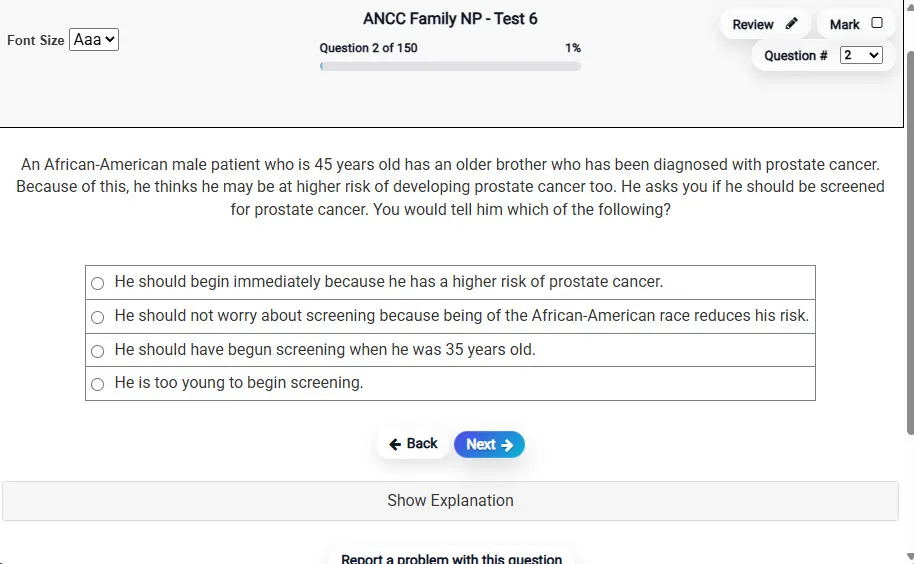
Answering a Question screen – Multiple-choice item view with navigation controls and progress tracker.
Answering a Question Multiple-choice item view with navigation controls and progress tracker.

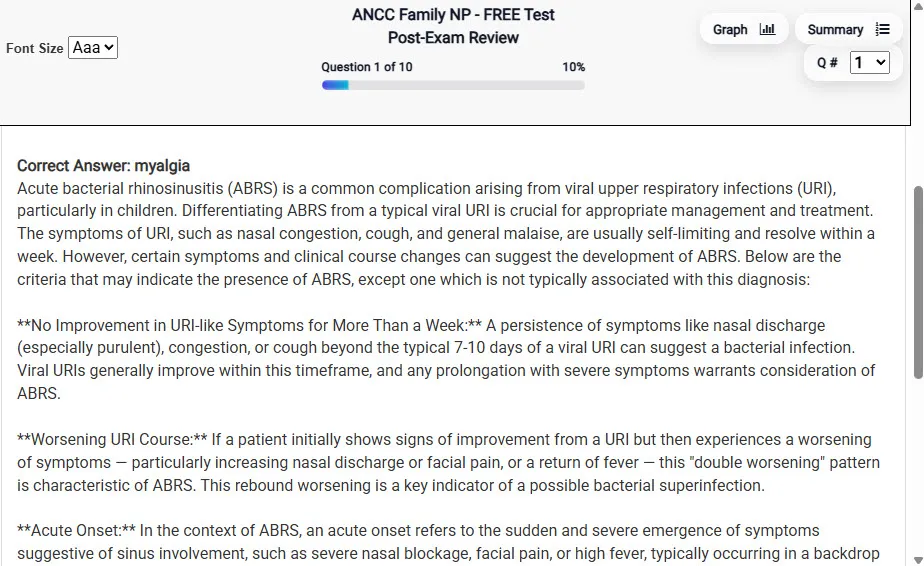
                           Detailed Explanation screen – 
                         Review mode showing chosen answer and rationale and references.
Detailed Explanation Review mode showing chosen answer and rationale and references.

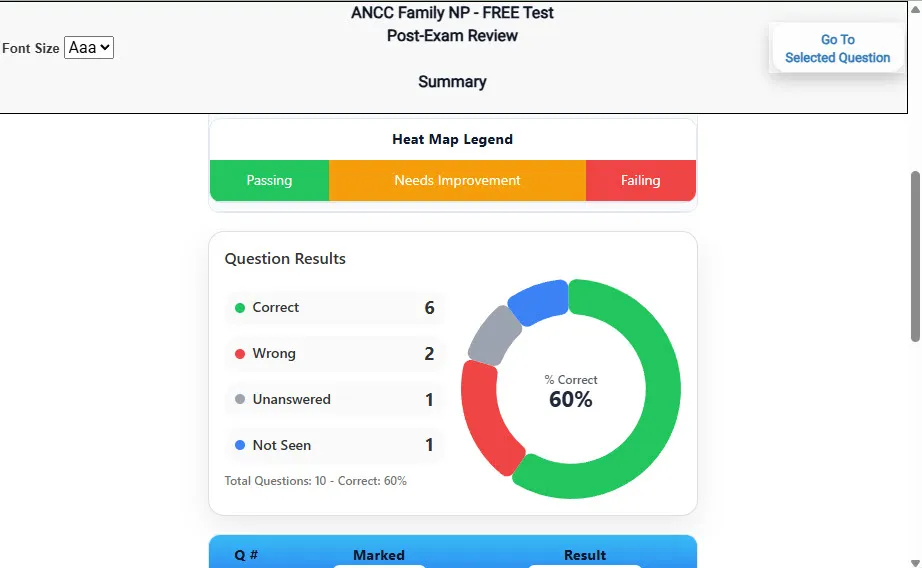
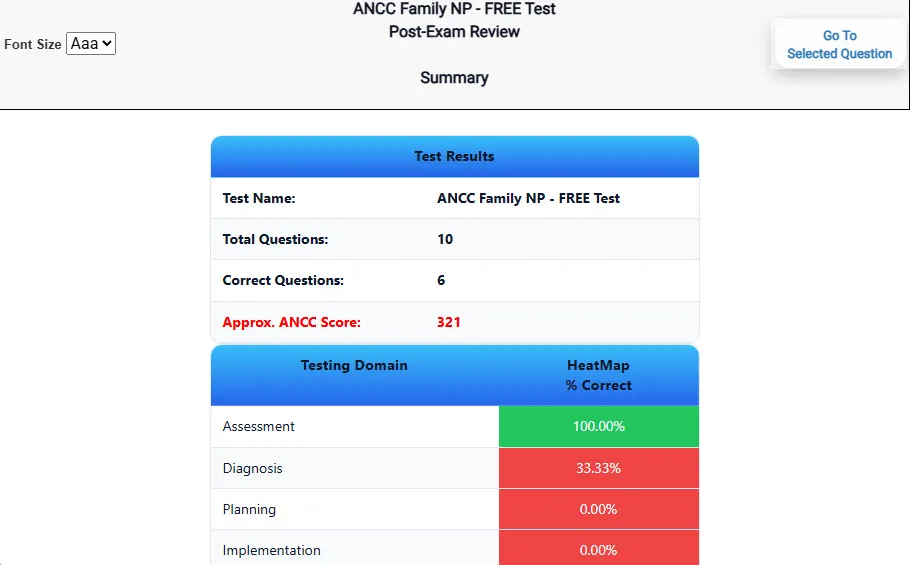
                           Review Summary 1 screen – 
                         Summary with counts for correct/wrong/unanswered and not seen items.
Review Summary 1 Summary with counts for correct/wrong/unanswered and not seen items.

                           Review Summary 2 screen – 
                         Advanced summary with category/domain breakdown and performance insights.
Review Summary 2 Advanced summary with category/domain breakdown and performance insights.

What Each Screen Shows

Answer Question Screen

  • Clean multiple-choice interface with progress bar.
  • Mark for review feature.
  • Matches real test pacing.

Detailed Explanation

  • Correct answer plus rationale.
  • Key concepts and guidelines highlighted.
  • Move between questions to fill knowledge gaps.

Review Summary 1

  • Overall results with total questions and scaled score.
  • Domain heatmap shows strengths and weaknesses.
  • Quick visual feedback on study priorities.

Review Summary 2

  • Chart of correct, wrong, unanswered, not seen.
  • Color-coded results for easy review.
  • Links back to missed items.

Top 10 Reasons to Use Exam Edge for your AMT Medical Technologist Exam Prep

  1. Focused on the AMT Medical Technologist Exam

    Our practice tests are built specifically for the AMT MT exam — every question mirrors the real topics, format, and difficulty so you're studying exactly what matters.

  2. Real Exam Simulation

    We match the per-question time limits and pressure of the actual AMT exam, so test day feels familiar and stress-free.

  3. 10 Full Practice Tests & 1,000 Unique Questions

    You'll have more than enough material to master every AMT MT concept — no repeats, no fluff.

  4. Lower Cost Than a Retake

    Ordering 5 practice exams costs less than retaking the AMT Medical Technologist exam after a failure. One low fee could save you both time and money.

  5. Flexible Testing

    Need to step away mid-exam? Pick up right where you left off — with your remaining time intact.

  6. Instant Scoring & Feedback

    See your raw score and an estimated AMT Medical Technologist score immediately after finishing each practice test.

  7. Detailed Explanations for Every Question

    Review correct and incorrect answers with clear, step-by-step explanations so you truly understand each topic.

  8. Trusted & Accredited

    We're fully accredited by the Better Business Bureau and uphold the highest standards of trust and transparency.

  9. Web-Based & Always Available

    No software to install. Access your AMT MT practice exams 24/7 from any computer or mobile device.

  10. Expert Support When You Need It

    Need extra help? Our specialized tutors are highly qualified and ready to support your AMT exam prep.


Pass the AMT Medical Technologist Exam with Realistic Practice Tests from Exam Edge

Preparing for your upcoming AMT Medical Technologist (MT) Certification Exam can feel overwhelming — but the right practice makes all the difference. Exam Edge gives you the tools, structure, and confidence to pass on your first try. Our online practice exams are built to match the real AMT MT exam in content, format, and difficulty.

  • 📝 10 AMT Medical Technologist Practice Tests: Access 10 full-length exams with 100 questions each, covering every major AMT Medical Technologist topic in depth.
  • Instant Online Access: Start practicing right away — no software, no waiting.
  • 🧠 Step-by-Step Explanations: Understand the reasoning behind every correct answer so you can master AMT MT exam concepts.
  • 🔄 Retake Each Exam Up to 4 Times: Build knowledge through repetition and track your improvement over time.
  • 🌐 Web-Based & Available 24/7: Study anywhere, anytime, on any device.
  • 🧘 Boost Your Test-Day Confidence: Familiarity with the AMT format reduces anxiety and helps you perform under pressure.

These AMT Medical Technologist practice exams are designed to simulate the real testing experience by matching question types, timing, and difficulty level. This approach helps you get comfortable not just with the exam content, but also with the testing environment, so you walk into your exam day focused and confident.


Exam Edge AMT Reviews


I took the AMT CMAS test this past Monday and got a perfect score. Exam Edge was a huge help!

Sue B, Colorado Springs, CO


AMT Medical Technologist Aliases Test Name

Here is a list of alternative names used for this exam.

  • AMT Medical Technologist
  • AMT Medical Technologist test
  • AMT Medical Technologist Certification Test
  • AMT MT test
  • AMT
  • AMT MT
  • MT test
  • AMT Medical Technologist (MT)
  • Medical Technologist certification