This is the content of the pop-over!

Lightning Deal Alert – 12% Off Ends at Midnight!

Strike while the savings are hot! Use promo code FlashSale at checkout for 12% off any Exam Edge test or bundle. Hurry—the clock is ticking!

HESI Medical Assisting (HESI-MA) Practice Tests & Test Prep by Exam Edge


HESI Medical Assisting  (CMS,RMS,NCMA) Exit   product image
(4.6)
Based on 37 Reviews

  • Real Exam Simulation: Timed questions and matching content build comfort for your HESI Medical Assisting test day.
  • Instant, 24/7 Access: Web-based HESI Medical Assisting (CMS,RMS,NCMA) Exit practice exams with no software needed.
  • Clear Explanations: Step-by-step answers and explanations for your HESI exam to strengthen understanding.
  • Boosted Confidence: Reduces anxiety and improves test-taking skills to ace your HESI Medical Assisting (CMS,RMS,NCMA) Exit (HESI-MA).

Featured on

HESI Medical Assisting (CMS,RMS,NCMA) Exit Online Practice Test Bundles

BEST VALUE
20 practice tests

$174.00

$799.00

SAVE $625

Only $8.70 per test!

  • 100% Pass Guarantee
  • 20 online practice tests
  • 100 questions per test
  • Bonus: 100 Flash Cards + Study Guide
  • Instant access
  • Detailed Explanations
  • Practice tests never expire
  • Timed, untimed, or study guide mode
MOST POPULAR
10 practice tests

$99.50

$399.50

SAVE $300

Only $9.95 per test!

  • 10 online practice tests
  • 100 questions per test
  • Bonus: 100 Flash Cards + Study Guide
  • Instant access
  • Detailed Explanations
  • Practice tests never expire
  • Timed, untimed, or study guide mode
5 practice tests

$69.75

$199.75

SAVE $130

Only $13.95 per test!

  • 5 online practice tests
  • 100 questions per test
  • Bonus: 100 Flash Cards
  • Instant access
  • Detailed Explanations
  • Practice tests never expire
  • Timed, untimed, or study guide mode
1 practice test

$39.95

  • 1 online practice test
  • 100 questions per test
  • Instant access
  • Detailed Explanations
  • Practice tests never expire
  • Timed, untimed, or study guide mode
Quick Select
Tap to choose a bundle

** All Prices are in US Dollars (USD) **


HESI Medical Assisting (HESI-MA) Resources

Jump to the section you need most.

Understanding the exact breakdown of the HESI Medical Assisting (CMS,RMS,NCMA) Exit test will help you know what to expect and how to most effectively prepare. The HESI Medical Assisting (CMS,RMS,NCMA) Exit has multiple-choice questions . The exam will be broken down into the sections below:

HESI Medical Assisting (CMS,RMS,NCMA) Exit Exam Blueprint
Domain Name % Number of
Questions
Anatomy and Physiology 11% 11
Medical Office Management - General Office Procedures 10% 10
Medical Office Management - Bookkeeping 4% 4
Medical Office Management - Insurance Processings 4% 4
Medical Procedures 12% 12
Patient Examination 12% 12
Phlebotomy 11% 11
Diagnostic Testing: ECG and other Lab Procedures 12% 12
Medical Terminology 12% 12
Pharmacology 12% 12

HESI Medical Assisting (CMS,RMS,NCMA) Exit Study Tips by Domain

  • Know directional terms and planes (anterior/posterior, medial/lateral, sagittal/frontal/transverse)—common trap: mixing up left/right when the patient is facing you.
  • Understand homeostasis and basic feedback loops—red flag: a question that asks for the “set point” (e.g., body temperature) is usually testing negative feedback.
  • Cardiovascular basics: follow blood flow through the heart and lungs in order—priority rule: right heart pumps to lungs, left heart pumps to body; don’t reverse oxygenated vs deoxygenated sides.
  • Respiratory anatomy and gas exchange—common trap: confusing ventilation (air movement) with respiration (gas exchange at alveoli and tissues).
  • Renal and urinary function: nephron role in filtration, reabsorption, and secretion—red flag: protein in urine points to a filtration barrier problem, not “normal” kidney function.
  • Endocrine and reproductive fundamentals: match major glands to key hormones and target organs—common trap: mixing up insulin vs glucagon actions (insulin lowers blood glucose; glucagon raises it).
  • Protect PHI at all times—verify identity with two identifiers before releasing results, and treat “quick updates” to family or employers without written authorization as a red flag.
  • Telephone/portal messages must be documented with date/time, caller, message, and action taken—common trap: failing to read back critical information (e.g., medication name/dose) to confirm accuracy.
  • Use professional scheduling rules—prioritize urgent symptoms (chest pain, SOB, neuro deficits) for immediate escalation/911 rather than “next available,” and flag double-booking providers as a safety risk.
  • Handle incoming mail/faxes/e-faxes with controlled workflows—time-stamp, route to the correct staff member, and never file unsigned provider orders (red flag: missing signature/date on orders or referrals).
  • Maintain record integrity—correct charting errors with a single line-through, date, time, and initials; contraindication: erasing, using white-out, or deleting entries without an audit trail.
  • Infection control is part of office procedures—use standard precautions for all patients and treat unlabeled specimens, unknown sharps, or “reused” single-use items as immediate stop-work hazards.
  • Post transactions using double-entry logic: every debit must have a matching credit—red flag if the trial balance doesn’t equal zero.
  • Reconcile the bank statement monthly by matching deposits, checks, and electronic payments—common trap: forgetting outstanding checks or deposits in transit.
  • Use a daily deposit slip and keep a cash receipts log (copays, deductibles, self-pay) with numbered receipts—priority rule: never leave collected cash unsecured or unlogged.
  • Manage accounts receivable with an aging report (e.g., 0–30, 31–60, 61–90, >90 days)—red flag: balances >90 days without documented follow-up or payment plan.
  • Handle refunds and overpayments with clear documentation and supervisor approval—common trap: refunding before confirming payer recoupment rules and patient balance accuracy.
  • Maintain separation of duties (collecting, posting, and reconciling should not be the same person when possible)—red flag: one staff member controls the entire payment-to-deposit process.
  • Verify coverage before nonemergent services and obtain required preauthorization; red flag: scheduling specialty imaging or procedures without documented auth often leads to denials.
  • Confirm patient demographics and insurance details (spelling, DOB, member ID, group #) at every visit; common trap: a single digit error can cause an “invalid member” rejection.
  • Collect and scan both sides of insurance cards and update coordination of benefits when there is more than one plan; priority rule: bill primary insurer first and send the EOB when filing to secondary.
  • Use correct coding support (ICD-10-CM, CPT/HCPCS) and ensure diagnosis supports medical necessity; red flag: mismatched diagnosis-to-procedure pairs frequently trigger payer edits.
  • Track timely filing limits and resubmission deadlines per payer; common trap: waiting to correct a claim until after the payer’s filing window closes.
  • Post payments accurately (allowed amount, adjustments, deductibles, copays) and reconcile denials with the remittance advice; priority rule: appeal with documentation when the EOB reason code indicates missing info rather than underpayment.
  • Use sterile vs. clean technique correctly—red flag: touching a sterile field with unsterile gloves means you must re-establish sterility before proceeding.
  • Medication administration basics apply in procedures (e.g., injections)—priority rule: verify the “rights” and check allergies before prep; common trap is skipping patient identification when the chart is “already open.”
  • Wound care/dressing changes require assessing drainage first—red flag: purulent drainage, increasing redness, warmth, or fever suggests infection and should be reported before routine re-dressing.
  • For specimen collection and handling during procedures, label at the bedside immediately—common trap: pre-labeling tubes/containers, which risks misidentification and rejected specimens.
  • Vital signs and patient response monitoring are procedural safety steps—priority rule: new hypotension, shortness of breath, or altered mental status after a procedure indicates possible adverse reaction and requires immediate escalation.
  • Patient education and consent support safe procedures—red flag: patient cannot restate instructions (e.g., wound care, activity limits) or appears uncertain, so re-teach before discharge to prevent nonadherence complications.
  • Verify patient identity with two identifiers (e.g., name and DOB) before any exam step; red flag: performing vitals or procedures after only a room-number confirmation.
  • Accurately measure and document vital signs with correct technique (proper cuff size, seated/rested for BP); common trap: using a cuff that is too small causes falsely high readings.
  • Use appropriate patient positioning and draping (e.g., lithotomy for pelvic, Sims for enemas/rectal); priority rule: maintain privacy and expose only the area being examined.
  • Recognize and promptly report abnormal findings (e.g., chest pain, SpO2 < 90%, new confusion, uncontrolled bleeding); red flag: delaying escalation while finishing routine intake.
  • Apply infection control throughout the exam (hand hygiene before/after, clean vs. sterile supplies, disinfect stethoscope/thermometers); common trap: reusing single-use items or skipping equipment cleaning between patients.
  • Document objectively and promptly (location/size/color, patient quotes in “”, time-stamped entries); contraindication: charting assumptions (e.g., “patient intoxicated”) instead of observable facts.
  • Confirm patient ID with two identifiers and match the requisition before sticking; red flag: unlabeled or mislabeled tubes are rejected and must be redrawn.
  • Follow order of draw to prevent additive carryover (e.g., blood cultures → light blue → serum → green → lavender → gray); common trap: drawing EDTA before serum can falsely increase potassium or decrease calcium.
  • For sodium citrate (light blue) coag tests, fill to the line for a 9:1 blood-to-anticoagulant ratio; priority rule: underfilled tubes can falsely prolong PT/INR or aPTT.
  • Limit tourniquet time to ≤ 1 minute and avoid fist pumping; red flag: prolonged stasis can cause hemoconcentration and skew labs (e.g., potassium, protein, hematocrit).
  • Prevent hemolysis by letting alcohol dry, using an appropriate needle gauge, and gentle inversion (don’t shake); common trap: hemolyzed specimens can falsely elevate potassium and invalidate results.
  • Know site restrictions: avoid IV-infusing arms, mastectomy side, or areas with hematoma; priority rule: if drawing near an IV, use the opposite arm or stop infusion per facility policy and document to avoid dilution errors.
  • For a standard 12-lead ECG, place limb leads on the torso only if permitted by facility policy; red flag: swapped RA/LA or RL/LL leads can mimic axis deviation or infarct patterns.
  • Before recording an ECG, confirm patient ID and ensure skin is clean/dry (clip hair if needed); common trap: motion, talking, or tremor produces artifact that looks like dysrhythmia.
  • Know normal calibration (25 mm/sec and 10 mm/mV) and verify the printout shows it; red flag: wrong speed/amplitude can falsely change PR/QRS/QT interpretation.
  • For CLIA-waived point-of-care tests (e.g., glucose, urine dip), run and document QC per manufacturer schedule; priority rule: do not report patient results if controls are out of range.
  • Urine specimen handling matters: use a clean-catch midstream for culture and label at bedside; red flag: unlabeled or delayed specimens can cause false growth or rejected samples.
  • Follow standard precautions with all specimens and sharps; contraindication cue: never recap needles—activate safety device immediately and dispose in a puncture-resistant sharps container.
  • Break down complex terms by word parts (prefix, root, suffix) and define from the end first; red flag: confusing “hyper-” vs “hypo-” reverses meaning and can invert a provider order.
  • Know common suffix patterns (e.g., -itis inflammation, -ectomy removal, -otomy incision, -ostomy new opening); common trap: mixing -otomy and -ostomy can change the procedure and documentation.
  • Use correct anatomical directionality (anterior/posterior, proximal/distal, medial/lateral) and planes; priority rule: always relate terms to the patient’s position, not the observer’s viewpoint.
  • Interpret abbreviations carefully and follow “do-not-use” safety principles; red flag: unclear abbreviations (e.g., IU, q.d., trailing zeros) should be clarified before charting or communicating.
  • Differentiate similar diagnostic and specialty terms (e.g., cardiology vs cardiomyopathy, nephrology vs nephrectomy); common trap: assuming “-logy” implies a procedure rather than a field of study.
  • Apply correct spelling and plural forms (e.g., diagnosis/diagnoses, bacterium/bacteria, phalanx/phalanges) in records; red flag: misspellings in charting can cause claim denials or misfiled results.
  • Verify the “rights” of medication administration (patient, drug, dose, route, time, documentation) and check two identifiers before giving anything—red flag: relying on room number or a family member’s confirmation.
  • Screen for allergies and previous reactions every time, especially with antibiotics and vaccines—common trap: documenting “NKDA” without asking about latex, tape, iodine/contrast, or food cross-reactivity.
  • Know high-alert medication basics (insulin, anticoagulants, opioids) and use independent dose/label checks per facility policy—priority rule: clarify any order with a trailing zero (e.g., 5.0 mg) or missing leading zero (e.g., .5 mg).
  • Monitor for therapeutic vs adverse effects and teach patients what requires urgent care—red flag: bleeding/bruising with anticoagulants, hypoglycemia signs with insulin/oral agents, or respiratory depression with opioids.
  • Prevent medication interactions by reviewing OTCs, herbals, and alcohol use—common trap: missing warfarin + NSAIDs/aspirin, nitrates + PDE-5 inhibitors, or MAOIs + decongestants.
  • Follow safe storage/handling rules: label and date multi-dose vials, maintain cold chain when required, and dispose of sharps properly—red flag: recapping needles or giving a medication from an unlabeled syringe.


Built to Fit Into Your Busy Life

Everything you need to prepare with confidence—without wasting a minute.

Three Study Modes

Timed, No Time Limit, or Explanation mode.

Actionable Analytics

Heatmaps and scaled scores highlight weak areas.

High-Yield Rationales

Concise explanations emphasize key concepts.

Realistic Interface

Matches the feel of the actual exam environment.

Accessible by Design

Clean layout reduces cognitive load.

Anytime, Anywhere

Web-based access 24/7 on any device.
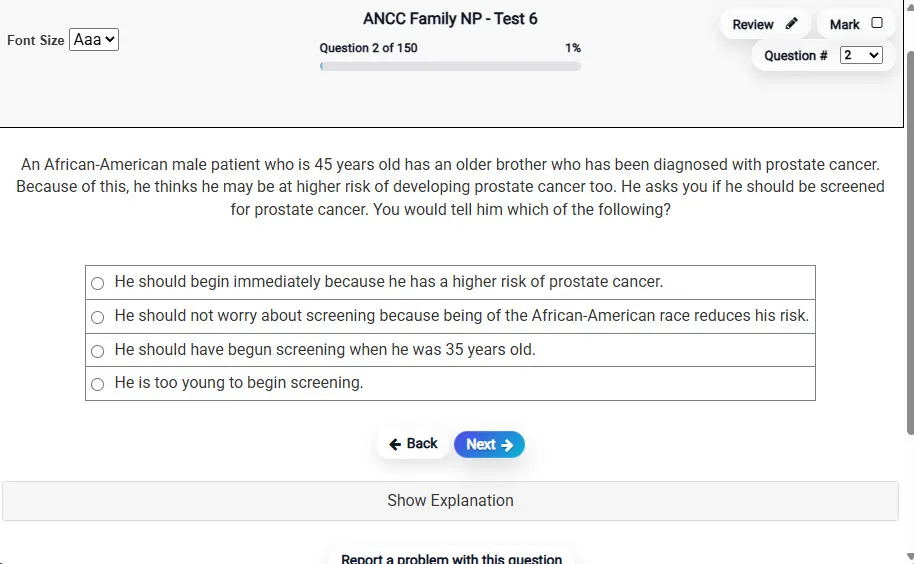
Answering a Question screen – Multiple-choice item view with navigation controls and progress tracker.
Answering a Question Multiple-choice item view with navigation controls and progress tracker.

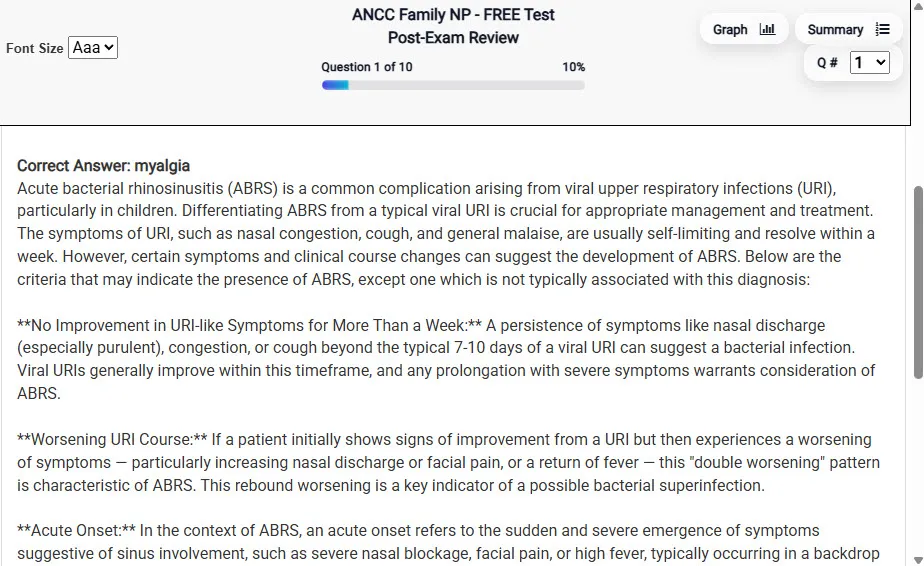
                           Detailed Explanation screen – 
                         Review mode showing chosen answer and rationale and references.
Detailed Explanation Review mode showing chosen answer and rationale and references.

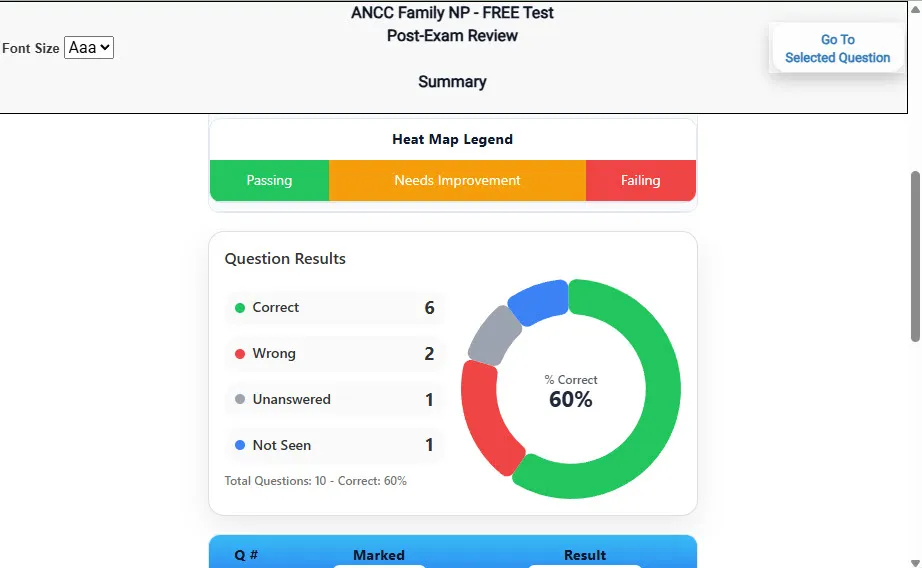
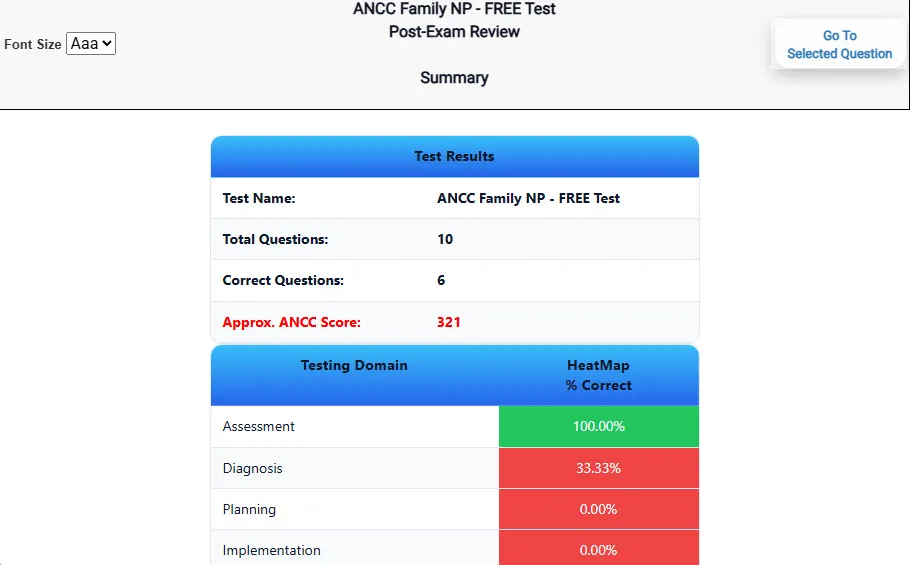
                           Review Summary 1 screen – 
                         Summary with counts for correct/wrong/unanswered and not seen items.
Review Summary 1 Summary with counts for correct/wrong/unanswered and not seen items.

                           Review Summary 2 screen – 
                         Advanced summary with category/domain breakdown and performance insights.
Review Summary 2 Advanced summary with category/domain breakdown and performance insights.

What Each Screen Shows

Answer Question Screen

  • Clean multiple-choice interface with progress bar.
  • Mark for review feature.
  • Matches real test pacing.

Detailed Explanation

  • Correct answer plus rationale.
  • Key concepts and guidelines highlighted.
  • Move between questions to fill knowledge gaps.

Review Summary 1

  • Overall results with total questions and scaled score.
  • Domain heatmap shows strengths and weaknesses.
  • Quick visual feedback on study priorities.

Review Summary 2

  • Chart of correct, wrong, unanswered, not seen.
  • Color-coded results for easy review.
  • Links back to missed items.

Top 10 Reasons to Use Exam Edge for your HESI Medical Assisting (CMS,RMS,NCMA) Exit Exam Prep

  1. Focused on the HESI Medical Assisting (CMS,RMS,NCMA) Exit Exam

    Our practice tests are built specifically for the HESI Medical Assisting exam — every question mirrors the real topics, format, and difficulty so you're studying exactly what matters.

  2. Real Exam Simulation

    We match the per-question time limits and pressure of the actual HESI exam, so test day feels familiar and stress-free.

  3. 20 Full Practice Tests & 2,000 Unique Questions

    You'll have more than enough material to master every HESI Medical Assisting concept — no repeats, no fluff.

  4. Lower Cost Than a Retake

    Ordering 5 practice exams costs less than retaking the HESI Medical Assisting (CMS,RMS,NCMA) Exit exam after a failure. One low fee could save you both time and money.

  5. Flexible Testing

    Need to step away mid-exam? Pick up right where you left off — with your remaining time intact.

  6. Instant Scoring & Feedback

    See your raw score and an estimated HESI Medical Assisting (CMS,RMS,NCMA) Exit score immediately after finishing each practice test.

  7. Detailed Explanations for Every Question

    Review correct and incorrect answers with clear, step-by-step explanations so you truly understand each topic.

  8. Trusted & Accredited

    We're fully accredited by the Better Business Bureau and uphold the highest standards of trust and transparency.

  9. Web-Based & Always Available

    No software to install. Access your HESI Medical Assisting practice exams 24/7 from any computer or mobile device.

  10. Expert Support When You Need It

    Need extra help? Our specialized tutors are highly qualified and ready to support your HESI exam prep.


Pass the HESI Medical Assisting (CMS,RMS,NCMA) Exit Exam with Realistic Practice Tests from Exam Edge

Preparing for your upcoming HESI Medical Assisting (CMS,RMS,NCMA) Exit (HESI-MA) Certification Exam can feel overwhelming — but the right practice makes all the difference. Exam Edge gives you the tools, structure, and confidence to pass on your first try. Our online practice exams are built to match the real HESI Medical Assisting exam in content, format, and difficulty.

  • 📝 20 HESI Medical Assisting (CMS,RMS,NCMA) Exit Practice Tests: Access 20 full-length exams with 100 questions each, covering every major HESI Medical Assisting (CMS,RMS,NCMA) Exit topic in depth.
  • Instant Online Access: Start practicing right away — no software, no waiting.
  • 🧠 Step-by-Step Explanations: Understand the reasoning behind every correct answer so you can master HESI Medical Assisting exam concepts.
  • 🔄 Retake Each Exam Up to 4 Times: Build knowledge through repetition and track your improvement over time.
  • 🌐 Web-Based & Available 24/7: Study anywhere, anytime, on any device.
  • 🧘 Boost Your Test-Day Confidence: Familiarity with the HESI format reduces anxiety and helps you perform under pressure.

These HESI Medical Assisting (CMS,RMS,NCMA) Exit practice exams are designed to simulate the real testing experience by matching question types, timing, and difficulty level. This approach helps you get comfortable not just with the exam content, but also with the testing environment, so you walk into your exam day focused and confident.


Exam Edge HESI Reviews


I just took my Hesi exit PN today and got a Hesi score of 1205 and a conversion score of 99.99%. Thanks for the help. Doing all those tests helped so much. Not because I saw the same questions but because I learned so much from the answer reasoning section. Hope to fly through my boards in a couple ...
Read More
Sharon, Texas

I recently had to test out of my school with an 850 on the Hesi PN, so I purchased the exams from you guys, about 5 to 7 exams, and passed the exit HesiPn with a 988! First time around! Then I purchased the NclexPN exam tests from you guys and I passed my nclex the first time around! These tests rea ...
Read More
Welsh, NC

I want to thank you. The tests are really helpful. I took them three times and after using your exams, I finally passed. The tests helped me especially in the math section, in which I got a 90.

DIANA , Texas

I can't believe this website doesn't have a high following status. I bought 40 practice questions, and I did 20 practice questions and took my Hesi exit. I scored 1070. I completed all 40 practice exams and passed my boards for the first time. Exam Edge introduced me to a bunch of topics and boosted ...
Read More
Juliet M., Tarpon Springs, Florida


HESI Medical Assisting (CMS,RMS,NCMA) Exit Aliases Test Name

Here is a list of alternative names used for this exam.

  • HESI Medical Assisting (CMS,RMS,NCMA) Exit
  • HESI Medical Assisting (CMS,RMS,NCMA) Exit test
  • HESI Medical Assisting (CMS,RMS,NCMA) Exit Certification Test
  • HESI Medical Assisting test
  • HESI
  • HESI HESI-MA
  • HESI-MA test
  • HESI Medical Assisting (CMS,RMS,NCMA) Exit (HESI-MA)
  • Medical Assisting (CMS,RMS,NCMA) Exit certification