This is the content of the pop-over!

HESI Dosage Calculations (HESI-DC) Practice Tests & Test Prep by Exam Edge


HESI Dosage Calculations  product image
(4.5)
Based on 32 Reviews

  • Real Exam Simulation: Timed questions and matching content build comfort for your HESI Dosage Calculations test day.
  • Instant, 24/7 Access: Web-based HESI Dosage Calculations practice exams with no software needed.
  • Clear Explanations: Step-by-step answers and explanations for your HESI exam to strengthen understanding.
  • Boosted Confidence: Reduces anxiety and improves test-taking skills to ace your HESI Dosage Calculations (HESI-DC).

Featured on

HESI Dosage Calculations Online Practice Test Bundles

BEST VALUE
10 practice tests

$99.50

$399.50

SAVE $300

Only $9.95 per test!

  • 100% Pass Guarantee
  • 10 online practice tests
  • 50 questions per test
  • Bonus: 100 Flash Cards + Study Guide
  • Instant access
  • Detailed Explanations
  • Practice tests never expire
  • Timed, untimed, or study guide mode
5 practice tests

$69.75

$199.75

SAVE $130

Only $13.95 per test!

  • 5 online practice tests
  • 50 questions per test
  • Bonus: 100 Flash Cards + Study Guide
  • Instant access
  • Detailed Explanations
  • Practice tests never expire
  • Timed, untimed, or study guide mode
1 practice test

$39.95

  • 1 online practice test
  • 50 questions per test
  • Instant access
  • Detailed Explanations
  • Practice tests never expire
  • Timed, untimed, or study guide mode
Quick Select
Tap to choose a bundle

** All Prices are in US Dollars (USD) **


HESI Dosage Calculations (HESI-DC) Resources

Jump to the section you need most.

Understanding the exact breakdown of the HESI Dosage Calculations test will help you know what to expect and how to most effectively prepare. The HESI Dosage Calculations has 50 multiple-choice questions . The exam will be broken down into the sections below:

HESI Dosage Calculations Exam Blueprint
Domain Name
Roman Numerals  
Fractions  
Decimal Numbers  
Measurement  
Equations and Variables  
Ratio and Proportion  
Percents and Solutions  
Powder Volume  
Children's Doses  
Business Calculations  

HESI Dosage Calculations Study Tips by Domain

  • Memorize the core symbols: I=1, V=5, X=10, L=50, C=100, D=500, M=1000—red flag if a symbol repeats more than three times in a row (invalid in standard use).
  • Use the subtractive rule: a smaller numeral before a larger one means subtraction (IV=4, IX=9, XL=40, XC=90, CD=400, CM=900)—common trap is reading IV as 6 or IX as 11.
  • Add left-to-right when numerals decrease or stay the same (VIII=8, XIII=13)—priority cue: if any smaller value appears after a larger one, you should not subtract it.
  • Watch for medication-order context: Roman numerals often indicate type/strength/sequence (e.g., Factor VIII, Vitamin K, cranial nerve II)—red flag is confusing the numeral for a dose amount.
  • Convert carefully around look-alikes: VI=6 vs IV=4, XI=11 vs IX=9—common trap is swapping order under time pressure.
  • If a Roman numeral appears on an order or label, verify it matches the intended item before calculating a dose—priority rule: unclear or nonstandard numerals require clarification rather than guesswork.
  • Reduce fractions to lowest terms before converting or comparing doses; red flag: leaving 6/8 instead of 3/4 can change the final answer when you cancel units.
  • When multiplying fractions, cross-cancel first to prevent arithmetic errors; common trap: multiplying all numerators/denominators without simplifying leads to wrong or messy results.
  • When dividing by a fraction, multiply by its reciprocal and keep units aligned; red flag: flipping the wrong fraction reverses the dose (e.g., mg per mL becomes mL per mg).
  • Convert mixed numbers to improper fractions before calculations; common trap: treating 1 1/2 as 1/2 or 1.2 instead of 3/2.
  • Add/subtract fractions only after finding a common denominator; red flag: adding numerators and denominators directly (1/4 + 1/4 ? 2/8).
  • Convert common clinical fractions to decimals accurately (e.g., 1/2 = 0.5, 1/4 = 0.25, 3/4 = 0.75); HESI trap: misplacing the decimal can cause a 10× error.
  • Align decimal points vertically before adding/subtracting; red flag: writing numbers in a column without lining up decimals is a common cause of 10× errors.
  • When multiplying decimals, count total decimal places in factors and place the decimal in the product accordingly; trap: forgetting to reinsert the decimal after multiplying whole numbers.
  • When dividing by a decimal, move the decimal in both divisor and dividend the same number of places to make the divisor a whole number; priority rule: never move only one number.
  • Use leading zeros (0.5 mg) and avoid trailing zeros (5 mg not 5.0 mg); HESI-style safety cue: missing a leading zero or adding a trailing zero can create a 10-fold dose error.
  • Convert between decimals and fractions/percents accurately (e.g., 0.25 = 25%); red flag: misplacing the decimal when converting to percent by moving it the wrong direction.
  • Round only at the end of multi-step problems and follow item instructions (e.g., tenths for mL, hundredths for weight-based doses); trap: early rounding can push the final dose outside a safe threshold.
  • Convert within the same system before calculating the dose (e.g., 1 kg = 2.2 lb; 1 g = 1000 mg) — red flag: mixing lb with kg or g with mg in the final setup.
  • Use leading zeros and avoid trailing zeros for measurements (e.g., 0.5 mL not .5 mL; 1.0 mg not 1.0 mg) — common HESI trap: trailing zeros lead to 10× errors.
  • Know key household-to-metric equivalents often tested (1 tsp = 5 mL; 1 tbsp = 15 mL; 1 oz = 30 mL) — priority rule: if both are available, choose metric to reduce error.
  • For IV rates, keep units aligned (mL/hr, gtt/min) and use the drop factor exactly as labeled (e.g., 10, 15, 20, 60 gtt/mL) — red flag: assuming all tubing is 60 gtt/mL.
  • Maintain dimensional analysis labels through every step (e.g., mg → mL) and cancel units visibly — common trap: skipping unit cancellation and ending with the wrong unit (like mg/hr instead of mL/hr).
  • Apply clinical reasonableness checks after conversion (e.g., adult IM volumes typically 1–3 mL; insulin measured in units, not mL) — contraindication cue: if a calculated volume looks unusually large/small, recheck the conversion.
  • Translate word problems into one equation by defining the variable first (e.g., let x = ordered dose in mg); red flag: solving before labeling x often flips what you’re finding.
  • Use dimensional consistency as an error check: every term added/subtracted must share units; common trap: adding mg and mL in the same expression.
  • For linear equations, isolate the variable with inverse operations one step at a time; priority rule: do the same operation to both sides to avoid sign mistakes.
  • When clearing decimals in an equation, multiply every term by the same power of 10; red flag: forgetting to multiply a lone constant term changes the entire balance.
  • For equations with fractions, multiply through by the least common denominator (LCD) before solving; common trap: distributing incorrectly across parentheses after applying the LCD.
  • After solving for x, substitute back to verify the original equation and confirm units make sense; red flag: a negative value for dose/time/volume is an immediate stop-and-recheck.
  • Set up ratios with like units on the same side (e.g., mg/mL = mg/mL) and cancel units before solving; red flag: mixing mL with L or mg with g without converting first.
  • Use the proportion desired/available = x/volume (or equivalent) and cross-multiply carefully; common trap: flipping one ratio so the answer becomes the reciprocal dose.
  • For oral liquids, write mg ordered / mg per mL = mL to give; priority rule: if the computed mL is far above a typical single dose (e.g., >20 mL), re-check the setup.
  • For tablets, use dose ordered / dose per tablet = tablets; red flag: orders that would require more than 2 tablets when only whole tablets are available (confirm if splitting is allowed).
  • For IV rates, keep time units consistent in the proportion (mL/hr or gtt/min, not both); common trap: forgetting to convert minutes to hours before solving.
  • Sanity-check proportion answers by estimating (e.g., if ordered dose is half the available dose, volume should be about half); red flag: a volume that increases when the ordered dose decreases.
  • Convert percent to ratio for solutions: X% = X g per 100 mL (w/v) unless stated otherwise; red flag if the order specifies % w/w or % v/v—units change the setup.
  • Use the dilution equation C1V1 = C2V2 and solve for the missing variable; common trap: mixing % and mg/mL without converting (1% = 1 g/100 mL = 10 mg/mL).
  • For mg/mL conversion, keep units aligned and cancel (e.g., g to mg, mL to L) before calculating; priority rule: convert first, then plug into the equation.
  • When mixing two solutions of different strengths, check whether the final concentration must fall between the two starting concentrations; red flag if your answer is outside that range.
  • For IV solutions with additives, compute dose concentration (mg in total mL) before rate calculations; common trap: using bag volume instead of the final volume after the medication is added when the question specifies it.
  • Round only at the end and follow typical med safety thresholds (e.g., concentrations to the nearest tenth/hundredth as instructed); red flag: early rounding that changes a final answer enough to fail a HESI-style tolerance.
  • Reconstitution: add the specified diluent volume to the vial, then use the label’s “resulting concentration” (e.g., 1 g in 9.6 mL = 100 mg/mL)—red flag: assuming final volume equals diluent volume.
  • Account for powder displacement when directions state “add diluent to yield X mL”; priority rule: use the yield (final) volume for concentration, not the amount you injected.
  • Withdraw with the ordered dose in mind: Volume to give = ordered dose ÷ concentration; common trap: mixing mg/mL from reconstitution with a dose ordered in g without converting units.
  • Multi-dose vial timing: once reconstituted, check stability (e.g., “use within 24 hours/refrigerate”)—red flag: calculating correctly but administering after the beyond-use time.
  • When partial vial doses are needed, label the vial with the new concentration and date/time; common trap: later doses are calculated using the original (pre-reconstitution) strength.
  • For powdered antibiotics with high concentrations, verify syringe measurability (e.g., tenths vs hundredths mL); red flag: a calculated volume smaller than the smallest graduation without a required rounding policy.
  • Weight-based dosing: verify the child’s weight is in kg before calculating mg/kg/dose or mcg/kg/min; red flag—using lb directly (1 kg = 2.2 lb).
  • For mg/kg/day orders, apply the frequency correctly (e.g., divide the total daily mg by number of doses); common trap—giving the full daily amount each dose.
  • Always compare your calculated dose to safe range/min-max if provided; priority rule—if the ordered or calculated dose exceeds the max (e.g., mg/kg/day cap), hold and clarify.
  • For IV infusions in children (e.g., mcg/kg/min), convert minutes to hours correctly when finding mL/hr; red flag—forgetting ×60 leads to a 60-fold error.
  • When rounding pediatric doses, follow the label/syringe precision (e.g., oral syringes to 0.1 mL, tiny doses may need 0.01 mL if device allows); contraindication—rounding early in multi-step problems.
  • Double-check concentration units and dosage form (mg/5 mL vs mg/mL, tablets vs liquid) before finalizing; common trap—mixing mg and mcg without converting (1 mg = 1000 mcg).
  • Use the cost-per-unit formula (total cost ÷ quantity) and double-check units (per tablet vs per mL)—mixing units is a common HESI trap.
  • For markups/discounts, apply percent to the original base (price × percent) before adding/subtracting—red flag: taking the percent of the already-discounted price unless stated.
  • When calculating tax and total price, add tax after discounts unless the problem says otherwise—priority rule: follow the sequence given and label each intermediate amount.
  • In payroll-style problems, compute gross pay first (rate × hours), then subtract withholdings—red flag: forgetting overtime thresholds (e.g., >40 hr/week) if mentioned.
  • For inventory/ordering, round only at the end and round up when partial packages are not allowed—common trap: ordering 1.2 boxes when only whole boxes can be purchased.
  • In budgeting/comparison questions, keep like terms together (monthly vs yearly) by converting to one timeframe first—red flag: comparing $/month to $/year without conversion.


Built to Fit Into Your Busy Life

Everything you need to prepare with confidence—without wasting a minute.

Three Study Modes

Timed, No Time Limit, or Explanation mode.

Actionable Analytics

Heatmaps and scaled scores highlight weak areas.

High-Yield Rationales

Concise explanations emphasize key concepts.

Realistic Interface

Matches the feel of the actual exam environment.

Accessible by Design

Clean layout reduces cognitive load.

Anytime, Anywhere

Web-based access 24/7 on any device.
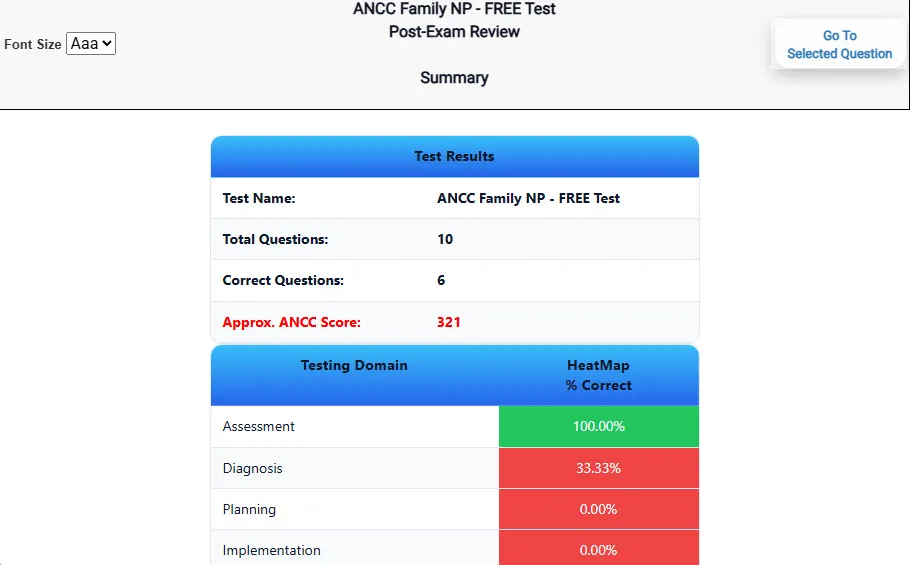
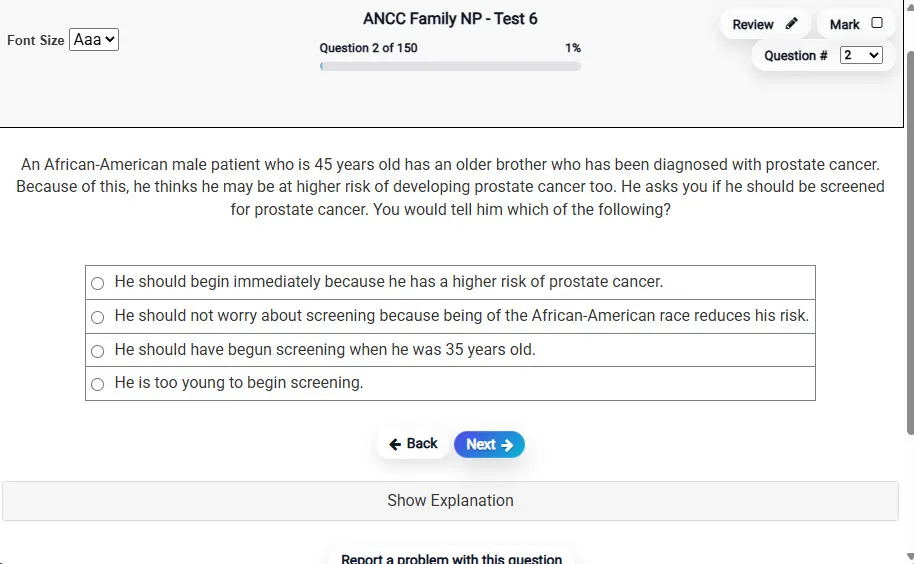
Answering a Question screen – Multiple-choice item view with navigation controls and progress tracker.
Answering a Question Multiple-choice item view with navigation controls and progress tracker.

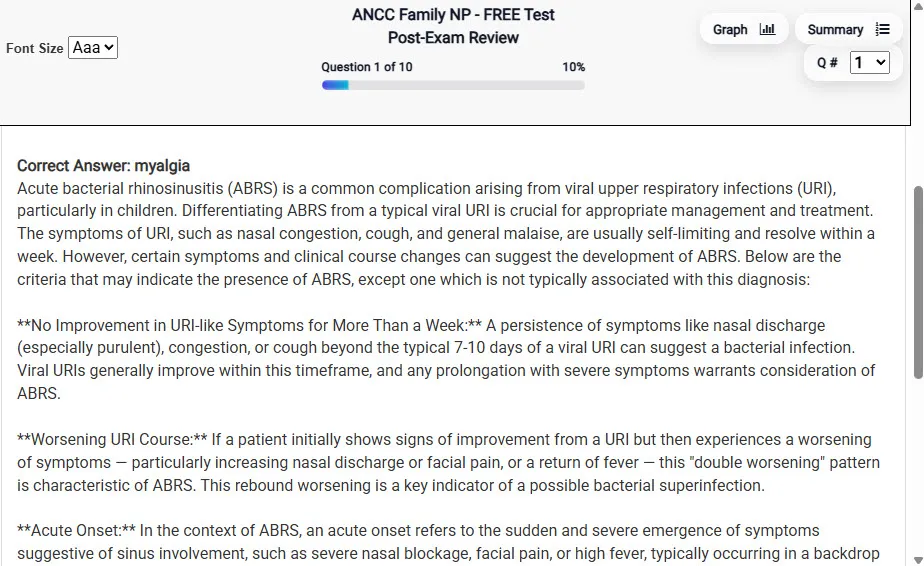
                           Detailed Explanation screen – 
                         Review mode showing chosen answer and rationale and references.
Detailed Explanation Review mode showing chosen answer and rationale and references.

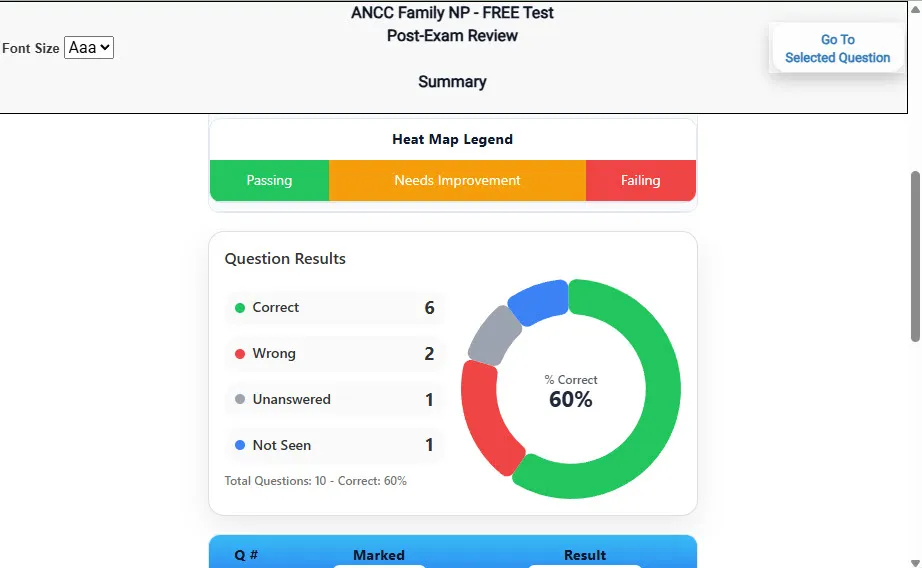
                           Review Summary 1 screen – 
                         Summary with counts for correct/wrong/unanswered and not seen items.
Review Summary 1 Summary with counts for correct/wrong/unanswered and not seen items.

                           Review Summary 2 screen – 
                         Advanced summary with category/domain breakdown and performance insights.
Review Summary 2 Advanced summary with category/domain breakdown and performance insights.

What Each Screen Shows

Answer Question Screen

  • Clean multiple-choice interface with progress bar.
  • Mark for review feature.
  • Matches real test pacing.

Detailed Explanation

  • Correct answer plus rationale.
  • Key concepts and guidelines highlighted.
  • Move between questions to fill knowledge gaps.

Review Summary 1

  • Overall results with total questions and scaled score.
  • Domain heatmap shows strengths and weaknesses.
  • Quick visual feedback on study priorities.

Review Summary 2

  • Chart of correct, wrong, unanswered, not seen.
  • Color-coded results for easy review.
  • Links back to missed items.

Top 10 Reasons to Use Exam Edge for your HESI Dosage Calculations Exam Prep

  1. Focused on the HESI Dosage Calculations Exam

    Our practice tests are built specifically for the HESI Dosage Calculations exam — every question mirrors the real topics, format, and difficulty so you're studying exactly what matters.

  2. Real Exam Simulation

    We match the per-question time limits and pressure of the actual HESI exam, so test day feels familiar and stress-free.

  3. 10 Full Practice Tests & 500 Unique Questions

    You'll have more than enough material to master every HESI Dosage Calculations concept — no repeats, no fluff.

  4. Lower Cost Than a Retake

    Ordering 5 practice exams costs less than retaking the HESI Dosage Calculations exam after a failure. One low fee could save you both time and money.

  5. Flexible Testing

    Need to step away mid-exam? Pick up right where you left off — with your remaining time intact.

  6. Instant Scoring & Feedback

    See your raw score and an estimated HESI Dosage Calculations score immediately after finishing each practice test.

  7. Detailed Explanations for Every Question

    Review correct and incorrect answers with clear, step-by-step explanations so you truly understand each topic.

  8. Trusted & Accredited

    We're fully accredited by the Better Business Bureau and uphold the highest standards of trust and transparency.

  9. Web-Based & Always Available

    No software to install. Access your HESI Dosage Calculations practice exams 24/7 from any computer or mobile device.

  10. Expert Support When You Need It

    Need extra help? Our specialized tutors are highly qualified and ready to support your HESI exam prep.


Pass the HESI Dosage Calculations Exam with Realistic Practice Tests from Exam Edge

Preparing for your upcoming HESI Dosage Calculations (HESI-DC) Certification Exam can feel overwhelming — but the right practice makes all the difference. Exam Edge gives you the tools, structure, and confidence to pass on your first try. Our online practice exams are built to match the real HESI Dosage Calculations exam in content, format, and difficulty.

  • 📝 10 HESI Dosage Calculations Practice Tests: Access 10 full-length exams with 50 questions each, covering every major HESI Dosage Calculations topic in depth.
  • Instant Online Access: Start practicing right away — no software, no waiting.
  • 🧠 Step-by-Step Explanations: Understand the reasoning behind every correct answer so you can master HESI Dosage Calculations exam concepts.
  • 🔄 Retake Each Exam Up to 4 Times: Build knowledge through repetition and track your improvement over time.
  • 🌐 Web-Based & Available 24/7: Study anywhere, anytime, on any device.
  • 🧘 Boost Your Test-Day Confidence: Familiarity with the HESI format reduces anxiety and helps you perform under pressure.

These HESI Dosage Calculations practice exams are designed to simulate the real testing experience by matching question types, timing, and difficulty level. This approach helps you get comfortable not just with the exam content, but also with the testing environment, so you walk into your exam day focused and confident.


Exam Edge HESI Reviews


I just took my Hesi exit PN today and got a Hesi score of 1205 and a conversion score of 99.99%. Thanks for the help. Doing all those tests helped so much. Not because I saw the same questions but because I learned so much from the answer reasoning section. Hope to fly through my boards in a couple ...
Read More
Sharon, Texas

I recently had to test out of my school with an 850 on the Hesi PN, so I purchased the exams from you guys, about 5 to 7 exams, and passed the exit HesiPn with a 988! First time around! Then I purchased the NclexPN exam tests from you guys and I passed my nclex the first time around! These tests rea ...
Read More
Welsh, NC

I want to thank you. The tests are really helpful. I took them three times and after using your exams, I finally passed. The tests helped me especially in the math section, in which I got a 90.

DIANA , Texas

I can't believe this website doesn't have a high following status. I bought 40 practice questions, and I did 20 practice questions and took my Hesi exit. I scored 1070. I completed all 40 practice exams and passed my boards for the first time. Exam Edge introduced me to a bunch of topics and boosted ...
Read More
Juliet M., Tarpon Springs, Florida


HESI Dosage Calculations Aliases Test Name

Here is a list of alternative names used for this exam.

  • HESI Dosage Calculations
  • HESI Dosage Calculations test
  • HESI Dosage Calculations Certification Test
  • HESI
  • HESI HESI-DC
  • HESI-DC test
  • HESI Dosage Calculations (HESI-DC)
  • Dosage Calculations certification