This is the content of the pop-over!

CCI RVS (RVS) Practice Tests & Test Prep by Exam Edge


CCI Registered Vascular Specialist  product image
(4.6)
Based on 22 Reviews

  • Real Exam Simulation: Timed questions and matching content build comfort for your CCI RVS test day.
  • Instant, 24/7 Access: Web-based CCI Registered Vascular Specialist practice exams with no software needed.
  • Clear Explanations: Step-by-step answers and explanations for your CCI exam to strengthen understanding.
  • Boosted Confidence: Reduces anxiety and improves test-taking skills to ace your CCI Registered Vascular Specialist (RVS).

Featured on

CCI Registered Vascular Specialist Online Practice Test Bundles

BEST VALUE
5 practice tests

$69.75

$199.75

SAVE $130

Only $13.95 per test!

  • 100% Pass Guarantee
  • 5 online practice tests
  • 100 questions per test
  • Bonus: 100 Flash Cards + Study Guide
  • Instant access
  • Detailed Explanations
  • Practice tests never expire
  • Timed, untimed, or study guide mode
1 practice test

$39.95

  • 1 online practice test
  • 100 questions per test
  • Instant access
  • Detailed Explanations
  • Practice tests never expire
  • Timed, untimed, or study guide mode
Quick Select
Tap to choose a bundle

** All Prices are in US Dollars (USD) **


CCI RVS (RVS) Resources

Jump to the section you need most.

Understanding the exact breakdown of the CCI Registered Vascular Specialist test will help you know what to expect and how to most effectively prepare. The CCI Registered Vascular Specialist has 130 multiple-choice questions . The exam will be broken down into the sections below:

CCI Registered Vascular Specialist Exam Blueprint
Domain Name % Number of
Questions
Maintaining Information - Facility Safety 8% 10
Applying Physical Principles 17% 22
Performing Abdominal/Visceral Examinations 9% 12
Performing Extracranial/Intracranial Examinations 19% 25
Performing Peripheral Arterial Examinations 24% 31
Performing Peripheral Venous Examinations 18% 23
Performing Special Procedures 5% 7

CCI Registered Vascular Specialist Study Tips by Domain

  • Verify patient identity with two identifiers and confirm laterality/procedure before scanning; red flag: a mismatch between requisition and patient history requires a hard stop and clarification.
  • Optimize documentation so images include correct labels (vessel/segment, side, view, Doppler angle/scale) and measurements are reproducible; common trap: saving unlabeled cine loops that cannot support a final interpretation.
  • Maintain HIPAA compliance by limiting on-screen PHI and securing workstations; red flag: leaving PACS/EMR logged in or discussing findings in public areas is a reportable breach.
  • Apply infection control with hand hygiene, probe/cord cleaning, and appropriate transducer covers for mucous-membrane contact; priority rule: follow high-level disinfection requirements for endocavitary probes and document reprocessing.
  • Ensure equipment and room safety by checking electrical integrity, cable condition, and safe patient transfers; contraindication cue: do not use damaged cords/gel warmers that pose shock or burn risk.
  • Use appropriate ergonomic and patient-safety positioning (bed height, reach, compression force) to prevent injury; common trap: excessive probe pressure causing patient pain or altering venous flow, leading to false findings.
  • Apply the Doppler equation correctly: higher transmitted frequency and higher insonation angle increase calculated velocity; red flag — angles >60° can markedly overestimate PSV and misclassify stenosis.
  • Optimize B-mode with depth, focus, and gain rather than “cranking up” overall gain; common trap — excessive gain creates pseudo-plaque and can hide a true lumen boundary.
  • Use PRF/scale and baseline to manage aliasing on color and spectral Doppler; priority rule — if you see wraparound in high-flow stenosis, raise PRF and lower color gain before changing angle.
  • Set wall filter low enough to preserve slow venous flow but high enough to suppress motion artifact; contraindication cue — too-high wall filter can falsely suggest venous occlusion by eliminating low-frequency signals.
  • Know when to adjust sample volume and steering: small gate for focal jets and larger for laminar flow; red flag — an oversized gate in stenosis blends velocities and can undercall peak velocity.
  • Follow ALARA by minimizing output power and dwell time while maintaining diagnostic quality; common trap — leaving power at maximum when simply improving image quality would be better achieved with gain/focus adjustments.
  • Pre-exam prep matters: verify NPO status (often 6–8 hours) and medication timing because bowel gas is a frequent red flag that can falsely suggest stenosis or hide the origins.
  • Use correct angle correction and sample placement: keep Doppler insonation ≤60° and align the cursor to the vessel wall—common trap is angling to a branch which overestimates PSV and inflates stenosis grading.
  • For mesenteric arteries, document fasting and, if ordered, postprandial waveforms; priority rule is to identify high-grade SMA/celiac disease by focal PSV elevation with post-stenotic turbulence (don’t rely on one velocity without morphology).
  • For renal arteries, evaluate aorta (inflow) and both renal arteries plus intrarenal waveforms; red flag is tardus-parvus intrarenal pattern suggesting proximal stenosis even when the main renal artery segment is poorly visualized.
  • When assessing AAA/EVAR, measure outer-to-outer diameter in true transverse and confirm in longitudinal; common trap is measuring obliquely or inner-to-inner which underestimates aneurysm size and can change follow-up thresholds.
  • For portal/hepatic system, confirm flow direction and respiratory/phasic behavior with proper scale and baseline; contraindication cue is not to call portal vein thrombosis without color fill optimization and compression correlation where applicable (low-flow can mimic occlusion).
  • Optimize carotid/vertebral Doppler angles: keep insonation ≤60° and use angle correction parallel to flow; red flag—reporting velocities without documenting angle, which can falsely upstage stenosis.
  • Use a standardized carotid stenosis approach (ICA PSV plus ICA/CCA PSV ratio and EDV) and correlate with plaque morphology; common trap—overcalling stenosis from turbulence when the sample gate is too large or placed post-stenosis.
  • When ICA is suspected near-occluded, look for markedly reduced distal flow, dampened waveform, and small-caliber lumen; priority rule—don’t label occlusion unless no color/power Doppler flow and no spectral signal after optimizing settings (low PRF, high gain, power Doppler).
  • Assess vertebral artery directionality and waveform to identify subclavian steal; red flag—to-and-fro or retrograde vertebral flow with ipsilateral arm symptoms, and confirm with proximal subclavian waveform/pressure differences.
  • For TCD, verify vessel ID by depth, flow direction, and response to temporal window insonation; common trap—mislabeling MCA/ACA when depths overlap, so document depth ranges and use contralateral comparison when windows are poor.
  • Screen for intracranial stenosis/vasospasm using mean flow velocities and ratios (e.g., Lindegaard for MCA); red flag—high MCA velocity with normal ratio suggests hyperemia rather than vasospasm, so interpret in physiologic context.
  • Verify correct patient positioning, limb warmth, and rest period before pressures; red flag: measuring right after ambulation or in a cold room can falsely elevate vasospasm and depress ankle pressures.
  • Choose cuff size and placement precisely (width ≈ 40% limb circumference, bladder length ≈ 80%); common trap: undersized cuffs at thigh/calf falsely increase segmental pressures and mislocalize disease.
  • Use continuous-wave Doppler at a 45–60° angle and optimize gain; priority rule: document waveform quality (triphasic/biphasic/monophasic) because waveform deterioration can reveal disease even when pressures appear near-normal.
  • Perform ABI (and toe pressures when indicated) with proper artery selection and highest ankle pressure per protocol; red flag: ABI > 1.30 suggests noncompressible vessels—switch to TBI and waveform/PVR interpretation rather than relying on ABI alone.
  • When doing segmental pressures and PVRs, look for a ≥ 20–30 mmHg drop between adjacent levels and corresponding contour change; common trap: ignoring collateral flow or calcification can mask focal stenosis unless waveform/PVR correlates.
  • For duplex imaging, sample at standardized sites and record PSV ratios and spectral broadening; priority cue: a focal PSV increase with post-stenotic turbulence is more significant than a single elevated PSV caused by probe angle error or poor insonation.
  • Use correct patient positioning for the venous question: reverse Trendelenburg for reflux mapping and supine with leg slightly externally rotated for DVT survey; red flag—scanning a dependent leg without documentation can exaggerate reflux.
  • For DVT, require full compressibility every 1–2 cm with gray-scale + color; common trap—calling “no DVT” based on color fill alone when the vein is not fully compressed.
  • Optimize Doppler for low-velocity venous flow (low PRF/scale, high gain to just below noise, appropriate wall filter); red flag—an overly high wall filter can falsely eliminate phasicity and low-level thrombus-related flow.
  • Interpret spectral patterns correctly: spontaneous, phasic flow with distal augmentation and appropriate respiratory variation; priority rule—loss of phasicity or poor augmentation suggests proximal obstruction until proven otherwise.
  • Differentiate acute vs chronic thrombus using a checklist (vein size, echogenicity, adherence, recanalization, collateralization); common trap—labeling echogenic, contracted veins with collaterals as “acute” rather than chronic/post-thrombotic change.
  • For reflux exams, measure reflux duration with standardized maneuvers (Valsalva for CFV/GSV junction, distal compression-release for segments) and report named segments; red flag—recording reflux times without stating the maneuver, patient position, or segment leads to non-actionable results.
  • Before any special procedure (e.g., pseudoaneurysm evaluation, dialysis access, TCD with vasomotor reactivity), verify indication and key contraindications—red flag: proceeding despite an unreviewed anticoagulation status or uncontrolled pain limiting cooperation.
  • For graft/fistula assessments, document inflow, anastomoses, and outflow with velocity and diameter mapping—common trap: missing a hemodynamically significant stenosis by sampling only mid-graft and not the arterial/venous anastomosis regions.
  • In pseudoaneurysm and post-catheterization studies, measure neck width/length, sac size, and characterize “to-and-fro” flow at the neck—red flag: confusing a hematoma (no internal flow) with a thrombosed pseudoaneurysm (peripheral flow or residual channel).
  • For TCD special testing (e.g., emboli detection, CO2/breath-hold reactivity), standardize insonation depth, angle, and timing while monitoring patient symptoms—common trap: attributing waveform changes to physiology when they are due to probe motion or poor temporal window.
  • When evaluating endoleaks or postoperative vascular repairs, use optimized color/power Doppler settings and low PRF for slow flow—priority rule: adjust gain/scale before concluding “no endoleak,” especially in obese patients or deep grafts.
  • During provocative maneuvers (e.g., thoracic outlet, popliteal entrapment), record baseline and symptomatic-position waveforms and pressures—red flag: interpreting compression as pathologic without correlating to reproduced symptoms and immediate return to baseline on release.


Built to Fit Into Your Busy Life

Everything you need to prepare with confidence—without wasting a minute.

Three Study Modes

Timed, No Time Limit, or Explanation mode.

Actionable Analytics

Heatmaps and scaled scores highlight weak areas.

High-Yield Rationales

Concise explanations emphasize key concepts.

Realistic Interface

Matches the feel of the actual exam environment.

Accessible by Design

Clean layout reduces cognitive load.

Anytime, Anywhere

Web-based access 24/7 on any device.
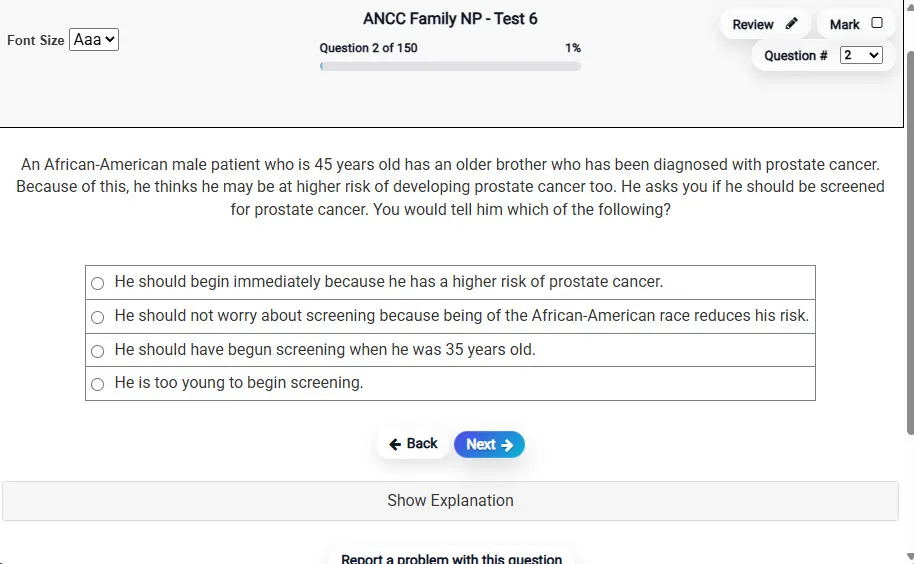
Answering a Question screen – Multiple-choice item view with navigation controls and progress tracker.
Answering a Question Multiple-choice item view with navigation controls and progress tracker.

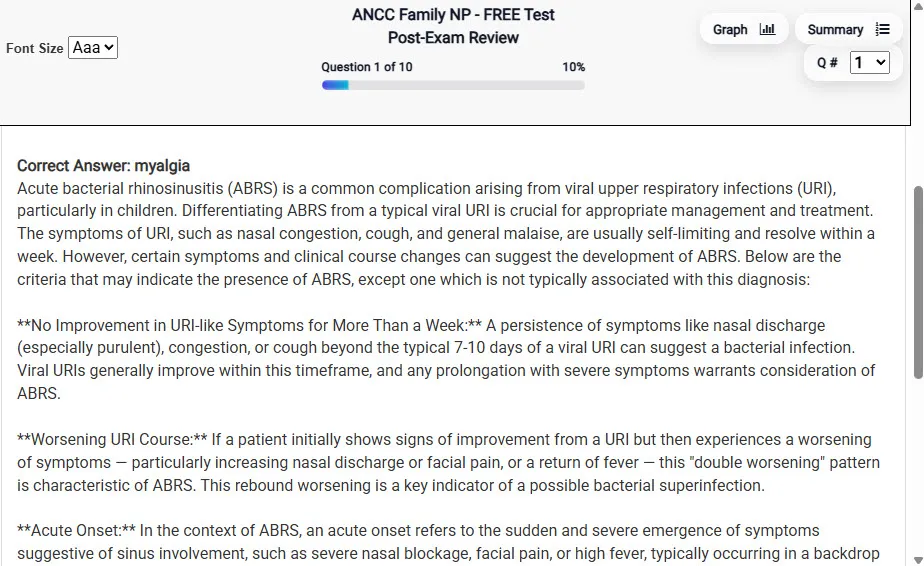
                           Detailed Explanation screen – 
                         Review mode showing chosen answer and rationale and references.
Detailed Explanation Review mode showing chosen answer and rationale and references.

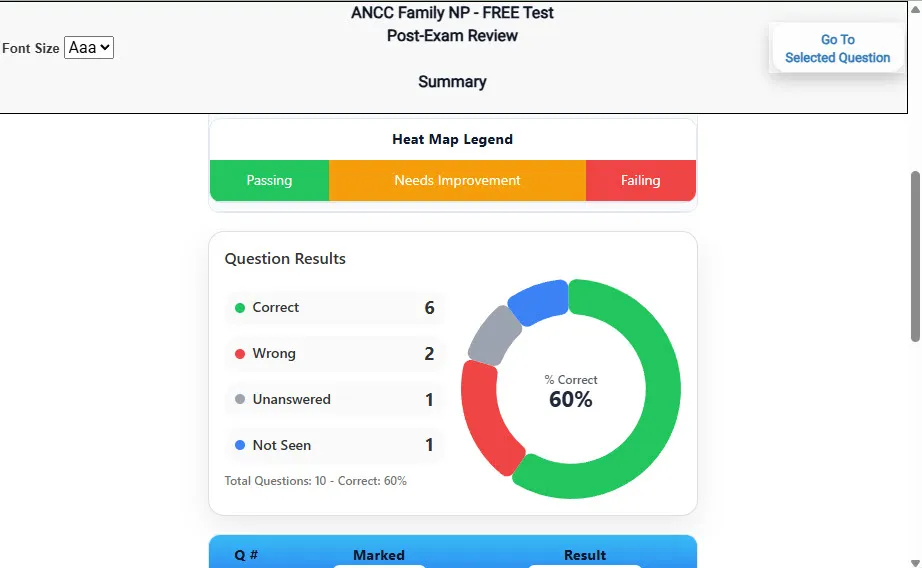
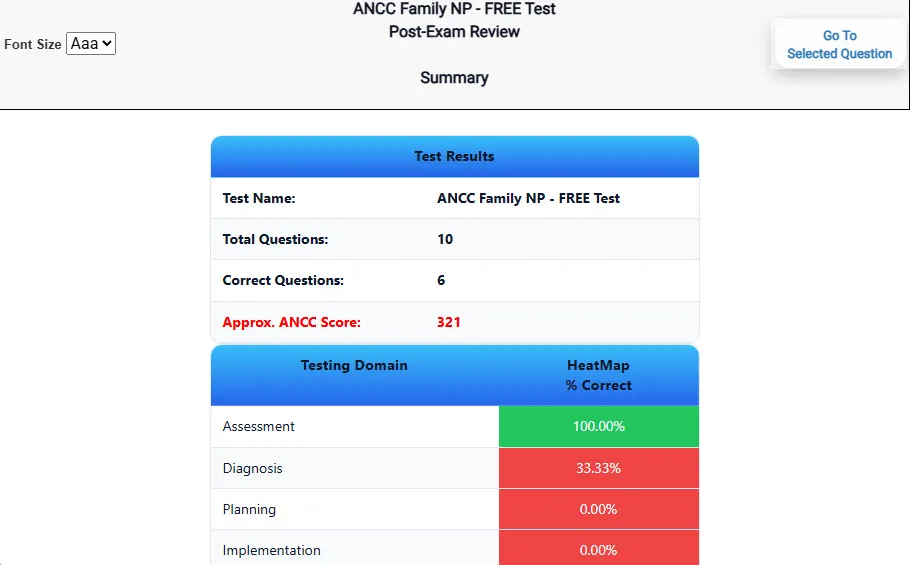
                           Review Summary 1 screen – 
                         Summary with counts for correct/wrong/unanswered and not seen items.
Review Summary 1 Summary with counts for correct/wrong/unanswered and not seen items.

                           Review Summary 2 screen – 
                         Advanced summary with category/domain breakdown and performance insights.
Review Summary 2 Advanced summary with category/domain breakdown and performance insights.

What Each Screen Shows

Answer Question Screen

  • Clean multiple-choice interface with progress bar.
  • Mark for review feature.
  • Matches real test pacing.

Detailed Explanation

  • Correct answer plus rationale.
  • Key concepts and guidelines highlighted.
  • Move between questions to fill knowledge gaps.

Review Summary 1

  • Overall results with total questions and scaled score.
  • Domain heatmap shows strengths and weaknesses.
  • Quick visual feedback on study priorities.

Review Summary 2

  • Chart of correct, wrong, unanswered, not seen.
  • Color-coded results for easy review.
  • Links back to missed items.

Top 10 Reasons to Use Exam Edge for your CCI Registered Vascular Specialist Exam Prep

  1. Focused on the CCI Registered Vascular Specialist Exam

    Our practice tests are built specifically for the CCI RVS exam — every question mirrors the real topics, format, and difficulty so you're studying exactly what matters.

  2. Real Exam Simulation

    We match the per-question time limits and pressure of the actual CCI exam, so test day feels familiar and stress-free.

  3. 5 Full Practice Tests & 500 Unique Questions

    You'll have more than enough material to master every CCI RVS concept — no repeats, no fluff.

  4. Lower Cost Than a Retake

    Ordering 5 practice exams costs less than retaking the CCI Registered Vascular Specialist exam after a failure. One low fee could save you both time and money.

  5. Flexible Testing

    Need to step away mid-exam? Pick up right where you left off — with your remaining time intact.

  6. Instant Scoring & Feedback

    See your raw score and an estimated CCI Registered Vascular Specialist score immediately after finishing each practice test.

  7. Detailed Explanations for Every Question

    Review correct and incorrect answers with clear, step-by-step explanations so you truly understand each topic.

  8. Trusted & Accredited

    We're fully accredited by the Better Business Bureau and uphold the highest standards of trust and transparency.

  9. Web-Based & Always Available

    No software to install. Access your CCI RVS practice exams 24/7 from any computer or mobile device.

  10. Expert Support When You Need It

    Need extra help? Our specialized tutors are highly qualified and ready to support your CCI exam prep.


Pass the CCI Registered Vascular Specialist Exam with Realistic Practice Tests from Exam Edge

Preparing for your upcoming CCI Registered Vascular Specialist (RVS) Certification Exam can feel overwhelming — but the right practice makes all the difference. Exam Edge gives you the tools, structure, and confidence to pass on your first try. Our online practice exams are built to match the real CCI RVS exam in content, format, and difficulty.

  • 📝 5 CCI Registered Vascular Specialist Practice Tests: Access 5 full-length exams with 100 questions each, covering every major CCI Registered Vascular Specialist topic in depth.
  • Instant Online Access: Start practicing right away — no software, no waiting.
  • 🧠 Step-by-Step Explanations: Understand the reasoning behind every correct answer so you can master CCI RVS exam concepts.
  • 🔄 Retake Each Exam Up to 4 Times: Build knowledge through repetition and track your improvement over time.
  • 🌐 Web-Based & Available 24/7: Study anywhere, anytime, on any device.
  • 🧘 Boost Your Test-Day Confidence: Familiarity with the CCI format reduces anxiety and helps you perform under pressure.

These CCI Registered Vascular Specialist practice exams are designed to simulate the real testing experience by matching question types, timing, and difficulty level. This approach helps you get comfortable not just with the exam content, but also with the testing environment, so you walk into your exam day focused and confident.


Exam Edge CCI (cardio) Reviews


Thank you for your services. I purchase the test prep for CCI Certified Cardiographic Technician and it was a big help. I passed my board exam the first time with a score of a 739. Thanks again, I will be using your services for my CCI CRAT boards here soon.

David, TN

Love all the different tests with rationale to test questions.

carlyle , alpharetta, Georgia

This is the go-to for RCS, CCI board review practice test. I failed two times and passed on my third attempt with the help of Exam Edge. I was not paid for this review, I just want to help others make the right decision in board preparation. Exam Edge has a great series of questions related to the R ...
Read More
Jason P,

Exam Edge is a great resource for people trying to study for their board exams. This is the second time I have used Exam Edge's services, and it gave me the confidence for when the time came for me to sit for the exams. I passed my CCI Cardiographic Technician and Rhythm Analysis Technician exams.

Amanda K, Ohio

"Thank you so much, Exam Edge!!! I just left Pearson Vue, Miami........ with 759! I couldn't have done it without your practice tests!"

AJR, Miami FL

I feel the practice exams prepared me very well for the real thing. I have test anxiety, so I purchased a set of 10 tests. I finished 6 of 10 tests and still passed with a nice score. I like the way your test are designed and how they make you actually learn physics and not just memorize the answers ...
Read More
Sherry B, Allen County, Indiana


CCI Registered Vascular Specialist Aliases Test Name

Here is a list of alternative names used for this exam.

  • CCI Registered Vascular Specialist
  • CCI Registered Vascular Specialist test
  • CCI Registered Vascular Specialist Certification Test
  • CCI RVS test
  • CCI (cardio)
  • CCI (cardio) RVS
  • RVS test
  • CCI Registered Vascular Specialist (RVS)
  • CCI Registered Vascular Specialist certification