This is the content of the pop-over!

AANP ENP (AANP-ENP) Practice Tests & Test Prep by Exam Edge


AANP Emergency Nurse Practitioner product image
(5.0)
Based on 25 Reviews

  • Real Exam Simulation: Timed questions and matching content build comfort for your AANP ENP test day.
  • Instant, 24/7 Access: Web-based AANP Emergency Nurse Practitioner practice exams with no software needed.
  • Clear Explanations: Step-by-step answers and explanations for your AANPCB exam to strengthen understanding.
  • Boosted Confidence: Reduces anxiety and improves test-taking skills to ace your AANP Emergency Nurse Practitioner (AANP-ENP).

Featured on

AANP Emergency Nurse Practitioner Online Practice Test Bundles

BEST VALUE
10 practice tests

$99.50

$299.50

SAVE $200

Only $9.95 per test!

  • 100% Pass Guarantee
  • 10 online practice tests
  • 100 questions per test
  • Bonus: 100 Flash Cards + Study Guide
  • Instant access
  • Detailed Explanations
  • Practice tests never expire
  • Timed, untimed, or study guide mode
5 practice tests

$59.75

$149.75

SAVE $90

Only $11.95 per test!

  • 5 online practice tests
  • 100 questions per test
  • Bonus: 100 Flash Cards + Study Guide
  • Instant access
  • Detailed Explanations
  • Practice tests never expire
  • Timed, untimed, or study guide mode
1 practice test

$29.95

  • 1 online practice test
  • 100 questions per test
  • Instant access
  • Detailed Explanations
  • Practice tests never expire
  • Timed, untimed, or study guide mode
Quick Select
Tap to choose a bundle

** All Prices are in US Dollars (USD) **


AANP ENP (AANP-ENP) Shortcuts


Understanding the exact breakdown of the AANP Emergency Nurse Practitioner test will help you know what to expect and how to most effectively prepare. The AANP Emergency Nurse Practitioner has multiple-choice questions . The exam will be broken down into the sections below:

AANP Emergency Nurse Practitioner Exam Blueprint
Domain Name % Number of
Questions
Medical Screening 16% 16
Medical Decision Making/ Differential Diagnosis 24% 24
Patient Management 36% 36
Patient Disposition 16% 16
Professional - Legal Ethical Practices 8% 8

AANP Emergency Nurse Practitioner Study Tips by Domain

  • Perform an immediate ABCDE and vital-sign screen on arrival, and treat unstable findings before completing the full history; red flag: hypotension, hypoxia, altered mental status, or active hemorrhage requires simultaneous resuscitation and rapid escalation.
  • Use a targeted chief-complaint history (OPQRST, SAMPLE) with focused review for high-risk symptoms; common trap: normal vitals do not exclude time-sensitive disease (e.g., PE, sepsis, intracranial bleed) when red flags are present.
  • Do a focused physical exam that includes a brief neuro and cardiopulmonary assessment on most ED presentations; priority rule: any new focal neurologic deficit, severe headache “worst,” or syncope with exertion triggers immediate stroke/arrhythmia workup pathways.
  • Screen early for pregnancy in patients with a uterus and abdominal pain, pelvic pain, or vaginal bleeding; threshold: obtain a pregnancy test before meds or imaging that could harm a fetus, and treat ectopic risk as emergent.
  • Assess pain, mental status, and safety (suicidal/homicidal ideation, intoxication, abuse) during screening; red flag: access to lethal means or command hallucinations warrants constant observation and rapid psychiatric/safety evaluation.
  • Identify infection and sepsis risk during screening (temperature, heart rate, respiratory rate, blood pressure, lactate consideration, immunocompromised status); contraindication: do not delay antibiotics and fluids in suspected sepsis for imaging or noncritical labs.
  • Prioritize life-threatening differentials first (airway, breathing, circulation, sepsis, stroke, ACS) and treat while evaluating; red flag: abnormal vitals or altered mental status should not be attributed to anxiety or intoxication without objective assessment.
  • Use high-risk symptom patterns to expand the differential beyond the chief complaint (e.g., chest pain = ACS/PE/aortic dissection/pneumothorax/esophageal rupture); common trap: anchoring on reproducible chest wall tenderness and missing ACS in older adults/diabetics.
  • Apply time-critical “can’t miss” rules: sudden severe headache (“worst”), syncope, new focal neuro deficit, severe abdominal pain out of proportion, or tearing back pain warrants expedited imaging/consult; threshold: do not delay for labs if suspicion for hemorrhage, dissection, or large-vessel stroke is high.
  • Account for atypical presentations in special populations—pregnant/postpartum, immunocompromised, elderly, pediatrics—and broaden infectious/thrombotic differentials; red flag: normal temperature does not exclude sepsis in older or immunosuppressed patients.
  • Interpret tests in clinical context and avoid false reassurance; priority rule: a normal ECG or single troponin early in symptoms does not rule out ACS—use serial testing/risk stratification when indicated.
  • Reassess after interventions and update the differential with response-to-treatment data; common trap: symptom improvement after analgesia/antiemetic does not exclude surgical abdomen, ectopic pregnancy, or intracranial pathology.
  • Prioritize ABCs with immediate interventions: if SpO2 < 90% (or respiratory distress), give oxygen and escalate to noninvasive ventilation or intubation prep; red flag—silent chest, altered mental status, or hypotension signals impending failure.
  • Use sepsis management thresholds: if suspected infection plus hypotension or lactate = 4, give 30 mL/kg crystalloid and start broad-spectrum antibiotics within 1 hour; common trap—delaying antibiotics while waiting for imaging or cultures.
  • Treat acute coronary syndrome risk early: give aspirin 162–325 mg chewed unless true allergy/active bleeding, and start nitroglycerin only if SBP = 90 and no RV infarct/PDE-5 use in last 24–48 hours; contraindication—recent sildenafil/tadalafil use or inferior STEMI with hypotension.
  • Manage stroke/TIA with time-based actions: check glucose first and obtain emergent neuroimaging; priority rule—do not lower BP before thrombolysis unless > 185/110, and avoid giving antiplatelets until hemorrhage is excluded.
  • Control pain and agitation safely: use multimodal analgesia and reassess; red flag—avoid NSAIDs in GI bleed, advanced CKD, or late pregnancy, and avoid benzodiazepines in severe COPD/hypercapnia unless airway support is ready.
  • Prevent iatrogenic harm with high-risk meds and procedures: confirm weight-based dosing for pediatrics and anticoagulants, and use ultrasound guidance for difficult IV/central access; common trap—missing compartment syndrome after splinting (pain out of proportion, pain with passive stretch) requiring immediate loosening and surgical consult.
  • Admit patients with persistent abnormal vital signs after initial ED therapy (e.g., new O2 requirement, hypotension, refractory tachycardia) as a priority rule; a common trap is discharging “improved” patients whose vitals remain unstable.
  • Discharge only when the patient can ambulate, tolerate PO (if appropriate), and has controlled pain/nausea on oral meds; red flag is repeated IV medication needs or recurrent symptoms during observation.
  • Escalate to ICU/transfer when airway/ventilation or hemodynamics may deteriorate (e.g., rising work of breathing, escalating oxygen, need for pressors); contraindication to floor admission is any ongoing requirement for continuous titration.
  • Ensure safe discharge planning by verifying reliable follow-up, transportation, and ability to obtain meds; threshold for admission/observation is lack of social support in high-risk conditions (e.g., syncope, anticoagulation bleeding risk).
  • Give explicit return precautions tied to specific worsening signs (e.g., chest pain, dyspnea, neuro deficits, fever with rigors) and document teach-back; common trap is vague “return if worse” instructions that don’t specify triggers.
  • Before discharge after procedures/sedation, confirm baseline mental status, stable vitals, and responsible adult supervision when required; red flag is ongoing sedation effect or inability to provide post-care instructions due to intoxication or cognitive impairment.

Built to Fit Into Your Busy Life

Everything you need to prepare with confidence—without wasting a minute.

Three Study Modes

Timed, No Time Limit, or Explanation mode.

Actionable Analytics

Heatmaps and scaled scores highlight weak areas.

High-Yield Rationales

Concise explanations emphasize key concepts.

Realistic Interface

Matches the feel of the actual exam environment.

Accessible by Design

Clean layout reduces cognitive load.

Anytime, Anywhere

Web-based access 24/7 on any device.
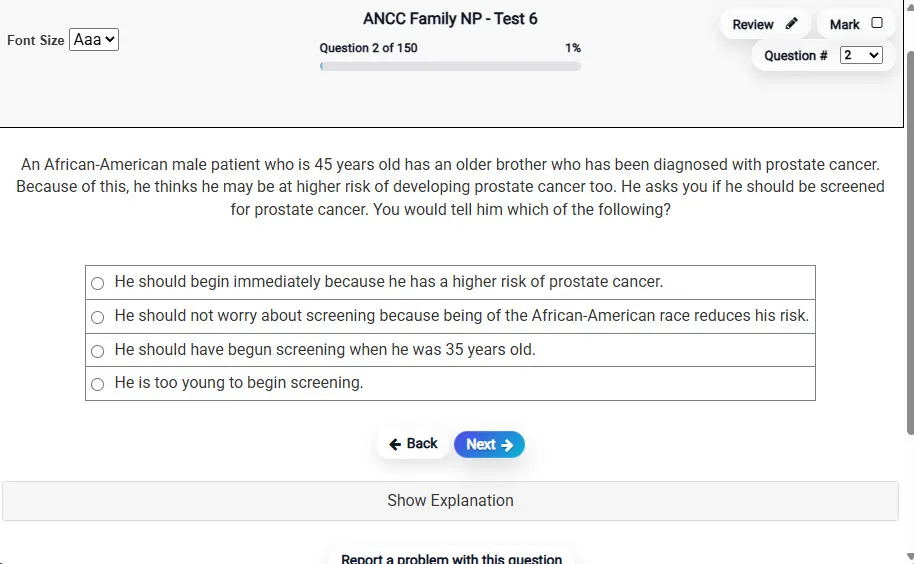
Answering a Question screen – Multiple-choice item view with navigation controls and progress tracker.
Answering a Question Multiple-choice item view with navigation controls and progress tracker.

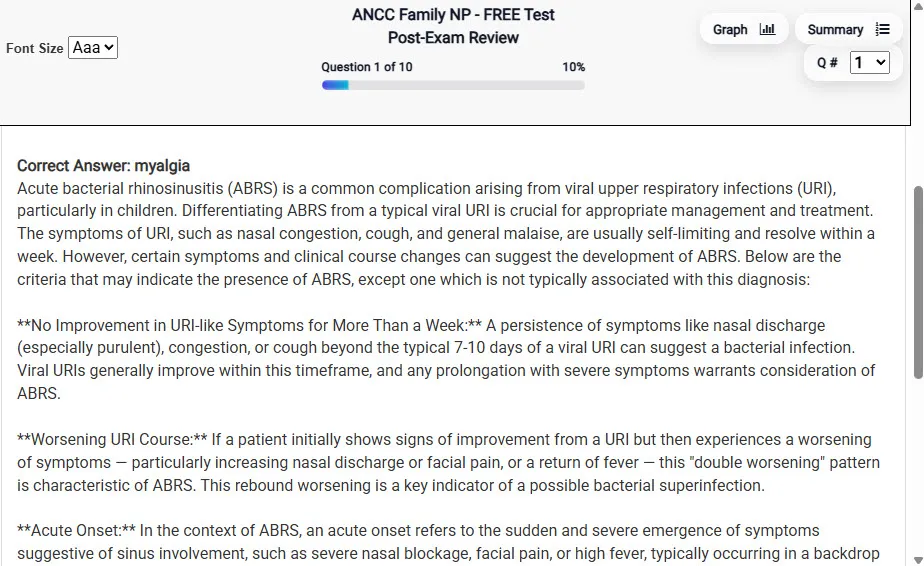
                           Detailed Explanation screen – 
                         Review mode showing chosen answer and rationale and references.
Detailed Explanation Review mode showing chosen answer and rationale and references.

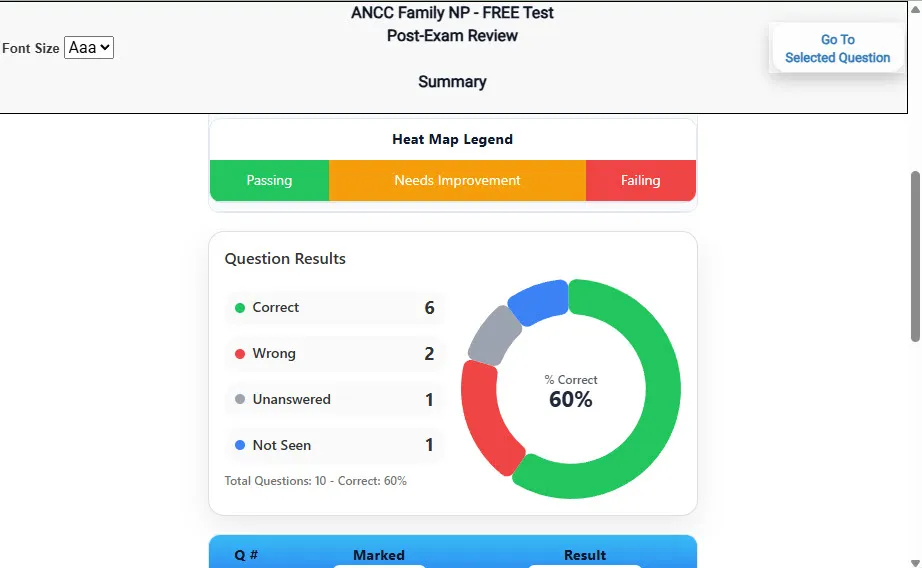
                           Review Summary 1 screen – 
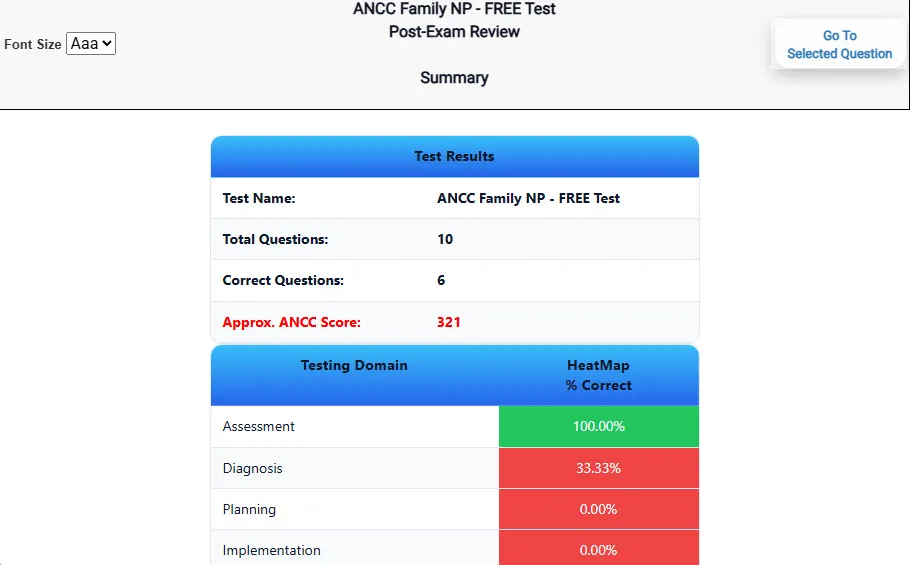
                         Summary with counts for correct/wrong/unanswered and not seen items.
Review Summary 1 Summary with counts for correct/wrong/unanswered and not seen items.

                           Review Summary 2 screen – 
                         Advanced summary with category/domain breakdown and performance insights.
Review Summary 2 Advanced summary with category/domain breakdown and performance insights.

What Each Screen Shows

Answer Question Screen

  • Clean multiple-choice interface with progress bar.
  • Mark for review feature.
  • Matches real test pacing.

Detailed Explanation

  • Correct answer plus rationale.
  • Key concepts and guidelines highlighted.
  • Move between questions to fill knowledge gaps.

Review Summary 1

  • Overall results with total questions and scaled score.
  • Domain heatmap shows strengths and weaknesses.
  • Quick visual feedback on study priorities.

Review Summary 2

  • Chart of correct, wrong, unanswered, not seen.
  • Color-coded results for easy review.
  • Links back to missed items.

Top 10 Reasons to Use Exam Edge for your AANP Emergency Nurse Practitioner Exam Prep

  1. Focused on the AANP Emergency Nurse Practitioner Exam

    Our practice tests are built specifically for the AANP ENP exam — every question mirrors the real topics, format, and difficulty so you're studying exactly what matters.

  2. Real Exam Simulation

    We match the per-question time limits and pressure of the actual AANPCB exam, so test day feels familiar and stress-free.

  3. 10 Full Practice Tests & 1,000 Unique Questions

    You'll have more than enough material to master every AANP ENP concept — no repeats, no fluff.

  4. Lower Cost Than a Retake

    Ordering 5 practice exams costs less than retaking the AANP Emergency Nurse Practitioner exam after a failure. One low fee could save you both time and money.

  5. Flexible Testing

    Need to step away mid-exam? Pick up right where you left off — with your remaining time intact.

  6. Instant Scoring & Feedback

    See your raw score and an estimated AANP Emergency Nurse Practitioner score immediately after finishing each practice test.

  7. Detailed Explanations for Every Question

    Review correct and incorrect answers with clear, step-by-step explanations so you truly understand each topic.

  8. Trusted & Accredited

    We're fully accredited by the Better Business Bureau and uphold the highest standards of trust and transparency.

  9. Web-Based & Always Available

    No software to install. Access your AANP ENP practice exams 24/7 from any computer or mobile device.

  10. Expert Support When You Need It

    Need extra help? Our specialized tutors are highly qualified and ready to support your AANPCB exam prep.


Pass the AANP Emergency Nurse Practitioner Exam with Realistic Practice Tests from Exam Edge

Preparing for your upcoming AANP Emergency Nurse Practitioner (AANP-ENP) Certification Exam can feel overwhelming — but the right practice makes all the difference. Exam Edge gives you the tools, structure, and confidence to pass on your first try. Our online practice exams are built to match the real AANP ENP exam in content, format, and difficulty.

  • 📝 10 AANP Emergency Nurse Practitioner Practice Tests: Access 10 full-length exams with 100 questions each, covering every major AANP Emergency Nurse Practitioner topic in depth.
  • Instant Online Access: Start practicing right away — no software, no waiting.
  • 🧠 Step-by-Step Explanations: Understand the reasoning behind every correct answer so you can master AANP ENP exam concepts.
  • 🔄 Retake Each Exam Up to 4 Times: Build knowledge through repetition and track your improvement over time.
  • 🌐 Web-Based & Available 24/7: Study anywhere, anytime, on any device.
  • 🧘 Boost Your Test-Day Confidence: Familiarity with the AANPCB format reduces anxiety and helps you perform under pressure.

These AANP Emergency Nurse Practitioner practice exams are designed to simulate the real testing experience by matching question types, timing, and difficulty level. This approach helps you get comfortable not just with the exam content, but also with the testing environment, so you walk into your exam day focused and confident.


Exam Edge AANP Reviews


I just passed my AANP boards. All thanks to the wonderful review tests. The review questions covered all the research and theory that was never fully covered in other review courses and even through school. Most of the test was all research and theory. I will highly recommend this website!!!

Deborah, St. Paul MN

After passing the AANP boards today I knew I had to write a testimonial. This site helped me tremendously! I didn't complete any review courses because I just could not afford to spend $495. I found your site via google and after reading the testimonials I bought all the tests for a great reduce ...
Read More
Nehelia , FL

Passed my test today. These exams were helpful. They helped me to identify weaknesses that I had, so that I could study up on those areas. Thanks

Donald, Oregon

I just want to let you know that I just passed my AANP family certification exam. Your exams are the best with the rationales you provide. I felt pretty comfortable taking the exam due to the fact that the certification exam was very similar to yours. Thanks so much, and I will recommend this websit ...
Read More
Mayra , New Jersey

I really think the test helped me, and without them would not have passed. Many of the questions were similar or based on the key concepts. Thank you so MUCH!!!!!!

Sosa, Florida

Thanks for your exams. I just passed the AANP exam, and the practice tests on aanp-fnp.com really helped. Thank you so much for your help!

Reed, Kansas


AANP Emergency Nurse Practitioner Aliases Test Name

Here is a list of alternative names used for this exam.

  • AANP Emergency Nurse Practitioner
  • AANP Emergency Nurse Practitioner test
  • AANP Emergency Nurse Practitioner Certification Test
  • AANP ENP test
  • AANP
  • AANP AANP-ENP
  • AANP-ENP test
  • AANP Emergency Nurse Practitioner (AANP-ENP)
  • Emergency Nurse Practitioner certification