This is the content of the pop-over!

MTEL General Curriculum Math (03) Practice Tests & Test Prep by Exam Edge


MTEL General Curriculum Math  product image
(5.0)
Based on 34 Reviews

  • Real Exam Simulation: Timed questions and matching content build comfort for your MTEL General Curriculum Math test day.
  • Instant, 24/7 Access: Web-based MTEL General Curriculum Math practice exams with no software needed.
  • Clear Explanations: Step-by-step answers and explanations for your MTEL exam to strengthen understanding.
  • Boosted Confidence: Reduces anxiety and improves test-taking skills to ace your MTEL General Curriculum Math (03).

Featured on

MTEL General Curriculum Math Online Practice Test Bundles

BEST VALUE
20 practice tests

$174.00

$799.00

SAVE $625

Only $8.70 per test!

  • 100% Pass Guarantee
  • 20 online practice tests
  • 45 questions per test
  • Bonus: 100 Flash Cards + Study Guide
  • Instant access
  • Detailed Explanations
  • Practice tests never expire
  • Timed, untimed, or study guide mode
MOST POPULAR
10 practice tests

$99.50

$399.50

SAVE $300

Only $9.95 per test!

  • 10 online practice tests
  • 45 questions per test
  • Bonus: 100 Flash Cards + Study Guide
  • Instant access
  • Detailed Explanations
  • Practice tests never expire
  • Timed, untimed, or study guide mode
5 practice tests

$69.75

$199.75

SAVE $130

Only $13.95 per test!

  • 5 online practice tests
  • 45 questions per test
  • Bonus: 100 Flash Cards
  • Instant access
  • Detailed Explanations
  • Practice tests never expire
  • Timed, untimed, or study guide mode
1 practice test

$39.95

  • 1 online practice test
  • 45 questions per test
  • Instant access
  • Detailed Explanations
  • Practice tests never expire
  • Timed, untimed, or study guide mode
Quick Select
Tap to choose a bundle

** All Prices are in US Dollars (USD) **


MTEL General Curriculum Math (03) Resources

Jump to the section you need most.

Understanding the exact breakdown of the MTEL General Curriculum Math test will help you know what to expect and how to most effectively prepare. The MTEL General Curriculum Math has multiple-choice questions . The exam will be broken down into the sections below:

MTEL General Curriculum Math Exam Blueprint
Domain Name % Number of
Questions
Numbers and Operations 42% 19
Functions and Algebra 26% 12
Geometry and Measurement 20% 9
Statistics and Probability 10% 5
Integration of Knowledge and Understanding 2% 1

MTEL General Curriculum Math Study Tips by Domain

  • Use place value and powers of 10 to convert between standard, expanded, and scientific notation; red flag: moving the decimal the wrong direction changes magnitude.
  • Compare and order rational numbers (fractions, decimals, percents, negatives) using a common form; common trap: thinking −0.4 is less than −2 because 4>2.
  • Apply integer and rational operations with attention to signs and order of operations; priority rule: handle parentheses/exponents before multiplying/dividing then adding/subtracting.
  • Work with fractions using common denominators or multiplicative inverses; red flag: adding fractions by adding denominators (e.g., 1/2 + 1/3 ≠ 2/5).
  • Use ratios, rates, and proportional reasoning to solve percent and unit-rate problems; common trap: confusing percent increase with final percent of original (e.g., “increase by 20%” ≠ “is 20%”).
  • Use divisibility, prime factorization, GCF/LCM, and remainders in number theory contexts; threshold cue: clarify whether a remainder should be reported as a remainder, as a fraction, or rounded based on the context.
  • Translate verbal descriptions into algebraic expressions/equations/inequalities and define variables clearly; red flag: reversing relationships in phrases like “less than” or “twice as many” (e.g., “5 less than x” is x − 5, not 5 − x).
  • Analyze functions using multiple representations (equation, table, graph, context) and identify domain/range appropriately; common trap: assuming the domain is all real numbers when the context restricts inputs (e.g., time, counts, nonnegative values).
  • Work fluently with linear functions (slope, intercepts, rate of change) and interpret parameters in context; priority rule: slope is Δy/Δx and a negative slope means decreasing as x increases—don’t confuse it with y-intercept.
  • Solve and check systems of equations/inequalities (substitution, elimination, graphing) and interpret solutions; red flag: reporting a single point when the question asks for the feasible region (shaded intersection) in linear inequalities.
  • Use exponent rules, radicals, and polynomial operations (factoring, expanding, simplifying rational expressions) accurately; common trap: canceling terms across addition (e.g., (x+1)/x ≠ 1+1/x) or forgetting to state restrictions (denominator ≠ 0).
  • Solve equations/inequalities including absolute value and quadratics and verify solutions; contraindication: for |ax+b| = c, you must split into two cases (ax+b=c and ax+b=−c), and extraneous solutions can arise after squaring.
  • Know triangle facts cold: the sum of interior angles is 180° and the exterior angle equals the sum of the two remote interior angles—red flag: mixing up interior vs. exterior when lines are extended.
  • Use similarity and the Pythagorean Theorem strategically (including 30-60-90 and 45-45-90 ratios); common trap: applying the Pythagorean Theorem to non-right triangles without checking for a right angle.
  • Be fluent with area and circumference formulas for polygons and circles, and remember to square units for area—priority rule: perimeter is linear units, area is square units, volume is cubic units.
  • Work confidently with coordinate geometry: slope, distance, midpoint, and equations of lines; red flag: confusing negative slope with negative intercept or forgetting absolute value under the square root in distance.
  • Convert and compare measurements across systems (e.g., inches–feet, cm–m) and within time/angle units; common trap: converting only one dimension in area/volume (scale factor squared/cubed).
  • Interpret geometric transformations (translations, reflections, rotations, dilations) and their effect on congruence/similarity; red flag: treating dilations as congruent when the scale factor is not 1.
  • Choose the correct center and spread for the situation: use median and IQR for skewed data/outliers, mean and standard deviation for roughly symmetric data—red flag: a single extreme value can shift the mean a lot but barely affects the median.
  • Read and compare distributions using shape, center, spread, and outliers (boxplots and histograms): common trap—concluding a higher mean from a higher maximum when the bulk of the data is lower.
  • Apply probability rules precisely: P(A∪B)=P(A)+P(B)−P(A∩B) and P(A|B)=P(A∩B)/P(B)—cue: if events are disjoint then P(A∩B)=0, but they are not automatically independent.
  • Recognize independence vs. mutual exclusivity: independent means P(A|B)=P(A) (or P(A∩B)=P(A)P(B))—contraindication: nontrivial disjoint events cannot be independent.
  • Work with counting and expected value in simple contexts (permutations/combinations, fair games): common trap—using permutations when order doesn’t matter (or forgetting to multiply by probabilities when computing expected value).
  • Interpret sampling and bias: random sampling reduces bias but doesn’t guarantee a representative sample if the frame is flawed—priority rule: don’t infer causation from correlation, especially in observational studies.
  • Translate across representations (verbal description ↔ table ↔ graph ↔ equation) and check by substitution; red flag: a graph that fits endpoints but violates the stated context in between.
  • Use unit analysis and magnitude estimates to judge reasonableness; common trap: mixing rates (e.g., miles/hour) with totals without converting units first.
  • Set up multi-step word problems by defining variables and writing constraints before computing; priority rule: label what each number represents to avoid swapping “per” with “of” quantities.
  • Choose and justify an efficient strategy (mental math, estimation, algebra, diagram) rather than brute-force computation; red flag: exact arithmetic when the question asks for an approximate value or comparison.
  • Interpret results in context with correct rounding and units; common trap: rounding mid-calculation and accumulating error—round at the end unless instructed otherwise.
  • Evaluate the validity of a solution by checking constraints and edge cases; priority rule: test boundary values (e.g., zero, negatives, maximum capacity) when a context implies restrictions.


Built to Fit Into Your Busy Life

Everything you need to prepare with confidence—without wasting a minute.

Three Study Modes

Timed, No Time Limit, or Explanation mode.

Actionable Analytics

Heatmaps and scaled scores highlight weak areas.

High-Yield Rationales

Concise explanations emphasize key concepts.

Realistic Interface

Matches the feel of the actual exam environment.

Accessible by Design

Clean layout reduces cognitive load.

Anytime, Anywhere

Web-based access 24/7 on any device.
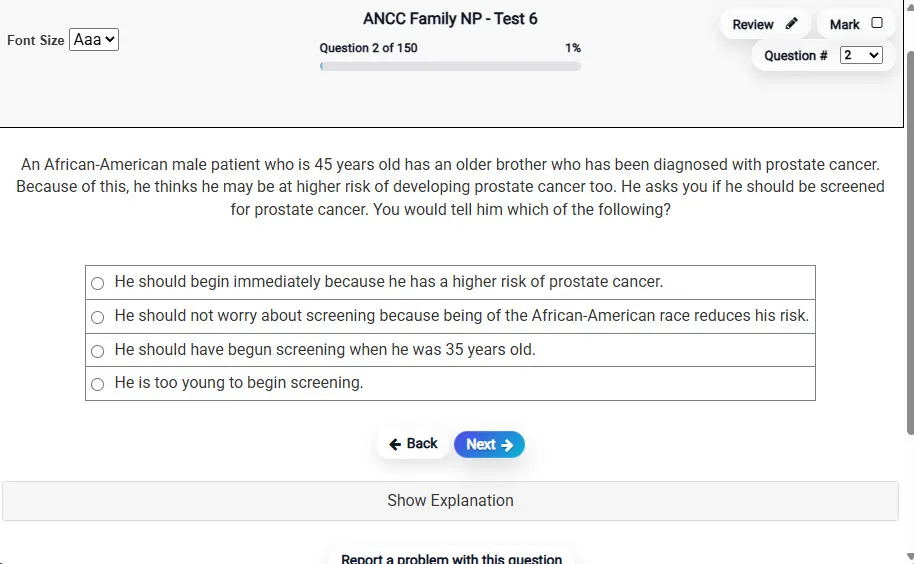
Answering a Question screen – Multiple-choice item view with navigation controls and progress tracker.
Answering a Question Multiple-choice item view with navigation controls and progress tracker.

                           Detailed Explanation screen – 
                         Review mode showing chosen answer and rationale and references.
Detailed Explanation Review mode showing chosen answer and rationale and references.

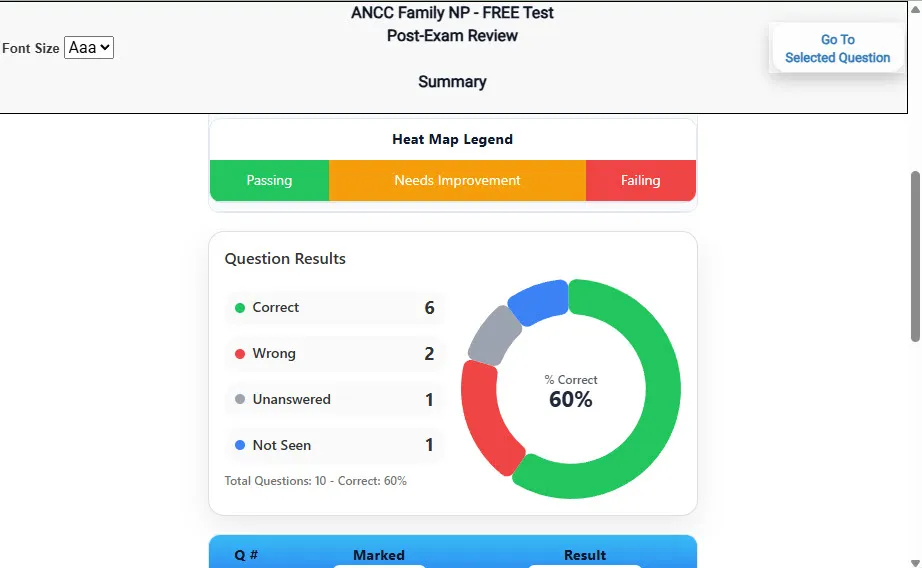
                           Review Summary 1 screen – 
                         Summary with counts for correct/wrong/unanswered and not seen items.
Review Summary 1 Summary with counts for correct/wrong/unanswered and not seen items.

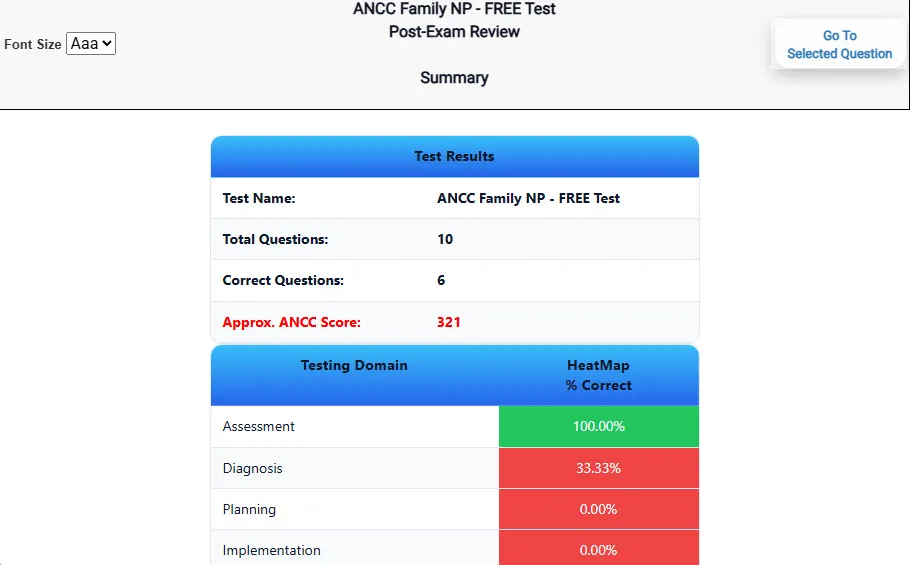
                           Review Summary 2 screen – 
                         Advanced summary with category/domain breakdown and performance insights.
Review Summary 2 Advanced summary with category/domain breakdown and performance insights.

What Each Screen Shows

Answer Question Screen

  • Clean multiple-choice interface with progress bar.
  • Mark for review feature.
  • Matches real test pacing.

Detailed Explanation

  • Correct answer plus rationale.
  • Key concepts and guidelines highlighted.
  • Move between questions to fill knowledge gaps.

Review Summary 1

  • Overall results with total questions and scaled score.
  • Domain heatmap shows strengths and weaknesses.
  • Quick visual feedback on study priorities.

Review Summary 2

  • Chart of correct, wrong, unanswered, not seen.
  • Color-coded results for easy review.
  • Links back to missed items.

Top 10 Reasons to Use Exam Edge for your MTEL General Curriculum Math Exam Prep

  1. Focused on the MTEL General Curriculum Math Exam

    Our practice tests are built specifically for the MTEL General Curriculum Math exam — every question mirrors the real topics, format, and difficulty so you're studying exactly what matters.

  2. Real Exam Simulation

    We match the per-question time limits and pressure of the actual MTEL exam, so test day feels familiar and stress-free.

  3. 20 Full Practice Tests & 900 Unique Questions

    You'll have more than enough material to master every MTEL General Curriculum Math concept — no repeats, no fluff.

  4. Lower Cost Than a Retake

    Ordering 5 practice exams costs less than retaking the MTEL General Curriculum Math exam after a failure. One low fee could save you both time and money.

  5. Flexible Testing

    Need to step away mid-exam? Pick up right where you left off — with your remaining time intact.

  6. Instant Scoring & Feedback

    See your raw score and an estimated MTEL General Curriculum Math score immediately after finishing each practice test.

  7. Detailed Explanations for Every Question

    Review correct and incorrect answers with clear, step-by-step explanations so you truly understand each topic.

  8. Trusted & Accredited

    We're fully accredited by the Better Business Bureau and uphold the highest standards of trust and transparency.

  9. Web-Based & Always Available

    No software to install. Access your MTEL General Curriculum Math practice exams 24/7 from any computer or mobile device.

  10. Expert Support When You Need It

    Need extra help? Our specialized tutors are highly qualified and ready to support your MTEL exam prep.


Pass the MTEL General Curriculum Math Exam with Realistic Practice Tests from Exam Edge

Preparing for your upcoming MTEL General Curriculum Math (03) Certification Exam can feel overwhelming — but the right practice makes all the difference. Exam Edge gives you the tools, structure, and confidence to pass on your first try. Our online practice exams are built to match the real MTEL General Curriculum Math exam in content, format, and difficulty.

  • 📝 20 MTEL General Curriculum Math Practice Tests: Access 20 full-length exams with 45 questions each, covering every major MTEL General Curriculum Math topic in depth.
  • Instant Online Access: Start practicing right away — no software, no waiting.
  • 🧠 Step-by-Step Explanations: Understand the reasoning behind every correct answer so you can master MTEL General Curriculum Math exam concepts.
  • 🔄 Retake Each Exam Up to 4 Times: Build knowledge through repetition and track your improvement over time.
  • 🌐 Web-Based & Available 24/7: Study anywhere, anytime, on any device.
  • 🧘 Boost Your Test-Day Confidence: Familiarity with the MTEL format reduces anxiety and helps you perform under pressure.

These MTEL General Curriculum Math practice exams are designed to simulate the real testing experience by matching question types, timing, and difficulty level. This approach helps you get comfortable not just with the exam content, but also with the testing environment, so you walk into your exam day focused and confident.

Exam Edge MTEL Reviews


I wanted to thank ExamEdge for helping me pass this teacher test the  first time. I had a lot of material to absorb in a short space of time and so I purchased the 15 practice tests and by test 15 I was so much more confident due to getting consistent passing scores. Thank you again, in my ...
Read More
Paul, Quincy, MA

I would like to commend your site in assisting me in passing the high school math test MTEL. I used your tests for practice and review and passed the test the first time. I was a little worried going into the test because the online tests were at such a high level. I found that I was very well prepa ...
Read More
Julie, MA


MTEL General Curriculum Math Aliases Test Name

Here is a list of alternative names used for this exam.

  • MTEL General Curriculum Math
  • MTEL General Curriculum Math test
  • MTEL General Curriculum Math Certification Test
  • MTEL
  • MTEL 03
  • 03 test
  • MTEL General Curriculum Math (03)
  • General Curriculum Math certification