This is the content of the pop-over!

MTEL General Curriculum (03) Practice Tests & Test Prep by Exam Edge


MTEL General Curriculum  product image
(5.0)
Based on 37 Reviews

  • Real Exam Simulation: Timed questions and matching content build comfort for your MTEL General Curriculum test day.
  • Instant, 24/7 Access: Web-based MTEL General Curriculum practice exams with no software needed.
  • Clear Explanations: Step-by-step answers and explanations for your MTEL exam to strengthen understanding.
  • Boosted Confidence: Reduces anxiety and improves test-taking skills to ace your MTEL General Curriculum (78).

Featured on

MTEL General Curriculum Online Practice Test Bundles

BEST VALUE
20 practice tests

$174.00

$799.00

SAVE $625

Only $8.70 per test!

  • 100% Pass Guarantee
  • 20 online practice tests
  • 120 questions per test
  • Bonus: 100 Flash Cards + Study Guide
  • Instant access
  • Detailed Explanations
  • Practice tests never expire
  • Timed, untimed, or study guide mode
MOST POPULAR
10 practice tests

$99.50

$399.50

SAVE $300

Only $9.95 per test!

  • 10 online practice tests
  • 120 questions per test
  • Bonus: 100 Flash Cards + Study Guide
  • Instant access
  • Detailed Explanations
  • Practice tests never expire
  • Timed, untimed, or study guide mode
5 practice tests

$69.75

$199.75

SAVE $130

Only $13.95 per test!

  • 5 online practice tests
  • 120 questions per test
  • Bonus: 100 Flash Cards
  • Instant access
  • Detailed Explanations
  • Practice tests never expire
  • Timed, untimed, or study guide mode
1 practice test

$39.95

  • 1 online practice test
  • 120 questions per test
  • Instant access
  • Detailed Explanations
  • Practice tests never expire
  • Timed, untimed, or study guide mode
Quick Select
Tap to choose a bundle

** All Prices are in US Dollars (USD) **


MTEL General Curriculum (78) Resources

Jump to the section you need most.

Understanding the exact breakdown of the MTEL General Curriculum test will help you know what to expect and how to most effectively prepare. The MTEL General Curriculum has 120 multiple-choice questions and 2 essay questions. The exam will be broken down into the sections below:

MTEL General Curriculum Exam Blueprint
Domain Name % Number of
Questions
Subtest 1: Language Arts and History/Social Science  
     Language Arts 30% 20
     History/Social Science 60% 40
Subtest 2: Mathematics - Science Technology/Engineering  
     Mathematics 48% 32
     Science and Technology/Engineering 42% 28

MTEL General Curriculum Study Tips by Domain

  • Know the test split: Subtest 1 mixes Language Arts with History/Social Science, so budget time by section; red flag is spending too long on one reading passage and rushing the constructed response.
  • When analyzing texts, anchor claims in explicit evidence (quote or precise detail); common trap is summarizing the passage instead of explaining how the evidence supports the idea.
  • Grammar/usage questions often hinge on sentence boundaries and agreement; priority rule is to check subject–verb agreement and pronoun antecedents before debating style.
  • For reading comprehension, track author’s purpose, tone, and inference from context; red flag is choosing an answer that is true generally but not supported by the specific text.
  • In U.S./world history and civics, distinguish primary vs. secondary sources and avoid presentism; common trap is judging past events by modern standards rather than historical context.
  • For geography/economics items, interpret maps/graphs and apply core terms (e.g., supply/demand, migration push–pull) accurately; red flag is ignoring units, scale, or axis labels on data displays.
  • Use context clues plus morphology (prefix/root/suffix) to infer meaning; red flag: choosing an answer that just “sounds right” but contradicts the passage.
  • Distinguish main idea from supporting details and summarize without adding new information; common trap: selecting a detail or example as the main idea.
  • Identify author’s purpose and audience using tone, diction, and text structure; priority rule: tie claims to specific evidence rather than personal opinion.
  • Recognize and use standard grammar and usage (e.g., subject–verb agreement, pronoun-antecedent agreement, modifiers); red flag: misplaced modifiers that change meaning.
  • Apply conventions of written English (punctuation, capitalization, spelling) to improve clarity; common trap: comma splices and run-ons in sentences joined by only a comma.
  • Know the writing process (planning, drafting, revising, editing) and features of narrative, informative, and persuasive writing; priority rule: revise for organization and coherence before fixing surface errors.
  • Build a fast timeline for U.S. and world history (e.g., Revolution → Constitution → Civil War → Industrialization) and use it to eliminate choices that place events out of sequence—a common MTEL trap.
  • For U.S. government, distinguish powers (enumerated, reserved, concurrent) and limits (checks and balances, judicial review); red flag: answers that confuse the Bill of Rights with the Constitution’s structural provisions.
  • In civics questions, match the level of government to the responsibility (local services vs. state education policy vs. federal treaties)—priority rule: if it involves interstate relations or national defense, suspect federal authority.
  • For economics, separate micro (supply/demand, elasticity) from macro (GDP, inflation, unemployment) and watch for the trap of treating “higher prices” as automatically meaning “higher demand” rather than a supply shift.
  • Use geography skills: interpret maps, latitude/longitude, and region characteristics; red flag: confusing weather with climate or assuming population density is highest in the largest land-area states.
  • When analyzing primary/secondary sources, identify author, purpose, and historical context; common trap: selecting a choice that quotes a source accurately but ignores bias or intended audience.
  • Expect a mixed-format Subtest 2 with both selected-response and open-response; common trap is spending too long on the first constructed response—budget time so you can fully show work and reasoning on both.
  • In Mathematics, show units and justify each step; red flag is giving only a final number with no setup (e.g., no equation, diagram, or reasoning), which can cost most of the open-response credit.
  • Be fluent with fractions/decimals/percents and proportional reasoning; priority rule: translate word problems into ratios or linear relationships before calculating to avoid “plug-and-chug” errors.
  • In Science, distinguish observation vs. inference and identify variables; common trap is calling the independent variable the one that “changes most” instead of the one intentionally manipulated.
  • In Technology/Engineering, read constraints and criteria carefully; red flag is proposing a design that violates a stated constraint (materials, cost, safety), even if it meets the performance goal.
  • When interpreting graphs/tables across math and science, check scale and axes first; common trap is misreading nonzero baselines or uneven intervals, leading to incorrect trend or rate conclusions.
  • Be fluent with place value, factors/multiples, primes, and divisibility tests—red flag: confusing greatest common factor (GCF) with least common multiple (LCM) on multi-step word problems.
  • Work accurately with fractions/decimals/percents (equivalence, operations, percent change)—common trap: forgetting to convert units or misapplying percent increase/decrease in successive changes.
  • Translate word problems into expressions/equations and check reasonableness—priority rule: label quantities and verify the answer fits the context (e.g., negative length, impossible rate) before finalizing.
  • Use proportional reasoning (rates, ratios, scale, similar figures) and distinguish direct vs. inverse variation—red flag: setting up proportions with mismatched units or reversed ratios.
  • Geometry focus: angle relationships, triangle properties, perimeter/area/volume, and coordinate basics—common trap: mixing up area vs. perimeter or using the wrong units (square/cubic) on constructed-response.
  • Data/probability: interpret tables/graphs, measures of center/spread, and simple probability—priority rule: watch for “not”, “at least”, and conditional wording; don’t average averages without considering group sizes.
  • Emphasize the science practices MTEL favors: forming testable hypotheses, identifying variables/controls, and drawing conclusions limited to the data; red flag—claiming causation from correlation or from a study with confounds.
  • Know key physical science relationships (force, energy, and simple circuits) and use units consistently; common trap—mixing mass vs. weight or assuming current is “used up” in a series circuit.
  • Earth/space: distinguish weather vs. climate and relate seasons to Earth’s tilt (not distance from the Sun); red flag—attributing seasons to orbital distance or confusing rotation with revolution.
  • Life science: connect structure to function (cells, body systems, ecosystems) and read food webs for energy flow; common trap—reversing energy direction or assuming matter disappears rather than cycling.
  • Technology/Engineering design: define criteria and constraints, prototype, test, and iterate using data; priority rule—constraints (cost, safety, materials) must be addressed explicitly, not treated as afterthoughts.
  • Measurement/data: select appropriate tools, estimate, and interpret graphs/tables with attention to variability; red flag—overstating precision beyond the measuring device or ignoring outliers without justification.


Built to Fit Into Your Busy Life

Everything you need to prepare with confidence—without wasting a minute.

Three Study Modes

Timed, No Time Limit, or Explanation mode.

Actionable Analytics

Heatmaps and scaled scores highlight weak areas.

High-Yield Rationales

Concise explanations emphasize key concepts.

Realistic Interface

Matches the feel of the actual exam environment.

Accessible by Design

Clean layout reduces cognitive load.

Anytime, Anywhere

Web-based access 24/7 on any device.
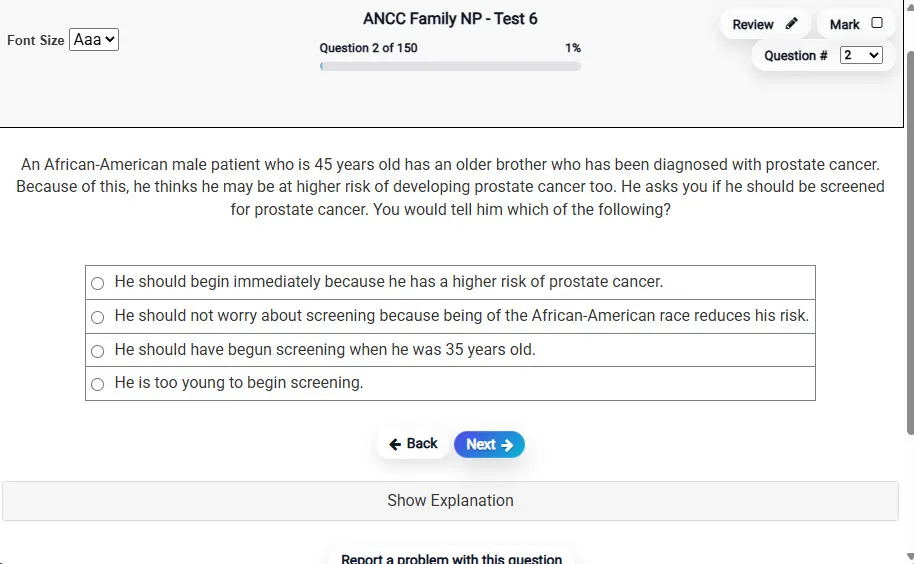
Answering a Question screen – Multiple-choice item view with navigation controls and progress tracker.
Answering a Question Multiple-choice item view with navigation controls and progress tracker.

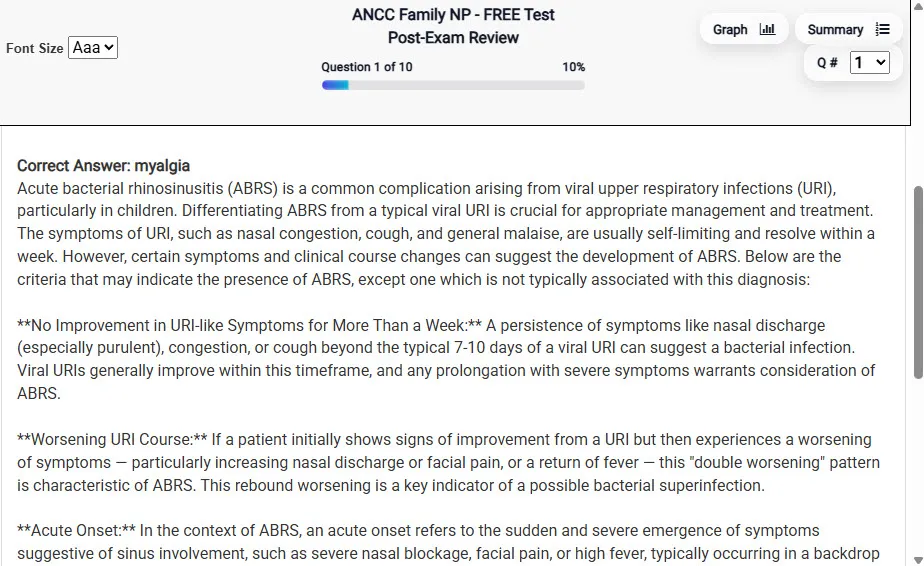
                           Detailed Explanation screen – 
                         Review mode showing chosen answer and rationale and references.
Detailed Explanation Review mode showing chosen answer and rationale and references.

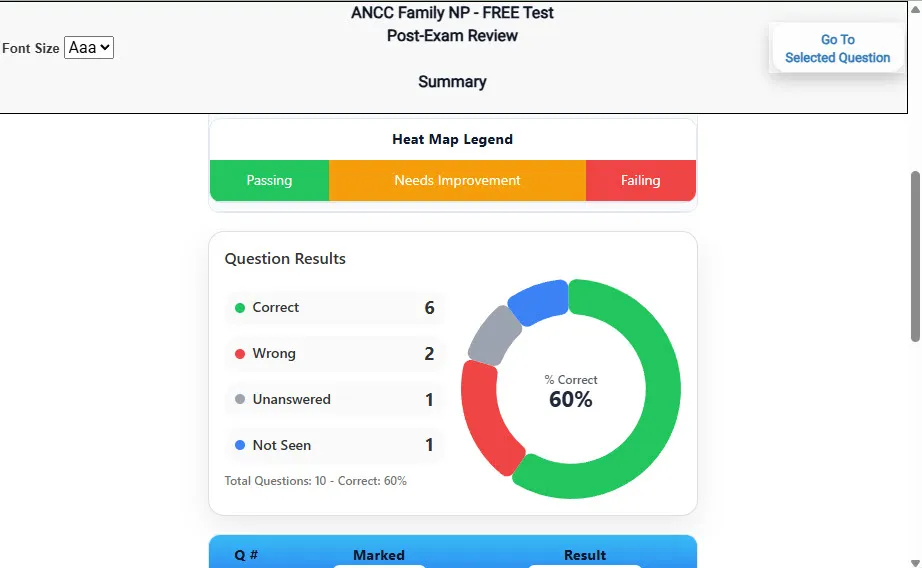
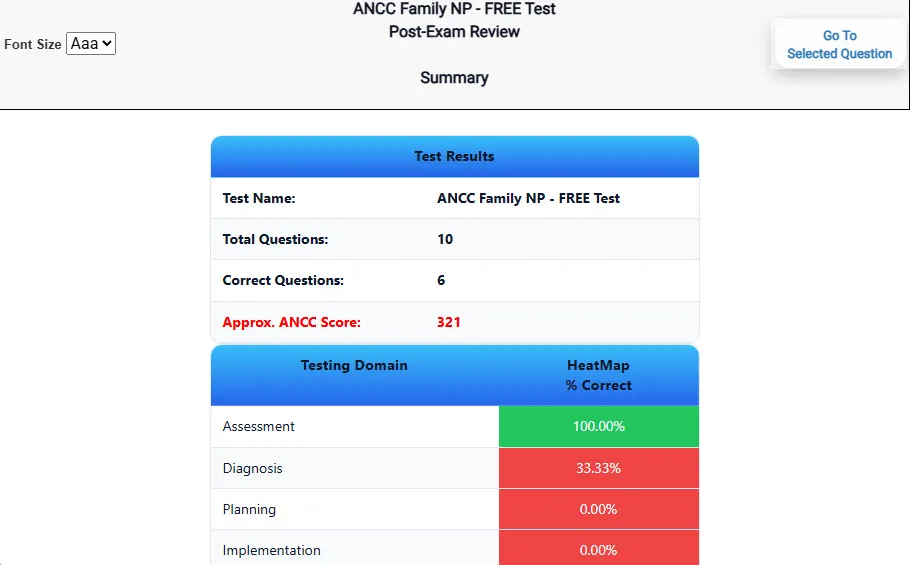
                           Review Summary 1 screen – 
                         Summary with counts for correct/wrong/unanswered and not seen items.
Review Summary 1 Summary with counts for correct/wrong/unanswered and not seen items.

                           Review Summary 2 screen – 
                         Advanced summary with category/domain breakdown and performance insights.
Review Summary 2 Advanced summary with category/domain breakdown and performance insights.

What Each Screen Shows

Answer Question Screen

  • Clean multiple-choice interface with progress bar.
  • Mark for review feature.
  • Matches real test pacing.

Detailed Explanation

  • Correct answer plus rationale.
  • Key concepts and guidelines highlighted.
  • Move between questions to fill knowledge gaps.

Review Summary 1

  • Overall results with total questions and scaled score.
  • Domain heatmap shows strengths and weaknesses.
  • Quick visual feedback on study priorities.

Review Summary 2

  • Chart of correct, wrong, unanswered, not seen.
  • Color-coded results for easy review.
  • Links back to missed items.

Top 10 Reasons to Use Exam Edge for your MTEL General Curriculum Exam Prep

  1. Focused on the MTEL General Curriculum Exam

    Our practice tests are built specifically for the MTEL General Curriculum exam — every question mirrors the real topics, format, and difficulty so you're studying exactly what matters.

  2. Real Exam Simulation

    We match the per-question time limits and pressure of the actual MTEL exam, so test day feels familiar and stress-free.

  3. 20 Full Practice Tests & 2,400 Unique Questions

    You'll have more than enough material to master every MTEL General Curriculum concept — no repeats, no fluff.

  4. Lower Cost Than a Retake

    Ordering 5 practice exams costs less than retaking the MTEL General Curriculum exam after a failure. One low fee could save you both time and money.

  5. Flexible Testing

    Need to step away mid-exam? Pick up right where you left off — with your remaining time intact.

  6. Instant Scoring & Feedback

    See your raw score and an estimated MTEL General Curriculum score immediately after finishing each practice test.

  7. Detailed Explanations for Every Question

    Review correct and incorrect answers with clear, step-by-step explanations so you truly understand each topic.

  8. Trusted & Accredited

    We're fully accredited by the Better Business Bureau and uphold the highest standards of trust and transparency.

  9. Web-Based & Always Available

    No software to install. Access your MTEL General Curriculum practice exams 24/7 from any computer or mobile device.

  10. Expert Support When You Need It

    Need extra help? Our specialized tutors are highly qualified and ready to support your MTEL exam prep.


Pass the MTEL General Curriculum Exam with Realistic Practice Tests from Exam Edge

Preparing for your upcoming MTEL General Curriculum (78) Certification Exam can feel overwhelming — but the right practice makes all the difference. Exam Edge gives you the tools, structure, and confidence to pass on your first try. Our online practice exams are built to match the real MTEL General Curriculum exam in content, format, and difficulty.

  • 📝 20 MTEL General Curriculum Practice Tests: Access 20 full-length exams with 120 questions each, covering every major MTEL General Curriculum topic in depth.
  • Instant Online Access: Start practicing right away — no software, no waiting.
  • 🧠 Step-by-Step Explanations: Understand the reasoning behind every correct answer so you can master MTEL General Curriculum exam concepts.
  • 🔄 Retake Each Exam Up to 4 Times: Build knowledge through repetition and track your improvement over time.
  • 🌐 Web-Based & Available 24/7: Study anywhere, anytime, on any device.
  • 🧘 Boost Your Test-Day Confidence: Familiarity with the MTEL format reduces anxiety and helps you perform under pressure.

These MTEL General Curriculum practice exams are designed to simulate the real testing experience by matching question types, timing, and difficulty level. This approach helps you get comfortable not just with the exam content, but also with the testing environment, so you walk into your exam day focused and confident.

Exam Edge MTEL Reviews


I wanted to thank ExamEdge for helping me pass this teacher test the  first time. I had a lot of material to absorb in a short space of time and so I purchased the 15 practice tests and by test 15 I was so much more confident due to getting consistent passing scores. Thank you again, in my ...
Read More
Paul, Quincy, MA

I would like to commend your site in assisting me in passing the high school math test MTEL. I used your tests for practice and review and passed the test the first time. I was a little worried going into the test because the online tests were at such a high level. I found that I was very well prepa ...
Read More
Julie, MA


MTEL General Curriculum Aliases Test Name

Here is a list of alternative names used for this exam.

  • MTEL General Curriculum
  • MTEL General Curriculum test
  • MTEL General Curriculum Certification Test
  • MTEL
  • MTEL 78
  • 78 test
  • MTEL General Curriculum (78)
  • General Curriculum certification