This is the content of the pop-over!

Lightning Deal Alert – 12% Off Ends at Midnight!

Strike while the savings are hot! Use promo code FlashSale at checkout for 12% off any Exam Edge test or bundle. Hurry—the clock is ticking!

AEPA Spanish (NT401) Practice Tests & Test Prep by Exam Edge


AEPA Spanish  product image
(4.8)
Based on 22 Reviews

  • Real Exam Simulation: Timed questions and matching content build comfort for your AEPA Spanish test day.
  • Instant, 24/7 Access: Web-based AEPA Spanish practice exams with no software needed.
  • Clear Explanations: Step-by-step answers and explanations for your AEPA exam to strengthen understanding.
  • Boosted Confidence: Reduces anxiety and improves test-taking skills to ace your AEPA Spanish (NT401).

Featured on

AEPA Spanish Online Practice Test Bundles

BEST VALUE
10 practice tests

$99.50

$399.50

SAVE $300

Only $9.95 per test!

  • 100% Pass Guarantee
  • 10 online practice tests
  • 100 questions per test
  • Bonus: 100 Flash Cards + Study Guide
  • Instant access
  • Detailed Explanations
  • Practice tests never expire
  • Timed, untimed, or study guide mode
5 practice tests

$69.75

$199.75

SAVE $130

Only $13.95 per test!

  • 5 online practice tests
  • 100 questions per test
  • Bonus: 100 Flash Cards + Study Guide
  • Instant access
  • Detailed Explanations
  • Practice tests never expire
  • Timed, untimed, or study guide mode
1 practice test

$39.95

  • 1 online practice test
  • 100 questions per test
  • Instant access
  • Detailed Explanations
  • Practice tests never expire
  • Timed, untimed, or study guide mode
Quick Select
Tap to choose a bundle

** All Prices are in US Dollars (USD) **


AEPA Spanish (NT401) Resources

Jump to the section you need most.

Understanding the exact breakdown of the AEPA Spanish test will help you know what to expect and how to most effectively prepare. The AEPA Spanish has 100 multiple-choice questions and 1 essay questions. The exam will be broken down into the sections below:

AEPA Spanish Exam Blueprint
Domain Name % Number of
Questions
Interpretive Listening 15% 15
Interpretive Reading 15% 15
Language Structures 13% 13
Cultural Understanding 15% 15
Presentational Writing 20% 20
Presentational Speaking 22% 22
     *Practice Exam only covers multiple choice questions  

AEPA Spanish Study Tips by Domain

  • Listen first for the communicative purpose (e.g., request, complaint, invitation) before details—common trap: choosing an answer that matches isolated words but not the speaker’s intent.
  • Track who is speaking and their relationship (usted vs. tú, titles, register) to infer setting and formality—red flag: mixing up perspectives after a pronoun or speaker change.
  • Use time markers and sequencing (ayer, ya, todavía, mientras, en cuanto) to place events correctly—common trap: assuming present tense when the audio implies past or future.
  • Attend to negation and limiting words (no, nunca, apenas, solo, sino) because they often flip the meaning—priority rule: verify whether the speaker is denying or correcting a point.
  • Infer meaning of unfamiliar words from context, cognates, and tone rather than guessing—contraindication: “false friends” like asistir (to attend) or actual (current) can mislead.
  • For short dialogues and announcements, identify key details (numbers, dates, locations, prices) on the first pass—red flag: confusing similar-sounding numbers (quince vs. cincuenta) or days (martes vs. miércoles).
  • Read for the main idea first, then verify with 1–2 key details; red flag: picking an option that matches a single detail but contradicts the passage’s overall point.
  • Use context to infer meaning of unfamiliar words rather than translating word-for-word; common trap: choosing a definition that matches an English cognate but doesn’t fit the sentence.
  • Track who is speaking and the text type (ad, email, news, instructions) to set purpose and tone; red flag: treating persuasive language as neutral information.
  • Pay attention to discourse markers (sin embargo, por lo tanto, aunque) to follow contrasts and cause/effect; common trap: missing a “however” shift and reversing the author’s stance.
  • Distinguish stated facts from implied conclusions by locating textual evidence; priority rule: if you can’t point to a line/phrase that supports it, the answer is likely too strong.
  • Handle reference and cohesion (pronouns, este/esa/aquello, el cual, lo que) by matching antecedents precisely; red flag: attaching a pronoun to the nearest noun instead of the one that fits meaning and agreement.
  • Maintain consistent subject–verb agreement in tense and mood; red flag: a singular subject with a plural verb (or vice versa) after intervening phrases.
  • Use the preterite vs. imperfect strategically (completed event vs. background/habit); common trap: using preterite for ongoing descriptions (“era” vs. “fue” changes meaning).
  • Apply the subjunctive after triggers (doubt, emotion, denial, nonexistence, recommendation); priority rule: certainty/statement of fact typically takes indicative.
  • Place object pronouns correctly and avoid doubling errors; red flag: misordering “se lo” (never “lo se”) and forgetting pronoun placement with infinitives/gerunds.
  • Choose ser vs. estar based on essence/identity vs. state/location/result; common trap: treating “estar aburrido” (state) as “ser aburrido” (inherent trait).
  • Use correct prepositions and contractions (a+el=“al”, de+el=“del”); red flag: missing personal “a” before a specific human direct object.
  • Prioritize culturally appropriate register (tú vs. usted) based on context and power distance; red flag: using informal address in service, professional, or unfamiliar interactions.
  • Distinguish pan-Hispanic norms from region-specific practices (e.g., meal times, forms of greeting); common trap: assuming one country’s custom applies across the Spanish-speaking world.
  • Interpret idioms, proverbs, and gestures in cultural context rather than literal meaning; red flag: translating dichos word-for-word and missing the intended social message.
  • Connect products, practices, and perspectives (e.g., festivals, foods, school routines) and infer underlying values; priority rule: choose answers that explain “why” a practice exists, not just what happens.
  • Recognize cultural variation within communities (urban/rural, generational, indigenous/afrodescendant influences); common trap: stereotyping or overgeneralizing a single identity marker.
  • Use appropriate conventions for politeness and interaction (turn-taking, indirectness, personal space); red flag: selecting responses that are linguistically correct but pragmatically abrupt or overly direct.
  • Organize writing with a clear purpose, audience, and register; red flag: mixing tú/usted or switching from formal to informal tone mid-response.
  • Develop ideas with specific details (examples, reasons, comparisons) rather than lists; common trap: repeating the prompt in Spanish without adding new information.
  • Use accurate verb tenses and mood (especially preterite vs. imperfect and subjunctive after expressions of doubt/necessity); red flag: defaulting to present tense for everything.
  • Maintain agreement and pronoun clarity (gender/number, subject–verb, object pronouns); common trap: mismatching adjectives or using lo/la/le inconsistently with the antecedent.
  • Control sentence structure and connectors (porque, aunque, sin embargo, por lo tanto) to show cohesion; red flag: run-on sentences joined only with “y” or comma splices.
  • Prioritize spelling, accents, and punctuation that change meaning (aún/aun, sí/si, tú/tu, más/mas); common trap: omitting accent marks on high-frequency words.
  • Organize your response with a clear intro–development–closing so the task is fully addressed; red flag: running out of time without a conclusion or leaving one prompt element unanswered.
  • Use a consistent register (tú/usted) and an appropriate tone for the scenario; common trap: switching forms mid-response or using overly informal language in a formal context.
  • Speak at a steady pace with intelligible pronunciation and natural stress/intonation; red flag: racing, excessive fillers (e.g., “eh”, “este”), or mumbling that obscures meaning.
  • Demonstrate control of verb tenses and moods (especially preterite vs. imperfect and basic subjunctive triggers); common trap: defaulting to present tense for everything or using the wrong past tense in narration.
  • Support ideas with specific details and examples rather than generalities; priority rule: add at least 2–3 concrete supporting points to avoid a list-like response.
  • Use cohesive devices (porque, sin embargo, por lo tanto, primero…después) to connect ideas smoothly; red flag: choppy sentences with no transitions that make the response sound like disconnected fragments.


Built to Fit Into Your Busy Life

Everything you need to prepare with confidence—without wasting a minute.

Three Study Modes

Timed, No Time Limit, or Explanation mode.

Actionable Analytics

Heatmaps and scaled scores highlight weak areas.

High-Yield Rationales

Concise explanations emphasize key concepts.

Realistic Interface

Matches the feel of the actual exam environment.

Accessible by Design

Clean layout reduces cognitive load.

Anytime, Anywhere

Web-based access 24/7 on any device.
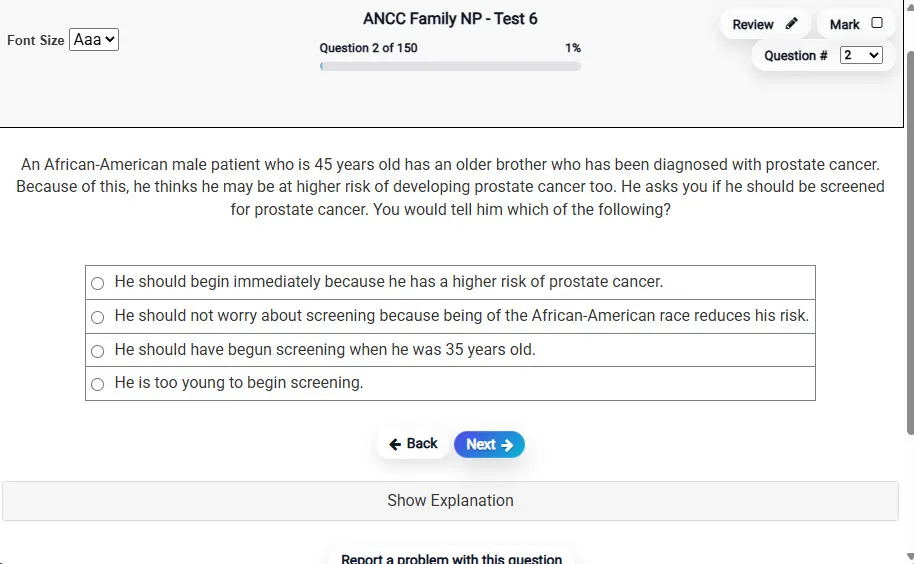
Answering a Question screen – Multiple-choice item view with navigation controls and progress tracker.
Answering a Question Multiple-choice item view with navigation controls and progress tracker.

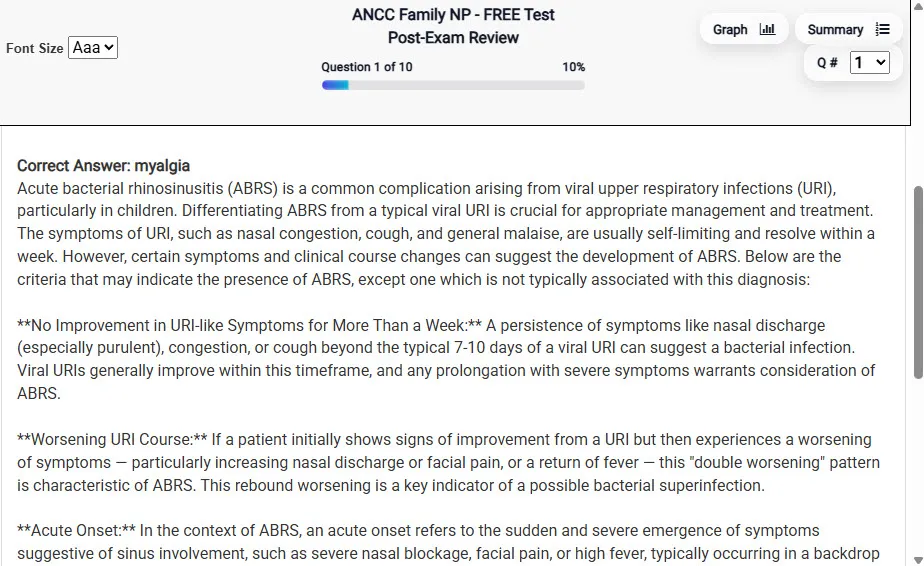
                           Detailed Explanation screen – 
                         Review mode showing chosen answer and rationale and references.
Detailed Explanation Review mode showing chosen answer and rationale and references.

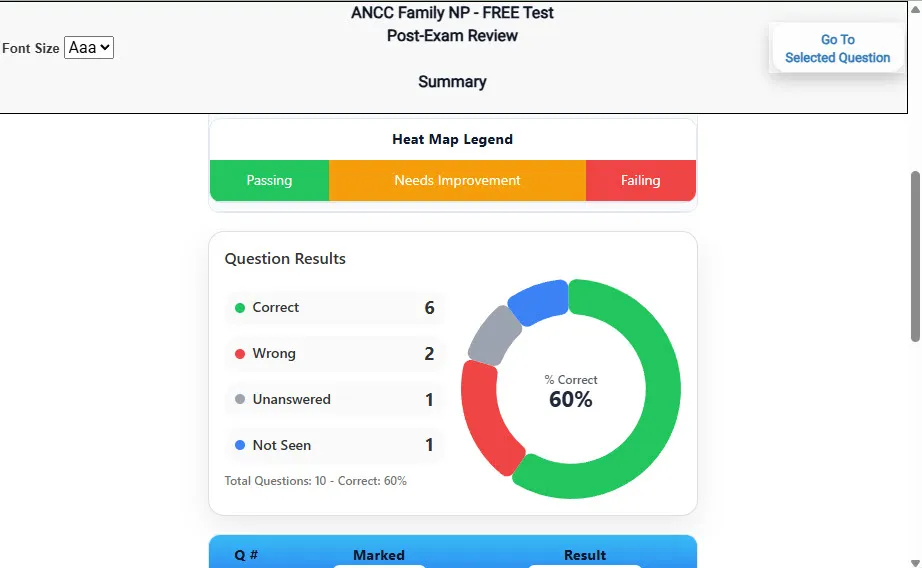
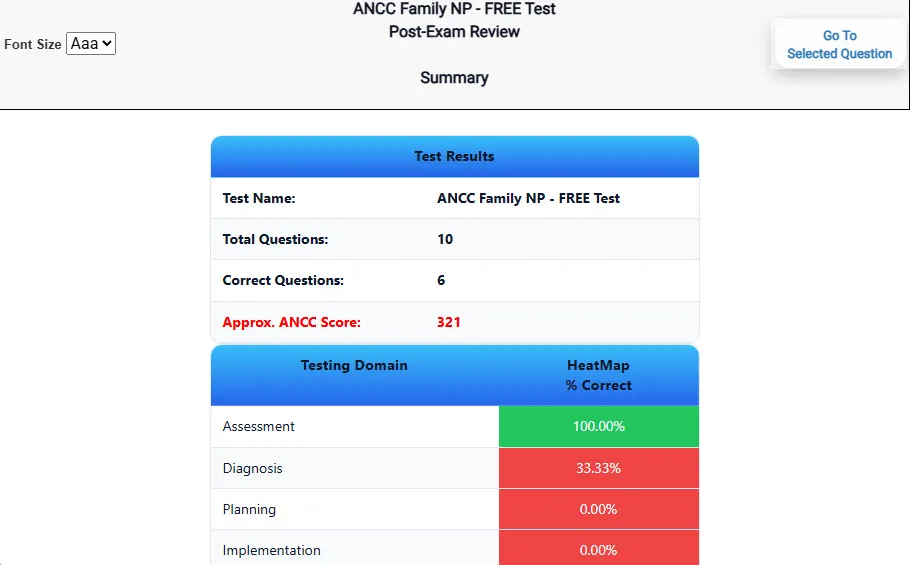
                           Review Summary 1 screen – 
                         Summary with counts for correct/wrong/unanswered and not seen items.
Review Summary 1 Summary with counts for correct/wrong/unanswered and not seen items.

                           Review Summary 2 screen – 
                         Advanced summary with category/domain breakdown and performance insights.
Review Summary 2 Advanced summary with category/domain breakdown and performance insights.

What Each Screen Shows

Answer Question Screen

  • Clean multiple-choice interface with progress bar.
  • Mark for review feature.
  • Matches real test pacing.

Detailed Explanation

  • Correct answer plus rationale.
  • Key concepts and guidelines highlighted.
  • Move between questions to fill knowledge gaps.

Review Summary 1

  • Overall results with total questions and scaled score.
  • Domain heatmap shows strengths and weaknesses.
  • Quick visual feedback on study priorities.

Review Summary 2

  • Chart of correct, wrong, unanswered, not seen.
  • Color-coded results for easy review.
  • Links back to missed items.

Top 10 Reasons to Use Exam Edge for your AEPA Spanish Exam Prep

  1. Focused on the AEPA Spanish Exam

    Our practice tests are built specifically for the AEPA Spanish exam — every question mirrors the real topics, format, and difficulty so you're studying exactly what matters.

  2. Real Exam Simulation

    We match the per-question time limits and pressure of the actual AEPA exam, so test day feels familiar and stress-free.

  3. 10 Full Practice Tests & 1,000 Unique Questions

    You'll have more than enough material to master every AEPA Spanish concept — no repeats, no fluff.

  4. Lower Cost Than a Retake

    Ordering 5 practice exams costs less than retaking the AEPA Spanish exam after a failure. One low fee could save you both time and money.

  5. Flexible Testing

    Need to step away mid-exam? Pick up right where you left off — with your remaining time intact.

  6. Instant Scoring & Feedback

    See your raw score and an estimated AEPA Spanish score immediately after finishing each practice test.

  7. Detailed Explanations for Every Question

    Review correct and incorrect answers with clear, step-by-step explanations so you truly understand each topic.

  8. Trusted & Accredited

    We're fully accredited by the Better Business Bureau and uphold the highest standards of trust and transparency.

  9. Web-Based & Always Available

    No software to install. Access your AEPA Spanish practice exams 24/7 from any computer or mobile device.

  10. Expert Support When You Need It

    Need extra help? Our specialized tutors are highly qualified and ready to support your AEPA exam prep.


Pass the AEPA Spanish Exam with Realistic Practice Tests from Exam Edge

Preparing for your upcoming AEPA Spanish (NT401) Certification Exam can feel overwhelming — but the right practice makes all the difference. Exam Edge gives you the tools, structure, and confidence to pass on your first try. Our online practice exams are built to match the real AEPA Spanish exam in content, format, and difficulty.

  • 📝 10 AEPA Spanish Practice Tests: Access 10 full-length exams with 100 questions each, covering every major AEPA Spanish topic in depth.
  • Instant Online Access: Start practicing right away — no software, no waiting.
  • 🧠 Step-by-Step Explanations: Understand the reasoning behind every correct answer so you can master AEPA Spanish exam concepts.
  • 🔄 Retake Each Exam Up to 4 Times: Build knowledge through repetition and track your improvement over time.
  • 🌐 Web-Based & Available 24/7: Study anywhere, anytime, on any device.
  • 🧘 Boost Your Test-Day Confidence: Familiarity with the AEPA format reduces anxiety and helps you perform under pressure.

These AEPA Spanish practice exams are designed to simulate the real testing experience by matching question types, timing, and difficulty level. This approach helps you get comfortable not just with the exam content, but also with the testing environment, so you walk into your exam day focused and confident.

Exam Edge AEPA Reviews


I passed my AEPA Basic Skills Math subtest today! This was the second time I took the test. My first time I scored 232. This time I scored 244. Taking your practice tests helped me a great deal, because several types of questions on the real test were also on your practice tests. Thanks so mu ...
Read More
Lakisha F, Arizona

I am disappointed in this service. I purchased the 15 tests to help me prepare for the second time taking the test and it did not help. The questions were not like what I experienced on the real test and the performance question was completely different and I don't feel prepared me. I would not p ...
Read More
Lesley , Clarkdale, Arizona


AEPA Spanish Aliases Test Name

Here is a list of alternative names used for this exam.

  • AEPA Spanish
  • AEPA Spanish test
  • AEPA Spanish Certification Test
  • AEPA
  • AEPA NT401
  • NT401 test
  • AEPA Spanish (NT401)
  • Spanish certification