This is the content of the pop-over!

ServSafe Food Safety Manager Practice Tests & Test Prep by Exam Edge


ServSafe Food Safety Manager  product image
(5.0)
Based on 17 Reviews

  • Real Exam Simulation: Timed questions and matching content build comfort for your ServSafe Food Safety Manager test day.
  • Instant, 24/7 Access: Web-based ServSafe Food Safety Manager practice exams with no software needed.
  • Clear Explanations: Step-by-step answers and explanations for your ServSafe exam to strengthen understanding.
  • Boosted Confidence: Reduces anxiety and improves test-taking skills to ace your ServSafe Food Safety Manager (FSM).

Featured on

ServSafe Food Safety Manager Online Practice Test Bundles

BEST VALUE
20 practice tests

$174.00

$599.00

SAVE $425

Only $8.70 per test!

  • 100% Pass Guarantee
  • 20 online practice tests
  • 80 questions per test
  • Bonus: 100 Flash Cards + Study Guide
  • Instant access
  • Detailed Explanations
  • Practice tests never expire
  • Timed, untimed, or study guide mode
MOST POPULAR
10 practice tests

$99.50

$299.50

SAVE $200

Only $9.95 per test!

  • 10 online practice tests
  • 80 questions per test
  • Bonus: 100 Flash Cards + Study Guide
  • Instant access
  • Detailed Explanations
  • Practice tests never expire
  • Timed, untimed, or study guide mode
5 practice tests

$59.75

$149.75

SAVE $90

Only $11.95 per test!

  • 5 online practice tests
  • 80 questions per test
  • Bonus: 100 Flash Cards
  • Instant access
  • Detailed Explanations
  • Practice tests never expire
  • Timed, untimed, or study guide mode
1 practice test

$29.95

  • 1 online practice test
  • 80 questions per test
  • Instant access
  • Detailed Explanations
  • Practice tests never expire
  • Timed, untimed, or study guide mode
MOST FLEXIBLE
Question Bank

As low as $59.95

400 Questions

Choose 1, 3, 6, or 12 months
A second login is required.

  • Exam Edge content in a powerful question bank
  • Customize Tests
  • Multiple Test & Flash Card Modes
  • Track performance over time
  • Instant access
  • Detailed Explanations
Quick Select
Tap to choose a bundle

** All Prices are in US Dollars (USD) **


ServSafe Food Safety Manager (FSM) Shortcuts


Understanding the exact breakdown of the ServSafe Food Safety Manager test will help you know what to expect and how to most effectively prepare. The ServSafe Food Safety Manager has 80 multiple-choice questions . The exam will be broken down into the sections below:

ServSafe Food Safety Manager Exam Blueprint
Domain Name % Number of
Questions
Preventing Contamination and Cross-Contamination 19% 15
Ensuring Personal Hygiene and Employee Health 18% 14
Actively Managing Controls in a Food Establishment 16% 13
Monitoring the Flow of Foods 13% 10
Ensuring Product Time and Temperature 14% 11
Conducting Cleaning and Sanitizing 11% 9
Managing the Physical Facility Design and Maintenance 6% 5
Preventing and Controlling Pests (Insects/Rodents) 4% 3

ServSafe Food Safety Manager Study Tips by Domain

  • Prevent cross-contamination by storing ready-to-eat foods above raw animal foods in this top-to-bottom order: seafood, whole cuts of beef/pork, ground meat/ground fish, poultry — red flag: raw chicken stored over produce.
  • Use separate equipment (or clean and sanitize between tasks) for raw and ready-to-eat foods; common trap: using the same cutting board/knife for raw meat then lettuce without sanitizing.
  • Prevent allergen cross-contact with dedicated tools/areas and by washing, rinsing, sanitizing, and air-drying before prepping allergen-free orders; priority rule: if you can’t guarantee separation, don’t serve it as allergen-free.
  • Control chemical contamination by labeling all spray bottles, storing chemicals away from food/equipment, and using only approved food-contact chemicals at the right concentration; red flag: chemicals stored above a prep table or in a food container.
  • Prevent physical contamination by keeping glass/metal fragments out of food (no drinking glasses on prep lines, protect light bulbs, keep packaging materials away from food); common trap: using chipped containers or broken utensil parts.
  • Avoid biological contamination from ready-to-eat handling by using gloves, deli tissue, or utensils and changing them between tasks; red flag: bare-hand contact with ready-to-eat foods unless a strict, approved alternative procedure is in place.
  • Exclude food handlers with vomiting or diarrhea and require them to be symptom-free for at least 24 hours (or cleared by a medical provider/health authority) before returning—common trap: letting them work because they “feel better” mid-shift.
  • Restrict employees with sore throat and fever from working with food; exclude them if serving a high-risk population (e.g., nursing homes)—red flag: assigning them to “just prep” without controls.
  • Wash hands correctly (at least 20 seconds with soap and warm running water) after restroom use, handling raw food, touching face/body, or bussing tables—priority rule: hand sanitizer never replaces handwashing.
  • Use gloves for ready-to-eat food but change them when contaminated and between tasks—common trap: washing or sanitizing gloves instead of replacing them.
  • Keep fingernails short, clean, and unpolished; only wear plain-band rings and avoid bracelets/watches when handling food—red flag: nail enhancements or chipped polish (physical contamination risk).
  • Require clean clothing, hair restraints, and no eating/drinking/chewing gum in prep areas—priority rule: allow drinks only in covered, spill-proof containers stored away from food/ice/utensils.
  • Apply the “active managerial control” approach by using written SOPs, training, and supervision to prevent hazards before they happen—red flag: relying only on end-of-shift checks.
  • Use HACCP principles to identify hazards and set critical limits (e.g., minimum internal cooking temps/time limits for TCS foods)—common trap: having a plan on paper but not monitoring it daily.
  • Focus controls on the five common risk factors: purchasing from approved sources, good personal hygiene, preventing cross-contamination, controlling time/temperature, and cleaning/sanitizing—priority rule: fix the factor tied to the highest illness risk first.
  • Verify controls with logs and observation (receiving, cooking temps, cooling, sanitizer concentration) and keep records consistent—red flag: missing dates/times or “filled in later” entries.
  • Correct problems immediately and document corrective actions (reheat, discard, re-cool, adjust sanitizer, retrain) when a critical limit is not met—common trap: keeping food after a limit is exceeded.
  • Managers must model compliance and enforce policies (exclude/restrict ill employees, glove use, handwashing) through routine active monitoring—red flag: standards change depending on who is on shift.
  • Control food through the flow (receiving → storing → prepping → cooking → holding → cooling → reheating → serving) so it doesn’t spend time in the temperature danger zone; red flag: no assigned person checking temps at each step.
  • At receiving, reject TCS food that shows time/temperature abuse (e.g., frozen food with ice crystals, shell eggs above 45°F, milk above 41°F); common trap: accepting deliveries without measuring product temperatures.
  • Use FIFO and date marking to keep product moving; priority rule: ready-to-eat TCS food held more than 24 hours at 41°F or lower must be date-marked and used within 7 days.
  • Prevent cross-contamination during storage and prep by sequencing (ready-to-eat above raw; raw poultry lowest); red flag: raw animal food stored over produce or prepared items.
  • Plan prep and service to minimize time out of temperature control; common trap: leaving food at room temperature during staging, portioning, or buffet setup without tracking time.
  • Verify the handoffs between steps (e.g., from cook line to holding to service) with logs and corrective actions; red flag: staff relying on “it feels hot/cold” instead of thermometer readings.
  • Control TCS food using time and temperature—keep cold food at 41°F (5°C) or lower and hot food at 135°F (57°C) or higher; red flag: any TCS food held between 41–135°F in the danger zone.
  • Cook foods to required minimum internal temperatures for 15 seconds unless otherwise specified—165°F poultry/stuffed foods, 155°F ground meats, 145°F seafood/steaks/chops/eggs for immediate service, 135°F produce/ready-to-eat hot-held; common trap: relying on color instead of a calibrated thermometer.
  • Reheat TCS food for hot holding to 165°F within 2 hours, then hold at 135°F or higher; red flag: using hot-holding equipment (steam table) to reheat.
  • Cool cooked TCS food from 135°F to 70°F within 2 hours and from 70°F to 41°F within 4 additional hours (total 6); common trap: deep, covered containers that slow cooling.
  • Thaw safely in refrigeration at 41°F or lower, under running potable water at 70°F or lower, in a microwave only if cooked immediately, or as part of cooking; red flag: thawing on the counter at room temperature.
  • Use thermometers correctly—sanitize the probe between uses and calibrate (ice-point 32°F or boiling-point 212°F adjusted for altitude); common trap: measuring only surface temperature instead of the thickest part.
  • Use the five-step cleaning process in order: scrape, wash, rinse, sanitize, air-dry; red flag—wiping dry after sanitizing can re-contaminate surfaces.
  • Mix sanitizer to the correct concentration and verify with test strips; common trap—“more is better” can be illegal, corrosive, and still ineffective.
  • Distinguish cleaning (removes soil) from sanitizing (reduces pathogens) and never sanitize a dirty surface; priority rule—food-contact surfaces must be cleaned and sanitized on schedule, not just at closing.
  • Follow the correct dishwasher temps/chemistry and check gauges or logs; red flag—sanitizing rinse too cool or chlorine depleted means dishes are not sanitized.
  • Store wiping cloths in sanitizer between uses and keep separate cloths for raw vs ready-to-eat areas; common trap—leaving cloths on counters spreads pathogens throughout the shift.
  • Prevent chemical contamination by labeling all chemicals and storing them away from food, equipment, and single-use items; red flag—unlabeled spray bottles or chemicals above prep areas are immediate violations.
  • Keep floors, walls, and ceilings smooth, nonabsorbent, and easy to clean; a red flag is cracked tile/grout or peeling paint that can harbor pathogens.
  • Maintain approved lighting with shatter-resistant covers where food is exposed; a common trap is missing shields over prep lines that can contaminate food with glass.
  • Ensure proper ventilation over cooking equipment and keep hoods/filters clean; a red flag is grease buildup or smoke/condensation that signals inadequate airflow and fire/contamination risk.
  • Verify plumbing protects potable water and prevents backflow (air gaps/backflow prevention where required); a priority rule is to treat any cross-connection or sewage backup as an immediate stop-and-fix hazard.
  • Control garbage and recyclables with covered, leak-proof containers and clean waste areas routinely; a common trap is overflowing dumpsters or soiled bins attracting pests and contaminating nearby receiving doors.
  • Keep equipment and utilities maintained and accessible for cleaning (proper spacing or sealed to floors/walls); a red flag is storing items in mechanical/electrical rooms or blocking access to handwashing sinks and service panels.
  • Keep doors, windows, and vents sealed and screened; a key threshold is a 1/4-inch gap or larger around doors/pipes — it can admit rodents. Red flag: daylight visible under an exterior door.
  • Eliminate food sources by storing all food at least 6 inches off the floor in pest-resistant containers and rotating stock (FIFO). Common trap: leaving opened dry goods (flour, sugar) in original bags invites insects.
  • Remove water and moisture — fix leaks, clear floor drains, and avoid standing water because pests need water more than food. Red flag: persistent condensation or wet mop buckets left overnight.
  • Maintain a strict waste program: covered, clean bins; empty before overflow; and keep dumpsters on a smooth, cleanable surface with lids closed. Common trap: propping dumpster lids open during busy shifts.
  • Use an integrated pest management (IPM) approach with monitoring devices (glue boards, traps) and documented corrective actions; treat repeated sightings as a priority rule requiring immediate escalation. Red flag: droppings, gnaw marks, or egg cases — not just live pests.
  • Work only with licensed pest control and store chemicals properly; never apply pesticides in food-prep areas unless approved and trained. Common trap: using over-the-counter sprays near food or clean equipment creates chemical contamination risk.

Built to Fit Into Your Busy Life

Everything you need to prepare with confidence—without wasting a minute.

Three Study Modes

Timed, No Time Limit, or Explanation mode.

Actionable Analytics

Heatmaps and scaled scores highlight weak areas.

High-Yield Rationales

Concise explanations emphasize key concepts.

Realistic Interface

Matches the feel of the actual exam environment.

Accessible by Design

Clean layout reduces cognitive load.

Anytime, Anywhere

Web-based access 24/7 on any device.
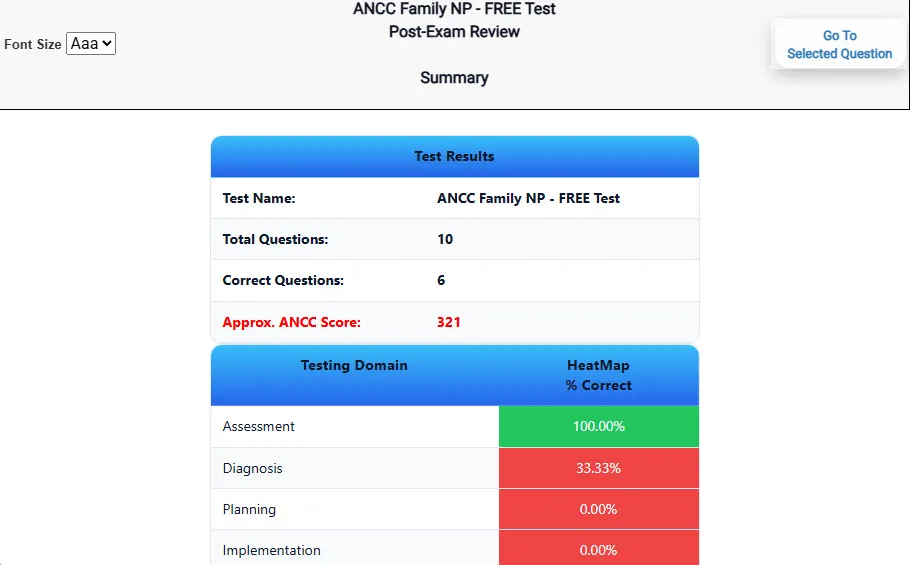
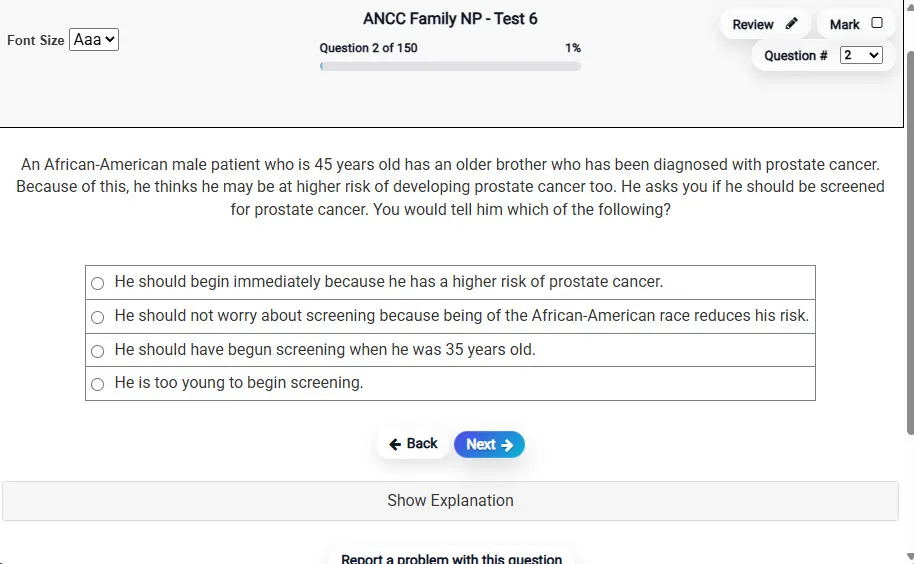
Answering a Question screen – Multiple-choice item view with navigation controls and progress tracker.
Answering a Question Multiple-choice item view with navigation controls and progress tracker.

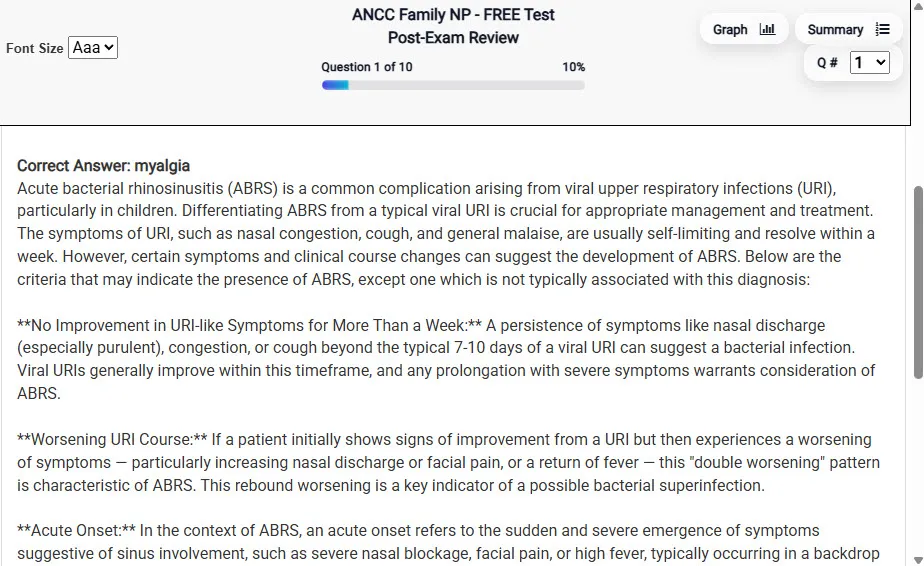
                           Detailed Explanation screen – 
                         Review mode showing chosen answer and rationale and references.
Detailed Explanation Review mode showing chosen answer and rationale and references.

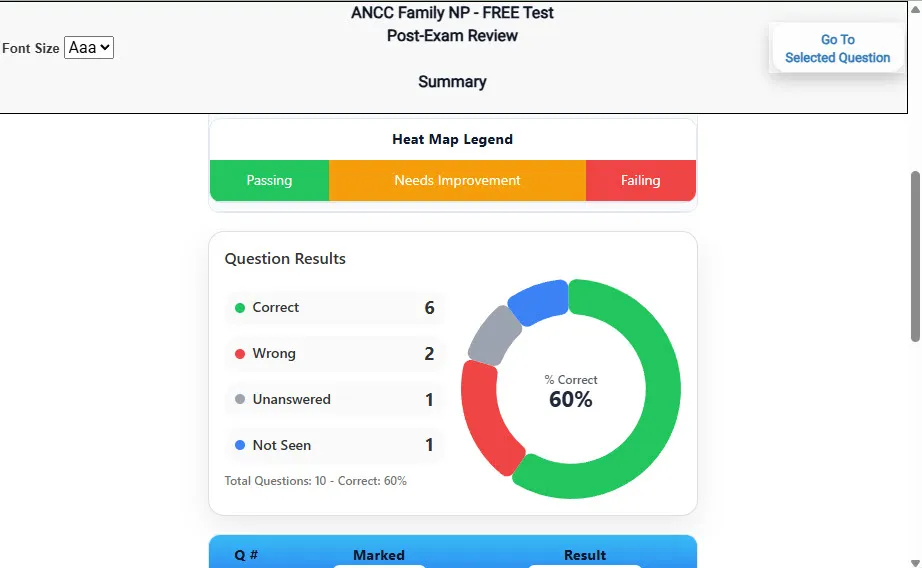
                           Review Summary 1 screen – 
                         Summary with counts for correct/wrong/unanswered and not seen items.
Review Summary 1 Summary with counts for correct/wrong/unanswered and not seen items.

                           Review Summary 2 screen – 
                         Advanced summary with category/domain breakdown and performance insights.
Review Summary 2 Advanced summary with category/domain breakdown and performance insights.

What Each Screen Shows

Answer Question Screen

  • Clean multiple-choice interface with progress bar.
  • Mark for review feature.
  • Matches real test pacing.

Detailed Explanation

  • Correct answer plus rationale.
  • Key concepts and guidelines highlighted.
  • Move between questions to fill knowledge gaps.

Review Summary 1

  • Overall results with total questions and scaled score.
  • Domain heatmap shows strengths and weaknesses.
  • Quick visual feedback on study priorities.

Review Summary 2

  • Chart of correct, wrong, unanswered, not seen.
  • Color-coded results for easy review.
  • Links back to missed items.

Top 10 Reasons to Use Exam Edge for your ServSafe Food Safety Manager Exam Prep

  1. Focused on the ServSafe Food Safety Manager Exam

    Our practice tests are built specifically for the ServSafe Food Safety Manager exam — every question mirrors the real topics, format, and difficulty so you're studying exactly what matters.

  2. Real Exam Simulation

    We match the per-question time limits and pressure of the actual ServSafe exam, so test day feels familiar and stress-free.

  3. 20 Full Practice Tests & 1,600 Unique Questions

    You'll have more than enough material to master every ServSafe Food Safety Manager concept — no repeats, no fluff.

  4. Lower Cost Than a Retake

    Ordering 5 practice exams costs less than retaking the ServSafe Food Safety Manager exam after a failure. One low fee could save you both time and money.

  5. Flexible Testing

    Need to step away mid-exam? Pick up right where you left off — with your remaining time intact.

  6. Instant Scoring & Feedback

    See your raw score and an estimated ServSafe Food Safety Manager score immediately after finishing each practice test.

  7. Detailed Explanations for Every Question

    Review correct and incorrect answers with clear, step-by-step explanations so you truly understand each topic.

  8. Trusted & Accredited

    We're fully accredited by the Better Business Bureau and uphold the highest standards of trust and transparency.

  9. Web-Based & Always Available

    No software to install. Access your ServSafe Food Safety Manager practice exams 24/7 from any computer or mobile device.

  10. Expert Support When You Need It

    Need extra help? Our specialized tutors are highly qualified and ready to support your ServSafe exam prep.


Pass the ServSafe Food Safety Manager Exam with Realistic Practice Tests from Exam Edge

Preparing for your upcoming ServSafe Food Safety Manager (FSM) Certification Exam can feel overwhelming — but the right practice makes all the difference. Exam Edge gives you the tools, structure, and confidence to pass on your first try. Our online practice exams are built to match the real ServSafe Food Safety Manager exam in content, format, and difficulty.

  • 📝 20 ServSafe Food Safety Manager Practice Tests: Access 20 full-length exams with 80 questions each, covering every major ServSafe Food Safety Manager topic in depth.
  • Instant Online Access: Start practicing right away — no software, no waiting.
  • 🧠 Step-by-Step Explanations: Understand the reasoning behind every correct answer so you can master ServSafe Food Safety Manager exam concepts.
  • 🔄 Retake Each Exam Up to 4 Times: Build knowledge through repetition and track your improvement over time.
  • 🌐 Web-Based & Available 24/7: Study anywhere, anytime, on any device.
  • 🧘 Boost Your Test-Day Confidence: Familiarity with the ServSafe format reduces anxiety and helps you perform under pressure.

These ServSafe Food Safety Manager practice exams are designed to simulate the real testing experience by matching question types, timing, and difficulty level. This approach helps you get comfortable not just with the exam content, but also with the testing environment, so you walk into your exam day focused and confident.


Exam Edge ServSafe Reviews


I cannot thank you enough. Because of your test practice, I just passed my exam! After practicing 11 exams, I was ready for the exam. The exam was so easy for me because of you. Thank you!

Dania,D, Orlando, FL,


ServSafe Food Safety Manager Aliases Test Name

Here is a list of alternative names used for this exam.

  • ServSafe Food Safety Manager
  • ServSafe Food Safety Manager test
  • ServSafe Food Safety Manager Certification Test
  • ServSafe
  • ServSafe FSM
  • FSM test
  • ServSafe Food Safety Manager (FSM)
  • Food Safety Manager certification