This is the content of the pop-over!

Lightning Deal Alert – 12% Off Ends at Midnight!

Strike while the savings are hot! Use promo code FlashSale at checkout for 12% off any Exam Edge test or bundle. Hurry—the clock is ticking!

NCCT Insurance and Coding Specialist (NCICS) Practice Tests & Test Prep by Exam Edge


NCCT National Insurance and Coding Specialist  product image
(4.5)
Based on 32 Reviews

  • Real Exam Simulation: Timed questions and matching content build comfort for your NCCT Insurance and Coding Specialist test day.
  • Instant, 24/7 Access: Web-based NCCT National Insurance and Coding Specialist practice exams with no software needed.
  • Clear Explanations: Step-by-step answers and explanations for your NCCT exam to strengthen understanding.
  • Boosted Confidence: Reduces anxiety and improves test-taking skills to ace your NCCT National Insurance and Coding Specialist (NCICS).

Featured on

NCCT National Insurance and Coding Specialist Online Practice Test Bundles

BEST VALUE
15 practice tests

$149.25

$599.25

SAVE $450

Only $9.95 per test!

  • 100% Pass Guarantee
  • 15 online practice tests
  • 100 questions per test
  • Bonus: 100 Flash Cards + Study Guide
  • Instant access
  • Detailed Explanations
  • Practice tests never expire
  • Timed, untimed, or study guide mode
MOST POPULAR
10 practice tests

$99.50

$399.50

SAVE $300

Only $9.95 per test!

  • 10 online practice tests
  • 100 questions per test
  • Bonus: 100 Flash Cards + Study Guide
  • Instant access
  • Detailed Explanations
  • Practice tests never expire
  • Timed, untimed, or study guide mode
5 practice tests

$69.75

$199.75

SAVE $130

Only $13.95 per test!

  • 5 online practice tests
  • 100 questions per test
  • Bonus: 100 Flash Cards
  • Instant access
  • Detailed Explanations
  • Practice tests never expire
  • Timed, untimed, or study guide mode
1 practice test

$39.95

  • 1 online practice test
  • 100 questions per test
  • Instant access
  • Detailed Explanations
  • Practice tests never expire
  • Timed, untimed, or study guide mode
Quick Select
Tap to choose a bundle

** All Prices are in US Dollars (USD) **


NCCT Insurance and Coding Specialist (NCICS) Resources

Jump to the section you need most.

Understanding the exact breakdown of the NCCT National Insurance and Coding Specialist test will help you know what to expect and how to most effectively prepare. The NCCT National Insurance and Coding Specialist has multiple-choice questions . The exam will be broken down into the sections below:

NCCT National Insurance and Coding Specialist Exam Blueprint
Domain Name % Number of
Questions
Medical Insurance and Billing 20% 20
Terminology 8% 8
Claims Process 24% 24
CPT Coding 25% 25
ICD-CM and HCPCS Level II Coding 23% 23

NCCT National Insurance and Coding Specialist Study Tips by Domain

  • Verify eligibility and benefits before the visit (effective dates, payer ID, plan type, copays/coinsurance, deductible status)—red flag: assuming an active policy means the service is covered.
  • Know payer order and coordination of benefits (primary vs secondary vs tertiary) and use correct claim type (CMS-1500/837P vs UB-04/837I)—common trap: billing the secondary payer without the primary EOB/ERA details.
  • Apply National Correct Coding Initiative (NCCI) edits, bundling rules, and modifier use (e.g., -25, -59, X{EPSU})—priority rule: only use a distinctness modifier when documentation clearly supports separate services.
  • Manage prior authorization, referrals, and medical necessity requirements—red flag: missing auth number or incorrect ordering provider can trigger preventable denials and patient complaints.
  • Interpret remittance advice (EOB/ERA) and denial codes (CARC/RARC) to decide resubmit vs appeal vs corrected claim—common trap: appealing a claim that actually needs a corrected billing error fix.
  • Post payments accurately and handle patient balances compliantly (write-offs, contractual adjustments, timely refunds)—contraindication: balance-billing when the payer contract or regulation prohibits it.
  • Differentiate suffix/prefix/root meaning (e.g., -itis inflammation, -ectomy removal, hyper- increased)—red flag: confusing -otomy (incision) with -ectomy (removal) changes the implied procedure.
  • Know common directional and positional terms (anterior/posterior, medial/lateral, proximal/distal)—common trap: mixing up proximal vs distal when describing extremity findings.
  • Use body planes and regions correctly (sagittal, frontal/coronal, transverse; abdominal quadrants)—priority rule: if a note says “RLQ pain,” do not default to “right lower abdomen” without confirming quadrant vs region wording.
  • Identify anatomy of major systems (cardiovascular, respiratory, GI, GU, neuro, integumentary)—red flag: confusing ureter (kidney to bladder) with urethra (bladder to outside) leads to wrong interpretation of documentation.
  • Recognize diagnostic and lab terminology/abbreviations (CBC, BMP/CMP, UA, culture, imaging like CT/MRI)—common trap: assuming an abbreviation (e.g., “MS”) has one meaning; confirm context before selecting a definition.
  • Distinguish similar-sounding clinical terms (benign vs malignant, acute vs chronic, hypo- vs hyper-)—threshold cue: “acute” implies sudden onset/short duration, so don’t label long-standing conditions as acute without documentation support.
  • Verify claim prerequisites before submission—patient demographics, correct policy/ID, provider NPI, and authorization/referral if required; red flag: missing prior auth often triggers immediate denial rather than a request for info.
  • Ensure claim form accuracy (CMS-1500 vs UB-04 as appropriate) with aligned dates of service, place of service, and rendering vs billing provider; common trap: mismatched NPIs or service location causes payer edits and delays.
  • Check medical necessity support (diagnosis-to-procedure linkage and documentation consistency); priority rule: if the diagnosis doesn’t justify the service, the claim may be denied even when codes are valid.
  • Apply payer timelines and timely filing limits; red flag: claims held for internal review past the deadline may become non-appealable, so track submission dates and confirmation reports.
  • Post payments correctly using the EOB/ERA and reconcile allowed amount, deductible, coinsurance, and adjustments; common trap: confusing a contractual write-off with a patient balance leads to improper billing.
  • Manage denials systematically by reading denial codes/remark codes and selecting the right path (corrected claim vs appeal); contraindication: appealing when a simple correction is required can waste time and miss appeal windows.
  • Select the correct CPT code by matching the documented service to the full descriptor, not just the code title—red flag: picking a “close enough” code when key elements (e.g., approach, site, extent) aren’t documented.
  • Apply E/M rules carefully by using the correct setting and service type (office vs outpatient vs inpatient/observation) and only what is documented—common trap: upcoding based on time without a qualifying total-time statement and required activities.
  • Use modifiers only when they meet payer and CPT definitions—priority rule: ensure documentation supports distinctness for -59 (or X{E,P,S,U}) and avoid using it to bypass an NCCI edit without a clear separate session/site/lesion.
  • For surgical coding, code the most extensive procedure and follow bundling rules (CPT/NCCI)—common trap: separately reporting components that are included in a comprehensive code (e.g., approach, closure, simple wound repair).
  • Report add-on codes only with their primary codes and never alone—red flag: billing an add-on code without its required “parent” procedure or when the base service wasn’t performed.
  • Follow CPT guidelines for unlisted procedures (e.g., 99xxx) by confirming no existing code fits and supplying comparison/justification—common trap: using an unlisted code to avoid documentation requirements or when a valid Category I/III code exists.
  • ICD-CM: code to the highest level of specificity (all required characters) and verify laterality and encounter type; red flag—using an unspecified code when documentation clearly supports a specific option.
  • ICD-CM Official Guidelines control sequencing (e.g., principal/first-listed, etiology/manifestation “code first”/“use additional code”); common trap—coding the symptom when a confirmed diagnosis is documented.
  • ICD-10-CM chapter rules matter (e.g., neoplasms, diabetes, obstetrics, injuries/poisonings) and many require multiple codes; priority rule—follow instructional notes like “Excludes1” as a hard stop.
  • HCPCS Level II: choose the correct code set for supplies, DME, drugs, and ambulance and apply modifiers when required; red flag—billing a drug without the correct unit measure (e.g., per mg vs per vial) or missing JW/waste when payer requires it.
  • Link diagnoses to procedures/supplies for medical necessity and avoid mismatch between ICD-CM and HCPCS (e.g., laterality, body site, status codes); common trap—using a history code (Z85/Z86) when the condition is active.
  • Use the Alphabetic Index to locate the code, then confirm in the Tabular List and follow all notes; red flag—coding directly from the Index without checking required 7th characters, placeholders (X), or inclusion/exclusion notes.


Built to Fit Into Your Busy Life

Everything you need to prepare with confidence—without wasting a minute.

Three Study Modes

Timed, No Time Limit, or Explanation mode.

Actionable Analytics

Heatmaps and scaled scores highlight weak areas.

High-Yield Rationales

Concise explanations emphasize key concepts.

Realistic Interface

Matches the feel of the actual exam environment.

Accessible by Design

Clean layout reduces cognitive load.

Anytime, Anywhere

Web-based access 24/7 on any device.
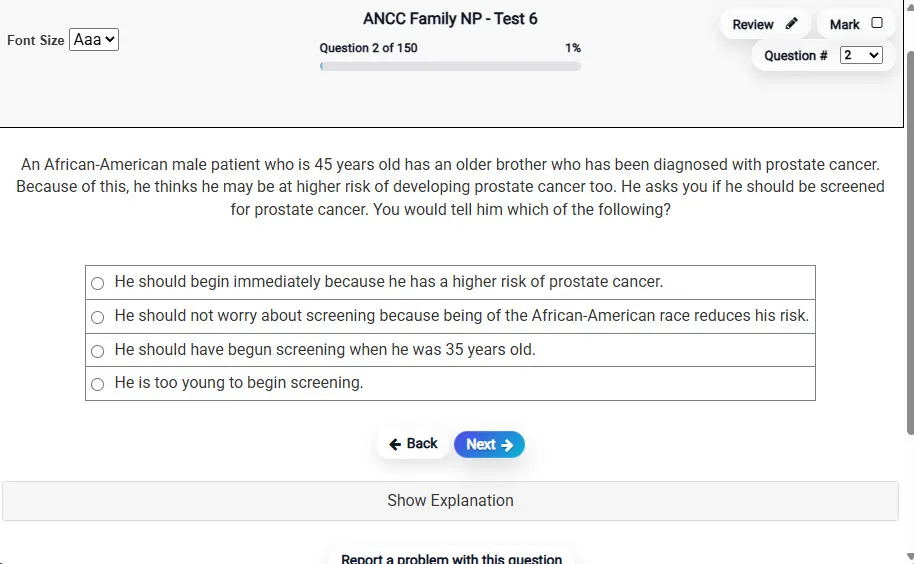
Answering a Question screen – Multiple-choice item view with navigation controls and progress tracker.
Answering a Question Multiple-choice item view with navigation controls and progress tracker.

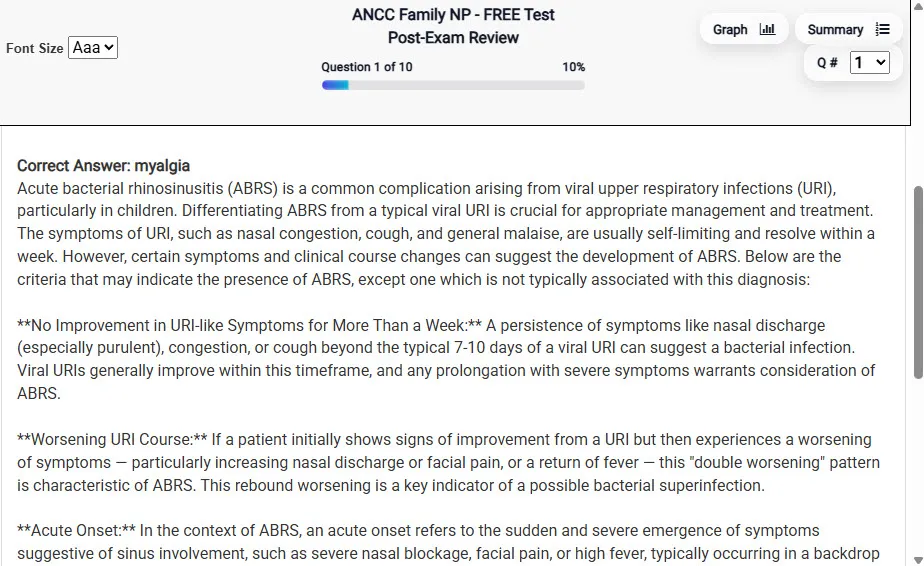
                           Detailed Explanation screen – 
                         Review mode showing chosen answer and rationale and references.
Detailed Explanation Review mode showing chosen answer and rationale and references.

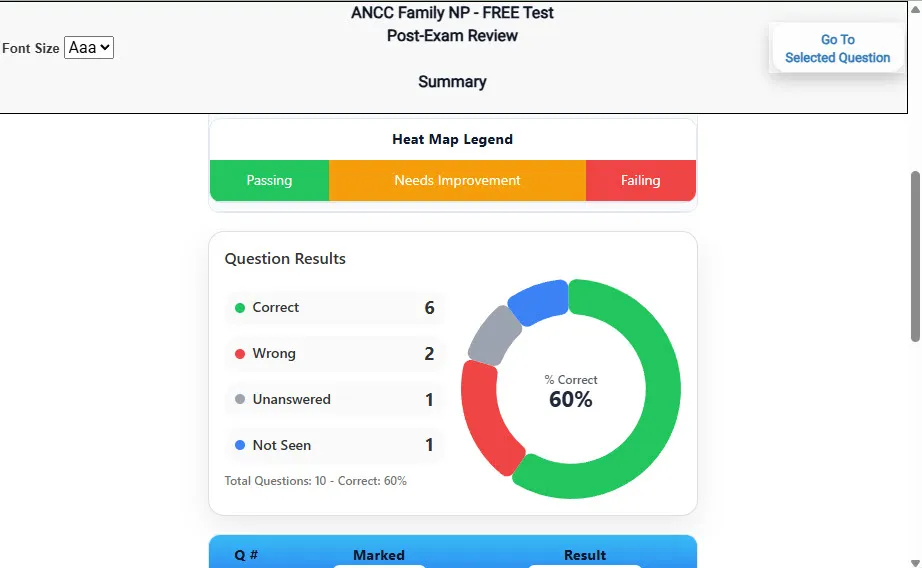
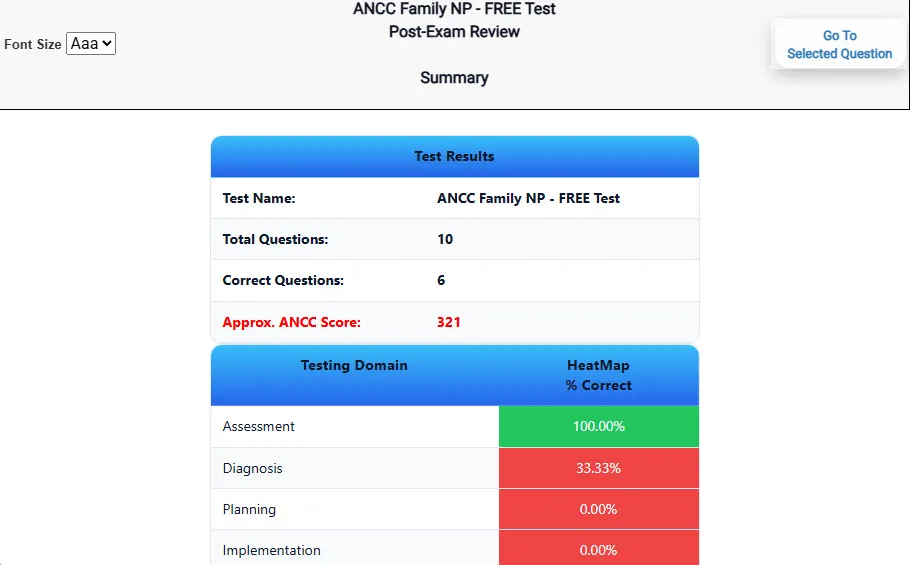
                           Review Summary 1 screen – 
                         Summary with counts for correct/wrong/unanswered and not seen items.
Review Summary 1 Summary with counts for correct/wrong/unanswered and not seen items.

                           Review Summary 2 screen – 
                         Advanced summary with category/domain breakdown and performance insights.
Review Summary 2 Advanced summary with category/domain breakdown and performance insights.

What Each Screen Shows

Answer Question Screen

  • Clean multiple-choice interface with progress bar.
  • Mark for review feature.
  • Matches real test pacing.

Detailed Explanation

  • Correct answer plus rationale.
  • Key concepts and guidelines highlighted.
  • Move between questions to fill knowledge gaps.

Review Summary 1

  • Overall results with total questions and scaled score.
  • Domain heatmap shows strengths and weaknesses.
  • Quick visual feedback on study priorities.

Review Summary 2

  • Chart of correct, wrong, unanswered, not seen.
  • Color-coded results for easy review.
  • Links back to missed items.

Top 10 Reasons to Use Exam Edge for your NCCT National Insurance and Coding Specialist Exam Prep

  1. Focused on the NCCT National Insurance and Coding Specialist Exam

    Our practice tests are built specifically for the NCCT Insurance and Coding Specialist exam — every question mirrors the real topics, format, and difficulty so you're studying exactly what matters.

  2. Real Exam Simulation

    We match the per-question time limits and pressure of the actual NCCT exam, so test day feels familiar and stress-free.

  3. 15 Full Practice Tests & 1,500 Unique Questions

    You'll have more than enough material to master every NCCT Insurance and Coding Specialist concept — no repeats, no fluff.

  4. Lower Cost Than a Retake

    Ordering 5 practice exams costs less than retaking the NCCT National Insurance and Coding Specialist exam after a failure. One low fee could save you both time and money.

  5. Flexible Testing

    Need to step away mid-exam? Pick up right where you left off — with your remaining time intact.

  6. Instant Scoring & Feedback

    See your raw score and an estimated NCCT National Insurance and Coding Specialist score immediately after finishing each practice test.

  7. Detailed Explanations for Every Question

    Review correct and incorrect answers with clear, step-by-step explanations so you truly understand each topic.

  8. Trusted & Accredited

    We're fully accredited by the Better Business Bureau and uphold the highest standards of trust and transparency.

  9. Web-Based & Always Available

    No software to install. Access your NCCT Insurance and Coding Specialist practice exams 24/7 from any computer or mobile device.

  10. Expert Support When You Need It

    Need extra help? Our specialized tutors are highly qualified and ready to support your NCCT exam prep.


Pass the NCCT National Insurance and Coding Specialist Exam with Realistic Practice Tests from Exam Edge

Preparing for your upcoming NCCT National Insurance and Coding Specialist (NCICS) Certification Exam can feel overwhelming — but the right practice makes all the difference. Exam Edge gives you the tools, structure, and confidence to pass on your first try. Our online practice exams are built to match the real NCCT Insurance and Coding Specialist exam in content, format, and difficulty.

  • 📝 15 NCCT National Insurance and Coding Specialist Practice Tests: Access 15 full-length exams with 100 questions each, covering every major NCCT National Insurance and Coding Specialist topic in depth.
  • Instant Online Access: Start practicing right away — no software, no waiting.
  • 🧠 Step-by-Step Explanations: Understand the reasoning behind every correct answer so you can master NCCT Insurance and Coding Specialist exam concepts.
  • 🔄 Retake Each Exam Up to 4 Times: Build knowledge through repetition and track your improvement over time.
  • 🌐 Web-Based & Available 24/7: Study anywhere, anytime, on any device.
  • 🧘 Boost Your Test-Day Confidence: Familiarity with the NCCT format reduces anxiety and helps you perform under pressure.

These NCCT National Insurance and Coding Specialist practice exams are designed to simulate the real testing experience by matching question types, timing, and difficulty level. This approach helps you get comfortable not just with the exam content, but also with the testing environment, so you walk into your exam day focused and confident.


Exam Edge NCCT Reviews


I just wanted to say thank you! Your study guides have been more than a blessing for me. I passed the ncct medical assistant's exam with no problems, other than self stress. Thanks again. Will recommend to anyone taking future exams.

CHARLES, KINGSTON, NY


NCCT National Insurance and Coding Specialist Aliases Test Name

Here is a list of alternative names used for this exam.

  • NCCT National Insurance and Coding Specialist
  • NCCT National Insurance and Coding Specialist test
  • NCCT National Insurance and Coding Specialist Certification Test
  • NCCT Insurance and Coding Specialist test
  • NCCT
  • NCCT NCICS
  • NCICS test
  • NCCT National Insurance and Coding Specialist (NCICS)
  • National Insurance and Coding Specialist certification