This is the content of the pop-over!

NBSTSA CST Practice Tests & Test Prep by Exam Edge


NBSTSA Certified Surgical Technologist   product image
(4.4)
Based on 20 Reviews

  • Real Exam Simulation: Timed questions and matching content build comfort for your NBSTSA CST test day.
  • Instant, 24/7 Access: Web-based NBSTSA Certified Surgical Technologist practice exams with no software needed.
  • Clear Explanations: Step-by-step answers and explanations for your NBSTSA exam to strengthen understanding.
  • Boosted Confidence: Reduces anxiety and improves test-taking skills to ace your NBSTSA Certified Surgical Technologist (CST).

Featured on

NBSTSA Certified Surgical Technologist Online Practice Test Bundles

BEST VALUE
25 practice tests

$218.75

$998.75

SAVE $780

Only $8.75 per test!

  • 100% Pass Guarantee
  • 25 online practice tests
  • 100 questions per test
  • Bonus: 100 Flash Cards + Study Guide
  • Instant access
  • Detailed Explanations
  • Practice tests never expire
  • Timed, untimed, or study guide mode
MOST POPULAR
10 practice tests

$99.50

$399.50

SAVE $300

Only $9.95 per test!

  • 10 online practice tests
  • 100 questions per test
  • Bonus: 100 Flash Cards + Study Guide
  • Instant access
  • Detailed Explanations
  • Practice tests never expire
  • Timed, untimed, or study guide mode
5 practice tests

$69.75

$199.75

SAVE $130

Only $13.95 per test!

  • 5 online practice tests
  • 100 questions per test
  • Bonus: 100 Flash Cards
  • Instant access
  • Detailed Explanations
  • Practice tests never expire
  • Timed, untimed, or study guide mode
1 practice test

$39.95

  • 1 online practice test
  • 100 questions per test
  • Instant access
  • Detailed Explanations
  • Practice tests never expire
  • Timed, untimed, or study guide mode
Quick Select
Tap to choose a bundle

** All Prices are in US Dollars (USD) **


NBSTSA CST (CST) Resources

Jump to the section you need most.

Understanding the exact breakdown of the NBSTSA Certified Surgical Technologist test will help you know what to expect and how to most effectively prepare. The NBSTSA Certified Surgical Technologist has 150 multiple-choice questions . The exam will be broken down into the sections below:

NBSTSA Certified Surgical Technologist Exam Blueprint
Domain Name
Perioperative Care:  
     Preoperative Preparation  
     Intraoperative Procedures  
     Postoperative Procedures  
Additional Duties  
     Administrative and Personnel  
     Equipment Sterilization and Maintenance  
Basic Science  
     Anatomy and Physiology  
     Microbiology  
     Surgical Pharmacology  

NBSTSA Certified Surgical Technologist Study Tips by Domain

  • Maintain surgical conscience and aseptic technique at all times—if sterility is in doubt (wet/strike-through/unattended), consider it contaminated and replace immediately.
  • Control the sterile field: only sterile-to-sterile contact above the waist/within view; red flag—reaching over an open sterile field or turning your back breaks control.
  • Perform accurate counts (sponges/sharps/instruments) per facility policy and at required times; trap—closing begins before count reconciliation and documentation are complete.
  • Use safe patient positioning with padding and neutral alignment; priority rule—verify pressure points and lines/tubes after draping and again after repositioning to prevent nerve/skin injury.
  • Apply electrosurgical safety: confirm correct unit/settings and proper dispersive pad placement on clean, dry, well-perfused muscle; contraindication—avoid placement over bony prominences, scar tissue, or metal implants.
  • Prevent surgical site infection by supporting timely antibiotic prophylaxis and normothermia; red flag—hair removal with a razor or excessive OR traffic increases infection risk.
  • Verify patient identity, procedure, site/side, and consent matches the schedule and H&P; red flag: any discrepancy requires stopping set-up and initiating the facility’s verification/time-out chain immediately.
  • Check NPO status, allergies (latex, iodine, antibiotics), implants, and anticoagulant use; common trap: assuming “no known allergies” includes latex—ask specifically and label the room/cart accordingly.
  • Perform surgical hand antisepsis and don sterile attire using correct donning sequence; priority rule: if you touch anything nonsterile after gowning/gloving, you are contaminated and must regown/reglove.
  • Prepare and open sterile supplies using correct peel-pack/paper wrap technique and verify indicator changes/expiration; red flag: any torn packaging, wet wrapper, missing chemical indicator, or failed integrator is nonsterile and must be removed and replaced.
  • Set up the sterile field and arrange instruments/sharps to minimize passing hazards; common trap: placing items closer than 1 inch from the table edge or reaching over an unsterile area—treat as contamination.
  • Assist with patient skin prep and hair removal per policy; contraindication: do not shave with a razor except per specific order—use clippers immediately before surgery and allow antiseptic contact/dry time before draping.
  • Maintain the sterile field at all times—if an item is out of your sight, below waist level, or you turn your back on it, treat it as contaminated (common trap: reaching over a sterile field).
  • Perform sterile counts per facility policy and at key times (before incision, cavity closure, skin closure, and at relief of personnel); any discrepancy is an immediate stop-and-reconcile red flag before closure.
  • Practice sharp safety: announce “sharp”, use a neutral zone when possible, and never recap a needle by hand—any sharps injury requires immediate reporting and exposure protocol initiation.
  • Anticipate surgeon needs by procedure steps and pass instruments correctly (firm, decisive, in correct orientation); red flag: repeated fumbling or incorrect orientation increases operative time and injury risk.
  • Protect patient positioning and pressure points intraoperatively (padding, limb alignment, avoid traction on nerves); contraindication cue: never place a tourniquet without verifying correct site/pressure/time documentation.
  • Maintain specimen integrity and identification: label with two identifiers, source, and laterality immediately—common trap: placing an unlabeled specimen on the back table or mixing multiple specimens in one container.
  • Perform final counts per facility policy and communicate results immediately to the surgeon and RN—red flag: never close or dress a wound with an unresolved incorrect count.
  • Assist with wound closure and dressing application while maintaining sterile technique—common trap: contaminating the field when removing drapes or passing staples/sutures off the sterile field.
  • Help prepare the patient for transport (lines, drains, catheters secured; padding maintained) and assist with safe transfer—priority rule: protect airway and all tubes during turns and moves.
  • Support specimen handling after the procedure (labeling, fixation, orientation, chain of custody) per policy—red flag: never allow an unlabeled or mislabeled specimen to leave the OR.
  • Initiate postoperative room turnover: dispose of sharps correctly, contain contaminated instruments, and send sets for decontamination—common trap: transporting instruments dry or with blades left on handles.
  • Complete required documentation/hand-off support for postoperative disposition (counts, specimens, implants, drains, dressings) and verify implant stickers/lot data—red flag: missing implant documentation can create reportable compliance issues.
  • Perform surgical counts per facility policy (sponges/sharps/instruments) at required times; red flag: any count discrepancy is treated as a retained item risk until reconciled and documented.
  • Handle and transport specimens using correct container, fixative, and labeling per surgeon orders; common trap: placing a specimen in formalin when a fresh/frozen or culture specimen is required.
  • Manage surgical waste and sharps per OSHA/BBP principles (puncture-resistant sharps containers, no recapping); priority rule: dispose of sharps immediately after use to prevent needlestick exposure.
  • Assist with room turnover and environmental cleaning (high-touch surfaces, equipment, and floors) following the cleaning sequence from clean to dirty; red flag: skipping contact time on disinfectants can invalidate decontamination.
  • Support fire and electrical safety (sponge counts with cautery use, cord management, proper placement of ESU dispersive electrode); common trap: placing the dispersive pad over bony prominences or scar tissue increases burn risk.
  • Participate in documentation/communication (implants, lot numbers, time-outs, variances) using chain-of-custody when applicable; red flag: missing implant identifiers or late charting can create compliance and patient-safety events.
  • Verify patient identity with two identifiers and confirm consent matches the planned procedure, site, and laterality—red flag: any mismatch requires stop and immediate escalation before prepping or positioning.
  • Maintain strict confidentiality (HIPAA) and avoid discussing cases in public areas—common trap: leaving printed schedules, labels, or screens visible to unauthorized individuals.
  • Document counts, implants, specimens, and variances in real time per facility policy—priority rule: if it isn’t documented, it didn’t happen (and unresolved count discrepancies trigger an intraoperative search and imaging per policy).
  • Use correct chain-of-custody for specimens (label at the field with two patient identifiers, source, and laterality) and communicate special handling—red flag: unlabeled or “handed-off” containers without read-back.
  • Follow role delineation and sterile technique boundaries—common trap: accepting tasks outside scope or breaking sterile field for convenience (e.g., reaching over unsterile areas), which must be corrected immediately.
  • Apply standard and transmission-based precautions based on isolation status and exposure risk—threshold: any blood/body fluid exposure requires immediate first aid and prompt reporting per exposure control plan.
  • Verify sterilizer cycle parameters match the IFU (time, temperature, pressure, dry time) before use; red flag: wet packs at end of cycle — treat as contaminated and do not use.
  • Perform and document Bowie-Dick testing for pre-vac steam sterilizers daily before the first processed load; common trap: running the test in a wrapped pack or with other items in the chamber.
  • Use chemical indicators correctly (external tape and internal CI in every package/tray) and check for correct color change at point of use; red flag: missing internal CI — consider the item unverified/unsafe.
  • Follow AAMI-style loading principles (do not overload, allow steam contact, keep peel packs on edge, separate heavy basins) because improper loading can cause cold spots; priority rule: if airflow/steam pathways are blocked, sterility cannot be assumed.
  • Maintain instrument function with cleaning, inspection, and lubrication per IFU (e.g., hinges, box locks, ratchets) before sterilization; contraindication: do not autoclave instruments with visible soil or pitting/corrosion.
  • Track sterilization with lot control (load number, sterilizer ID, contents, operator) and initiate recall if a biological indicator is positive; red flag: using items from a load without confirmed BI results when facility policy requires quarantine.
  • Apply basic physics in the OR: tension/traction and leverage change tissue stress—red flag when using long instruments on delicate structures because small hand force can create large tip force.
  • Understand electrosurgery principles: cutting uses continuous current, coagulation uses intermittent/high voltage—common trap is activating ESU in open air or near oxygen-rich fields, increasing fire risk.
  • Know laser basics (wavelength-specific tissue effects) and safety—priority rule is correct eyewear for the laser in use and controlling plume exposure as a biohazard.
  • Use fluid dynamics fundamentals: higher pressure/height increases flow and extravasation risk—red flag is unexpected swelling or decreased outflow during irrigation suggesting infiltration or obstruction.
  • Recognize pH/temperature effects on hemostasis and medications—common trap is using cold irrigation or leaving skin prep wet, which can worsen bleeding and raise ignition/chemical injury risk.
  • Apply radiation science basics for fluoroscopy: time, distance, shielding—threshold cue is maximizing distance and using lead/thyroid protection whenever the C-arm is in use.
  • Identify surgical planes and layers for common incisions (skin, subcutaneous fat, fascia, muscle, peritoneum); red flag: handing a sharp to the surgeon before fascia is clearly defined increases risk of organ injury.
  • Know major vessels and “danger zones” (e.g., carotid sheath, femoral triangle, Circle of Willis) to anticipate clamps and suction; common trap: confusing artery vs vein orientation and failing to have vascular instruments ready.
  • Recognize key nerves at risk (recurrent laryngeal, phrenic, facial, radial/ulnar/median) and protect with appropriate retractors; red flag: prolonged, high-tension retraction can cause neuropraxia.
  • Understand respiratory anatomy and ventilation implications (trachea, bronchi, pleura) during thoracic/upper abdominal cases; priority rule: sudden rising airway pressures with hypotension suggests tension pneumothorax and requires immediate escalation.
  • Apply GI and hepatobiliary anatomy (esophagus, stomach, bowel mesentery, cystic duct/artery) to anticipate critical views; common trap: mistaking the common bile duct for the cystic duct during cholecystectomy setups.
  • Use musculoskeletal anatomy (tendons, ligaments, joint capsule, growth plates) to support ortho positioning and instrumentation; red flag: improper positioning or tourniquet misuse can compromise distal perfusion and must be checked before incision.
  • Differentiate normal flora vs. contamination vs. infection—red flag: treating any positive culture as infection without correlating to source, timing, and symptoms.
  • Know key pathogen categories (bacteria, viruses, fungi, spores, prions) and their controls—priority rule: spores require sterilization, not just low-level disinfection.
  • Apply chain of infection and standard precautions to break transmission—common trap: assuming gloves replace hand hygiene when moving between tasks/fields.
  • Use Aseptic Technique principles to prevent surgical site infection—red flag: moisture/wicking through drapes or wrappers compromises the barrier and contaminates the field.
  • Understand biofilm implications on implants and instruments—priority rule: thorough cleaning must occur before disinfection/sterilization because bioburden shields microbes.
  • Recognize exposure risks (bloodborne and airborne) and required responses—common trap: delaying reporting/first aid after sharps injury instead of immediate wash, notify, and follow facility protocol.
  • Verify the “5 rights” plus allergy/latex status before passing any medication to the sterile field—red flag: any unlabeled syringe or cup must be discarded, not “identified later.”
  • Antibiotic prophylaxis should be timed so adequate tissue levels exist at incision and redosed for long cases or major blood loss—trap: forgetting redose after significant hemorrhage or prolonged tourniquet time.
  • Local anesthetics have maximum safe doses and systemic toxicity risk (LAST)—red flag: tinnitus, metallic taste, circumoral numbness, seizures, or sudden dysrhythmia after infiltration requires immediate alert and rescue support.
  • Handle vasoconstrictors/irrigants correctly: epinephrine concentration errors can be catastrophic—trap: confusing 1:1,000 vs 1:100,000/1:200,000 or adding to a solution without a second check.
  • Account for anticoagulants/antiplatelets and reversal agents on the field (e.g., heparin/protamine) with strict dosing communication—red flag: protamine given too rapidly can cause severe hypotension/anaphylactoid reactions.
  • Controlled substances require secure handling and witnessed waste per policy—trap: incomplete documentation or un-witnessed disposal is a testable compliance failure even if the dose was clinically correct.


Built to Fit Into Your Busy Life

Everything you need to prepare with confidence—without wasting a minute.

Three Study Modes

Timed, No Time Limit, or Explanation mode.

Actionable Analytics

Heatmaps and scaled scores highlight weak areas.

High-Yield Rationales

Concise explanations emphasize key concepts.

Realistic Interface

Matches the feel of the actual exam environment.

Accessible by Design

Clean layout reduces cognitive load.

Anytime, Anywhere

Web-based access 24/7 on any device.
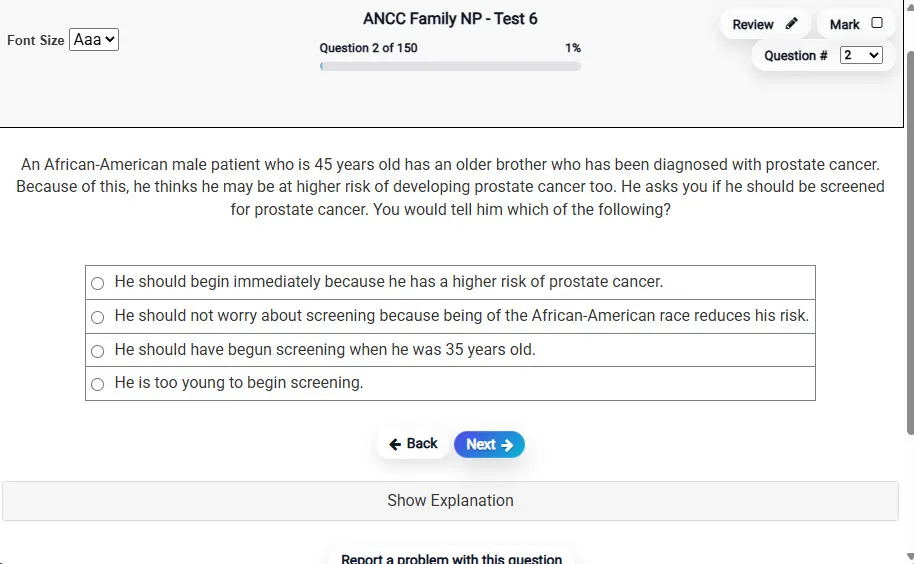
Answering a Question screen – Multiple-choice item view with navigation controls and progress tracker.
Answering a Question Multiple-choice item view with navigation controls and progress tracker.

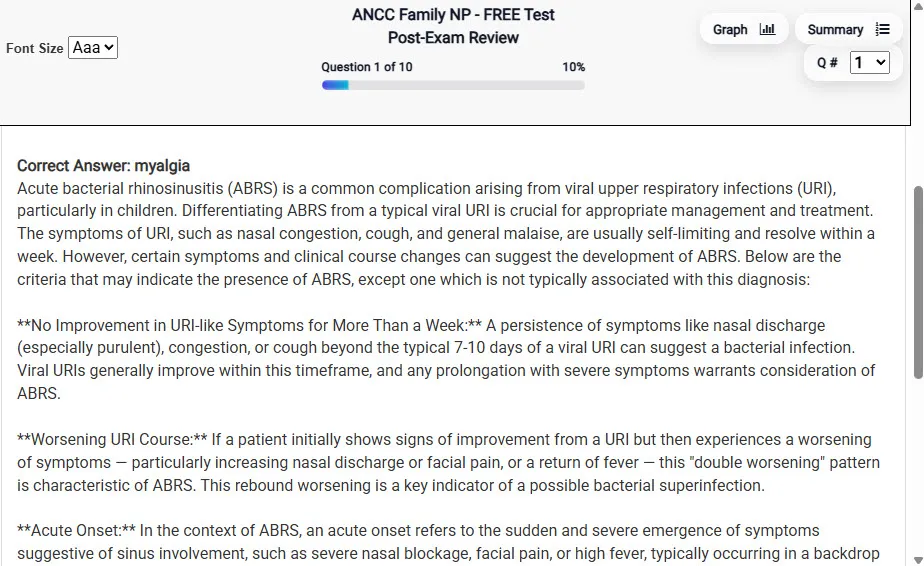
                           Detailed Explanation screen – 
                         Review mode showing chosen answer and rationale and references.
Detailed Explanation Review mode showing chosen answer and rationale and references.

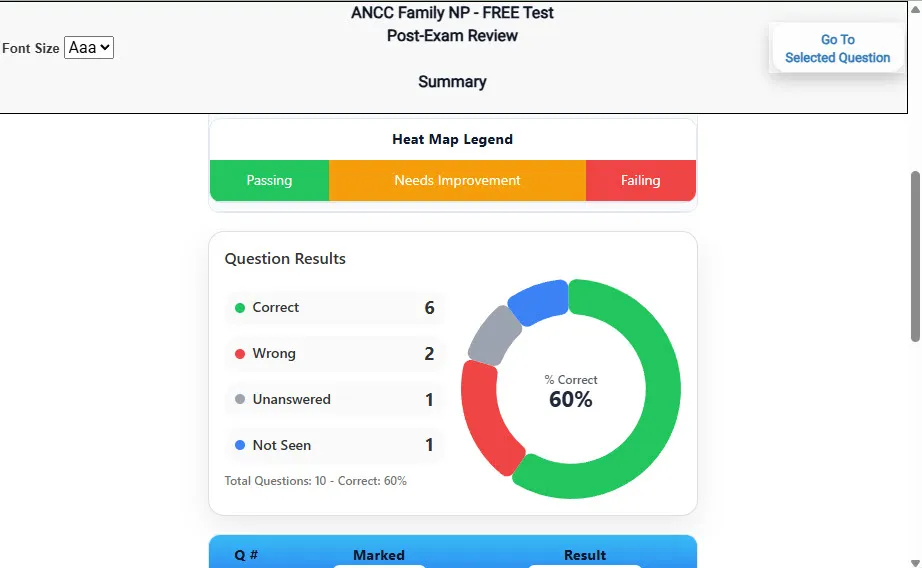
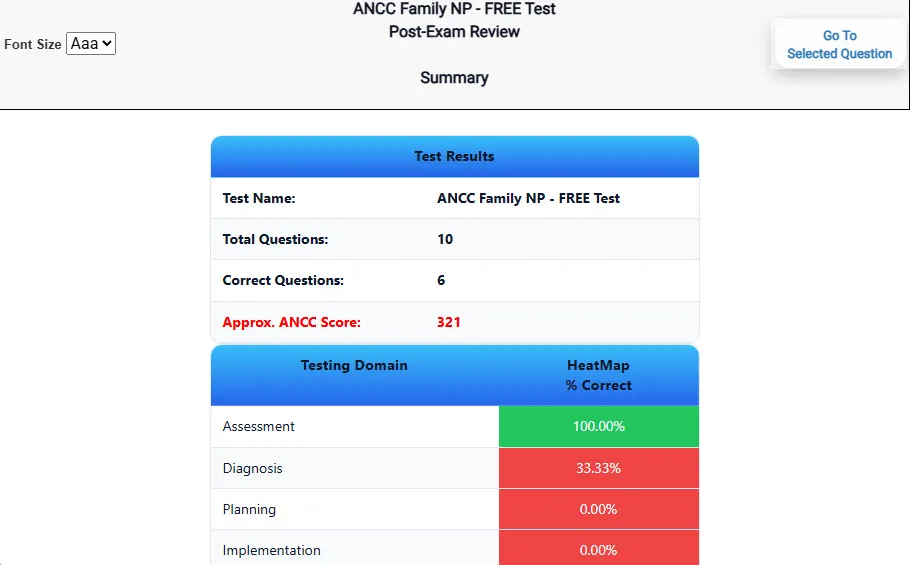
                           Review Summary 1 screen – 
                         Summary with counts for correct/wrong/unanswered and not seen items.
Review Summary 1 Summary with counts for correct/wrong/unanswered and not seen items.

                           Review Summary 2 screen – 
                         Advanced summary with category/domain breakdown and performance insights.
Review Summary 2 Advanced summary with category/domain breakdown and performance insights.

What Each Screen Shows

Answer Question Screen

  • Clean multiple-choice interface with progress bar.
  • Mark for review feature.
  • Matches real test pacing.

Detailed Explanation

  • Correct answer plus rationale.
  • Key concepts and guidelines highlighted.
  • Move between questions to fill knowledge gaps.

Review Summary 1

  • Overall results with total questions and scaled score.
  • Domain heatmap shows strengths and weaknesses.
  • Quick visual feedback on study priorities.

Review Summary 2

  • Chart of correct, wrong, unanswered, not seen.
  • Color-coded results for easy review.
  • Links back to missed items.

Top 10 Reasons to Use Exam Edge for your NBSTSA Certified Surgical Technologist Exam Prep

  1. Focused on the NBSTSA Certified Surgical Technologist Exam

    Our practice tests are built specifically for the NBSTSA CST exam — every question mirrors the real topics, format, and difficulty so you're studying exactly what matters.

  2. Real Exam Simulation

    We match the per-question time limits and pressure of the actual NBSTSA exam, so test day feels familiar and stress-free.

  3. 25 Full Practice Tests & 2,500 Unique Questions

    You'll have more than enough material to master every NBSTSA CST concept — no repeats, no fluff.

  4. Lower Cost Than a Retake

    Ordering 5 practice exams costs less than retaking the NBSTSA Certified Surgical Technologist exam after a failure. One low fee could save you both time and money.

  5. Flexible Testing

    Need to step away mid-exam? Pick up right where you left off — with your remaining time intact.

  6. Instant Scoring & Feedback

    See your raw score and an estimated NBSTSA Certified Surgical Technologist score immediately after finishing each practice test.

  7. Detailed Explanations for Every Question

    Review correct and incorrect answers with clear, step-by-step explanations so you truly understand each topic.

  8. Trusted & Accredited

    We're fully accredited by the Better Business Bureau and uphold the highest standards of trust and transparency.

  9. Web-Based & Always Available

    No software to install. Access your NBSTSA CST practice exams 24/7 from any computer or mobile device.

  10. Expert Support When You Need It

    Need extra help? Our specialized tutors are highly qualified and ready to support your NBSTSA exam prep.


Pass the NBSTSA Certified Surgical Technologist Exam with Realistic Practice Tests from Exam Edge

Preparing for your upcoming NBSTSA Certified Surgical Technologist (CST) Certification Exam can feel overwhelming — but the right practice makes all the difference. Exam Edge gives you the tools, structure, and confidence to pass on your first try. Our online practice exams are built to match the real NBSTSA CST exam in content, format, and difficulty.

  • 📝 25 NBSTSA Certified Surgical Technologist Practice Tests: Access 25 full-length exams with 100 questions each, covering every major NBSTSA Certified Surgical Technologist topic in depth.
  • Instant Online Access: Start practicing right away — no software, no waiting.
  • 🧠 Step-by-Step Explanations: Understand the reasoning behind every correct answer so you can master NBSTSA CST exam concepts.
  • 🔄 Retake Each Exam Up to 4 Times: Build knowledge through repetition and track your improvement over time.
  • 🌐 Web-Based & Available 24/7: Study anywhere, anytime, on any device.
  • 🧘 Boost Your Test-Day Confidence: Familiarity with the NBSTSA format reduces anxiety and helps you perform under pressure.

These NBSTSA Certified Surgical Technologist practice exams are designed to simulate the real testing experience by matching question types, timing, and difficulty level. This approach helps you get comfortable not just with the exam content, but also with the testing environment, so you walk into your exam day focused and confident.


Exam Edge NBSTSA Reviews


NBSTSA Certified Surgical Technologist Aliases Test Name

Here is a list of alternative names used for this exam.

  • NBSTSA Certified Surgical Technologist
  • NBSTSA Certified Surgical Technologist test
  • NBSTSA Certified Surgical Technologist Certification Test
  • NBSTSA CST test
  • NBSTSA
  • NBSTSA CST
  • CST test
  • NBSTSA Certified Surgical Technologist (CST)
  • Certified Surgical Technologist certification