This is the content of the pop-over!

MCA Elem Ed MC Math and Science Subtest (073) Practice Tests & Test Prep by Exam Edge


MCA Elementary Education Multi-Content Mathematics and Science  product image
(4.5)
Based on 22 Reviews

  • Real Exam Simulation: Timed questions and matching content build comfort for your MCA Elem Ed MC Math and Science Subtest test day.
  • Instant, 24/7 Access: Web-based MCA Elementary Education Multi-Content Mathematics and Science practice exams with no software needed.
  • Clear Explanations: Step-by-step answers and explanations for your MCA exam to strengthen understanding.
  • Boosted Confidence: Reduces anxiety and improves test-taking skills to ace your MCA Elementary Education Multi-Content Mathematics and Science (073).

Featured on

MCA Elementary Education Multi-Content Mathematics and Science Online Practice Test Bundles

BEST VALUE
20 practice tests

$174.00

$799.00

SAVE $625

Only $8.70 per test!

  • 100% Pass Guarantee
  • 20 online practice tests
  • 80 questions per test
  • Bonus: 100 Flash Cards + Study Guide
  • Instant access
  • Detailed Explanations
  • Practice tests never expire
  • Timed, untimed, or study guide mode
MOST POPULAR
10 practice tests

$99.50

$399.50

SAVE $300

Only $9.95 per test!

  • 10 online practice tests
  • 80 questions per test
  • Bonus: 100 Flash Cards + Study Guide
  • Instant access
  • Detailed Explanations
  • Practice tests never expire
  • Timed, untimed, or study guide mode
5 practice tests

$69.75

$199.75

SAVE $130

Only $13.95 per test!

  • 5 online practice tests
  • 80 questions per test
  • Bonus: 100 Flash Cards
  • Instant access
  • Detailed Explanations
  • Practice tests never expire
  • Timed, untimed, or study guide mode
1 practice test

$39.95

  • 1 online practice test
  • 80 questions per test
  • Instant access
  • Detailed Explanations
  • Practice tests never expire
  • Timed, untimed, or study guide mode
Quick Select
Tap to choose a bundle

** All Prices are in US Dollars (USD) **


MCA Elem Ed MC Math and Science Subtest (073) Resources

Jump to the section you need most.

Understanding the exact breakdown of the MCA Elementary Education Multi-Content Mathematics and Science test will help you know what to expect and how to most effectively prepare. The MCA Elementary Education Multi-Content Mathematics and Science has 80 multiple-choice questions . The exam will be broken down into the sections below:

MCA Elementary Education Multi-Content Mathematics and Science Exam Blueprint
Domain Name % Number of
Questions
Mathematics 55% 44
     Number sense and operations  
     Relationships and algebraic thinking  
     Geometry and measurement  
     Data analysis - statistics probability  
Science 45% 36
     Physical science  
     Life science  
     Earth and space science  

MCA Elementary Education Multi-Content Mathematics and Science Study Tips by Domain

  • Prioritize mathematical reasoning and justification—be ready to explain why an algorithm works with models (arrays, number lines, area models); red flag: choosing an answer that has no supporting reasoning when the prompt asks “why.”
  • Use precise vocabulary and symbols (e.g., factor vs. multiple, expression vs. equation); common trap: treating an equal sign as “the answer comes next” rather than a statement of equivalence.
  • Check units and scale across representations (tables, graphs, diagrams, equations); red flag: mixing units (cm vs. m) or misreading axes intervals when interpreting or creating graphs.
  • Attend to grade-level progression—concrete models to pictorial to abstract; priority rule: if a student error is shown, identify the misconception (place value, regrouping, fraction magnitude) before selecting an intervention.
  • Be fluent moving between forms (fractions, decimals, percents) and compare by value, not appearance; common trap: assuming a longer decimal is larger (e.g., 0.4 vs. 0.35) or comparing fractions without common referents.
  • Verify solutions using estimation or inverse operations and interpret reasonableness in context; red flag: accepting a result that contradicts constraints (negative length, probability > 1, or a total smaller than an addend).
  • Demonstrate place value through multi-digit numbers and decimals (e.g., regrouping across zeros); red flag: aligning digits by the left edge instead of by place value.
  • Compare and order fractions/decimals using benchmarks like 0, 1/2, and 1; common trap: assuming the larger denominator means a larger fraction.
  • Compute with whole numbers using properties (commutative, associative, distributive) to justify strategies; priority rule: show why the strategy works, not just the final answer.
  • Add, subtract, multiply, and divide fractions/decimals in context with attention to units; red flag: adding denominators or canceling across addition/subtraction.
  • Use division concepts (sharing vs. grouping) and interpret remainders in word problems; common trap: leaving a remainder un-interpreted when the context requires rounding up or down.
  • Apply ratio/rate and percent reasoning (unit rates, percent of a quantity) and check reasonableness; red flag: mixing up percent increase/decrease with the new total vs. the change amount.
  • Represent and compare patterns using multiple forms (tables, rules, graphs, words); red flag: confusing the pattern’s term number (n) with the term value.
  • Write and interpret expressions/equations for real contexts (e.g., “3 more than x”); common trap: reversing subtraction in statements like “5 less than x” (x – 5, not 5 – x).
  • Solve one-step and simple multi-step equations/inequalities with whole numbers and fractions using inverse operations; priority rule: whatever you do to one side, do to the other—and don’t forget to distribute before combining like terms.
  • Analyze functional relationships (input/output) and identify whether a relationship is linear by checking for a constant rate of change; red flag: assuming equal y-values differences imply linearity without confirming equal x-steps.
  • Use properties of operations (commutative, associative, distributive) to generate equivalent expressions and mental strategies; common trap: distributing incorrectly across addition/subtraction signs (a(b – c) = ab – ac).
  • Interpret and create coordinate graphs to show relationships, including reading points and trends; threshold cue: label axes and scales correctly—mis-scaled axes can change the perceived rate of change.
  • Angle facts: complementary sum to 90°, supplementary sum to 180°, and vertical angles are congruent; red flag—confusing adjacent angles with vertical angles.
  • Triangle rules: interior angles sum to 180° and side length comparisons match opposite angle sizes; common trap—forgetting that an exterior angle equals the sum of the two remote interior angles.
  • Area vs. perimeter: area is square units and perimeter is linear units; priority rule—always label units correctly or you likely chose the wrong quantity.
  • Volume uses cubic units and can be found by layering (e.g., prisms: base area × height); red flag—mixing up surface area (square units) with volume (cubic units).
  • Coordinate geometry: use ordered pairs (x, y) and compute distance on grids by counting or applying structure; common trap—reversing x- and y-coordinates when plotting or reading points.
  • Measurement conversions within a system require multiplying/dividing by powers of 10 (metric) or standard equivalences (customary); red flag—adding units (e.g., cm + m) without converting first.
  • Choose the right display for the data type: bar charts for categories and line plots/histograms for numerical data; red flag—using a line graph to imply continuity when the x-axis is categorical.
  • Interpret center and spread together (mean/median with range/IQR); common trap—reporting the mean when an outlier clearly skews the distribution.
  • Compare two groups using similar scales and consistent bins; priority rule—don’t conclude a difference if the axes are rescaled or truncated.
  • Use probability as a number from 0 to 1 and treat complements correctly (P(not A)=1−P(A)); red flag—adding probabilities of non-mutually-exclusive events.
  • Distinguish theoretical vs. experimental probability and expect variation in small samples; common trap—assuming short-run results must match the theoretical probability (gambler’s fallacy).
  • Separate correlation from causation and check for confounding variables; red flag—making a causal claim from an observational study or biased sample.
  • Use the science and engineering practices to justify claims with evidence (CER)—red flag: answers that state an opinion without data or a clear reasoning link.
  • Apply crosscutting concepts (patterns; cause and effect; systems)—common trap: picking a concept label that doesn’t match the phenomenon described.
  • Interpret data from tables/graphs and identify variables and controls in investigations—priority rule: a fair test changes one independent variable while holding other factors constant.
  • Differentiate observation vs. inference and hypothesis vs. theory—red flag: calling a supported explanation a “guess” or treating hypotheses as proven facts.
  • Evaluate experimental design quality (sample size, repeated trials, measurement error)—common trap: assuming one trial or small, biased samples provide reliable conclusions.
  • Use appropriate units and measurement tools (metric, temperature, time) and report with reasonable precision—contraindication: over-reporting digits beyond the instrument’s resolution.
  • Differentiate physical vs. chemical changes using evidence (e.g., new substance formation)—red flag: calling melting or dissolving a chemical change without evidence.
  • Use particle models to explain states of matter and phase changes—priority rule: temperature changes particle motion, but the substance’s mass stays constant in a closed system.
  • Apply conservation of matter with simple mixtures and reactions—common trap: forgetting to account for gases leaving an open container when mass seems to “disappear.”
  • Analyze forces and motion with balanced vs. unbalanced forces—red flag: assuming an object needs a continuous force to keep moving at constant velocity (confusing Newton’s 1st law).
  • Represent energy transfer (heat, light, sound, electrical) and transformations—priority rule: energy is conserved even when it becomes less useful (e.g., thermal energy spreading out).
  • Distinguish series vs. parallel circuits and predict brightness/current changes—common trap: thinking current is “used up” by a bulb instead of being the same through a series path.
  • Differentiate plant vs. animal cell structures and functions (e.g., cell wall, chloroplast, nucleus)—red flag: saying chloroplasts are found in animal cells or that the cell wall is the same as the cell membrane.
  • Trace matter and energy in ecosystems (food chains/webs, producers/consumers/decomposers) and apply the “energy decreases at higher trophic levels” rule—common trap: thinking energy cycles the same way matter does.
  • Use inheritance basics (traits, variation, simple dominant/recessive models) to predict offspring outcomes—priority cue: if a trait “skips a generation,” consider recessive inheritance rather than blending.
  • Compare life cycle stages (e.g., metamorphosis in insects/amphibians) and distinguish growth from reproduction—red flag: treating a change in form (metamorphosis) as a change in species.
  • Explain how structure supports function in organisms (e.g., roots for absorption, lungs/gills for gas exchange)—common trap: reversing function (e.g., saying stomata take in water rather than regulate gas exchange and water loss).
  • Apply evolution and adaptation concepts using evidence (fossils, comparative traits) and note that populations evolve, not individuals—contraindication: avoid “organisms adapt because they need to” as a cause.
  • Model Earth’s structure (crust, mantle, core) and plate tectonics using evidence like earthquakes, volcanoes, and seafloor spreading—red flag: mixing up weathering/erosion with plate-driven mountain building.
  • Interpret rock cycle pathways (igneous, sedimentary, metamorphic) and the processes that cause changes—common trap: thinking rocks only change at the surface or that “lava” and “magma” are interchangeable.
  • Explain weathering, erosion, deposition, and landform change (rivers, glaciers, wind) with cause-and-effect evidence—priority rule: weathering breaks down, erosion moves, deposition drops.
  • Compare weather vs. climate and read basic climate data (temperature/precipitation patterns) to justify claims—red flag: using a single storm or week of data to argue climate change.
  • Use Sun–Earth–Moon models to predict day/night, seasons, Moon phases, and eclipses—common trap: attributing seasons to Earth’s distance from the Sun instead of axial tilt.
  • Describe the solar system and gravity-driven orbits, including relative scale and the role of the Sun as a star—threshold cue: if a diagram asks for order, place planets by distance from the Sun, not by size.


Built to Fit Into Your Busy Life

Everything you need to prepare with confidence—without wasting a minute.

Three Study Modes

Timed, No Time Limit, or Explanation mode.

Actionable Analytics

Heatmaps and scaled scores highlight weak areas.

High-Yield Rationales

Concise explanations emphasize key concepts.

Realistic Interface

Matches the feel of the actual exam environment.

Accessible by Design

Clean layout reduces cognitive load.

Anytime, Anywhere

Web-based access 24/7 on any device.
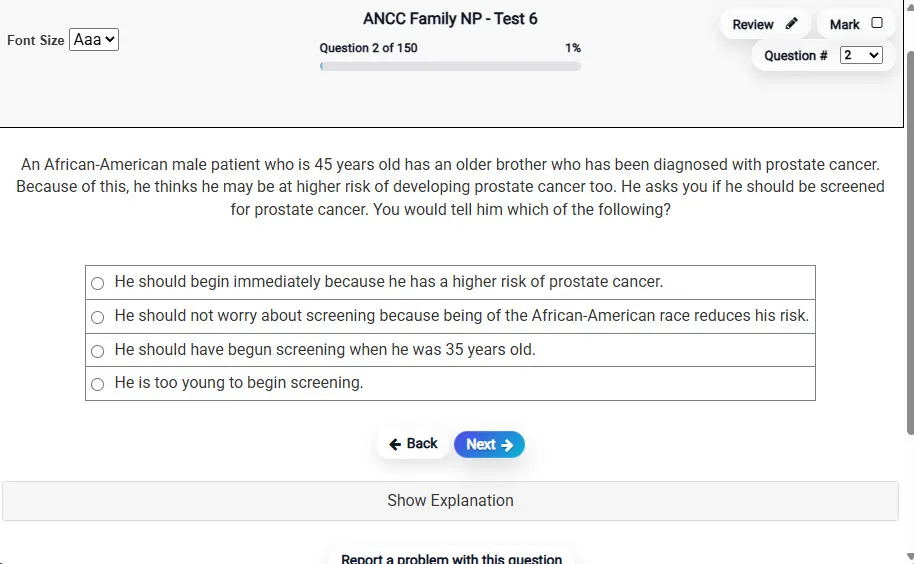
Answering a Question screen – Multiple-choice item view with navigation controls and progress tracker.
Answering a Question Multiple-choice item view with navigation controls and progress tracker.

                           Detailed Explanation screen – 
                         Review mode showing chosen answer and rationale and references.
Detailed Explanation Review mode showing chosen answer and rationale and references.

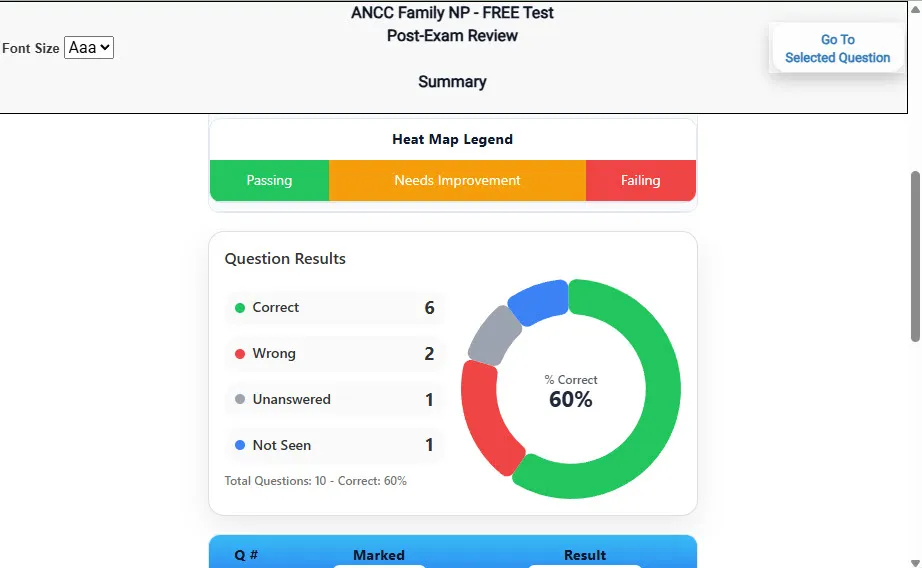
                           Review Summary 1 screen – 
                         Summary with counts for correct/wrong/unanswered and not seen items.
Review Summary 1 Summary with counts for correct/wrong/unanswered and not seen items.

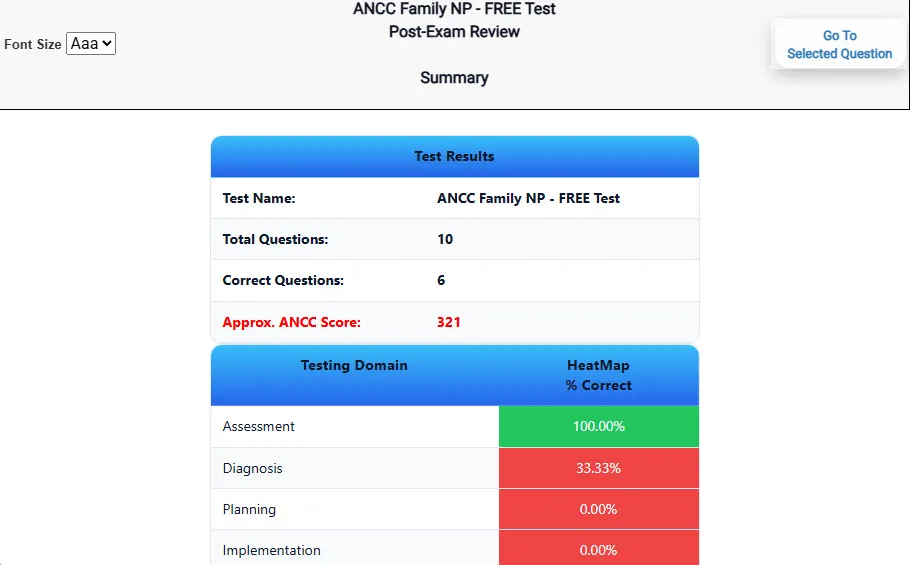
                           Review Summary 2 screen – 
                         Advanced summary with category/domain breakdown and performance insights.
Review Summary 2 Advanced summary with category/domain breakdown and performance insights.

What Each Screen Shows

Answer Question Screen

  • Clean multiple-choice interface with progress bar.
  • Mark for review feature.
  • Matches real test pacing.

Detailed Explanation

  • Correct answer plus rationale.
  • Key concepts and guidelines highlighted.
  • Move between questions to fill knowledge gaps.

Review Summary 1

  • Overall results with total questions and scaled score.
  • Domain heatmap shows strengths and weaknesses.
  • Quick visual feedback on study priorities.

Review Summary 2

  • Chart of correct, wrong, unanswered, not seen.
  • Color-coded results for easy review.
  • Links back to missed items.

Top 10 Reasons to Use Exam Edge for your MCA Elementary Education Multi-Content Mathematics and Science Exam Prep

  1. Focused on the MCA Elementary Education Multi-Content Mathematics and Science Exam

    Our practice tests are built specifically for the MCA Elem Ed MC Math and Science Subtest exam — every question mirrors the real topics, format, and difficulty so you're studying exactly what matters.

  2. Real Exam Simulation

    We match the per-question time limits and pressure of the actual MCA exam, so test day feels familiar and stress-free.

  3. 20 Full Practice Tests & 1,600 Unique Questions

    You'll have more than enough material to master every MCA Elem Ed MC Math and Science Subtest concept — no repeats, no fluff.

  4. Lower Cost Than a Retake

    Ordering 5 practice exams costs less than retaking the MCA Elementary Education Multi-Content Mathematics and Science exam after a failure. One low fee could save you both time and money.

  5. Flexible Testing

    Need to step away mid-exam? Pick up right where you left off — with your remaining time intact.

  6. Instant Scoring & Feedback

    See your raw score and an estimated MCA Elementary Education Multi-Content Mathematics and Science score immediately after finishing each practice test.

  7. Detailed Explanations for Every Question

    Review correct and incorrect answers with clear, step-by-step explanations so you truly understand each topic.

  8. Trusted & Accredited

    We're fully accredited by the Better Business Bureau and uphold the highest standards of trust and transparency.

  9. Web-Based & Always Available

    No software to install. Access your MCA Elem Ed MC Math and Science Subtest practice exams 24/7 from any computer or mobile device.

  10. Expert Support When You Need It

    Need extra help? Our specialized tutors are highly qualified and ready to support your MCA exam prep.


Pass the MCA Elementary Education Multi-Content Mathematics and Science Exam with Realistic Practice Tests from Exam Edge

Preparing for your upcoming MCA Elementary Education Multi-Content Mathematics and Science (073) Certification Exam can feel overwhelming — but the right practice makes all the difference. Exam Edge gives you the tools, structure, and confidence to pass on your first try. Our online practice exams are built to match the real MCA Elem Ed MC Math and Science Subtest exam in content, format, and difficulty.

  • 📝 20 MCA Elementary Education Multi-Content Mathematics and Science Practice Tests: Access 20 full-length exams with 80 questions each, covering every major MCA Elementary Education Multi-Content Mathematics and Science topic in depth.
  • Instant Online Access: Start practicing right away — no software, no waiting.
  • 🧠 Step-by-Step Explanations: Understand the reasoning behind every correct answer so you can master MCA Elem Ed MC Math and Science Subtest exam concepts.
  • 🔄 Retake Each Exam Up to 4 Times: Build knowledge through repetition and track your improvement over time.
  • 🌐 Web-Based & Available 24/7: Study anywhere, anytime, on any device.
  • 🧘 Boost Your Test-Day Confidence: Familiarity with the MCA format reduces anxiety and helps you perform under pressure.

These MCA Elementary Education Multi-Content Mathematics and Science practice exams are designed to simulate the real testing experience by matching question types, timing, and difficulty level. This approach helps you get comfortable not just with the exam content, but also with the testing environment, so you walk into your exam day focused and confident.

Exam Edge MCA Reviews


MCA Elementary Education Multi-Content Mathematics and Science Aliases Test Name

Here is a list of alternative names used for this exam.

  • MCA Elementary Education Multi-Content Mathematics and Science
  • MCA Elementary Education Multi-Content Mathematics and Science test
  • MCA Elementary Education Multi-Content Mathematics and Science Certification Test
  • MCA Elem Ed MC Math and Science Subtest test
  • MCA
  • MCA 073
  • 073 test
  • MCA Elementary Education Multi-Content Mathematics and Science (073)
  • Elementary Education Multi-Content Mathematics and Science certification