This is the content of the pop-over!

Lightning Deal Alert – 12% Off Ends at Midnight!

Strike while the savings are hot! Use promo code FlashSale at checkout for 12% off any Exam Edge test or bundle. Hurry—the clock is ticking!

TACHS (TACHS) Practice Tests & Test Prep by Exam Edge


Test for Admission into Catholic High Schools  product image
(5.0)
Based on 34 Reviews

  • Real Exam Simulation: Timed questions and matching content build comfort for your TACHS test day.
  • Instant, 24/7 Access: Web-based Test for Admission into Catholic High Schools practice exams with no software needed.
  • Clear Explanations: Step-by-step answers and explanations for your TACHS exam to strengthen understanding.
  • Boosted Confidence: Reduces anxiety and improves test-taking skills to ace your Test for Admission into Catholic High Schools (TACHS).

Featured on

Test for Admission into Catholic High Schools Online Practice Test Bundles

BEST VALUE
20 practice tests

$174.00

$799.00

SAVE $625

Only $8.70 per test!

  • 100% Pass Guarantee
  • 20 online practice tests
  • 100 questions per test
  • Bonus: 100 Flash Cards + Study Guide
  • Instant access
  • Detailed Explanations
  • Practice tests never expire
  • Timed, untimed, or study guide mode
MOST POPULAR
10 practice tests

$99.50

$399.50

SAVE $300

Only $9.95 per test!

  • 10 online practice tests
  • 100 questions per test
  • Bonus: 100 Flash Cards + Study Guide
  • Instant access
  • Detailed Explanations
  • Practice tests never expire
  • Timed, untimed, or study guide mode
5 practice tests

$69.75

$199.75

SAVE $130

Only $13.95 per test!

  • 5 online practice tests
  • 100 questions per test
  • Bonus: 100 Flash Cards
  • Instant access
  • Detailed Explanations
  • Practice tests never expire
  • Timed, untimed, or study guide mode
1 practice test

$39.95

  • 1 online practice test
  • 100 questions per test
  • Instant access
  • Detailed Explanations
  • Practice tests never expire
  • Timed, untimed, or study guide mode
Quick Select
Tap to choose a bundle

** All Prices are in US Dollars (USD) **


TACHS (TACHS) Resources

Jump to the section you need most.

Understanding the exact breakdown of the Test for Admission into Catholic High Schools test will help you know what to expect and how to most effectively prepare. The Test for Admission into Catholic High Schools has 200 multiple-choice questions . The exam will be broken down into the sections below:

Test for Admission into Catholic High Schools Exam Blueprint
Domain Name
Reading  
     Vocabulary test  
     Reading Comprehension test  
Language  
     Spelling test  
     Capitalization test  
     Punctuation test  
     Usage test  
     Expression test  
Math  
Ability - general abstract reasoning  

Test for Admission into Catholic High Schools Study Tips by Domain

  • Start by reading the questions first to set a purpose, then skim the passage for where each answer likely lives—red flag: answering from memory without returning to the text.
  • For main idea, choose the option that covers the whole passage (not just one paragraph)—common trap: picking a catchy detail or an opinion-sounding statement.
  • For inference, select what must be true based on text evidence—threshold rule: if you can’t point to a specific line or two that supports it, it’s probably too strong.
  • Watch for author’s tone and purpose words (e.g., “however,” “should,” “surprisingly”)—common trap: confusing the author’s view with a character’s view or a quoted source.
  • Use context clues for vocabulary-in-context (contrast, example, synonym, definition)—red flag: choosing the most common meaning of a word when the surrounding sentence signals a different one.
  • Manage time by answering line-reference and detail questions quickly and flagging one hard inference to revisit—priority rule: don’t leave any blank, since an educated guess beats no response.
  • Focus on meaning-in-context—choose the word that best fits the sentence’s tone and logic; red flag: picking a familiar word that doesn’t match the surrounding clues.
  • Know common TACHS-tier prefixes/suffixes (un-, re-, pre-, -ful, -less, -tion) to infer meaning fast; trap: confusing similar-looking roots (e.g., “con-” vs “contra-”).
  • Watch for connotation differences (childish vs youthful, stubborn vs determined); priority rule: eliminate options that match denotation but miss the sentence’s attitude.
  • Use elimination with part of speech first (noun/verb/adj.) before meaning; red flag: an answer that fits the meaning but not the grammar slot.
  • Handle synonyms/antonyms carefully—look for the best match, not just “close”; common trap: choosing an extreme word when the sentence suggests a mild one.
  • For analogies-style thinking, identify the relationship (cause/effect, part/whole, degree); red flag: options that share a topic but don’t share the same relationship.
  • Read the question first when time is tight so you know whether to hunt for a detail, infer an idea, or identify the author’s purpose—common trap: rereading the whole passage for a single line reference.
  • Anchor every answer in the passage text; red flag: options that sound reasonable but introduce a new fact, stronger language, or a conclusion the author never states.
  • For main idea, pick the choice that covers most paragraphs without being too narrow or too broad—trap: selecting a vivid example or the first paragraph’s topic as the main point.
  • For inference questions, choose what must be true given the evidence, not what could be true—red flag: answer choices requiring outside knowledge or assumptions beyond the passage.
  • For vocabulary-in-context, substitute the answer into the sentence and confirm it fits the surrounding tone and contrast words (e.g., “however,” “although”)—trap: picking the most common meaning instead of the contextual meaning.
  • Use line/paragraph references strategically: locate the cited section, read one sentence before and after, then answer—priority rule: eliminate choices contradicted by that local context.
  • Prioritize grammar and sentence correctness: choose the option that fixes subject–verb agreement, pronoun reference, and verb tense consistency; red flag—answers that sound “formal” but introduce agreement errors.
  • Watch for parallel structure in lists and paired ideas (e.g., “not only… but also”); common trap—mixing nouns with verbs or changing verb forms mid-sentence.
  • Use context to resolve word choice and clarity (who did what to whom); red flag—ambiguous pronouns like “it,” “they,” or “this” with no clear antecedent.
  • Maintain logical comparisons and modifiers (compare like with like, place modifiers next to what they modify); common trap—dangling or misplaced modifiers that change meaning.
  • Check sentence boundaries: fix run-ons with a period, semicolon, or conjunction–comma, and fix fragments by adding a subject or complete verb; red flag—comma splices.
  • Prefer concise, standard English over wordy rewrites; priority rule—when two answers are grammatically correct, choose the clearer, more precise one without unnecessary extra words.
  • Expect TACHS-style spelling items that target commonly confused vowel patterns (ei/ie, ea/ee, -able/-ible)—red flag: choosing what “looks right” instead of applying a rule.
  • Know how adding endings changes spelling (drop final silent e, double final consonant after CVC, change y to i)—common trap: forgetting the exception when adding -ing (e.g., keep the e when needed to preserve soft c/g: “change” → “changing”).
  • Watch homophones and near-homophones (their/there/they’re, principal/principle)—priority rule: confirm meaning in context before selecting a spelling.
  • Be alert to prefixes/suffixes that create tricky spellings (dis-, mis-, re-, -tion/-sion/-cian)—red flag: mixing endings like “-sion” and “-tion” without checking the base word.
  • Handle plurals and possessives cleanly (s/es, words ending in y, f/fe)—common trap: using an apostrophe to form a plural (e.g., “apple’s”).
  • Use quick process-of-elimination: scan each option for one definite rule break (double letters, missing silent letter, wrong suffix)—threshold cue: if you can’t justify the choice with a rule, re-check for a more defensible option.
  • Capitalize proper nouns and titles: people, specific places, organizations, religions, languages, and nationalities; red flag—capitalizing generic nouns like “the school” or “the city” when not part of a name.
  • Capitalize titles before a name (President Lee, Sister Maria) but usually not after a name (Lee, the president); common trap—overcapitalizing job titles used generically (a doctor, the principal).
  • Capitalize the first word of a sentence and the pronoun “I” every time; priority rule—scan for missing initial caps after end punctuation (., !, ?).
  • Capitalize days, months, holidays, and historical events but not seasons unless part of a name; red flag—writing “Spring” for the season or lowercasing “Thanksgiving.”
  • In TACHS-style school contexts, capitalize specific course names and official names (English 9, Algebra I, St. Joseph High School) but not subjects used generally (math, history); common trap—capitalizing every subject in a list.
  • Capitalize the first word and key words in titles of books/articles, and capitalize the first word of a direct quote; red flag—capitalizing short articles/prepositions in the middle of a title (a, an, the, of) unless they start it.
  • Use commas to separate items in a series and to set off introductory phrases; red flag: skipping the comma after an opening word group (e.g., “After the game,”).
  • Place commas around nonessential (parenthetical) information; common trap: using commas with essential clauses that start with “that” (usually no comma).
  • Use semicolons to join two closely related independent clauses or to separate complex list items; priority rule: if you can replace it with a period, a semicolon may be correct.
  • Use colons after a complete sentence to introduce a list, explanation, or quotation; contraindication: do not place a colon right after a verb or preposition.
  • Check apostrophes for possession vs. plurals; common trap: confusing “its” (possessive) with “it’s” (it is/it has).
  • Use quotation marks for direct quotes and titles of short works, and keep punctuation placement consistent; red flag: putting a period/comma outside the closing quotation mark in standard American style.
  • Match subject–verb agreement across tricky subjects (indefinite pronouns, collective nouns, and “either/neither”)—red flag: a singular subject with a plural verb after a prepositional phrase.
  • Keep pronoun–antecedent agreement and clarity—common trap: “their” with “each/everyone” or a vague “it/this/they” with no clear noun to refer to.
  • Use the correct verb tense and maintain consistency within a sentence or paragraph—priority rule: don’t shift from past to present without a time cue like “now” or “today.”
  • Choose the right word for comparisons and logic (fewer/less, number/amount, between/among, good/well)—red flag: “less” used with countable nouns (e.g., “less students”).
  • Place modifiers next to what they modify—common trap: a dangling opener (e.g., “Walking to school,” followed by a subject that isn’t walking).
  • Use parallel structure in lists and paired constructions (both/and, either/or, not only/but also)—red flag: mixing forms like “to study, reading, and to practice” in the same list.
  • Revise for clarity by choosing the most direct wording and removing redundancy; red flag: options that add extra words without adding meaning.
  • Maintain parallel structure in lists and paired ideas (e.g., “to read, to write, and to speak”); common trap: mixing verb forms or switching patterns mid-sentence.
  • Watch pronoun clarity and agreement (its/they, who/which, subject–verb); red flag: a pronoun that could refer to more than one noun.
  • Keep modifiers next to what they modify; common trap: dangling or misplaced phrases like “Running down the street, the backpack…”.
  • Choose consistent tense and logical sequence; red flag: a sentence that shifts from past to present (or changes point of view) without a clear reason.
  • Prefer precise word choice and correct comparisons (fewer/less, good/well, between/among); common trap: “more better” or unclear comparison groups (“better than John” vs “better than John does”).
  • Prioritize arithmetic fluency (fractions, decimals, percents) and conversions; red flag: mixing percent change with percent of (e.g., 20% off vs 20% of).
  • Master ratios, rates, and proportions (unit rate, scale drawings); common trap: forgetting to keep units consistent (minutes vs hours, inches vs feet).
  • Be solid on basic algebra (distribute, combine like terms, solve one- and two-step equations/inequalities); priority rule: whatever you do to one side, do to the other.
  • Know exponents and order of operations (PEMDAS) including negatives; red flag: treating -32 as 9 instead of -9 without parentheses.
  • Cover geometry essentials (perimeter, area, volume, angles) and recognize formula cues; common trap: using perimeter formulas when the question asks for area (square units).
  • Practice word problems with a quick plan (define variables, write an equation, check reasonableness); red flag: answers that don’t match context (e.g., negative people, impossible lengths).
  • Expect nonverbal pattern tasks (matrices, sequences, odd-one-out)—use a consistent rule-hunt order: shape → count → position → shading to avoid random guessing.
  • Common trap: assuming only one change between figures; actively check for two simultaneous rules (e.g., rotation + number of elements) before selecting an answer.
  • For sequences, verify direction and step size—red flag if you pick an option that fits the first jump but breaks the second (always test at least two transitions).
  • In spatial/rotation items, note whether the figure is being rotated or reflected; priority rule: if left-right flips occur, it’s reflection, not rotation.
  • Use elimination when unsure: cross out choices that violate any confirmed feature (count, orientation, fill)—don’t overweigh one feature like color if other attributes change too.
  • Time is a constraint on TACHS-style ability questions—common strategy is to skip any item that lacks a clear rule within ~30 seconds and return later to prevent a time sink.


Built to Fit Into Your Busy Life

Everything you need to prepare with confidence—without wasting a minute.

Three Study Modes

Timed, No Time Limit, or Explanation mode.

Actionable Analytics

Heatmaps and scaled scores highlight weak areas.

High-Yield Rationales

Concise explanations emphasize key concepts.

Realistic Interface

Matches the feel of the actual exam environment.

Accessible by Design

Clean layout reduces cognitive load.

Anytime, Anywhere

Web-based access 24/7 on any device.
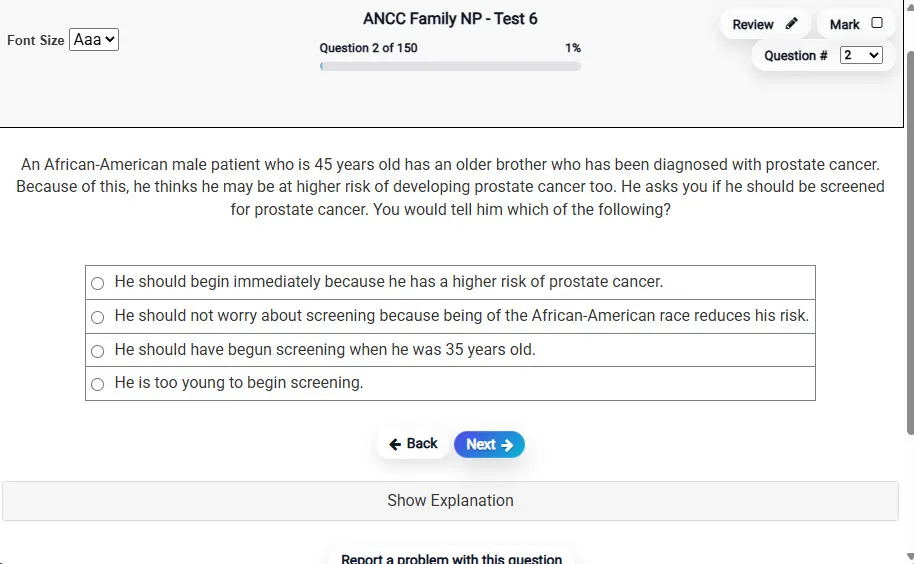
Answering a Question screen – Multiple-choice item view with navigation controls and progress tracker.
Answering a Question Multiple-choice item view with navigation controls and progress tracker.

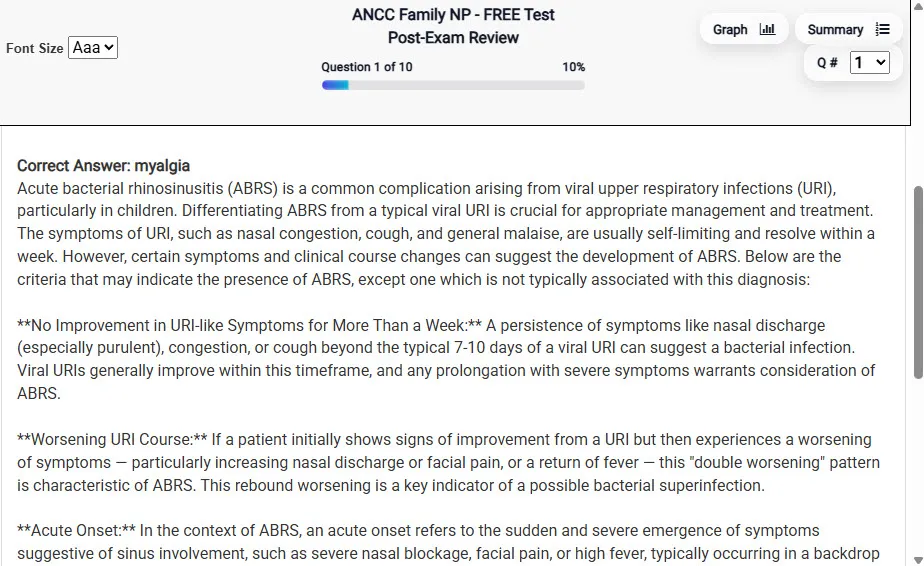
                           Detailed Explanation screen – 
                         Review mode showing chosen answer and rationale and references.
Detailed Explanation Review mode showing chosen answer and rationale and references.

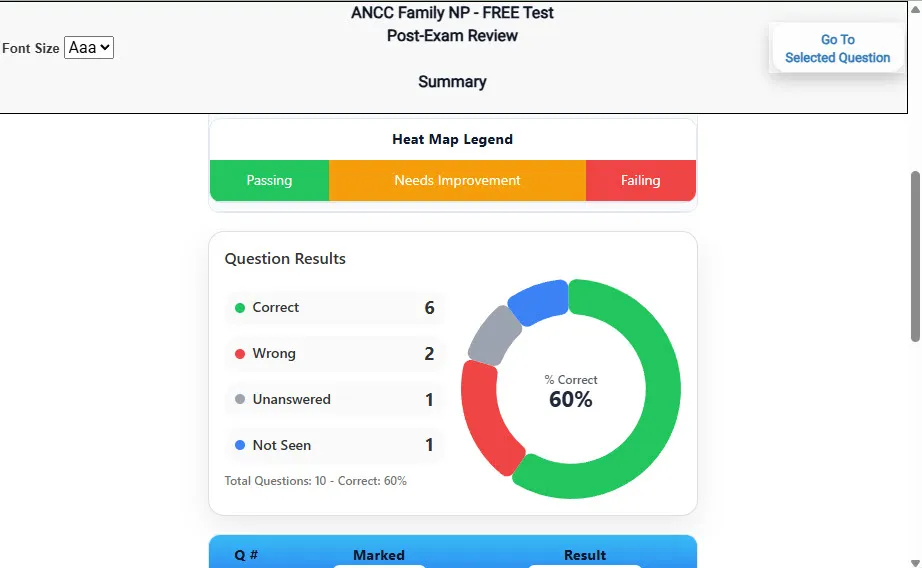
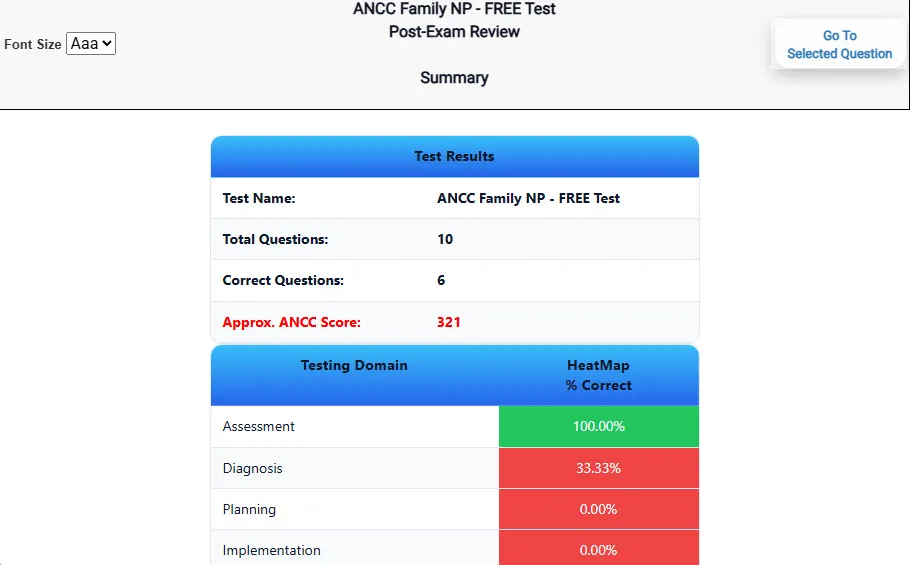
                           Review Summary 1 screen – 
                         Summary with counts for correct/wrong/unanswered and not seen items.
Review Summary 1 Summary with counts for correct/wrong/unanswered and not seen items.

                           Review Summary 2 screen – 
                         Advanced summary with category/domain breakdown and performance insights.
Review Summary 2 Advanced summary with category/domain breakdown and performance insights.

What Each Screen Shows

Answer Question Screen

  • Clean multiple-choice interface with progress bar.
  • Mark for review feature.
  • Matches real test pacing.

Detailed Explanation

  • Correct answer plus rationale.
  • Key concepts and guidelines highlighted.
  • Move between questions to fill knowledge gaps.

Review Summary 1

  • Overall results with total questions and scaled score.
  • Domain heatmap shows strengths and weaknesses.
  • Quick visual feedback on study priorities.

Review Summary 2

  • Chart of correct, wrong, unanswered, not seen.
  • Color-coded results for easy review.
  • Links back to missed items.

Top 10 Reasons to Use Exam Edge for your Test for Admission into Catholic High Schools Exam Prep

  1. Focused on the Test for Admission into Catholic High Schools Exam

    Our practice tests are built specifically for the TACHS exam — every question mirrors the real topics, format, and difficulty so you're studying exactly what matters.

  2. Real Exam Simulation

    We match the per-question time limits and pressure of the actual TACHS exam, so test day feels familiar and stress-free.

  3. 20 Full Practice Tests & 2,000 Unique Questions

    You'll have more than enough material to master every TACHS concept — no repeats, no fluff.

  4. Lower Cost Than a Retake

    Ordering 5 practice exams costs less than retaking the Test for Admission into Catholic High Schools exam after a failure. One low fee could save you both time and money.

  5. Flexible Testing

    Need to step away mid-exam? Pick up right where you left off — with your remaining time intact.

  6. Instant Scoring & Feedback

    See your raw score and an estimated Test for Admission into Catholic High Schools score immediately after finishing each practice test.

  7. Detailed Explanations for Every Question

    Review correct and incorrect answers with clear, step-by-step explanations so you truly understand each topic.

  8. Trusted & Accredited

    We're fully accredited by the Better Business Bureau and uphold the highest standards of trust and transparency.

  9. Web-Based & Always Available

    No software to install. Access your TACHS practice exams 24/7 from any computer or mobile device.

  10. Expert Support When You Need It

    Need extra help? Our specialized tutors are highly qualified and ready to support your TACHS exam prep.


Pass the Test for Admission into Catholic High Schools Exam with Realistic Practice Tests from Exam Edge

Preparing for your upcoming Test for Admission into Catholic High Schools (TACHS) Certification Exam can feel overwhelming — but the right practice makes all the difference. Exam Edge gives you the tools, structure, and confidence to pass on your first try. Our online practice exams are built to match the real TACHS exam in content, format, and difficulty.

  • 📝 20 Test for Admission into Catholic High Schools Practice Tests: Access 20 full-length exams with 100 questions each, covering every major Test for Admission into Catholic High Schools topic in depth.
  • Instant Online Access: Start practicing right away — no software, no waiting.
  • 🧠 Step-by-Step Explanations: Understand the reasoning behind every correct answer so you can master TACHS exam concepts.
  • 🔄 Retake Each Exam Up to 4 Times: Build knowledge through repetition and track your improvement over time.
  • 🌐 Web-Based & Available 24/7: Study anywhere, anytime, on any device.
  • 🧘 Boost Your Test-Day Confidence: Familiarity with the TACHS format reduces anxiety and helps you perform under pressure.

These Test for Admission into Catholic High Schools practice exams are designed to simulate the real testing experience by matching question types, timing, and difficulty level. This approach helps you get comfortable not just with the exam content, but also with the testing environment, so you walk into your exam day focused and confident.

Exam Edge TACHS Reviews


Test for Admission into Catholic High Schools Aliases Test Name

Here is a list of alternative names used for this exam.

  • Test for Admission into Catholic High Schools
  • Test for Admission into Catholic High Schools test
  • Test for Admission into Catholic High Schools Certification Test
  • TACHS test
  • TACHS
  • TACHS TACHS
  • TACHS test
  • Test for Admission into Catholic High Schools (TACHS)
  • Test for Admission into Catholic High Schools certification