This is the content of the pop-over!

Lightning Deal Alert – 12% Off Ends at Midnight!

Strike while the savings are hot! Use promo code FlashSale at checkout for 12% off any Exam Edge test or bundle. Hurry—the clock is ticking!

Child Development Associate - Family (CDA) Practice Tests & Test Prep by Exam Edge


Child Development Associate Family  product image
(4.6)
Based on 34 Reviews

  • Real Exam Simulation: Timed questions and matching content build comfort for your Child Development Associate Family test day.
  • Instant, 24/7 Access: Web-based Child Development Associate Family practice exams with no software needed.
  • Clear Explanations: Step-by-step answers and explanations for your CDA exam to strengthen understanding.
  • Boosted Confidence: Reduces anxiety and improves test-taking skills to ace your Child Development Associate Family (CDA).

Featured on

Child Development Associate Family Online Practice Test Bundles

BEST VALUE
5 practice tests

$69.75

$199.75

SAVE $130

Only $13.95 per test!

  • 100% Pass Guarantee
  • 5 online practice tests
  • 65 questions per test
  • Bonus: 100 Flash Cards + Study Guide
  • Instant access
  • Detailed Explanations
  • Practice tests never expire
  • Timed, untimed, or study guide mode
1 practice test

$39.95

  • 1 online practice test
  • 65 questions per test
  • Instant access
  • Detailed Explanations
  • Practice tests never expire
  • Timed, untimed, or study guide mode
Quick Select
Tap to choose a bundle

** All Prices are in US Dollars (USD) **


Child Development Associate Family (CDA) Resources

Jump to the section you need most.

Understanding the exact breakdown of the Child Development Associate Family test will help you know what to expect and how to most effectively prepare. The Child Development Associate Family has multiple-choice questions . The exam will be broken down into the sections below:

Child Development Associate Family Exam Blueprint
Domain Name
Planning a safe and healthy learning environment  
Advancing Children's physical and intellectual Development  
Supporting Children's social and emotional development  
Building productive relationships with families  
Managing an effective program  
Maintaining a commitment to professionalism  
Observing and recording choldren's behavior  
Understanding principles of child development and learning  

Child Development Associate Family Study Tips by Domain

  • Run daily safety checks using a written checklist (floors, outlets, cords, choking hazards, safe sleep equipment) and document fixes; red flag: assuming yesterday’s setup is still safe after room changes.
  • Follow safe sleep every time (back to sleep, firm mattress, no blankets/toys, no propping bottles) and verify supervision policy; common trap: placing an infant in a swing/bouncer for sleep.
  • Use active supervision (positioning, scanning, counting, knowing each child’s location) especially during transitions; priority rule: most injuries occur during transitions and outdoor play when ratios drift.
  • Apply infection control consistently (handwashing at required times, gloving for bodily fluids, disinfecting high-touch surfaces) and enforce illness exclusion; red flag: sanitizing instead of disinfecting after diapering.
  • Maintain safe food practices (allergy list posted, cross-contact prevention, correct refrigeration/labeling) and child-safe meal supervision; common trap: serving whole grapes/hot dogs or leaving children unsupervised while eating.
  • Be prepared for emergencies (posted evacuation/lockdown plans, stocked first-aid kit, accessible emergency contacts, regular drills) and know when to call 911; red flag: missing consent/medication forms or expired emergency supplies.
  • Plan daily gross-motor and fine-motor experiences with clear learning goals (e.g., balance, grasp, bilateral coordination) and adapt for each child; red flag: long periods of seated or “one-size-fits-all” activities.
  • Use developmentally appropriate practice—skills build from simple to complex with hands-on exploration; common trap: pushing worksheets, flashcards, or forced sitting before children are ready.
  • Embed language, early literacy, and math in routines (talk, read, sing, count, compare, sort) and respond with back-and-forth conversation; priority rule: children learn more from interactive talk than from passive screen time.
  • Support inquiry and science thinking by asking open-ended questions and encouraging prediction, testing, and reflection; red flag: giving answers too quickly or correcting in a way that shuts down curiosity.
  • Provide inclusive adaptations (multiple materials, assistive supports, alternative ways to show learning) and collaborate with specialists when needed; common trap: treating accommodations as “extra” instead of required access.
  • Promote healthy habits that enable learning—nutrition, hydration, rest, hygiene, and outdoor activity—and align with family/cultural practices when possible; contraindication: using food, physical activity, or bathroom access as a reward or punishment.
  • Provide predictable routines and clear, positively stated rules; red flag: frequent behavior escalations often trace back to inconsistent expectations between adults.
  • Teach emotion vocabulary and coping steps (e.g., “stop–name it–breathe–ask for help”); common trap: telling children to “calm down” without modeling what to do.
  • Use positive guidance first (attention to desired behavior, choices, redirection) and reserve consequences as last resort; priority rule: consequences must be immediate, related, and reasonable.
  • Support peer skills with coached turn-taking, sharing scripts, and problem-solving steps; red flag: adults who solve every conflict prevent children from learning negotiation.
  • Build secure relationships through warm, responsive interactions and individualized comfort strategies; contraindication: withholding affection or using isolation as punishment for emotional outbursts.
  • Ensure fairness and belonging by using culturally responsive materials and avoiding labels; common trap: describing a child as “bad” instead of stating observable behavior and teaching replacement skills.
  • Establish two-way communication routines (daily notes/app, brief check-ins) and invite family input; red flag: contacting families only when there is a problem.
  • Maintain confidentiality by sharing a child’s information only with authorized caregivers and on a need-to-know basis; common trap: discussing children in hallways, group chats, or in front of other families.
  • Handle concerns using objective observations and specific examples rather than labels (e.g., “hit twice during block play” vs. “aggressive”); priority rule: focus on behavior, safety, and next steps.
  • Create inclusive, culturally responsive practices (pronounce names correctly, honor home language, avoid assumptions); red flag: using one “default” approach for all families.
  • Partner with families on individual goals and consistent strategies across home and program (sleep, toileting, behavior supports); common trap: giving prescriptive advice without asking what works at home.
  • Support transitions and family engagement (orientations, clear drop-off/pick-up procedures, shared routines); priority rule: verify identity/authorization at pick-up every time—never release a child to an unapproved adult.
  • Maintain consistent daily schedules with clear transition cues; a common trap is abrupt changes that trigger behavior issues and reduce learning time.
  • Use accurate child and classroom records (attendance, incident reports, medication logs) and store them confidentially; red flag: incomplete or back-dated documentation.
  • Implement reliable staff/volunteer procedures (ratios, supervision zones, handoffs) and verify they are followed; priority rule: never leave children unsupervised during breaks or transitions.
  • Plan curriculum materials and room setup in advance to minimize downtime; red flag: frequent “waiting” lines or large-group idle time that predicts misbehavior.
  • Follow established health/safety and emergency routines (drills, allergy plans, sanitation schedules) and review after incidents; common trap: assuming everyone “already knows” procedures without practice.
  • Communicate program policies consistently (fees, arrival/departure, illness exclusion) and apply them fairly; red flag: making exceptions without documentation, which invites conflict and compliance gaps.
  • Maintain confidentiality at all times—never discuss a child or family in public areas, on personal devices, or on social media (red flag: posting photos or “cute stories” without written permission).
  • Follow the program’s chain of command and reporting procedures; if you suspect abuse/neglect, report immediately per policy and mandated reporter rules (common trap: waiting for “proof” or asking colleagues to “confirm” first).
  • Set and keep professional boundaries with families—avoid gifts, borrowing/lending, or private babysitting if your program prohibits it (red flag: texting families from a personal number about non-school matters).
  • Use ethical, bias-aware practice: provide equitable care and guidance without favoritism (common trap: labeling a child as “bad” instead of describing observable behavior).
  • Commit to ongoing learning aligned with CDA expectations—seek feedback, reflect, and document professional development (priority rule: address safety and guidance gaps before adding new curriculum strategies).
  • Model reliability and respectful conduct—be punctual, prepared, and consistent in policy enforcement (red flag: ignoring a rule for one family or child “just this once”).
  • Use objective, observable language (what you see/hear) and avoid labels like “bad” or “lazy”—red flag: any note that assumes intent (e.g., “trying to annoy”) instead of describing behavior.
  • Choose a method that matches the question: running record for sequences, anecdotal note for brief incidents, frequency count for repeated behaviors, and time sampling for duration—common trap: using only anecdotal notes when you really need counts to show patterns.
  • Record the ABCs (Antecedent–Behavior–Consequence) when behavior is challenging—priority rule: document what happened right before and immediately after, not just the behavior itself.
  • Include context details (date/time, setting, peers/adults present) and capture exact quotes when relevant—red flag: missing time or location makes it hard to identify triggers and routines.
  • Protect confidentiality in all records—common trap: writing full names where others can see them or discussing observations in public areas; store notes securely and share only with authorized staff/families as appropriate.
  • Use observations to plan next steps and track progress over time—threshold cue: if a behavior is frequent, intense, or persists across settings/routines, increase documentation and follow the program’s referral/consultation process.
  • Use developmental milestones as guides, not pass/fail rules—red flag: labeling a child as “behind” from one observation without considering age range and opportunity to practice.
  • Plan with the whole child in mind (physical, cognitive, language, social-emotional) because domains develop together—common trap: pushing early academics while ignoring self-regulation and play.
  • Match expectations to the child’s developmental level and temperament—priority rule: adjust the environment and teaching strategy before assuming the child is being “noncompliant.”
  • Recognize that culture, language, and family routines shape development and behavior—red flag: interpreting differences (e.g., eye contact, communication style) as a behavior problem without family input.
  • Apply principles of learning (active, hands-on exploration; repetition; meaningful context)—common trap: relying on worksheets or long group times that exceed children’s attention span.
  • Differentiate between typical developmental variations and concerns that need follow-up—threshold cue: persistent skill loss, lack of progress over time, or functioning that significantly limits participation warrants documentation and referral per program policy.


Built to Fit Into Your Busy Life

Everything you need to prepare with confidence—without wasting a minute.

Three Study Modes

Timed, No Time Limit, or Explanation mode.

Actionable Analytics

Heatmaps and scaled scores highlight weak areas.

High-Yield Rationales

Concise explanations emphasize key concepts.

Realistic Interface

Matches the feel of the actual exam environment.

Accessible by Design

Clean layout reduces cognitive load.

Anytime, Anywhere

Web-based access 24/7 on any device.
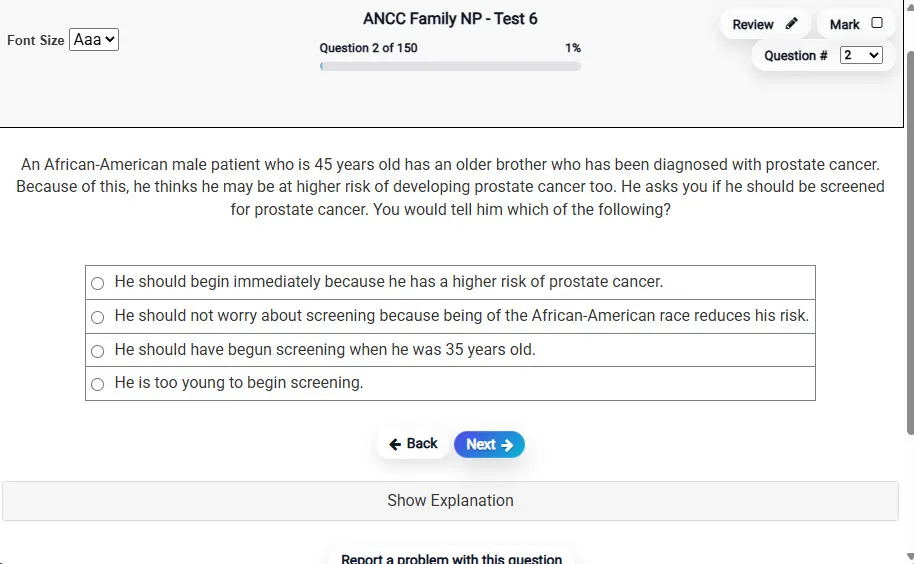
Answering a Question screen – Multiple-choice item view with navigation controls and progress tracker.
Answering a Question Multiple-choice item view with navigation controls and progress tracker.

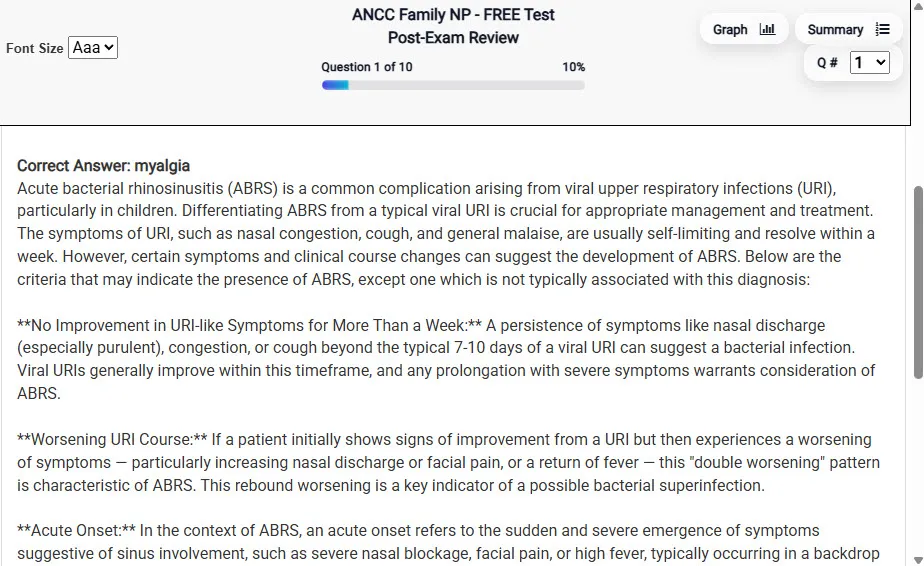
                           Detailed Explanation screen – 
                         Review mode showing chosen answer and rationale and references.
Detailed Explanation Review mode showing chosen answer and rationale and references.

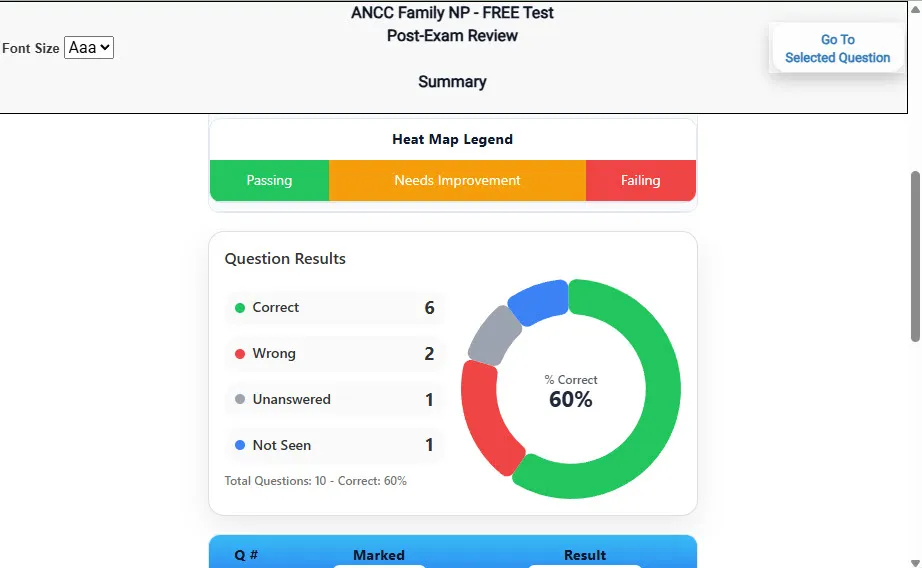
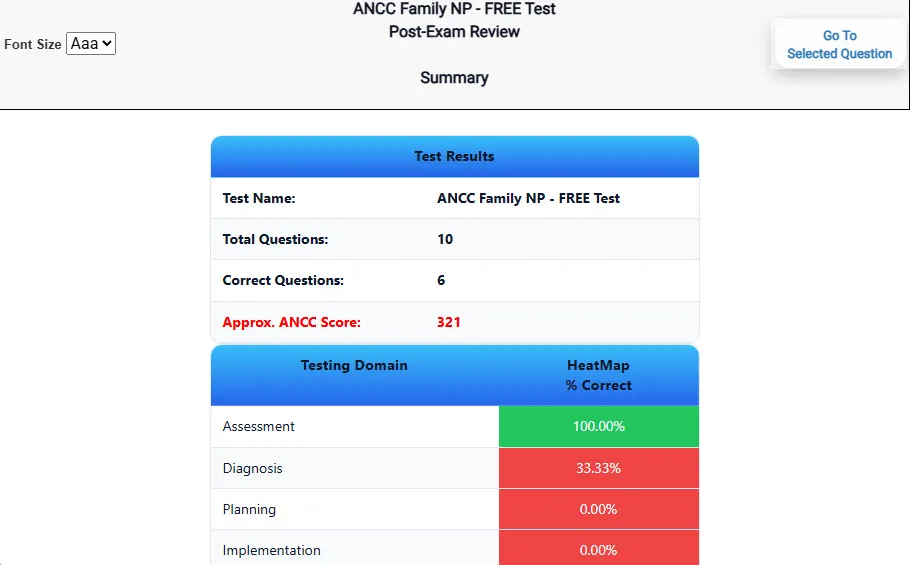
                           Review Summary 1 screen – 
                         Summary with counts for correct/wrong/unanswered and not seen items.
Review Summary 1 Summary with counts for correct/wrong/unanswered and not seen items.

                           Review Summary 2 screen – 
                         Advanced summary with category/domain breakdown and performance insights.
Review Summary 2 Advanced summary with category/domain breakdown and performance insights.

What Each Screen Shows

Answer Question Screen

  • Clean multiple-choice interface with progress bar.
  • Mark for review feature.
  • Matches real test pacing.

Detailed Explanation

  • Correct answer plus rationale.
  • Key concepts and guidelines highlighted.
  • Move between questions to fill knowledge gaps.

Review Summary 1

  • Overall results with total questions and scaled score.
  • Domain heatmap shows strengths and weaknesses.
  • Quick visual feedback on study priorities.

Review Summary 2

  • Chart of correct, wrong, unanswered, not seen.
  • Color-coded results for easy review.
  • Links back to missed items.

Top 10 Reasons to Use Exam Edge for your Child Development Associate Family Exam Prep

  1. Focused on the Child Development Associate Family Exam

    Our practice tests are built specifically for the Child Development Associate Family exam — every question mirrors the real topics, format, and difficulty so you're studying exactly what matters.

  2. Real Exam Simulation

    We match the per-question time limits and pressure of the actual CDA exam, so test day feels familiar and stress-free.

  3. 5 Full Practice Tests & 325 Unique Questions

    You'll have more than enough material to master every Child Development Associate Family concept — no repeats, no fluff.

  4. Lower Cost Than a Retake

    Ordering 5 practice exams costs less than retaking the Child Development Associate Family exam after a failure. One low fee could save you both time and money.

  5. Flexible Testing

    Need to step away mid-exam? Pick up right where you left off — with your remaining time intact.

  6. Instant Scoring & Feedback

    See your raw score and an estimated Child Development Associate Family score immediately after finishing each practice test.

  7. Detailed Explanations for Every Question

    Review correct and incorrect answers with clear, step-by-step explanations so you truly understand each topic.

  8. Trusted & Accredited

    We're fully accredited by the Better Business Bureau and uphold the highest standards of trust and transparency.

  9. Web-Based & Always Available

    No software to install. Access your Child Development Associate Family practice exams 24/7 from any computer or mobile device.

  10. Expert Support When You Need It

    Need extra help? Our specialized tutors are highly qualified and ready to support your CDA exam prep.


Pass the Child Development Associate Family Exam with Realistic Practice Tests from Exam Edge

Preparing for your upcoming Child Development Associate Family (CDA) Certification Exam can feel overwhelming — but the right practice makes all the difference. Exam Edge gives you the tools, structure, and confidence to pass on your first try. Our online practice exams are built to match the real Child Development Associate Family exam in content, format, and difficulty.

  • 📝 5 Child Development Associate Family Practice Tests: Access 5 full-length exams with 65 questions each, covering every major Child Development Associate Family topic in depth.
  • Instant Online Access: Start practicing right away — no software, no waiting.
  • 🧠 Step-by-Step Explanations: Understand the reasoning behind every correct answer so you can master Child Development Associate Family exam concepts.
  • 🔄 Retake Each Exam Up to 4 Times: Build knowledge through repetition and track your improvement over time.
  • 🌐 Web-Based & Available 24/7: Study anywhere, anytime, on any device.
  • 🧘 Boost Your Test-Day Confidence: Familiarity with the CDA format reduces anxiety and helps you perform under pressure.

These Child Development Associate Family practice exams are designed to simulate the real testing experience by matching question types, timing, and difficulty level. This approach helps you get comfortable not just with the exam content, but also with the testing environment, so you walk into your exam day focused and confident.


Exam Edge CDA Reviews


The program helped me get ready for my CDA Exam. I liked that there were multiple tests to take and that you could reset each test and take it again. I feel like these practice tests helped me ultimately pass the exam.

Tracey , Bluemont, Virginia

I really like the area; it was organized. Very quiet environment to take a test. And I would recommend it to anyone who wants to take a test. Thank you so much.

Faisa, minneapolis, Minnesota


Child Development Associate Family Aliases Test Name

Here is a list of alternative names used for this exam.

  • Child Development Associate Family
  • Child Development Associate Family test
  • Child Development Associate Family Certification Test
  • CDA
  • CDA CDA
  • CDA test
  • Child Development Associate Family (CDA)
  • Child Development Associate Family certification