This is the content of the pop-over!

NYSTCE CST Literacy (065) Practice Tests & Test Prep by Exam Edge


NYSTCE CST Literacy  product image
(4.8)
Based on 32 Reviews

  • Real Exam Simulation: Timed questions and matching content build comfort for your NYSTCE CST Literacy test day.
  • Instant, 24/7 Access: Web-based NYSTCE CST Literacy practice exams with no software needed.
  • Clear Explanations: Step-by-step answers and explanations for your NYSTCE exam to strengthen understanding.
  • Boosted Confidence: Reduces anxiety and improves test-taking skills to ace your NYSTCE CST Literacy (065).

Featured on

NYSTCE CST Literacy Online Practice Test Bundles

BEST VALUE
15 practice tests

$149.25

$599.25

SAVE $450

Only $9.95 per test!

  • 100% Pass Guarantee
  • 15 online practice tests
  • 100 questions per test
  • Bonus: 100 Flash Cards + Study Guide
  • Instant access
  • Detailed Explanations
  • Practice tests never expire
  • Timed, untimed, or study guide mode
MOST POPULAR
10 practice tests

$99.50

$399.50

SAVE $300

Only $9.95 per test!

  • 10 online practice tests
  • 100 questions per test
  • Bonus: 100 Flash Cards + Study Guide
  • Instant access
  • Detailed Explanations
  • Practice tests never expire
  • Timed, untimed, or study guide mode
5 practice tests

$69.75

$199.75

SAVE $130

Only $13.95 per test!

  • 5 online practice tests
  • 100 questions per test
  • Bonus: 100 Flash Cards
  • Instant access
  • Detailed Explanations
  • Practice tests never expire
  • Timed, untimed, or study guide mode
1 practice test

$39.95

  • 1 online practice test
  • 100 questions per test
  • Instant access
  • Detailed Explanations
  • Practice tests never expire
  • Timed, untimed, or study guide mode
Quick Select
Tap to choose a bundle

** All Prices are in US Dollars (USD) **


NYSTCE CST Literacy (065) Resources

Jump to the section you need most.

Understanding the exact breakdown of the NYSTCE CST Literacy test will help you know what to expect and how to most effectively prepare. The NYSTCE CST Literacy has 90 multiple-choice questions and 1 essay questions. The exam will be broken down into the sections below:

NYSTCE CST Literacy Exam Blueprint
Domain Name % Number of
Questions
Foundations of Language and Literacy Development 09% 8
Foundations of Literacy Instruction and Assessment 15% 14
Role of the Literacy Professional 07% 6
Reading & Writing: Foundational Skills 13% 12
Text Complexity and Text Comprehension 14% 13
Reading & Writing: Different Types of Text 10% 9
Language and Vocabulary Development 12% 11
Analysis - Synthesis Application (Constructed-Response) - Not Included 20% 18

NYSTCE CST Literacy Study Tips by Domain

  • Map major language components to literacy outcomes (phonology, morphology, syntax, semantics, pragmatics) and avoid the common trap of treating a phonics issue as a comprehension problem (or vice versa).
  • Know typical developmental trajectories (oral language, emergent literacy, decoding, fluency, comprehension, writing) and flag a red flag when a student shows persistent difficulty across time despite appropriate instruction.
  • Differentiate language difference vs. disorder for multilingual learners by prioritizing evidence from both languages; a key contraindication is labeling limited English proficiency as a disability without cross-linguistic data.
  • Connect early literacy predictors (phonological awareness, print concepts, letter knowledge, rapid naming) to screening decisions; a priority rule is to intervene early when multiple risk indicators cluster rather than waiting for a formal diagnosis.
  • Align instructional language supports with developmental needs (explicit academic language, sentence frames, discourse routines) and watch for the trap of simplifying text so much that students lose access to grade-level meaning.
  • Use culturally and linguistically responsive practices to support identity and engagement; a red flag is relying on a single normed measure or one text type to make high-stakes decisions about a learner’s language development.
  • Align instruction to a clear progression of standards-based learning targets (phonological awareness → phonics → fluency → comprehension → writing); NYSTCE trap: naming activities (e.g., “guided reading”) without stating the specific skill and evidence of mastery.
  • Use a balanced assessment system—universal screening, diagnostic follow-up, ongoing formative checks, and summative measures; red flag: treating a single score (especially a level/benchmark) as sufficient to plan targeted instruction.
  • Interpret assessment data correctly (accuracy vs. rate vs. prosody; decoding vs. language comprehension) and link results to an instructional response; priority rule: don’t prescribe comprehension strategies when the data show weak decoding/word recognition.
  • Select and deliver explicit, systematic instruction with modeling (“I do”), guided practice (“we do”), and independent application (“you do”); common trap: assigning independent work before providing sufficient guided practice and corrective feedback.
  • Differentiate using flexible grouping and scaffolds tied to need (not labels) and monitor progress at a defined interval; threshold cue: if progress-monitoring trendlines are flat for 2–3 data points, adjust intensity, time, or method.
  • Ensure assessments and instruction are valid, reliable, and equitable for multilingual learners and students with IEPs/504 plans; red flag: penalizing language proficiency on a reading measure intended to assess decoding (provide appropriate accommodations without changing the construct).
  • Use a data-cycle stance—screen, diagnose, plan, progress-monitor, and adjust—and don’t wait for end-of-unit tests; a red flag is relying on one assessment point to make high-stakes placement decisions.
  • Align interventions to identified needs (e.g., phonological/decoding vs. language/comprehension) and document fidelity; a common trap is choosing a popular program without matching it to diagnostic evidence.
  • Collaborate in MTSS/RTI and IEP processes by bringing specific data and instructional recommendations; a priority rule is to distinguish accommodations (access) from modifications (expectations) to avoid compliance errors.
  • Conduct coaching and professional learning that is job-embedded (model, co-teach, observe, feedback) rather than one-off workshops; red flag: feedback that is not tied to an observable look-for in literacy instruction.
  • Partner with families and caregivers using clear, culturally sustaining communication and actionable home practices; a common trap is assigning generic reading logs without explicit guidance on what to do when the child struggles.
  • Maintain ethical and legal responsibilities (confidentiality, mandated reporting, equitable access to rigorous texts); red flag: sharing student data in informal settings or using biased screening/assessment practices without considering validity and fairness.
  • Plan explicit, systematic instruction in phonological awareness, phonics, and decoding (including syllable types and morphemes); red flag: relying on “context clues” as the primary strategy for unknown words.
  • Teach phonemic awareness at the phoneme level (segmenting, blending, manipulating) and connect it quickly to print; common trap: confusing phonological awareness tasks with phonics/letter naming.
  • Build word recognition through accurate decoding, irregular word mapping, and repeated reading for automaticity; priority rule: accuracy first, then rate, then prosody.
  • Address spelling as an encoding system tied to phoneme–grapheme patterns, syllable patterns, and morphology; red flag: treating spelling errors as random rather than diagnostic (e.g., omission of inflectional endings).
  • Use fluency assessment data (accuracy, WCPM, prosody) to choose interventions; common trap: increasing speed without verifying comprehension and decoding accuracy.
  • Differentiate foundational-skill supports for multilingual learners and students with dyslexia/reading disability while keeping grade-level content accessible; contraindication: lowering text complexity instead of providing decoding/fluency scaffolds.
  • Determine text complexity using a three-part model—quantitative measures, qualitative factors, and reader/task considerations; red flag: relying on a single readability score to justify placement.
  • Match instructional scaffolds to complexity (e.g., previewing structure, chunking, guiding questions) while keeping the text as the “source of truth”; common trap: replacing the complex text with summaries that remove the need to read.
  • Teach comprehension strategies explicitly (monitoring, questioning, summarizing, visualizing, inferencing) and plan for gradual release; priority rule: students must cite text evidence for claims, not opinions.
  • Address coherence and structure across genres (narrative, informational, argumentative) by teaching features like headings, cohesion devices, and argument claims/reasons; red flag: treating all texts as if they follow the same structure.
  • Plan supports for multilingual learners and students with disabilities that maintain grade-level rigor (e.g., vocabulary preteaching, sentence frames, strategic partner talk); contraindication: lowering complexity instead of providing access supports.
  • Use formative checks to diagnose breakdowns (word meaning, syntax, background knowledge, inference, attention) and respond with targeted reteaching; common trap: interpreting low comprehension as a single “skills deficit” without pinpointing the barrier.
  • Distinguish narrative, informational, and argumentative texts by their purpose and structure; red flag: labeling a text by topic alone instead of by how it’s organized and what it’s trying to do.
  • Teach and assess genre-specific text structures (e.g., story grammar, compare/contrast, cause/effect, claim–reasons–evidence) with explicit signal words; common trap: giving only a generic graphic organizer that doesn’t match the structure.
  • Align writing tasks to the text type and required evidence (e.g., citing sources for informational/argument) and use NYSTCE-like rubrics (focus, organization, evidence, conventions); priority rule: if the prompt demands text-based evidence, personal opinion alone is insufficient.
  • Use mentor texts to model genre features (leads, transitions, domain-specific language, conclusions) and then require imitation before independent drafting; red flag: moving to independent writing without showing what a successful exemplar looks like.
  • Integrate reading-to-write routines (annotate for key details, track claims and evidence, summarize objectively) based on text type; common trap: treating summarizing and opinion writing as the same task.
  • Differentiate supports by text type (sentence frames for argument, note-taking matrices for informational, story maps for narrative) while maintaining the same learning target; contraindication: over-scaffolding that writes the student’s ideas for them.
  • Distinguish receptive vs. expressive vocabulary and recognize that students often comprehend more words than they can produce; red flag: assuming correct decoding equals word understanding.
  • Teach word-learning strategies (morphemic analysis, context clues, dictionary/Glossary use) and cue students to verify with morphology when context is misleading; common trap: relying on surrounding words alone for polysemous terms.
  • Use morphology (roots, prefixes, suffixes) to support academic vocabulary growth across content areas; priority rule: explicitly teach high-utility morphemes (e.g., re-, un-, -tion) before low-frequency ones.
  • Plan instruction around tiers of vocabulary (Tier 1, 2, 3) and prioritize Tier 2 words that transfer across texts; red flag: spending disproportionate time on isolated Tier 3 terms with minimal cross-text payoff.
  • Integrate oral language routines (discussion protocols, sentence frames, dialogic read-aloud) to build syntax and semantics; contraindication: correcting form in a way that shuts down student talk—recast and expand instead.
  • For multilingual learners, leverage cognates and contrastive analysis while addressing false cognates explicitly; common trap: treating all cognates as reliable without confirming meaning in context.


Built to Fit Into Your Busy Life

Everything you need to prepare with confidence—without wasting a minute.

Three Study Modes

Timed, No Time Limit, or Explanation mode.

Actionable Analytics

Heatmaps and scaled scores highlight weak areas.

High-Yield Rationales

Concise explanations emphasize key concepts.

Realistic Interface

Matches the feel of the actual exam environment.

Accessible by Design

Clean layout reduces cognitive load.

Anytime, Anywhere

Web-based access 24/7 on any device.
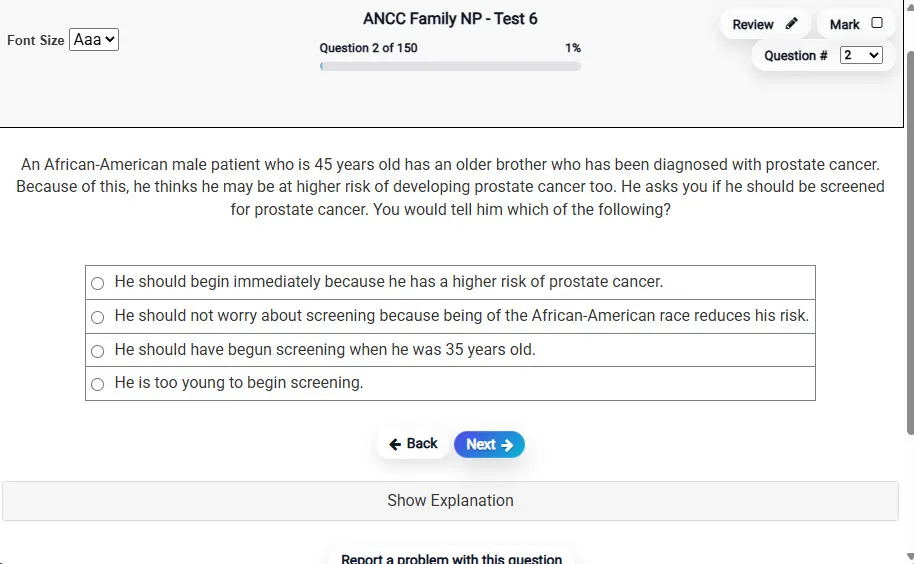
Answering a Question screen – Multiple-choice item view with navigation controls and progress tracker.
Answering a Question Multiple-choice item view with navigation controls and progress tracker.

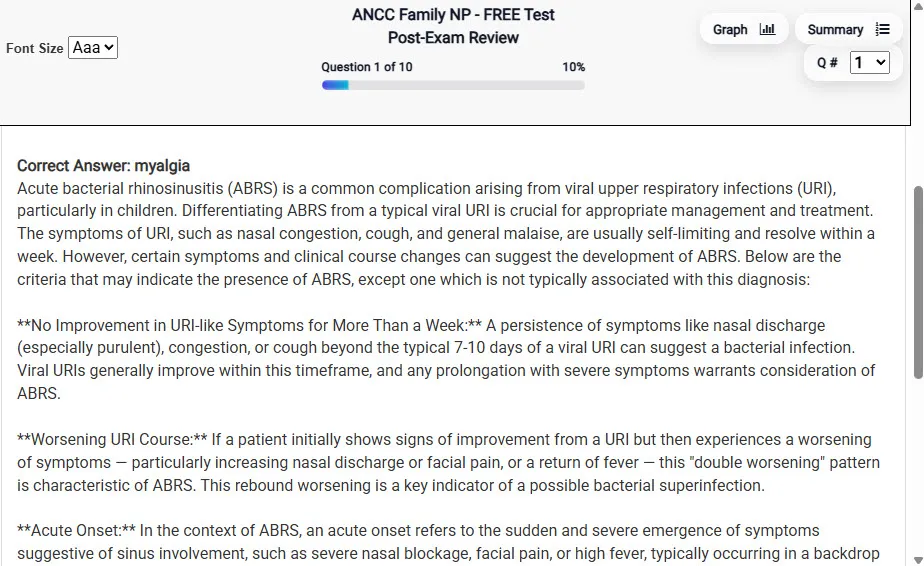
                           Detailed Explanation screen – 
                         Review mode showing chosen answer and rationale and references.
Detailed Explanation Review mode showing chosen answer and rationale and references.

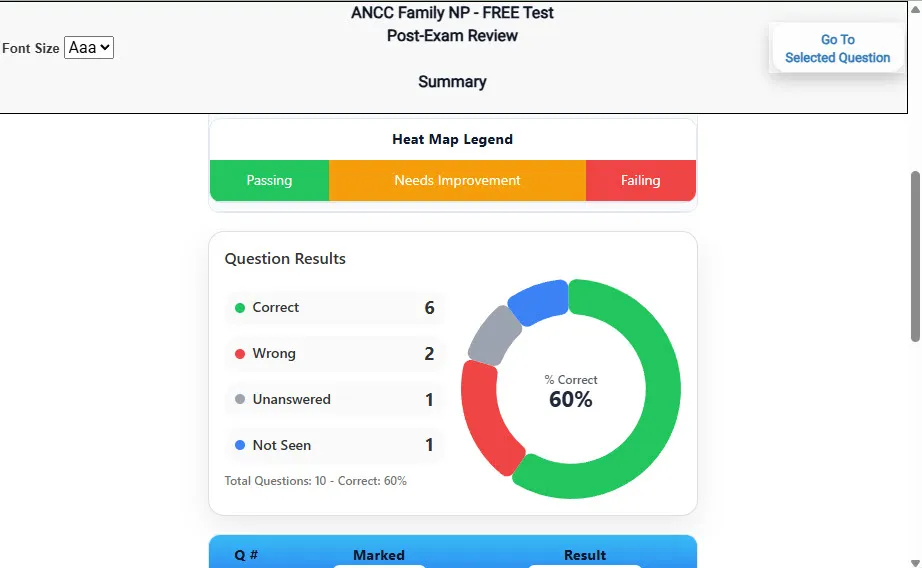
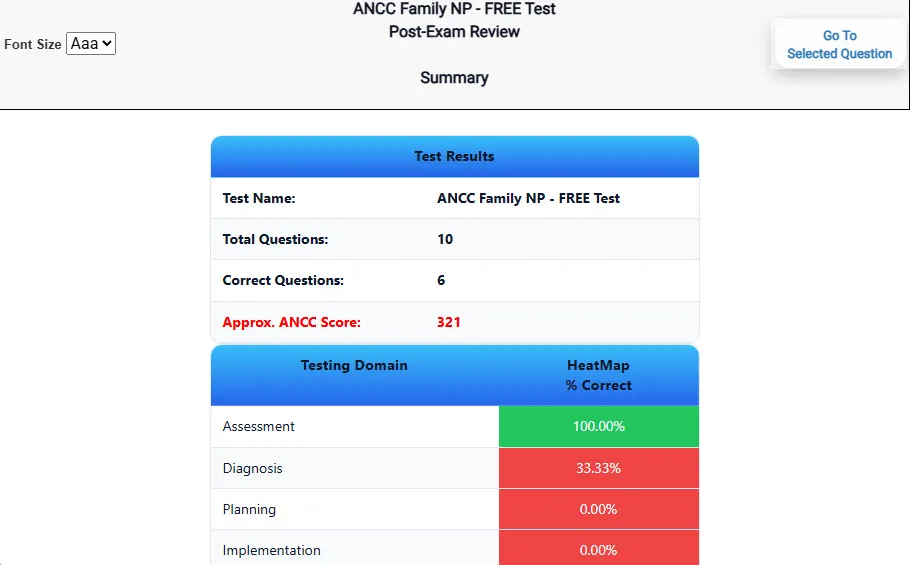
                           Review Summary 1 screen – 
                         Summary with counts for correct/wrong/unanswered and not seen items.
Review Summary 1 Summary with counts for correct/wrong/unanswered and not seen items.

                           Review Summary 2 screen – 
                         Advanced summary with category/domain breakdown and performance insights.
Review Summary 2 Advanced summary with category/domain breakdown and performance insights.

What Each Screen Shows

Answer Question Screen

  • Clean multiple-choice interface with progress bar.
  • Mark for review feature.
  • Matches real test pacing.

Detailed Explanation

  • Correct answer plus rationale.
  • Key concepts and guidelines highlighted.
  • Move between questions to fill knowledge gaps.

Review Summary 1

  • Overall results with total questions and scaled score.
  • Domain heatmap shows strengths and weaknesses.
  • Quick visual feedback on study priorities.

Review Summary 2

  • Chart of correct, wrong, unanswered, not seen.
  • Color-coded results for easy review.
  • Links back to missed items.

Top 10 Reasons to Use Exam Edge for your NYSTCE CST Literacy Exam Prep

  1. Focused on the NYSTCE CST Literacy Exam

    Our practice tests are built specifically for the NYSTCE CST Literacy exam — every question mirrors the real topics, format, and difficulty so you're studying exactly what matters.

  2. Real Exam Simulation

    We match the per-question time limits and pressure of the actual NYSTCE exam, so test day feels familiar and stress-free.

  3. 15 Full Practice Tests & 1,500 Unique Questions

    You'll have more than enough material to master every NYSTCE CST Literacy concept — no repeats, no fluff.

  4. Lower Cost Than a Retake

    Ordering 5 practice exams costs less than retaking the NYSTCE CST Literacy exam after a failure. One low fee could save you both time and money.

  5. Flexible Testing

    Need to step away mid-exam? Pick up right where you left off — with your remaining time intact.

  6. Instant Scoring & Feedback

    See your raw score and an estimated NYSTCE CST Literacy score immediately after finishing each practice test.

  7. Detailed Explanations for Every Question

    Review correct and incorrect answers with clear, step-by-step explanations so you truly understand each topic.

  8. Trusted & Accredited

    We're fully accredited by the Better Business Bureau and uphold the highest standards of trust and transparency.

  9. Web-Based & Always Available

    No software to install. Access your NYSTCE CST Literacy practice exams 24/7 from any computer or mobile device.

  10. Expert Support When You Need It

    Need extra help? Our specialized tutors are highly qualified and ready to support your NYSTCE exam prep.


Pass the NYSTCE CST Literacy Exam with Realistic Practice Tests from Exam Edge

Preparing for your upcoming NYSTCE CST Literacy (065) Certification Exam can feel overwhelming — but the right practice makes all the difference. Exam Edge gives you the tools, structure, and confidence to pass on your first try. Our online practice exams are built to match the real NYSTCE CST Literacy exam in content, format, and difficulty.

  • 📝 15 NYSTCE CST Literacy Practice Tests: Access 15 full-length exams with 100 questions each, covering every major NYSTCE CST Literacy topic in depth.
  • Instant Online Access: Start practicing right away — no software, no waiting.
  • 🧠 Step-by-Step Explanations: Understand the reasoning behind every correct answer so you can master NYSTCE CST Literacy exam concepts.
  • 🔄 Retake Each Exam Up to 4 Times: Build knowledge through repetition and track your improvement over time.
  • 🌐 Web-Based & Available 24/7: Study anywhere, anytime, on any device.
  • 🧘 Boost Your Test-Day Confidence: Familiarity with the NYSTCE format reduces anxiety and helps you perform under pressure.

These NYSTCE CST Literacy practice exams are designed to simulate the real testing experience by matching question types, timing, and difficulty level. This approach helps you get comfortable not just with the exam content, but also with the testing environment, so you walk into your exam day focused and confident.


Exam Edge NYSTCE Reviews


Not a user friendly experience

Amelia , Rochester, New York

Didn't really reflect the questions that were on the test for the most part. Also, they totally got the format of the constructed response question wrong, which never changes. Overall OK if you have nothing else, but definitely not worth the price they charge in my opinion.

Randy , Queens, New York

It was a good test run. Now I know what to expect and what I need to study.

Timothy , Eden, New York

The experience was very practical and I did well.

Trina , Silver Spring , MD

Very easy to navigate.

Collene , Silver Spring , MD

Exam Edge was terrific. Even better than I hoped. Just completing and reviewing the tests are a great learning experience. I can't wait to take the certification test. Tom S.

Thomas , Port Washington, NY


NYSTCE CST Literacy Aliases Test Name

Here is a list of alternative names used for this exam.

  • NYSTCE CST Literacy
  • NYSTCE CST Literacy test
  • NYSTCE CST Literacy Certification Test
  • NYSTCE
  • NYSTCE 065
  • 065 test
  • NYSTCE CST Literacy (065)
  • CST Literacy certification