This is the content of the pop-over!

ServSafe Practice Tests for Food Handlers


ServSafe Food Handler  product image
(5.0)
Based on 20 Reviews

  • Real Exam Simulation: Timed questions and matching content build comfort for your ServSafe Food Handler test day.
  • Instant, 24/7 Access: Web-based ServSafe Food Handler practice exams with no software needed.
  • Clear Explanations: Step-by-step answers and explanations for your ServSafe exam to strengthen understanding.
  • Boosted Confidence: Reduces anxiety and improves test-taking skills to ace your ServSafe Food Handler .

Featured on

ServSafe Food Handler Online Practice Test Bundles

BEST VALUE
20 practice tests

$174.00

$599.00

SAVE $425

Only $8.70 per test!

  • 100% Pass Guarantee
  • 20 online practice tests
  • 40 questions per test
  • Bonus: 100 Flash Cards + Study Guide
  • Instant access
  • Detailed Explanations
  • Practice tests never expire
  • Timed, untimed, or study guide mode
MOST POPULAR
10 practice tests

$99.50

$299.50

SAVE $200

Only $9.95 per test!

  • 10 online practice tests
  • 40 questions per test
  • Bonus: 100 Flash Cards + Study Guide
  • Instant access
  • Detailed Explanations
  • Practice tests never expire
  • Timed, untimed, or study guide mode
5 practice tests

$59.75

$149.75

SAVE $90

Only $11.95 per test!

  • 5 online practice tests
  • 40 questions per test
  • Bonus: 100 Flash Cards
  • Instant access
  • Detailed Explanations
  • Practice tests never expire
  • Timed, untimed, or study guide mode
1 practice test

$29.95

  • 1 online practice test
  • 40 questions per test
  • Instant access
  • Detailed Explanations
  • Practice tests never expire
  • Timed, untimed, or study guide mode
MOST FLEXIBLE
Question Bank

As low as $59.95

200 Questions

Choose 1, 3, 6, or 12 months
A second login is required.

  • Exam Edge content in a powerful question bank
  • Customize Tests
  • Multiple Test & Flash Card Modes
  • Track performance over time
  • Instant access
  • Detailed Explanations
Quick Select
Tap to choose a bundle

** All Prices are in US Dollars (USD) **


ServSafe Food Handler () Shortcuts


Understanding the exact breakdown of the ServSafe Food Handler test will help you know what to expect and how to most effectively prepare. The ServSafe Food Handler has 40 multiple-choice questions . The exam will be broken down into the sections below:

ServSafe Food Handler Exam Blueprint
Domain Name % Number of
Questions
Preventing Contamination and Cross-Contamination 19% 8
Ensuring Personal Hygiene and Employee Health 18% 7
Actively Managing Controls in a Food Establishment 16% 6
Monitoring the Flow of Foods 13% 5
Ensuring Product Time and Temperature 14% 6
Conducting Cleaning and Sanitizing 11% 4
Managing the Physical Facility Design and Maintenance 6% 2
Preventing and Controlling Pests (Insects/Rodents) 4% 2

ServSafe Food Handler Study Tips by Domain

  • Keep raw animal foods separated from ready-to-eat foods at all times—store raw meat, poultry, and seafood below produce and cooked items to prevent drips (red flag: raw juices in a cooler).
  • Use separate, labeled cutting boards/utensils for raw vs. ready-to-eat foods, or wash/rinse/sanitize between tasks (common trap: “quick wipe” instead of full sanitizing).
  • Prevent allergen cross-contact by using dedicated equipment and clean gloves/utensils for allergen-free orders (priority rule: never reuse a wipe cloth on allergen residues).
  • Never use bare hands with ready-to-eat food—use gloves, deli tissue, or utensils, and change gloves when switching tasks (red flag: same gloves touch phone/face then food).
  • Keep chemicals and cleaners away from food and food-contact surfaces—store them in a designated area and never above food (common trap: spray bottles left on prep tables).
  • Use single-use towels or properly sanitized wiping cloths stored in sanitizer solution between uses (threshold cue: if the sanitizer bucket is missing/dirty, treat the cloth as contaminated).
  • Wash hands in a designated handwashing sink for at least 20 seconds with soap and warm water, then dry with a single-use towel; red flag: using a prep sink or rinsing without soap counts as no handwashing.
  • Wash hands at key times—before starting work, after using the restroom, after handling raw meat/seafood/poultry, after touching face/hair/body, and after taking out trash; common trap: changing gloves without washing hands first.
  • Exclude or restrict sick employees based on symptoms; priority rule: vomiting or diarrhea means do not work with food and report to the manager immediately.
  • Cover cuts and wounds with an impermeable bandage and wear a single-use glove or finger cot over the bandage; contraindication: uncovered or draining wounds cannot be near exposed food.
  • Maintain clean personal hygiene—clean uniforms, restrained hair, and minimal jewelry; red flag: wearing a plain band on the hand is typically the only acceptable hand jewelry.
  • Use gloves correctly as a barrier, not a substitute for handwashing; common trap: handling money/phones then touching ready-to-eat food with the same gloves.
  • Use active managerial control to prevent the “Big 6” risk factors—time-temperature abuse, poor personal hygiene, cross-contamination, purchasing from unsafe sources, contaminated equipment, and food from unsafe sources; red flag: relying on “we’ve always done it this way” instead of written procedures.
  • Apply HACCP thinking by identifying critical control points (CCPs) where you can prevent or eliminate hazards; common trap: monitoring too late (after service) rather than at receiving, prep, cooking, cooling, and holding.
  • Establish standard operating procedures (SOPs) for routine tasks (handwashing, glove use, sanitizer setup, thermometer use) and make them easy to follow; priority rule: SOPs must be specific enough that a new hire can do the task correctly.
  • Train and verify—managers must observe and correct behaviors in real time (e.g., checking temps, stopping bare-hand contact with RTE food); red flag: training without follow-up coaching or documentation.
  • Keep simple records to prove control (temperature logs, cleaning schedules, corrective actions); common trap: “pencil-whipping” logs—writing numbers without actually measuring.
  • When monitoring shows a loss of control, take immediate corrective action and prevent recurrence (reheat, discard, re-cool properly, re-sanitize, retrain); threshold cue: if you can’t verify safety, discard the food.
  • Keep food moving in one direction from receiving → storage → prep → cook → hold → serve; red flag: raw and ready-to-eat items share the same prep space or equipment without cleaning and sanitizing in between.
  • At receiving, reject time/temperature abused items and damaged packaging; common trap: accepting refrigerated foods delivered warm or with leaking, torn, or swollen packages.
  • Store foods to prevent cross-contamination—ready-to-eat above raw, and raw poultry below raw ground meats below raw seafood below whole cuts; priority rule: label and date items so FIFO is actually possible.
  • During preparation, minimize time in the temperature danger zone; red flag: thawing or prepping large batches at room temperature instead of under refrigeration, running water, microwave, or as part of cooking.
  • After cooking, control the next step immediately—hold hot foods hot and cold foods cold, or cool and reheat correctly; common trap: leaving food on the counter to “cool down” without shallow pans and rapid cooling steps.
  • During service, protect food from contamination with clean utensils, barriers, and proper handling; red flag: bare-hand contact with ready-to-eat food or using the same utensil for raw and ready-to-eat items.
  • Keep cold TCS food at 41°F (5°C) or lower and hot TCS food at 135°F (57°C) or higher; red flag: any TCS food sitting in the 41–135°F (5–57°C) danger zone.
  • Cook TCS foods to required minimum internal temperatures with a calibrated thermometer (e.g., poultry 165°F, ground meats 155°F, seafood/steaks 145°F); common trap: guessing doneness by color or time alone.
  • Cool hot TCS food from 135°F to 70°F within 2 hours and from 70°F to 41°F within 4 more hours; priority rule: if it hasn’t reached 70°F in 2 hours, reheat to 165°F for 15 seconds and start cooling again or discard.
  • Reheat TCS food for hot holding to 165°F for 15 seconds within 2 hours; contraindication: do not use hot-holding equipment (steam table/warmer) to reheat.
  • Thaw safely in a cooler at 41°F or lower, under running water at 70°F or lower, in the microwave if cooked immediately, or as part of the cooking process; red flag: thawing on the counter at room temperature.
  • Use time as a control only if procedures are followed (cold held up to 6 hours never above 70°F; hot held up to 4 hours); common trap: failing to label the start time and discard time.
  • Clean first, then sanitize; sanitizer on dirty surfaces doesn’t work—red flag: wiping with sanitizer without washing/rinsing beforehand.
  • Use the right sanitizer concentration and contact time (test strips required); common trap: mixing “stronger is better” which can be unsafe and still ineffective.
  • Wash–rinse–sanitize–air-dry for food-contact items; priority rule: never towel-dry sanitized items because it can recontaminate them.
  • Dish machine vs. three-compartment sink steps must match the method; red flag: skipping the rinse step when using a chemical sanitizer in the sink.
  • Store wiping cloths in sanitizer solution between uses and keep separate cloths for food-contact vs. floors; common trap: using the same rag on prep tables and then on the floor.
  • Clean and sanitize food-contact surfaces after each task, when switching foods (especially raw to ready-to-eat), and at least every 4 hours if in constant use; red flag: “looks clean” is treated as “safe.”
  • Keep the facility designed to prevent contamination—smooth, nonabsorbent, easily cleanable floors/walls/ceilings and sealed gaps; red flag: cracked tiles, peeling paint, or exposed insulation over prep areas.
  • Maintain plumbing and drainage to avoid backflow and leaks; common trap: storing items under leaky pipes or ignoring slow drains that can contaminate food-contact surfaces.
  • Provide adequate lighting with shields or shatter-resistant bulbs; red flag: unshielded bulbs over food or prep areas (risk of glass contamination).
  • Ensure proper ventilation in kitchens and restrooms to control grease, smoke, and moisture; priority rule: fix broken hoods/fans quickly because condensation can drip onto food and surfaces.
  • Manage waste and recycling areas to minimize odors and pests—clean, covered, and away from doors; red flag: overflowing dumpsters or open trash containers near entrances.
  • Maintain equipment and handwashing stations in good working order (hot/cold running water, soap, paper towels); common trap: blocked or repurposed hand sinks that employees can’t access when needed.
  • Inspect for pests daily and use a log to note sightings, droppings, gnaw marks, and nesting materials—one confirmed sign is enough to trigger action. Red flag: seeing pests during daylight often indicates a larger infestation.
  • Block entry by sealing gaps around pipes, doors, and windows; install door sweeps and keep exterior doors closed. Common trap: leaving a delivery door propped open “just for a minute” invites flies and rodents.
  • Remove food and water sources by storing food at least 6 inches off the floor, in sealed containers, and keeping dumpsters closed and clean. Priority rule: clean up spills immediately because moisture plus crumbs can sustain pests.
  • Eliminate harborage by keeping storage areas organized, removing clutter and cardboard, and rotating stock (FIFO). Red flag: items stored against walls or in unused equipment create hidden nesting sites.
  • Work with a licensed pest control operator and follow label directions for any pesticides; keep chemicals away from food and food-contact surfaces. Contraindication: never spray pesticides around exposed food or during food prep/service.
  • Respond fast to activity: stop using contaminated items, clean and sanitize affected areas, and notify a manager for corrective action and possible product discard. Common trap: trying to “handle it later” instead of isolating and documenting the issue immediately.

Built to Fit Into Your Busy Life

Everything you need to prepare with confidence—without wasting a minute.

Three Study Modes

Timed, No Time Limit, or Explanation mode.

Actionable Analytics

Heatmaps and scaled scores highlight weak areas.

High-Yield Rationales

Concise explanations emphasize key concepts.

Realistic Interface

Matches the feel of the actual exam environment.

Accessible by Design

Clean layout reduces cognitive load.

Anytime, Anywhere

Web-based access 24/7 on any device.
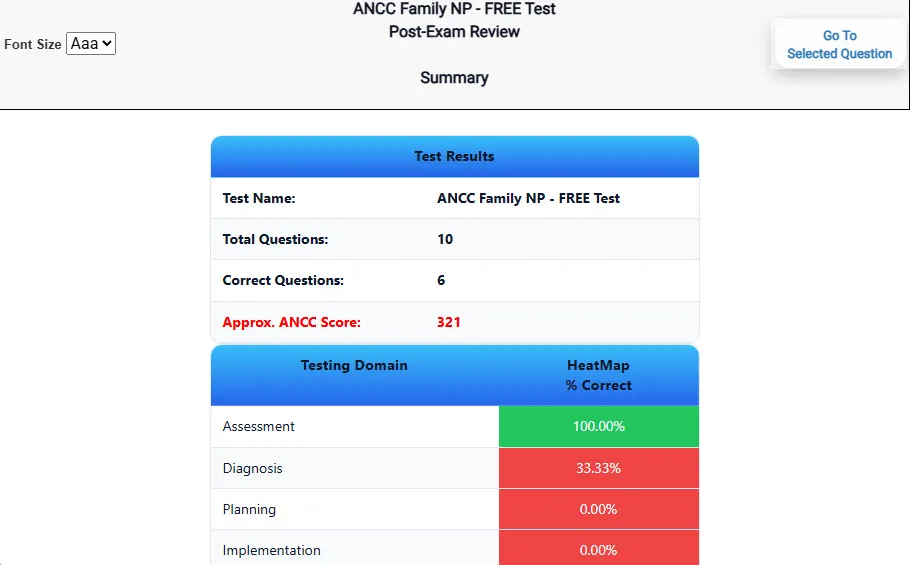
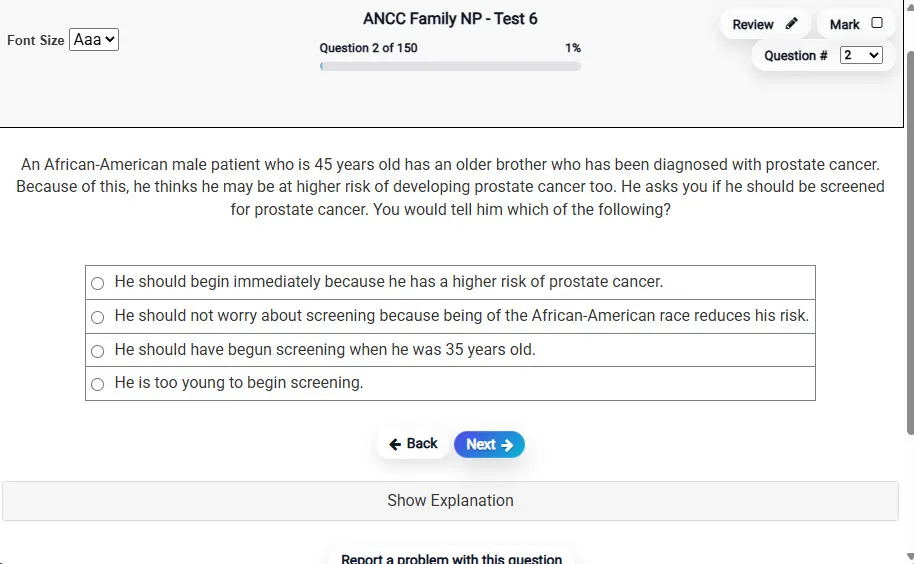
Answering a Question screen – Multiple-choice item view with navigation controls and progress tracker.
Answering a Question Multiple-choice item view with navigation controls and progress tracker.

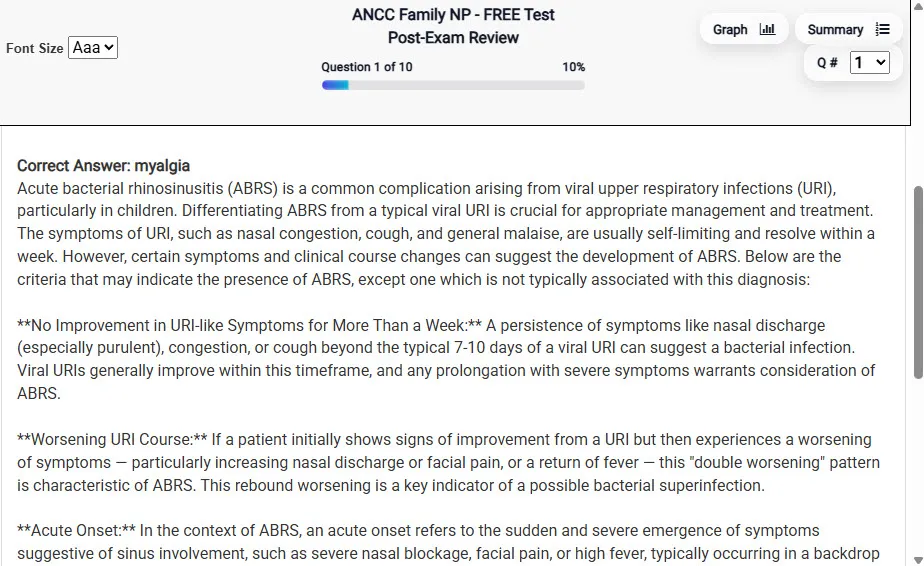
                           Detailed Explanation screen – 
                         Review mode showing chosen answer and rationale and references.
Detailed Explanation Review mode showing chosen answer and rationale and references.

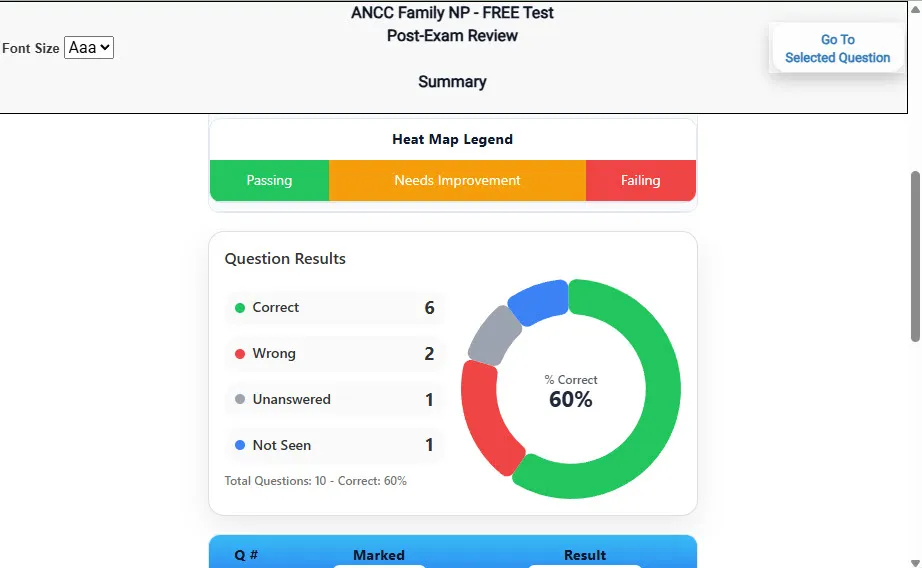
                           Review Summary 1 screen – 
                         Summary with counts for correct/wrong/unanswered and not seen items.
Review Summary 1 Summary with counts for correct/wrong/unanswered and not seen items.

                           Review Summary 2 screen – 
                         Advanced summary with category/domain breakdown and performance insights.
Review Summary 2 Advanced summary with category/domain breakdown and performance insights.

What Each Screen Shows

Answer Question Screen

  • Clean multiple-choice interface with progress bar.
  • Mark for review feature.
  • Matches real test pacing.

Detailed Explanation

  • Correct answer plus rationale.
  • Key concepts and guidelines highlighted.
  • Move between questions to fill knowledge gaps.

Review Summary 1

  • Overall results with total questions and scaled score.
  • Domain heatmap shows strengths and weaknesses.
  • Quick visual feedback on study priorities.

Review Summary 2

  • Chart of correct, wrong, unanswered, not seen.
  • Color-coded results for easy review.
  • Links back to missed items.

Top 10 Reasons to Use Exam Edge for your ServSafe Food Handler Exam Prep

  1. Focused on the ServSafe Food Handler Exam

    Our practice tests are built specifically for the ServSafe Food Handler exam — every question mirrors the real topics, format, and difficulty so you're studying exactly what matters.

  2. Real Exam Simulation

    We match the per-question time limits and pressure of the actual ServSafe exam, so test day feels familiar and stress-free.

  3. 20 Full Practice Tests & 800 Unique Questions

    You'll have more than enough material to master every ServSafe Food Handler concept — no repeats, no fluff.

  4. Lower Cost Than a Retake

    Ordering 5 practice exams costs less than retaking the ServSafe Food Handler exam after a failure. One low fee could save you both time and money.

  5. Flexible Testing

    Need to step away mid-exam? Pick up right where you left off — with your remaining time intact.

  6. Instant Scoring & Feedback

    See your raw score and an estimated ServSafe Food Handler score immediately after finishing each practice test.

  7. Detailed Explanations for Every Question

    Review correct and incorrect answers with clear, step-by-step explanations so you truly understand each topic.

  8. Trusted & Accredited

    We're fully accredited by the Better Business Bureau and uphold the highest standards of trust and transparency.

  9. Web-Based & Always Available

    No software to install. Access your ServSafe Food Handler practice exams 24/7 from any computer or mobile device.

  10. Expert Support When You Need It

    Need extra help? Our specialized tutors are highly qualified and ready to support your ServSafe exam prep.


Pass the ServSafe Food Handler Exam with Realistic Practice Tests from Exam Edge

Preparing for your upcoming ServSafe Food Handler () Certification Exam can feel overwhelming — but the right practice makes all the difference. Exam Edge gives you the tools, structure, and confidence to pass on your first try. Our online practice exams are built to match the real ServSafe Food Handler exam in content, format, and difficulty.

  • 📝 20 ServSafe Food Handler Practice Tests: Access 20 full-length exams with 40 questions each, covering every major ServSafe Food Handler topic in depth.
  • Instant Online Access: Start practicing right away — no software, no waiting.
  • 🧠 Step-by-Step Explanations: Understand the reasoning behind every correct answer so you can master ServSafe Food Handler exam concepts.
  • 🔄 Retake Each Exam Up to 4 Times: Build knowledge through repetition and track your improvement over time.
  • 🌐 Web-Based & Available 24/7: Study anywhere, anytime, on any device.
  • 🧘 Boost Your Test-Day Confidence: Familiarity with the ServSafe format reduces anxiety and helps you perform under pressure.

These ServSafe Food Handler practice exams are designed to simulate the real testing experience by matching question types, timing, and difficulty level. This approach helps you get comfortable not just with the exam content, but also with the testing environment, so you walk into your exam day focused and confident.


Exam Edge ServSafe Reviews


I cannot thank you enough. Because of your test practice, I just passed my exam! After practicing 11 exams, I was ready for the exam. The exam was so easy for me because of you. Thank you!

Dania,D, Orlando, FL,


ServSafe Food Handler Aliases Test Name

Here is a list of alternative names used for this exam.

  • ServSafe Food Handler
  • ServSafe Food Handler test
  • ServSafe Food Handler Certification Test
  • ServSafe
  • ServSafe
  • test
  • ServSafe Food Handler ()
  • Food Handler certification