This is the content of the pop-over!

NYSTCE CST Multi-subject: Teachers Of Early Childhood EC-2 - Math (212) Practice Tests & Test Prep by Exam Edge


NYSTCE CST Multi-subject Teachers Of  Early Childhood EC-2 - Math  product image
(4.8)
Based on 34 Reviews

  • Real Exam Simulation: Timed questions and matching content build comfort for your NYSTCE CST Multi-subject: Teachers Of Early Childhood EC-2 - Math test day.
  • Instant, 24/7 Access: Web-based NYSTCE CST Multi-subject Teachers Of Early Childhood EC-2 - Math practice exams with no software needed.
  • Clear Explanations: Step-by-step answers and explanations for your NYSTCE exam to strengthen understanding.
  • Boosted Confidence: Reduces anxiety and improves test-taking skills to ace your NYSTCE CST Multi-subject Teachers Of Early Childhood EC-2 - Math (212).

Featured on

NYSTCE CST Multi-subject Teachers Of Early Childhood EC-2 - Math Online Practice Test Bundles

BEST VALUE
20 practice tests

$174.00

$799.00

SAVE $625

Only $8.70 per test!

  • 100% Pass Guarantee
  • 20 online practice tests
  • 40 questions + 1 essay per test
  • Bonus: 100 Flash Cards + Study Guide
  • Instant access
  • Detailed Explanations
  • Practice tests never expire
  • Timed, untimed, or study guide mode
MOST POPULAR
10 practice tests

$99.50

$399.50

SAVE $300

Only $9.95 per test!

  • 10 online practice tests
  • 40 questions + 1 essay per test
  • Bonus: 100 Flash Cards + Study Guide
  • Instant access
  • Detailed Explanations
  • Practice tests never expire
  • Timed, untimed, or study guide mode
5 practice tests

$69.75

$199.75

SAVE $130

Only $13.95 per test!

  • 5 online practice tests
  • 40 questions + 1 essay per test
  • Bonus: 100 Flash Cards
  • Instant access
  • Detailed Explanations
  • Practice tests never expire
  • Timed, untimed, or study guide mode
1 practice test

$39.95

  • 1 online practice test
  • 40 questions + 1 essay per test
  • Instant access
  • Detailed Explanations
  • Practice tests never expire
  • Timed, untimed, or study guide mode
Quick Select
Tap to choose a bundle

** All Prices are in US Dollars (USD) **


NYSTCE CST Multi-subject: Teachers Of Early Childhood EC-2 - Math (212) Resources

Jump to the section you need most.

Understanding the exact breakdown of the NYSTCE CST Multi-subject Teachers Of Early Childhood EC-2 - Math test will help you know what to expect and how to most effectively prepare. The NYSTCE CST Multi-subject Teachers Of Early Childhood EC-2 - Math has 40 multiple-choice questions and 1 essay questions. The exam will be broken down into the sections below:

NYSTCE CST Multi-subject Teachers Of Early Childhood EC-2 - Math Exam Blueprint
Domain Name % Number of
Questions
Number and Operations 20% 8
Operations and Algebraic Thinking 30% 12
Measurement - Geometry Data 20% 8
Instruction in Mathematics 10% 4
Analysis - Synthesis Application 20% 8

NYSTCE CST Multi-subject Teachers Of Early Childhood EC-2 - Math Study Tips by Domain

  • Fluency expectation: demonstrate quick recall of addition/subtraction within 20 and use place-value strategies for multi-digit computation; red flag is relying on counting-all when a composed/decomposed strategy is available.
  • Place value through hundreds (and beyond as appropriate) includes grouping into tens/ones and comparing numbers with >, <, =; common trap is treating the digit as the value (e.g., thinking 62 < 58 because 2 < 8).
  • Understand and model standard algorithms as extensions of place value (regrouping/borrowing/carrying); priority rule: always justify regrouping with base-ten reasoning, not “crossing out and putting a 1” without meaning.
  • Fractions as equal parts of a whole and as numbers on a number line (halves, thirds, fourths, etc.); red flag is comparing by denominator alone (e.g., claiming 1/8 > 1/4 because 8 > 4).
  • Connect fractions to fair sharing and to multiplication/division contexts (e.g., partitioning sets and shapes); common trap is using unequal partitions or mixing “number of parts” with “size of parts.”
  • Interpret and compute with whole-number division as equal groups/arrays and relate it to multiplication; threshold cue: distinguish remainder interpretations (leftover vs. need another group) because the context determines whether to round up, down, or keep the remainder.
  • Emphasize the meanings of operations with concrete contexts (join/separate, put together/take apart, compare) before symbols; red flag: teaching “key words” (e.g., “altogether” always means add) as a shortcut.
  • Model unknowns in different positions (e.g., 8 + ? = 11, ? + 3 = 10, 12 – ? = 7) using drawings/objects; common trap: only giving problems where the unknown is the final result.
  • Teach properties through structure (commutative/associative for addition, distributive as equal groups/arrays) and have students justify with examples; red flag: applying commutativity to subtraction/division.
  • Build fluency with addition/subtraction within 20 via strategies (make ten, doubles/near doubles, count on/back) tied to representations; priority rule: strategy explanations matter more than speed-only timed drills.
  • Develop equal groups and arrays as foundations for multiplication/division and early patterns, even if formal facts aren’t required; common trap: introducing multiplication solely as repeated addition without linking to grouping/arrays.
  • Use true/false and open number sentences (e.g., 7 + 4 = 6 + 5, 9 + 3 = 9 + __) to build equivalence; red flag: treating the equals sign as “the answer is” rather than “is the same as.”
  • Convert within a measurement system using place-value reasoning (e.g., 1 ft = 12 in) and label units — red flag: students writing correct numbers but mismatching units (in vs. cm).
  • Use direct comparison and nonstandard units (paper clips, cubes) before standard tools — common trap: switching unit size mid-task, which invalidates the comparison.
  • Teach time as an interval and as clock reading (hour/half-hour/quarter-hour) — priority rule: anchor to the minute hand first because it determines “past/to” and fraction-of-hour language.
  • Develop geometry through composing/decomposing shapes and describing attributes (sides, corners, faces) — contraindication: defining shapes by orientation (e.g., calling a rotated square a “diamond”).
  • Model spatial reasoning with position and movement words (above, below, next to, behind, left/right) — common trap: left/right confusion, so use the child’s perspective and a consistent reference point.
  • Represent and interpret data with object graphs/picture graphs and simple bar graphs — red flag: counting pictures without applying the key (e.g., one symbol = 2) or mixing categories.
  • Plan instruction around coherent progressions (concrete → pictorial → abstract) aligned to NYS learning standards; red flag: jumping to algorithms before students demonstrate strategy-based understanding.
  • Elicit and use evidence of student thinking with targeted questions and quick checks (e.g., “How do you know?”); common trap: accepting correct answers without requiring justification or representation.
  • Select manipulatives and visual models (ten-frames, number lines, base-ten blocks) that match the learning goal; contraindication: letting tools become the goal rather than explicitly connecting them to symbols and language.
  • Differentiate with purposeful scaffolds (sentence frames, worked examples, strategic grouping) while maintaining grade-level rigor; red flag: reducing cognitive demand by changing the task instead of the support.
  • Address misconceptions proactively (e.g., bigger number means bigger fraction; counting squares vs. side lengths) through error analysis; priority rule: treat misconceptions as patterns to diagnose, not one-off mistakes to correct.
  • Use math-specific language routines (define, compare, justify) and support multilingual learners with visuals and precise vocabulary; common trap: over-relying on keywords (e.g., “altogether” means add) instead of reasoning about the situation.
  • When modeling with mathematics, translate a real situation into an equation or diagram and then interpret the result back in context; red flag: accepting an answer with impossible units (e.g., “3 apples” for a length).
  • Choose and justify a problem-solving strategy (act it out, draw a picture, use objects, make a table) that matches the numbers and the question; common trap: switching strategies midstream without keeping the same meaning for each symbol or object.
  • Analyze student work for the misconception behind an error (e.g., counting all instead of counting on, treating the equals sign as “the answer comes next”); priority rule: identify the thinking first, then the fix.
  • Synthesize multiple representations (ten-frames, number lines, equations, story problems) to show the same relationship; red flag: a correct equation that does not match the story’s action (joining vs. separating).
  • Check reasonableness using estimation or benchmark numbers (0, 1, 5, 10, doubles) before finalizing an answer; common trap: not noticing when the result should be larger/smaller than the starting amount.
  • Communicate mathematical reasoning clearly using precise language (more/less, equal, same as, total, left) and labels; contraindication: vague explanations like “I just knew” without referencing quantities or steps.


Built to Fit Into Your Busy Life

Everything you need to prepare with confidence—without wasting a minute.

Three Study Modes

Timed, No Time Limit, or Explanation mode.

Actionable Analytics

Heatmaps and scaled scores highlight weak areas.

High-Yield Rationales

Concise explanations emphasize key concepts.

Realistic Interface

Matches the feel of the actual exam environment.

Accessible by Design

Clean layout reduces cognitive load.

Anytime, Anywhere

Web-based access 24/7 on any device.
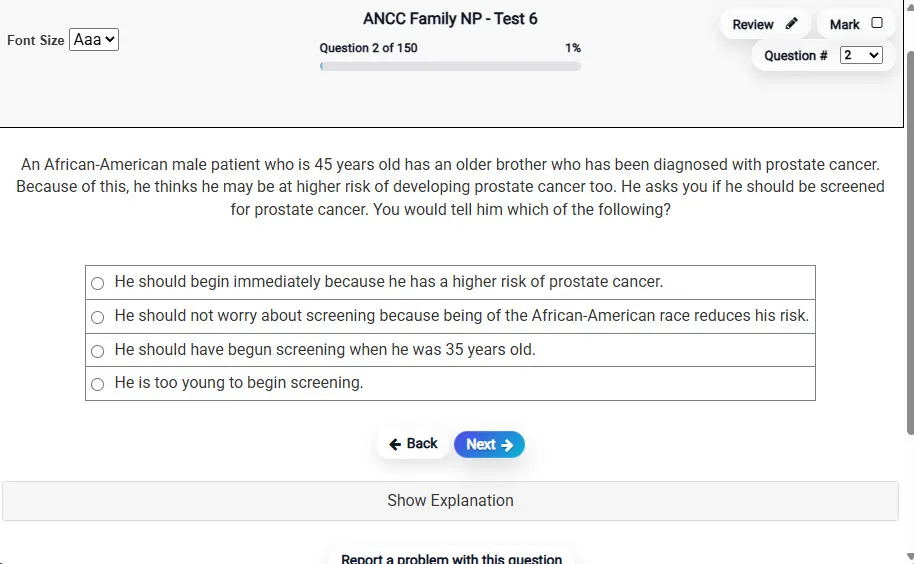
Answering a Question screen – Multiple-choice item view with navigation controls and progress tracker.
Answering a Question Multiple-choice item view with navigation controls and progress tracker.

                           Detailed Explanation screen – 
                         Review mode showing chosen answer and rationale and references.
Detailed Explanation Review mode showing chosen answer and rationale and references.

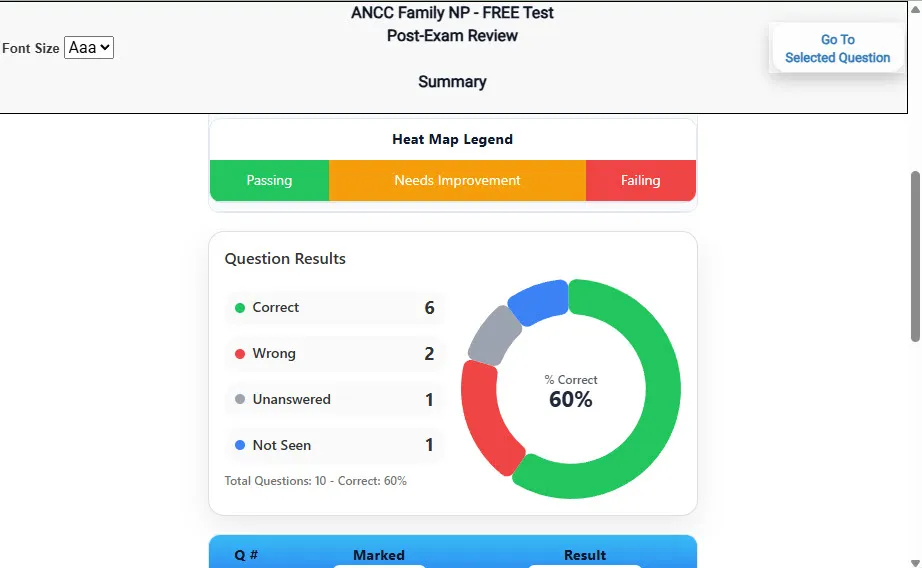
                           Review Summary 1 screen – 
                         Summary with counts for correct/wrong/unanswered and not seen items.
Review Summary 1 Summary with counts for correct/wrong/unanswered and not seen items.

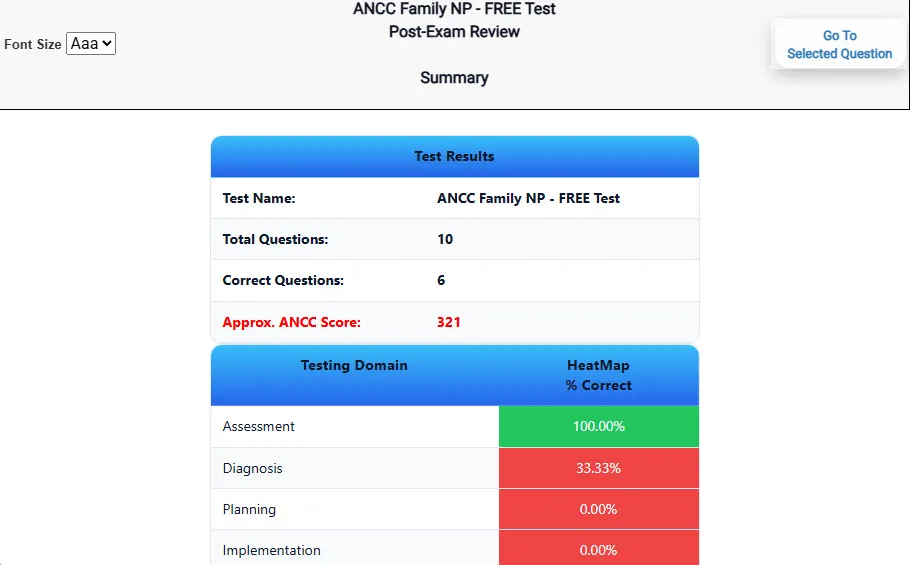
                           Review Summary 2 screen – 
                         Advanced summary with category/domain breakdown and performance insights.
Review Summary 2 Advanced summary with category/domain breakdown and performance insights.

What Each Screen Shows

Answer Question Screen

  • Clean multiple-choice interface with progress bar.
  • Mark for review feature.
  • Matches real test pacing.

Detailed Explanation

  • Correct answer plus rationale.
  • Key concepts and guidelines highlighted.
  • Move between questions to fill knowledge gaps.

Review Summary 1

  • Overall results with total questions and scaled score.
  • Domain heatmap shows strengths and weaknesses.
  • Quick visual feedback on study priorities.

Review Summary 2

  • Chart of correct, wrong, unanswered, not seen.
  • Color-coded results for easy review.
  • Links back to missed items.

Top 10 Reasons to Use Exam Edge for your NYSTCE CST Multi-subject Teachers Of Early Childhood EC-2 - Math Exam Prep

  1. Focused on the NYSTCE CST Multi-subject Teachers Of Early Childhood EC-2 - Math Exam

    Our practice tests are built specifically for the NYSTCE CST Multi-subject: Teachers Of Early Childhood EC-2 - Math exam — every question mirrors the real topics, format, and difficulty so you're studying exactly what matters.

  2. Real Exam Simulation

    We match the per-question time limits and pressure of the actual NYSTCE exam, so test day feels familiar and stress-free.

  3. 20 Full Practice Tests & 820 Unique Questions

    You'll have more than enough material to master every NYSTCE CST Multi-subject: Teachers Of Early Childhood EC-2 - Math concept — no repeats, no fluff.

  4. Lower Cost Than a Retake

    Ordering 5 practice exams costs less than retaking the NYSTCE CST Multi-subject Teachers Of Early Childhood EC-2 - Math exam after a failure. One low fee could save you both time and money.

  5. Flexible Testing

    Need to step away mid-exam? Pick up right where you left off — with your remaining time intact.

  6. Instant Scoring & Feedback

    See your raw score and an estimated NYSTCE CST Multi-subject Teachers Of Early Childhood EC-2 - Math score immediately after finishing each practice test.

  7. Detailed Explanations for Every Question

    Review correct and incorrect answers with clear, step-by-step explanations so you truly understand each topic.

  8. Trusted & Accredited

    We're fully accredited by the Better Business Bureau and uphold the highest standards of trust and transparency.

  9. Web-Based & Always Available

    No software to install. Access your NYSTCE CST Multi-subject: Teachers Of Early Childhood EC-2 - Math practice exams 24/7 from any computer or mobile device.

  10. Expert Support When You Need It

    Need extra help? Our specialized tutors are highly qualified and ready to support your NYSTCE exam prep.


Pass the NYSTCE CST Multi-subject Teachers Of Early Childhood EC-2 - Math Exam with Realistic Practice Tests from Exam Edge

Preparing for your upcoming NYSTCE CST Multi-subject Teachers Of Early Childhood EC-2 - Math (212) Certification Exam can feel overwhelming — but the right practice makes all the difference. Exam Edge gives you the tools, structure, and confidence to pass on your first try. Our online practice exams are built to match the real NYSTCE CST Multi-subject: Teachers Of Early Childhood EC-2 - Math exam in content, format, and difficulty.

  • 📝 20 NYSTCE CST Multi-subject Teachers Of Early Childhood EC-2 - Math Practice Tests: Access 20 full-length exams with 41 questions each, covering every major NYSTCE CST Multi-subject Teachers Of Early Childhood EC-2 - Math topic in depth.
  • Instant Online Access: Start practicing right away — no software, no waiting.
  • 🧠 Step-by-Step Explanations: Understand the reasoning behind every correct answer so you can master NYSTCE CST Multi-subject: Teachers Of Early Childhood EC-2 - Math exam concepts.
  • 🔄 Retake Each Exam Up to 4 Times: Build knowledge through repetition and track your improvement over time.
  • 🌐 Web-Based & Available 24/7: Study anywhere, anytime, on any device.
  • 🧘 Boost Your Test-Day Confidence: Familiarity with the NYSTCE format reduces anxiety and helps you perform under pressure.

These NYSTCE CST Multi-subject Teachers Of Early Childhood EC-2 - Math practice exams are designed to simulate the real testing experience by matching question types, timing, and difficulty level. This approach helps you get comfortable not just with the exam content, but also with the testing environment, so you walk into your exam day focused and confident.

Exam Edge NYSTCE Reviews


Thank you, Exam Edge, for helping me pass my NYSTCE CST Multi-subject: Teachers Of Early Childhood EC-2 - Math exam. Your instructors are excellent.

Helen, NY

Not a user friendly experience

Amelia , Rochester, New York

Didn't really reflect the questions that were on the test for the most part. Also, they totally got the format of the constructed response question wrong, which never changes. Overall OK if you have nothing else, but definitely not worth the price they charge in my opinion.

Randy , Queens, New York

It was a good test run. Now I know what to expect and what I need to study.

Timothy , Eden, New York

The experience was very practical and I did well.

Trina , Silver Spring , MD

Very easy to navigate.

Collene , Silver Spring , MD


NYSTCE CST Multi-subject Teachers Of Early Childhood EC-2 - Math Aliases Test Name

Here is a list of alternative names used for this exam.

  • NYSTCE CST Multi-subject Teachers Of Early Childhood EC-2 - Math
  • NYSTCE CST Multi-subject Teachers Of Early Childhood EC-2 - Math test
  • NYSTCE CST Multi-subject Teachers Of Early Childhood EC-2 - Math Certification Test
  • NYSTCE CST Multi-subject: Teachers Of Early Childhood EC-2 - Math test
  • NYSTCE
  • NYSTCE 212
  • 212 test
  • NYSTCE CST Multi-subject Teachers Of Early Childhood EC-2 - Math (212)
  • CST Multi-subject Teachers Of Early Childhood EC-2 - Math certification