This is the content of the pop-over!

Praxis Library Media Specialist (5311) Practice Tests & Test Prep by Exam Edge


Praxis Library Media Specialist  product image
(5.0)
Based on 25 Reviews

  • Real Exam Simulation: Timed questions and matching content build comfort for your Praxis Library Media Specialist test day.
  • Instant, 24/7 Access: Web-based Praxis Library Media Specialist practice exams with no software needed.
  • Clear Explanations: Step-by-step answers and explanations for your Praxis exam to strengthen understanding.
  • Boosted Confidence: Reduces anxiety and improves test-taking skills to ace your Praxis Library Media Specialist (5311).

Featured on

Praxis Library Media Specialist Online Practice Test Bundles

BEST VALUE
15 practice tests

$149.25

$599.25

SAVE $450

Only $9.95 per test!

  • 100% Pass Guarantee
  • 15 online practice tests
  • 120 questions per test
  • Bonus: 100 Flash Cards + Study Guide
  • Instant access
  • Detailed Explanations
  • Practice tests never expire
  • Timed, untimed, or study guide mode
MOST POPULAR
10 practice tests

$99.50

$399.50

SAVE $300

Only $9.95 per test!

  • 10 online practice tests
  • 120 questions per test
  • Bonus: 100 Flash Cards + Study Guide
  • Instant access
  • Detailed Explanations
  • Practice tests never expire
  • Timed, untimed, or study guide mode
5 practice tests

$69.75

$199.75

SAVE $130

Only $13.95 per test!

  • 5 online practice tests
  • 120 questions per test
  • Bonus: 100 Flash Cards
  • Instant access
  • Detailed Explanations
  • Practice tests never expire
  • Timed, untimed, or study guide mode
1 practice test

$39.95

  • 1 online practice test
  • 120 questions per test
  • Instant access
  • Detailed Explanations
  • Practice tests never expire
  • Timed, untimed, or study guide mode
Quick Select
Tap to choose a bundle

** All Prices are in US Dollars (USD) **


Praxis Library Media Specialist (5311) Resources

Jump to the section you need most.

Understanding the exact breakdown of the Praxis Library Media Specialist test will help you know what to expect and how to most effectively prepare. The Praxis Library Media Specialist has 120 multiple-choice questions . The exam will be broken down into the sections below:

Praxis Library Media Specialist Exam Blueprint
Domain Name % Number of
Questions
Program Administration 18% 22
Collection Development 21% 25
Information Access and Delivery 21% 25
Learning and Teaching 28% 34
Professional Development
Leadership Advocacy
12% 14

Praxis Library Media Specialist Study Tips by Domain

  • Align the library program plan to district/state standards and school improvement goals; red flag: activities that can’t be tied to measurable outcomes or curriculum priorities.
  • Use a written budget that covers collections, technology, supplies, and services with clear justifications; common trap: spending heavily on one-time purchases without a sustainability or replacement cycle.
  • Establish and apply selection, reconsideration, and weeding procedures consistently; priority rule: document decisions and follow policy step-by-step to reduce censorship and equity risks.
  • Manage circulation, inventory, and access policies to maximize availability while protecting privacy; red flag: student records or reading histories disclosed beyond legitimate educational interest.
  • Supervise staff and volunteers with defined roles, training, and schedules; common trap: allowing volunteers to handle confidential data or make independent collection decisions.
  • Plan for facilities, safety, and technology operations (layout, traffic flow, emergency procedures, device management); contraindication: ignoring ADA/accessibility needs when rearranging spaces or deploying new tools.
  • Use a written selection policy aligned to curriculum and student needs; red flag: buying based on popularity or vendor bundles without documented criteria.
  • Balance the collection using data (circulation, in-house use, holds, curriculum maps) and fill identified gaps; common trap: equating low checkout with low value for reference, diverse voices, or new programs.
  • Apply systematic weeding (e.g., currency, accuracy, condition, relevance) and document actions; priority rule: remove outdated health, science, law, and technology materials first.
  • Build inclusive collections with intentional representation and accessibility (languages, formats, reading levels); red flag: relying on a single perspective or using “classics” to justify lack of diversity.
  • Manage digital resources (databases, e-books, streaming) with licensing, privacy, and access in mind; common trap: ignoring concurrent-user limits, off-campus authentication needs, or student data collection in contracts.
  • Prepare for challenges with a reconsideration procedure and keep records of complaints and decisions; contraindication: removing or restricting materials before the formal review is completed.
  • Apply reference interview strategies (open-ended, clarifying, and confirming questions) to pinpoint the real need—red flag: skipping the interview often leads to the wrong format, reading level, or scope.
  • Use effective search techniques across catalogs and databases (controlled vocabulary, Boolean operators, filters/limiters, and citation chasing)—common trap: relying only on keyword search can miss subject headings and authoritative records.
  • Teach students to evaluate sources for authority, accuracy, bias, currency, and relevance—priority rule: treat “.org/.com” as a weak indicator and verify authorship, evidence, and publication context.
  • Ensure ethical and legal access (copyright, fair use, licensing, and proper attribution) when sharing or remixing content—contraindication: posting database PDFs or full works to open sites typically violates license terms.
  • Promote equitable access through accessible formats and assistive technologies (captioning, alt text, readable design, and device/platform compatibility)—red flag: resources that are not screen-reader friendly or lack captions create compliance and equity issues.
  • Guide patrons in managing and communicating information (note-taking, citation tools, avoiding plagiarism, and protecting privacy)—common trap: collecting or sharing student search histories or personal data without a clear need and policy.
  • Write measurable learning targets that align to standards and assessment evidence; red flag: activities that don’t map to a stated objective and rubric/criteria.
  • Co-plan and co-teach with classroom teachers using an inquiry model (e.g., question → locate → evaluate → synthesize → share); common trap: treating information literacy as a one-shot lesson disconnected from classroom content.
  • Teach source evaluation (authority, accuracy, bias, currency, relevance) and require citations; priority rule: any student claim without evidence and attribution needs revision before scoring.
  • Differentiate instruction with scaffolds (leveled texts, chunking, exemplars, assistive tech) while keeping the same learning goal; red flag: lowering the standard instead of adjusting supports and products.
  • Use formative checks (exit tickets, conference notes, quick polls) to adjust instruction in real time; common trap: waiting for a final product before addressing misunderstandings about research or plagiarism.
  • Explicitly teach digital citizenship (privacy, copyright/fair use, acceptable use, academic integrity); contraindication: sharing student work or data publicly without documented permissions and district policy compliance.
  • Align advocacy to district priorities and student outcomes (equity, literacy, inquiry) — red flag: pitching “more books” without data tied to measurable goals.
  • Use evidence to demonstrate impact (circulation, database use, collaboration logs, student work samples) — common trap: reporting activity counts without showing learning or access gains.
  • Lead ethical information practices (copyright, fair use, privacy, intellectual freedom) — priority rule: document reconsideration/challenge procedures before a complaint arises.
  • Build collaborative partnerships with teachers and administrators (co-planning, co-teaching, shared assessments) — red flag: being invited only for “coverage” instead of instructional design.
  • Engage in ongoing professional learning (standards updates, instructional tech, culturally responsive practice) — common trap: adopting tools without evaluating accessibility, data privacy, or instructional fit.
  • Communicate and market the program to stakeholders (newsletters, dashboards, family outreach) — threshold cue: tailor messages by audience (principal vs. teachers vs. families) or support will stall.


Built to Fit Into Your Busy Life

Everything you need to prepare with confidence—without wasting a minute.

Three Study Modes

Timed, No Time Limit, or Explanation mode.

Actionable Analytics

Heatmaps and scaled scores highlight weak areas.

High-Yield Rationales

Concise explanations emphasize key concepts.

Realistic Interface

Matches the feel of the actual exam environment.

Accessible by Design

Clean layout reduces cognitive load.

Anytime, Anywhere

Web-based access 24/7 on any device.
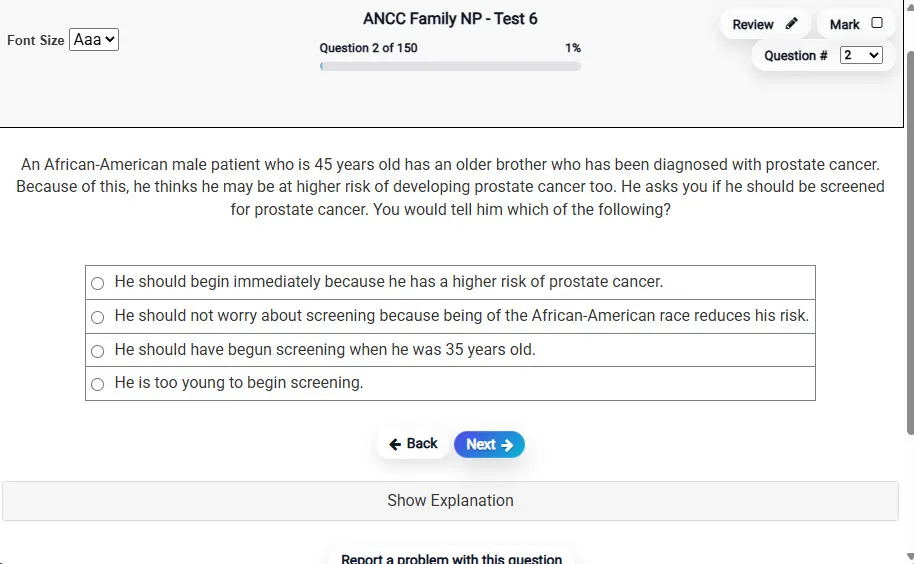
Answering a Question screen – Multiple-choice item view with navigation controls and progress tracker.
Answering a Question Multiple-choice item view with navigation controls and progress tracker.

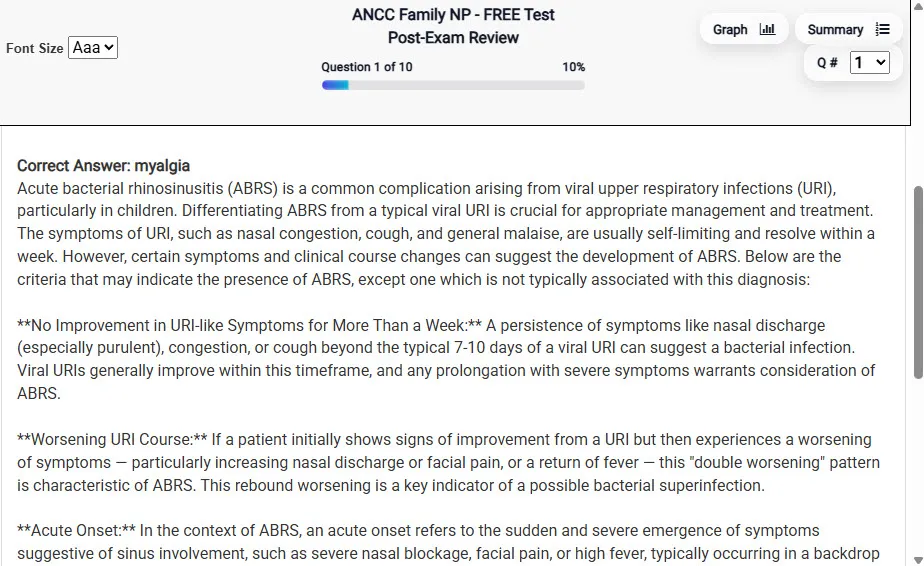
                           Detailed Explanation screen – 
                         Review mode showing chosen answer and rationale and references.
Detailed Explanation Review mode showing chosen answer and rationale and references.

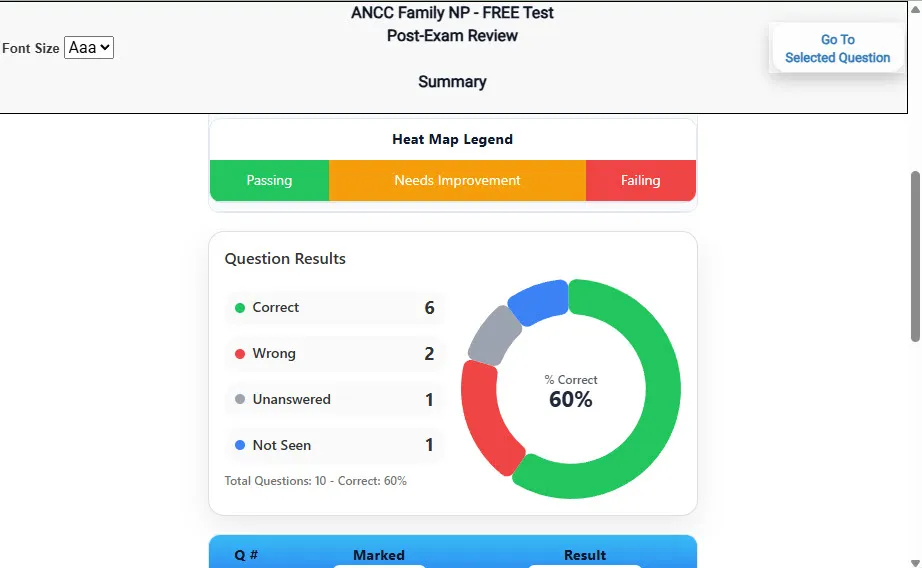
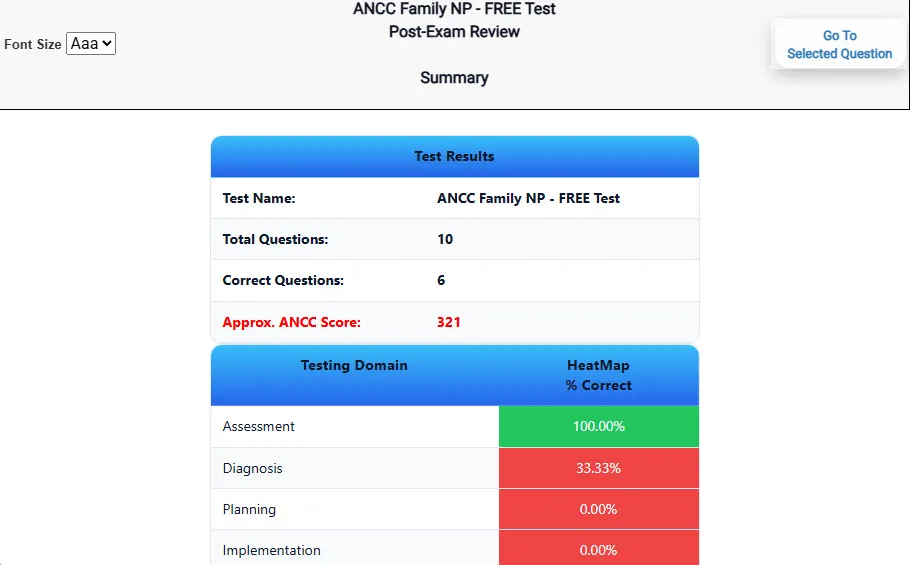
                           Review Summary 1 screen – 
                         Summary with counts for correct/wrong/unanswered and not seen items.
Review Summary 1 Summary with counts for correct/wrong/unanswered and not seen items.

                           Review Summary 2 screen – 
                         Advanced summary with category/domain breakdown and performance insights.
Review Summary 2 Advanced summary with category/domain breakdown and performance insights.

What Each Screen Shows

Answer Question Screen

  • Clean multiple-choice interface with progress bar.
  • Mark for review feature.
  • Matches real test pacing.

Detailed Explanation

  • Correct answer plus rationale.
  • Key concepts and guidelines highlighted.
  • Move between questions to fill knowledge gaps.

Review Summary 1

  • Overall results with total questions and scaled score.
  • Domain heatmap shows strengths and weaknesses.
  • Quick visual feedback on study priorities.

Review Summary 2

  • Chart of correct, wrong, unanswered, not seen.
  • Color-coded results for easy review.
  • Links back to missed items.

Top 10 Reasons to Use Exam Edge for your Praxis Library Media Specialist Exam Prep

  1. Focused on the Praxis Library Media Specialist Exam

    Our practice tests are built specifically for the Praxis Library Media Specialist exam — every question mirrors the real topics, format, and difficulty so you're studying exactly what matters.

  2. Real Exam Simulation

    We match the per-question time limits and pressure of the actual Praxis exam, so test day feels familiar and stress-free.

  3. 15 Full Practice Tests & 1,800 Unique Questions

    You'll have more than enough material to master every Praxis Library Media Specialist concept — no repeats, no fluff.

  4. Lower Cost Than a Retake

    Ordering 5 practice exams costs less than retaking the Praxis Library Media Specialist exam after a failure. One low fee could save you both time and money.

  5. Flexible Testing

    Need to step away mid-exam? Pick up right where you left off — with your remaining time intact.

  6. Instant Scoring & Feedback

    See your raw score and an estimated Praxis Library Media Specialist score immediately after finishing each practice test.

  7. Detailed Explanations for Every Question

    Review correct and incorrect answers with clear, step-by-step explanations so you truly understand each topic.

  8. Trusted & Accredited

    We're fully accredited by the Better Business Bureau and uphold the highest standards of trust and transparency.

  9. Web-Based & Always Available

    No software to install. Access your Praxis Library Media Specialist practice exams 24/7 from any computer or mobile device.

  10. Expert Support When You Need It

    Need extra help? Our specialized tutors are highly qualified and ready to support your Praxis exam prep.


Pass the Praxis Library Media Specialist Exam with Realistic Practice Tests from Exam Edge

Preparing for your upcoming Praxis Library Media Specialist (5311) Certification Exam can feel overwhelming — but the right practice makes all the difference. Exam Edge gives you the tools, structure, and confidence to pass on your first try. Our online practice exams are built to match the real Praxis Library Media Specialist exam in content, format, and difficulty.

  • 📝 15 Praxis Library Media Specialist Practice Tests: Access 15 full-length exams with 120 questions each, covering every major Praxis Library Media Specialist topic in depth.
  • Instant Online Access: Start practicing right away — no software, no waiting.
  • 🧠 Step-by-Step Explanations: Understand the reasoning behind every correct answer so you can master Praxis Library Media Specialist exam concepts.
  • 🔄 Retake Each Exam Up to 4 Times: Build knowledge through repetition and track your improvement over time.
  • 🌐 Web-Based & Available 24/7: Study anywhere, anytime, on any device.
  • 🧘 Boost Your Test-Day Confidence: Familiarity with the Praxis format reduces anxiety and helps you perform under pressure.

These Praxis Library Media Specialist practice exams are designed to simulate the real testing experience by matching question types, timing, and difficulty level. This approach helps you get comfortable not just with the exam content, but also with the testing environment, so you walk into your exam day focused and confident.


Exam Edge Praxis Reviews


I failed the Praxis Math test five times before I found your site. After taking all your practice tests, on my next attempt I passed by five points! I can honestly say this site is the reason I passed. Thank you!!!

Nikki P, Tennessee

Just wanted to say thanks for helping me pass the Praxis I Reading! Your practice tests and especially your explanations are great. They gave me the confidence I needed! Now I can student teach this fall. I'm so glad I found PraxisReading.com!

Denise C, Florida

Thank you so much. I just received my results in the mail. I scored a 179 and passed the Praxis I Writing! I'll never have to worry about retaking this test again! PraxisWriting.com is great. I told all my friends about this site.

Susan K, Virginia

I failed the Parapro test four times before I found your site. After taking all your practice tests, on my next attempt I passed by seven points! I can honestly say that this site is the reason I passed. Thank you!!!

Rebecca S, Texas

Hi! Just returned from taking my Praxis computerized and am happy to say that I passed with a 175. The last time I took the test I missed by 1 point. Your tests definitely made the difference for me! The set up was so similar to the test and the types of questions were also similar that I felt ve ...
Read More
Brad Y, Pennsylvania

I have taken the math praxis 3 times and wanted to give up. I ordered the bundle of math tests and I passed the math praxis today. Thank you for all the help.

Jacob D, South Carolina


Praxis Library Media Specialist Aliases Test Name

Here is a list of alternative names used for this exam.

  • Praxis Library Media Specialist
  • Praxis Library Media Specialist test
  • Praxis Library Media Specialist Certification Test
  • Praxis
  • Praxis 5311
  • 5311 test
  • Praxis Library Media Specialist (5311)
  • Library Media Specialist certification