This is the content of the pop-over!

Lightning Deal Alert – 12% Off Ends at Midnight!

Strike while the savings are hot! Use promo code FlashSale at checkout for 12% off any Exam Edge test or bundle. Hurry—the clock is ticking!

ILTS Early Childhood Special Education (152) Practice Tests & Test Prep by Exam Edge


ILTS Early Childhood Special Education  product image
(4.6)
Based on 32 Reviews

  • Real Exam Simulation: Timed questions and matching content build comfort for your ILTS Early Childhood SPED test day.
  • Instant, 24/7 Access: Web-based ILTS Early Childhood Special Education practice exams with no software needed.
  • Clear Explanations: Step-by-step answers and explanations for your ILTS exam to strengthen understanding.
  • Boosted Confidence: Reduces anxiety and improves test-taking skills to ace your ILTS Early Childhood Special Education (152).

Featured on

ILTS Early Childhood Special Education Online Practice Test Bundles

BEST VALUE
20 practice tests

$174.00

$799.00

SAVE $625

Only $8.70 per test!

  • 100% Pass Guarantee
  • 20 online practice tests
  • 125 questions per test
  • Bonus: 100 Flash Cards + Study Guide
  • Instant access
  • Detailed Explanations
  • Practice tests never expire
  • Timed, untimed, or study guide mode
MOST POPULAR
10 practice tests

$99.50

$399.50

SAVE $300

Only $9.95 per test!

  • 10 online practice tests
  • 125 questions per test
  • Bonus: 100 Flash Cards + Study Guide
  • Instant access
  • Detailed Explanations
  • Practice tests never expire
  • Timed, untimed, or study guide mode
5 practice tests

$69.75

$199.75

SAVE $130

Only $13.95 per test!

  • 5 online practice tests
  • 125 questions per test
  • Bonus: 100 Flash Cards
  • Instant access
  • Detailed Explanations
  • Practice tests never expire
  • Timed, untimed, or study guide mode
1 practice test

$39.95

  • 1 online practice test
  • 125 questions per test
  • Instant access
  • Detailed Explanations
  • Practice tests never expire
  • Timed, untimed, or study guide mode
Quick Select
Tap to choose a bundle

** All Prices are in US Dollars (USD) **


ILTS Early Childhood SPED (152) Resources

Jump to the section you need most.

Understanding the exact breakdown of the ILTS Early Childhood Special Education test will help you know what to expect and how to most effectively prepare. The ILTS Early Childhood Special Education has 125 multiple-choice questions . The exam will be broken down into the sections below:

ILTS Early Childhood Special Education Exam Blueprint
Domain Name
Foundations and Characteristics  
Assessing Students and Developing Individualized Programs  
Planning and Delivering Instructional Content  
Managing the Learning Environment and Promoting Students' Social Interaction Skills  
Maintaining Effective Communication - Collaboration Professionalism  

ILTS Early Childhood Special Education Study Tips by Domain

  • Know IDEA/Part B early childhood special education eligibility basics and the “adverse effect on educational performance” requirement—red flag if a child has a diagnosis but no documented functional impact in routines.
  • Differentiate typical development from disability indicators across domains (motor, communication, cognition, social-emotional, adaptive)—common trap is judging delay only by age norms instead of performance in everyday activities.
  • Recognize characteristics of high-incidence disabilities (e.g., speech/language impairment, developmental delay, ASD) and how they appear in preschool settings—priority rule: describe observable behaviors, not labels, when linking characteristics to needs.
  • Apply key learning and behavior principles (reinforcement, prompting, shaping, generalization) to young children—red flag if a strategy works only with one adult or one activity, indicating poor generalization.
  • Understand cultural/linguistic and socioeconomic influences on development and assessment interpretation—common trap is misidentifying second-language acquisition patterns (e.g., silent period, code-switching) as disability.
  • Identify risk factors and protective factors (prematurity, hearing/vision issues, trauma, chronic health conditions) and their classroom implications—contraindication: assuming behavior is “willful” without ruling out sensory, communication, or medical contributors.
  • Use multiple data sources (screening, observation, work samples, family input) to make eligibility and planning decisions; red flag: relying on a single test score or one setting’s behavior.
  • Select assessment tools that match the child’s language, culture, and sensory/motor needs and follow standardized procedures; common trap: invalid results from improper accommodations (e.g., translating a norm-referenced test without guidance).
  • Write present levels that are measurable and linked to assessment evidence across routines; priority rule: every IEP goal should trace back to a documented need in the present levels.
  • Develop SMART IEP goals with clear conditions and criteria (e.g., frequency/accuracy across days); red flag: vague goals like “will improve” without a mastery threshold.
  • Decide services and placement using least restrictive environment (LRE) reasoning and data on supports needed; common trap: choosing a more restrictive setting for convenience rather than documented educational need.
  • Implement progress monitoring with scheduled data collection and decision rules for instructional changes; priority cue: if data show a flat trend for 2–3 collection periods, adjust instruction or supports and document the rationale.
  • Plan instruction from IEP outcomes using measurable objectives (condition–behavior–criterion) and embed practice across routines; red flag: activities that are “cute” but not linked to a documented goal.
  • Use systematic instruction (model–prompt–practice–fade) with planned error correction and data decision rules; common trap: prompting too much without a fading plan, creating prompt dependence.
  • Differentiate with Universal Design for Learning (multiple means of engagement, representation, action/expression) while keeping the same learning target; priority rule: modify access first before lowering expectations.
  • Integrate assistive technology, AAC, and visual supports into daily lessons and ensure staff use consistent symbols/commands; red flag: providing a device/support but not teaching it or using it across settings.
  • Deliver explicit early literacy and language instruction (phonological awareness, print concepts, vocabulary, narrative) within meaningful contexts; common trap: relying on worksheets or passive read-alouds without interactive scaffolding.
  • Teach early math and functional skills through hands-on, distributed practice with generalization plans; threshold: if a child performs a skill only with one material/person, instruction must add varied materials, peers, and settings.
  • Set up the environment to prevent problem behavior before it starts—clear traffic paths, defined centers, and visual schedules; red flag: frequent transitions without warnings or cues.
  • Teach and reinforce 3–5 positively stated classroom rules with consistent routines; common trap: adding new rules after misbehavior instead of reteaching expectations.
  • Use proactive behavior supports (choice-making, first/then, high-probability request sequences) aligned to function; priority rule: don’t escalate prompts or consequences until you check the likely function (escape, attention, tangible, sensory).
  • Implement data-based behavior plans with measurable targets and reinforcement schedules; red flag: consequences that inadvertently reward the behavior (e.g., sending a child to a preferred area after disruption).
  • Explicitly teach social skills (turn-taking, requesting, repair strategies) using modeling, role-play, and social narratives; common trap: expecting generalization without practice across peers, settings, and materials.
  • Facilitate peer-mediated interaction (buddy systems, structured cooperative play scripts, guided play) while fading adult support; red flag: adults hovering and prompting every exchange, reducing independent peer interaction.
  • Use family-centered, culturally responsive communication (interpreters, translated materials, preferred contact methods) and verify understanding with teach-back; red flag: relying on a child or sibling to interpret sensitive information.
  • Document all parent/guardian contacts and team decisions promptly (date, participants, key points, follow-up) to support compliance; common trap: informal hallway agreements not reflected in written records.
  • Collaborate in IEP meetings by aligning goals, services, and data across providers (SLP/OT/PT, gen ed, related services) with clear roles; priority rule: if it isn’t measurable and assigned, it often doesn’t get implemented.
  • Maintain confidentiality under FERPA/IDEA by sharing student information only with authorized team members and using secure systems; red flag: emailing identifiable student data to personal accounts or discussing cases in public spaces.
  • Use conflict-resolution strategies (active listening, reframing, focusing on student needs, proposing options) to address disagreements with families or colleagues; common trap: treating disputes as personal rather than returning to data and legal requirements.
  • Demonstrate professionalism through ethical practice and boundaries (timely responses, respectful language, mandated reporting when required) and seek supervision when unsure; contraindication: delaying required reporting or altering records to “make things fit.”


Built to Fit Into Your Busy Life

Everything you need to prepare with confidence—without wasting a minute.

Three Study Modes

Timed, No Time Limit, or Explanation mode.

Actionable Analytics

Heatmaps and scaled scores highlight weak areas.

High-Yield Rationales

Concise explanations emphasize key concepts.

Realistic Interface

Matches the feel of the actual exam environment.

Accessible by Design

Clean layout reduces cognitive load.

Anytime, Anywhere

Web-based access 24/7 on any device.
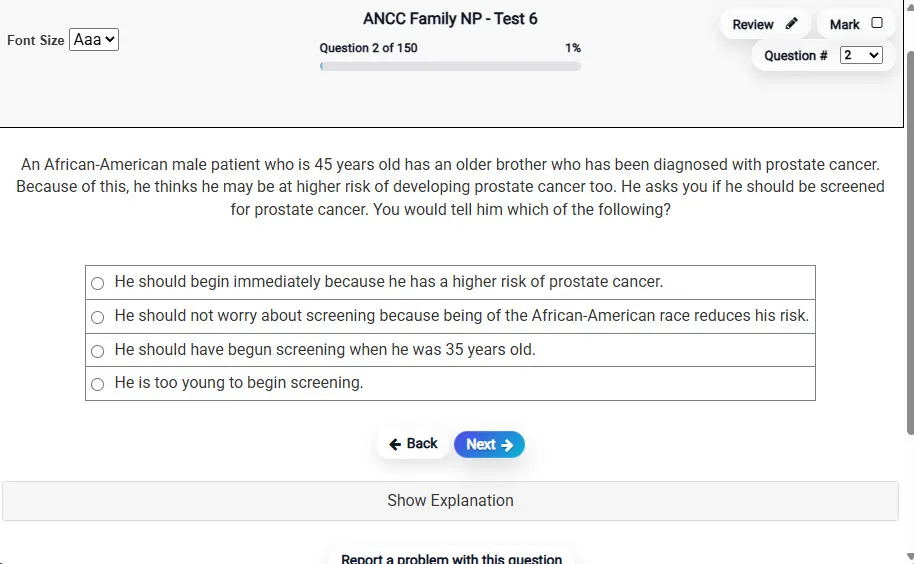
Answering a Question screen – Multiple-choice item view with navigation controls and progress tracker.
Answering a Question Multiple-choice item view with navigation controls and progress tracker.

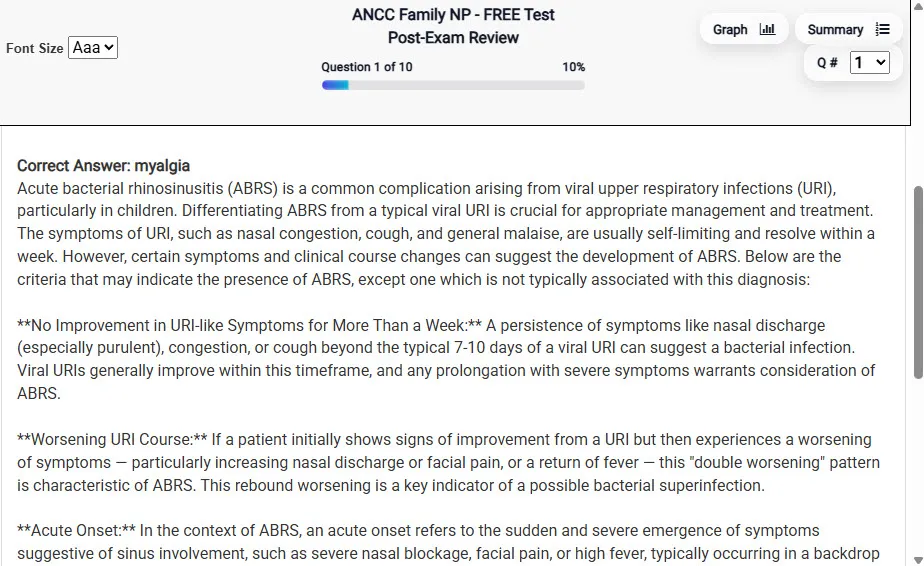
                           Detailed Explanation screen – 
                         Review mode showing chosen answer and rationale and references.
Detailed Explanation Review mode showing chosen answer and rationale and references.

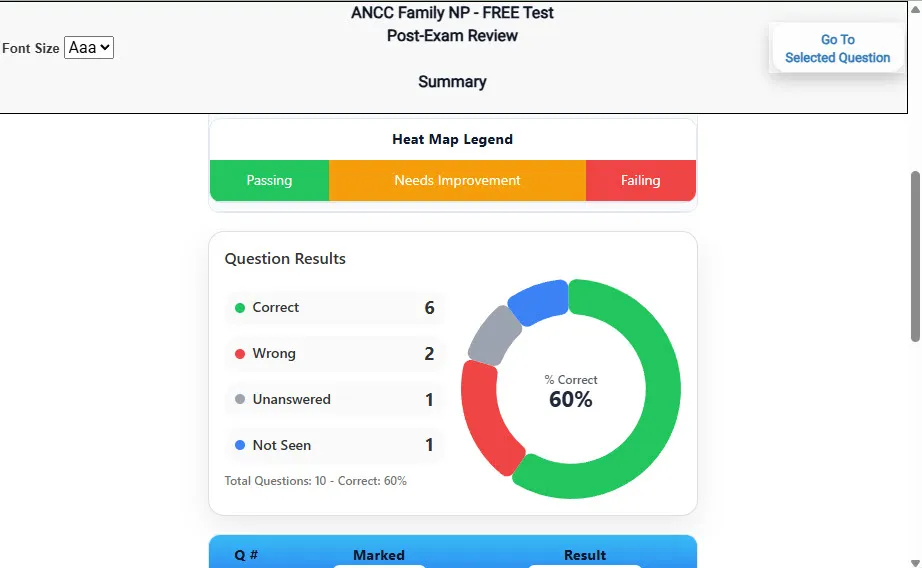
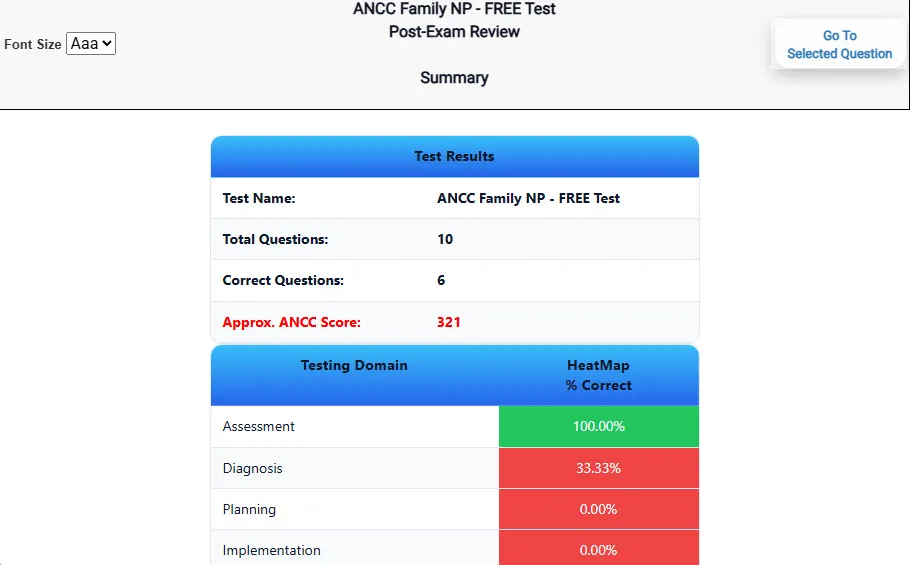
                           Review Summary 1 screen – 
                         Summary with counts for correct/wrong/unanswered and not seen items.
Review Summary 1 Summary with counts for correct/wrong/unanswered and not seen items.

                           Review Summary 2 screen – 
                         Advanced summary with category/domain breakdown and performance insights.
Review Summary 2 Advanced summary with category/domain breakdown and performance insights.

What Each Screen Shows

Answer Question Screen

  • Clean multiple-choice interface with progress bar.
  • Mark for review feature.
  • Matches real test pacing.

Detailed Explanation

  • Correct answer plus rationale.
  • Key concepts and guidelines highlighted.
  • Move between questions to fill knowledge gaps.

Review Summary 1

  • Overall results with total questions and scaled score.
  • Domain heatmap shows strengths and weaknesses.
  • Quick visual feedback on study priorities.

Review Summary 2

  • Chart of correct, wrong, unanswered, not seen.
  • Color-coded results for easy review.
  • Links back to missed items.

Top 10 Reasons to Use Exam Edge for your ILTS Early Childhood Special Education Exam Prep

  1. Focused on the ILTS Early Childhood Special Education Exam

    Our practice tests are built specifically for the ILTS Early Childhood SPED exam — every question mirrors the real topics, format, and difficulty so you're studying exactly what matters.

  2. Real Exam Simulation

    We match the per-question time limits and pressure of the actual ILTS exam, so test day feels familiar and stress-free.

  3. 20 Full Practice Tests & 2,500 Unique Questions

    You'll have more than enough material to master every ILTS Early Childhood SPED concept — no repeats, no fluff.

  4. Lower Cost Than a Retake

    Ordering 5 practice exams costs less than retaking the ILTS Early Childhood Special Education exam after a failure. One low fee could save you both time and money.

  5. Flexible Testing

    Need to step away mid-exam? Pick up right where you left off — with your remaining time intact.

  6. Instant Scoring & Feedback

    See your raw score and an estimated ILTS Early Childhood Special Education score immediately after finishing each practice test.

  7. Detailed Explanations for Every Question

    Review correct and incorrect answers with clear, step-by-step explanations so you truly understand each topic.

  8. Trusted & Accredited

    We're fully accredited by the Better Business Bureau and uphold the highest standards of trust and transparency.

  9. Web-Based & Always Available

    No software to install. Access your ILTS Early Childhood SPED practice exams 24/7 from any computer or mobile device.

  10. Expert Support When You Need It

    Need extra help? Our specialized tutors are highly qualified and ready to support your ILTS exam prep.


Pass the ILTS Early Childhood Special Education Exam with Realistic Practice Tests from Exam Edge

Preparing for your upcoming ILTS Early Childhood Special Education (152) Certification Exam can feel overwhelming — but the right practice makes all the difference. Exam Edge gives you the tools, structure, and confidence to pass on your first try. Our online practice exams are built to match the real ILTS Early Childhood SPED exam in content, format, and difficulty.

  • 📝 20 ILTS Early Childhood Special Education Practice Tests: Access 20 full-length exams with 125 questions each, covering every major ILTS Early Childhood Special Education topic in depth.
  • Instant Online Access: Start practicing right away — no software, no waiting.
  • 🧠 Step-by-Step Explanations: Understand the reasoning behind every correct answer so you can master ILTS Early Childhood SPED exam concepts.
  • 🔄 Retake Each Exam Up to 4 Times: Build knowledge through repetition and track your improvement over time.
  • 🌐 Web-Based & Available 24/7: Study anywhere, anytime, on any device.
  • 🧘 Boost Your Test-Day Confidence: Familiarity with the ILTS format reduces anxiety and helps you perform under pressure.

These ILTS Early Childhood Special Education practice exams are designed to simulate the real testing experience by matching question types, timing, and difficulty level. This approach helps you get comfortable not just with the exam content, but also with the testing environment, so you walk into your exam day focused and confident.


Exam Edge ILTS Reviews


Navigating this site is excellent. Thank you

dwaina , chicago, Illinois

These are great exams to help prepare you for the exams. I passed my ILTS Learning Behavior Specialist I (155) exam on the first attempt. The question structure readily prepares you for how the structure will be on the test, multiple choice questions that are relevant to what is needed to know for t ...
Read More
Jugoslav, Cook County, Illinois

I took the Integrated Social Studies OAE exam once and didn't pass after trying a few different programs to help me study for the test. Then I purchased the Exam Edge practice tests and after taking 12 practice tests, I gave the OAE exam another shot. And to my surprise, I passed the exam! Thank you ...
Read More
Steve, Strongsville, OH

I used Exam Edge to help me pass my Science 4-8 TExES exam on my first try! The practice exams look exactly how the real test looked and the timer helped me be a little less nervous. Now I’m using their practice exams to help me prepare to take my Science 7-12 TExES exam. Wish me luck! :)

Shamai , TX

Dear Exam Edge, I recently ordered a five-pack of tests and successfully passed the ILTS Mathematics content area test with a score of 280/300. I found your tests a very effective way of testing my knowledge of the content material on the real test and seeing explanations of each problem. I scored b ...
Read More
Alistair, IL

The practice tests were EXACTLY what I needed! The test explanations for answers were the teaching points I needed to help understand certain subjects. Thank you for your help!

Arnita , South Holland, Illinois


ILTS Early Childhood Special Education Aliases Test Name

Here is a list of alternative names used for this exam.

  • ILTS Early Childhood Special Education
  • ILTS Early Childhood Special Education test
  • ILTS Early Childhood Special Education Certification Test
  • ILTS Early Childhood SPED test
  • ILTS
  • ILTS 152
  • 152 test
  • ILTS Early Childhood Special Education (152)
  • Early Childhood Special Education certification