This is the content of the pop-over!

Lightning Deal Alert – 12% Off Ends at Midnight!

Strike while the savings are hot! Use promo code FlashSale at checkout for 12% off any Exam Edge test or bundle. Hurry—the clock is ticking!

Praxis PLT: PreK–12 (5625) Practice Tests & Test Prep by Exam Edge


Praxis Principles of Learning and Teaching PreK-12 product image
(4.7)
Based on 28 Reviews

  • Real Exam Simulation: Timed questions and matching content build comfort for your Praxis PLT: PreK-12 test day.
  • Instant, 24/7 Access: Web-based Praxis Principles of Learning and Teaching PreK-12 practice exams with no software needed.
  • Clear Explanations: Step-by-step answers and explanations for your Praxis exam to strengthen understanding.
  • Boosted Confidence: Reduces anxiety and improves test-taking skills to ace your Praxis Principles of Learning and Teaching PreK-12 (5625).

Featured on

Praxis Principles of Learning and Teaching PreK-12 Online Practice Test Bundles

BEST VALUE
20 practice tests

$174.00

$799.00

SAVE $625

Only $8.70 per test!

  • 100% Pass Guarantee
  • 20 online practice tests
  • 100 questions per test
  • Bonus: 100 Flash Cards + Study Guide
  • Instant access
  • Detailed Explanations
  • Practice tests never expire
  • Timed, untimed, or study guide mode
MOST POPULAR
10 practice tests

$99.50

$399.50

SAVE $300

Only $9.95 per test!

  • 10 online practice tests
  • 100 questions per test
  • Bonus: 100 Flash Cards + Study Guide
  • Instant access
  • Detailed Explanations
  • Practice tests never expire
  • Timed, untimed, or study guide mode
5 practice tests

$69.75

$199.75

SAVE $130

Only $13.95 per test!

  • 5 online practice tests
  • 100 questions per test
  • Bonus: 100 Flash Cards
  • Instant access
  • Detailed Explanations
  • Practice tests never expire
  • Timed, untimed, or study guide mode
1 practice test

$39.95

  • 1 online practice test
  • 100 questions per test
  • Instant access
  • Detailed Explanations
  • Practice tests never expire
  • Timed, untimed, or study guide mode
Quick Select
Tap to choose a bundle

** All Prices are in US Dollars (USD) **


Praxis PLT: PreK-12 (5625) Resources

Jump to the section you need most.

Understanding the exact breakdown of the Praxis Principles of Learning and Teaching PreK-12 test will help you know what to expect and how to most effectively prepare. The Praxis Principles of Learning and Teaching PreK-12 has 100 multiple-choice questions . The exam will be broken down into the sections below:

Praxis Principles of Learning and Teaching PreK-12 Exam Blueprint
Domain Name % Number of
Questions
Students as Learners 31% 31
Instructional Process 30% 30
Assessment 20% 20
Professional Development - Leadership Community 19% 19

Praxis Principles of Learning and Teaching PreK-12 Study Tips by Domain

  • Connect developmental stages to realistic expectations (e.g., early childhood concrete thinking vs. adolescents’ emerging abstract reasoning); red flag: demanding formal reasoning tasks without supports like models or examples.
  • Use motivation principles (intrinsic/extrinsic, self-efficacy, goal orientation) to plan supports; common trap: over-relying on rewards and then blaming students when engagement drops once incentives stop.
  • Apply learning theory (behaviorism, cognitivism, constructivism, social learning) to select strategies; priority rule: if a student can’t generalize a skill, add guided practice with feedback rather than more independent work.
  • Address individual differences (IEPs/504s, English learners, giftedness, cultural/linguistic background) through access supports; red flag: modifying the learning target when the intent is accommodation (supports) rather than modification (different expectations).
  • Identify classroom factors affecting learning (attention, trauma/stress, peer influence, family/community context) and respond with predictable routines; common trap: interpreting avoidance or shutdown as defiance without checking for unmet needs or triggers.
  • Promote metacognition and self-regulation (planning, monitoring, reflection) with explicit strategy instruction; threshold cue: if students can’t explain how they solved a problem, they likely need modeling of thinking steps before more practice.
  • Align objectives, instruction, and checks for understanding so students can demonstrate the intended skill—red flag: activities that are engaging but don’t measure the stated objective.
  • Use multiple ways to model and represent content (e.g., visuals, think-alouds, examples/non-examples)—common trap: explaining once and assuming comprehension without a student restatement.
  • Build in guided practice with immediate, specific feedback before independent work—priority rule: increase scaffolds (prompts, cues, worked examples) when error rates stay high.
  • Differentiate by readiness, interest, or learning profile while keeping the same learning target—red flag: lowering expectations instead of adjusting supports (time, grouping, materials).
  • Use flexible grouping (whole class, small group, partners, individual) based on data from formative checks—common trap: keeping groups static despite new evidence of mastery.
  • Manage transitions and behavior with clear routines, proximity, and consistent consequences—priority rule: address behavior early and privately to prevent escalation and loss of instructional time.
  • Align each assessment to a specific learning objective and the cognitive demand taught; red flag: a test that measures recall when instruction targeted application or analysis.
  • Use formative checks (e.g., questioning, exit tickets, observation) to adjust instruction quickly; common trap: collecting data but not changing grouping, pacing, or re-teaching based on results.
  • Choose the right assessment type (selected-response, constructed-response, performance task) to match the skill; priority rule: use performance-based measures for complex processes like problem-solving and writing.
  • Ensure validity and reliability by using clear directions, consistent scoring, and enough items/samples; red flag: grading with vague criteria or changing standards midstream.
  • Apply fair and accessible practices (accommodations vs. modifications) while maintaining the construct; contraindication: an accommodation that alters what is being measured (e.g., reading a reading comprehension test aloud when decoding is part of the construct).
  • Interpret results cautiously using multiple data points and awareness of bias and error; common trap: making high-stakes decisions from a single score or comparing students without considering growth and context.
  • Follow legal/ethical duties — confidentiality and mandated reporting — and treat any request to “keep it between us” about abuse/self-harm as a red flag requiring immediate reporting per policy.
  • Use student data to drive improvement (e.g., identify a need, choose an intervention, monitor results) and avoid the common trap of changing instruction without a baseline measure to compare progress.
  • Collaborate effectively in teams (grade-level, IEP/504, MTSS) by bringing specific evidence and clear next steps; a key cue is that vague concerns without documentation often stall support services.
  • Engage families as partners using culturally responsive, strengths-based communication; a priority rule is to offer multiple communication modes (interpreters, translated materials) rather than assuming nonresponse equals lack of interest.
  • Demonstrate instructional leadership by aligning classroom decisions to standards, school goals, and equity; a common trap is implementing popular strategies that conflict with district curriculum or create inconsistent expectations across classrooms.
  • Pursue targeted professional learning (coaching, observation cycles, feedback) tied to a student outcome; a practical cue is that PD is most defensible when you can state the goal, evidence collected, and the adjustment you made.


Built to Fit Into Your Busy Life

Everything you need to prepare with confidence—without wasting a minute.

Three Study Modes

Timed, No Time Limit, or Explanation mode.

Actionable Analytics

Heatmaps and scaled scores highlight weak areas.

High-Yield Rationales

Concise explanations emphasize key concepts.

Realistic Interface

Matches the feel of the actual exam environment.

Accessible by Design

Clean layout reduces cognitive load.

Anytime, Anywhere

Web-based access 24/7 on any device.
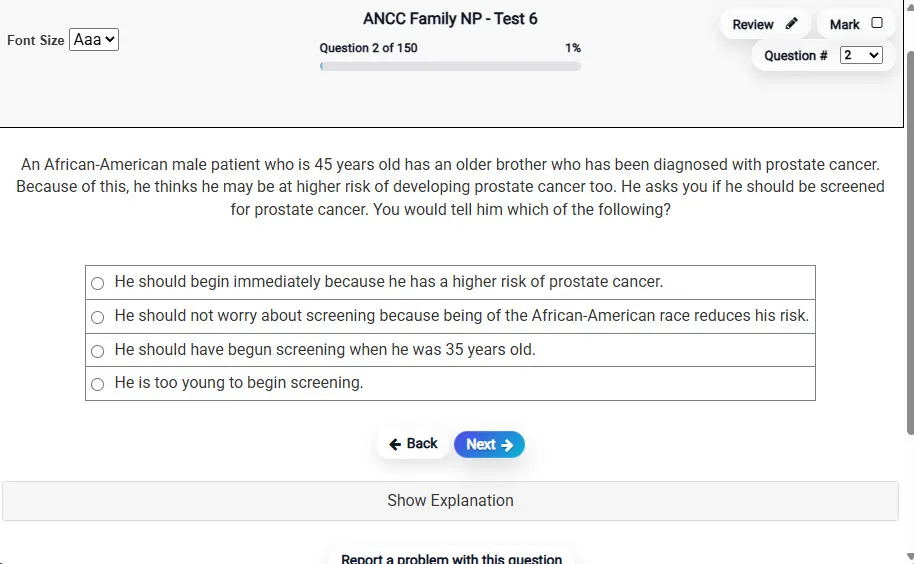
Answering a Question screen – Multiple-choice item view with navigation controls and progress tracker.
Answering a Question Multiple-choice item view with navigation controls and progress tracker.

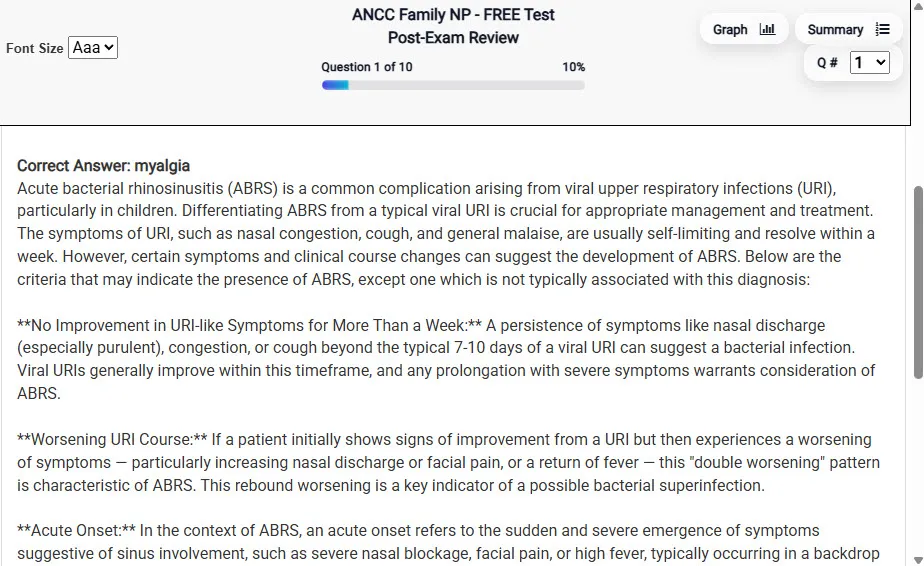
                           Detailed Explanation screen – 
                         Review mode showing chosen answer and rationale and references.
Detailed Explanation Review mode showing chosen answer and rationale and references.

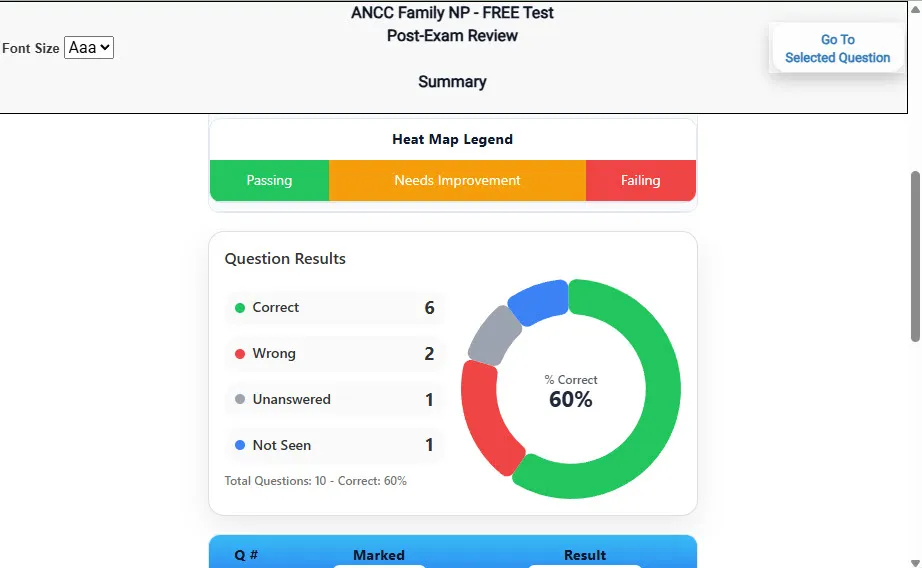
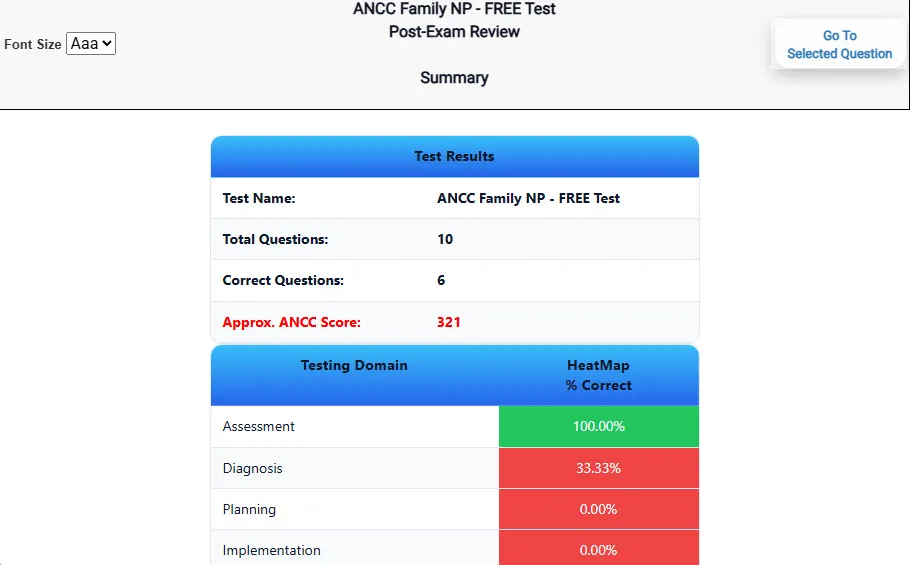
                           Review Summary 1 screen – 
                         Summary with counts for correct/wrong/unanswered and not seen items.
Review Summary 1 Summary with counts for correct/wrong/unanswered and not seen items.

                           Review Summary 2 screen – 
                         Advanced summary with category/domain breakdown and performance insights.
Review Summary 2 Advanced summary with category/domain breakdown and performance insights.

What Each Screen Shows

Answer Question Screen

  • Clean multiple-choice interface with progress bar.
  • Mark for review feature.
  • Matches real test pacing.

Detailed Explanation

  • Correct answer plus rationale.
  • Key concepts and guidelines highlighted.
  • Move between questions to fill knowledge gaps.

Review Summary 1

  • Overall results with total questions and scaled score.
  • Domain heatmap shows strengths and weaknesses.
  • Quick visual feedback on study priorities.

Review Summary 2

  • Chart of correct, wrong, unanswered, not seen.
  • Color-coded results for easy review.
  • Links back to missed items.

Top 10 Reasons to Use Exam Edge for your Praxis Principles of Learning and Teaching PreK-12 Exam Prep

  1. Focused on the Praxis Principles of Learning and Teaching PreK-12 Exam

    Our practice tests are built specifically for the Praxis PLT: PreK-12 exam — every question mirrors the real topics, format, and difficulty so you're studying exactly what matters.

  2. Real Exam Simulation

    We match the per-question time limits and pressure of the actual Praxis exam, so test day feels familiar and stress-free.

  3. 20 Full Practice Tests & 2,000 Unique Questions

    You'll have more than enough material to master every Praxis PLT: PreK-12 concept — no repeats, no fluff.

  4. Lower Cost Than a Retake

    Ordering 5 practice exams costs less than retaking the Praxis Principles of Learning and Teaching PreK-12 exam after a failure. One low fee could save you both time and money.

  5. Flexible Testing

    Need to step away mid-exam? Pick up right where you left off — with your remaining time intact.

  6. Instant Scoring & Feedback

    See your raw score and an estimated Praxis Principles of Learning and Teaching PreK-12 score immediately after finishing each practice test.

  7. Detailed Explanations for Every Question

    Review correct and incorrect answers with clear, step-by-step explanations so you truly understand each topic.

  8. Trusted & Accredited

    We're fully accredited by the Better Business Bureau and uphold the highest standards of trust and transparency.

  9. Web-Based & Always Available

    No software to install. Access your Praxis PLT: PreK-12 practice exams 24/7 from any computer or mobile device.

  10. Expert Support When You Need It

    Need extra help? Our specialized tutors are highly qualified and ready to support your Praxis exam prep.


Pass the Praxis Principles of Learning and Teaching PreK-12 Exam with Realistic Practice Tests from Exam Edge

Preparing for your upcoming Praxis Principles of Learning and Teaching PreK-12 (5625) Certification Exam can feel overwhelming — but the right practice makes all the difference. Exam Edge gives you the tools, structure, and confidence to pass on your first try. Our online practice exams are built to match the real Praxis PLT: PreK-12 exam in content, format, and difficulty.

  • 📝 20 Praxis Principles of Learning and Teaching PreK-12 Practice Tests: Access 20 full-length exams with 100 questions each, covering every major Praxis Principles of Learning and Teaching PreK-12 topic in depth.
  • Instant Online Access: Start practicing right away — no software, no waiting.
  • 🧠 Step-by-Step Explanations: Understand the reasoning behind every correct answer so you can master Praxis PLT: PreK-12 exam concepts.
  • 🔄 Retake Each Exam Up to 4 Times: Build knowledge through repetition and track your improvement over time.
  • 🌐 Web-Based & Available 24/7: Study anywhere, anytime, on any device.
  • 🧘 Boost Your Test-Day Confidence: Familiarity with the Praxis format reduces anxiety and helps you perform under pressure.

These Praxis Principles of Learning and Teaching PreK-12 practice exams are designed to simulate the real testing experience by matching question types, timing, and difficulty level. This approach helps you get comfortable not just with the exam content, but also with the testing environment, so you walk into your exam day focused and confident.


Exam Edge Praxis Reviews


I am always suspicious of online reviews, however, let me say that I am a chemistry and physics teacher in Pennsylvania and a bona-fide user of the Exam Edge Math 5165 Praxis practice exams. I purchased the entire package of 15 mock exams. To prepare for the Praxis, I completed 14 of the 15 tests an ...
Read More
Tom, Tunkhannock, PA

I was originally using books that I had found online. I took the exam twice and did not do well. I was determined to do better and came across Exam Edge. The things I found very helpful and liked was the projected score, I could go back and look at every question, look at the explanation and learn f ...
Read More
Ashlie ,D, Litchfield, CT

Exam Edge is a great resource! I was discouraged with all the practice test results I was getting at first, but the actual test was much easier and I believe that was because of the difficulty of the practice tests! I wound up scoring a full 10 points higher than the passing score! Thank you Exam Ed ...
Read More
Kenneth , Alabama

I passed the business praxis. I purchased the bundle of 20 tests and went through each and every one. So helpful.

Annette , Rochelle Park, New Jersey

I decided to take the Technology Praxis II about 2 weeks ago to try and get a job teaching technology next year... I am already a Biology teacher. Last week, the day before I left on vacation, I got a job offer... based on passing the Praxis II 5051. That gave me two days to get ready.... I purchase ...
Read More
Mindy , New Jersey

I've taken 3 practice test so far and they've been very helpful! Wording on some questions has definitely made me a more cautious reader.

Chris , Bridgeport, Connecticut


Praxis Principles of Learning and Teaching PreK-12 Aliases Test Name

Here is a list of alternative names used for this exam.

  • Praxis Principles of Learning and Teaching PreK-12
  • Praxis Principles of Learning and Teaching PreK-12 test
  • Praxis Principles of Learning and Teaching PreK-12 Certification Test
  • Praxis PLT: PreK-12 test
  • Praxis
  • Praxis 5625
  • 5625 test
  • Praxis Principles of Learning and Teaching PreK-12 (5625)
  • Principles of Learning and Teaching PreK-12 certification