This is the content of the pop-over!

ORELA Special Education (601) Practice Tests & Test Prep by Exam Edge


ORELA Special Education  product image
(5.0)
Based on 17 Reviews

  • Real Exam Simulation: Timed questions and matching content build comfort for your ORELA SPED test day.
  • Instant, 24/7 Access: Web-based ORELA Special Education practice exams with no software needed.
  • Clear Explanations: Step-by-step answers and explanations for your ORELA exam to strengthen understanding.
  • Boosted Confidence: Reduces anxiety and improves test-taking skills to ace your ORELA Special Education (601).

Featured on

ORELA Special Education Online Practice Test Bundles

BEST VALUE
15 practice tests

$149.25

$599.25

SAVE $450

Only $9.95 per test!

  • 100% Pass Guarantee
  • 15 online practice tests
  • 150 questions per test
  • Bonus: 100 Flash Cards + Study Guide
  • Instant access
  • Detailed Explanations
  • Practice tests never expire
  • Timed, untimed, or study guide mode
MOST POPULAR
10 practice tests

$99.50

$399.50

SAVE $300

Only $9.95 per test!

  • 10 online practice tests
  • 150 questions per test
  • Bonus: 100 Flash Cards + Study Guide
  • Instant access
  • Detailed Explanations
  • Practice tests never expire
  • Timed, untimed, or study guide mode
5 practice tests

$69.75

$199.75

SAVE $130

Only $13.95 per test!

  • 5 online practice tests
  • 150 questions per test
  • Bonus: 100 Flash Cards
  • Instant access
  • Detailed Explanations
  • Practice tests never expire
  • Timed, untimed, or study guide mode
1 practice test

$39.95

  • 1 online practice test
  • 150 questions per test
  • Instant access
  • Detailed Explanations
  • Practice tests never expire
  • Timed, untimed, or study guide mode
Quick Select
Tap to choose a bundle

** All Prices are in US Dollars (USD) **


ORELA SPED (601) Resources

Jump to the section you need most.

Understanding the exact breakdown of the ORELA Special Education test will help you know what to expect and how to most effectively prepare. The ORELA Special Education has multiple-choice questions . The exam will be broken down into the sections below:

ORELA Special Education Exam Blueprint
Domain Name % Number of
Questions
Students with Disabilities 20% 30
Assessment and Program Planning 20% 30
Learning Environments and Instructional Practices 40% 60
Foundations and Professional Practice 20% 30

ORELA Special Education Study Tips by Domain

  • Differentiate eligibility categories (e.g., SLD vs. ID vs. ED vs. ASD) by the pattern of strengths/needs and the evidence source; red flag: basing identification on a single test score or a general low achievement profile without ruling out exclusionary factors.
  • Apply the LRE continuum and placement decision-making from general education with supports to more restrictive settings; common trap: choosing a self-contained placement because it is “available” rather than because supplementary aids/services in the general setting were tried and documented.
  • Recognize disability-specific characteristics that affect access (e.g., executive-function deficits in ADHD, pragmatic language needs in ASD, sensory access issues in hearing/vision loss); priority rule: address the access barrier first (e.g., communication mode, assistive tech) before increasing task difficulty.
  • Identify required IEP considerations tied to disability needs (e.g., behavior, communication, assistive technology, health/medical, transition as applicable); red flag: skipping a functional behavior assessment when repeated behavior is impeding learning.
  • Use data to distinguish skill deficits from performance deficits (can’t do vs. won’t do) for students with EBD/ADHD/SLD; common trap: treating noncompliance as a skill deficit without verifying motivation, triggers, and reinforcement history.
  • Ensure accommodations and modifications match the student’s disability-related need and preserve construct validity; contraindication: providing a modification (e.g., reading the test) when the construct is decoding/reading comprehension unless the assessment explicitly allows it.
  • Use multiple data sources (screeners, classroom performance, observations, family input) to make eligibility and instructional decisions; red flag: relying on a single test score or one setting for conclusions.
  • Plan evaluations and reevaluations to answer specific referral questions and to differentiate disability from lack of instruction or limited English proficiency; common trap: skipping documentation of appropriate instruction/interventions before referral.
  • Write IEP present levels (PLAAFP) that are measurable and directly linked to evaluation data; priority rule: every annual goal must trace back to an identified need in the PLAAFP.
  • Develop measurable annual goals with clear criteria, conditions, and methods of measurement; red flag: goals that describe activities (e.g., “will participate”) rather than observable performance.
  • Select accommodations/modifications based on documented need and ensure they are used routinely during instruction before high-stakes assessments; common trap: adding last-minute testing accommodations not provided in daily instruction.
  • Create a progress-monitoring plan with a defined schedule and decision rules for instructional changes; priority cue: if data show flat or declining trend across several data points, adjust intervention rather than waiting for the next IEP meeting.
  • Design instruction using UDL and explicit teaching (model–guided practice–independent practice) while planning multiple means of engagement, representation, and expression; red flag: relying on a single modality (e.g., lecture only) when data show access barriers.
  • Implement accommodations and modifications aligned to the IEP/504 and the lesson objective (e.g., read-aloud vs. reduced complexity); common trap: giving an accommodation that changes the construct being assessed (e.g., reading test items on a decoding assessment).
  • Use evidence-based behavioral supports (FBA-driven BIP, reinforcement schedules, antecedent strategies) and monitor fidelity; priority rule: address safety and legally required supports before adding new consequences or removing services.
  • Differentiate instruction with data-based decision making (progress monitoring, error analysis, curriculum-based measures) and adjust intensity (time, grouping, scaffolds); red flag: changing interventions too frequently to determine response (“intervention hopping”).
  • Structure inclusive settings with effective co-teaching/paraprofessional roles (one teach/one assist, station, parallel) and planned prompts/fading; common trap: paraprofessionals providing primary instruction without teacher direction or creating overdependence.
  • Teach functional, communication, and social skills across routines using generalization plans (multiple settings/people, natural cues) and assistive technology as needed; contraindication: introducing AT without training/support and then interpreting poor use as lack of ability.
  • Apply IDEA/Section 504/ADA roles correctly: IDEA requires an IEP and specialized instruction, while 504 provides accommodations without an IEP—red flag if someone proposes a “504 IEP” or uses 504 to replace needed special education.
  • Follow procedural safeguards and timelines (consent, evaluation, eligibility, reevaluation)—common trap is implementing services or changing placement without documented parent consent and prior written notice.
  • Use least restrictive environment (LRE) decision-making based on individual need and supplementary aids/services first—red flag if placement is chosen because of disability label, staffing, or program availability.
  • Maintain confidentiality under FERPA/IDEA: share records only with authorized staff and secure data—common trap is discussing a student’s disability in hallways, email threads, or with non-team members.
  • Practice ethical, culturally responsive collaboration: interpret evaluation data in context and avoid biased assumptions—red flag if behavior or language difference is treated as disability without targeted interventions and documentation.
  • Know mandated reporting and safety obligations: report suspected abuse/neglect immediately per district/state procedure—priority rule is student safety over parent notification or administrative delays.


Built to Fit Into Your Busy Life

Everything you need to prepare with confidence—without wasting a minute.

Three Study Modes

Timed, No Time Limit, or Explanation mode.

Actionable Analytics

Heatmaps and scaled scores highlight weak areas.

High-Yield Rationales

Concise explanations emphasize key concepts.

Realistic Interface

Matches the feel of the actual exam environment.

Accessible by Design

Clean layout reduces cognitive load.

Anytime, Anywhere

Web-based access 24/7 on any device.
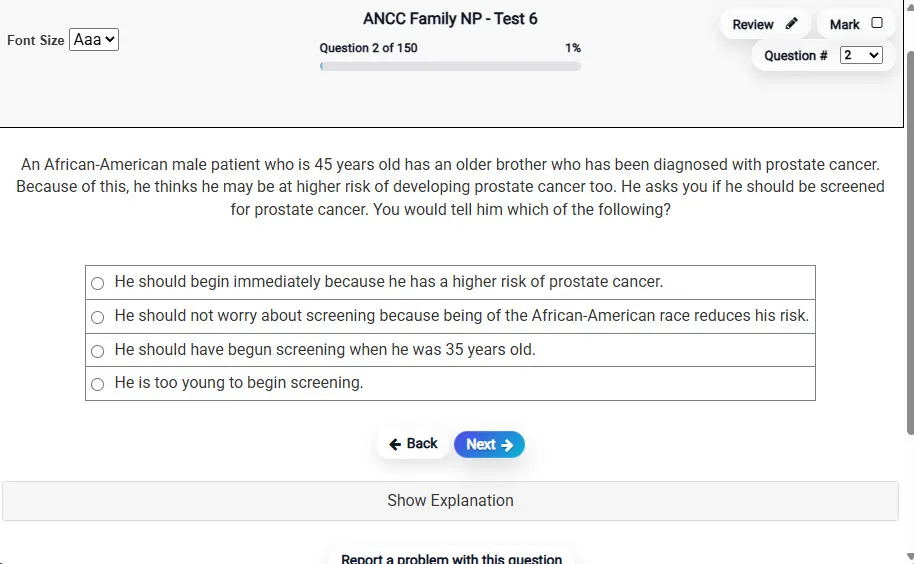
Answering a Question screen – Multiple-choice item view with navigation controls and progress tracker.
Answering a Question Multiple-choice item view with navigation controls and progress tracker.

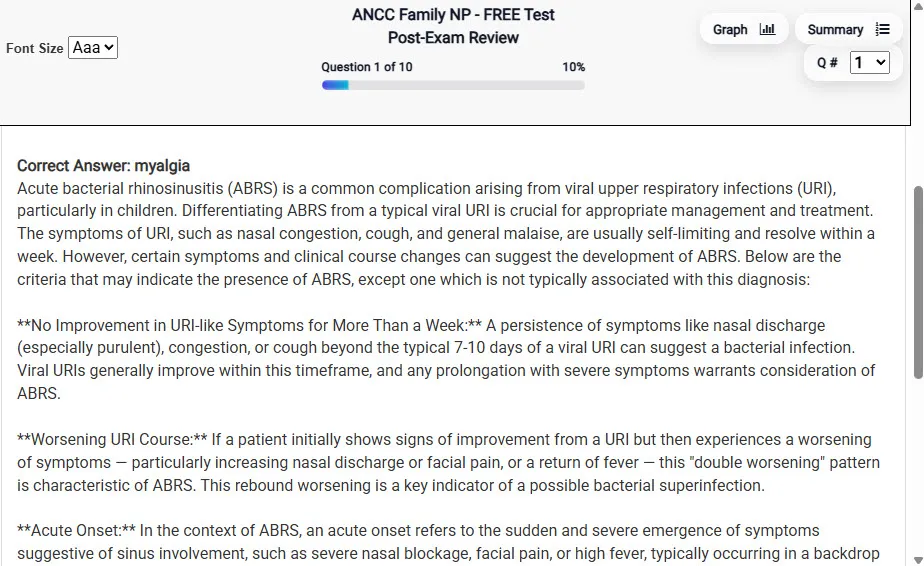
                           Detailed Explanation screen – 
                         Review mode showing chosen answer and rationale and references.
Detailed Explanation Review mode showing chosen answer and rationale and references.

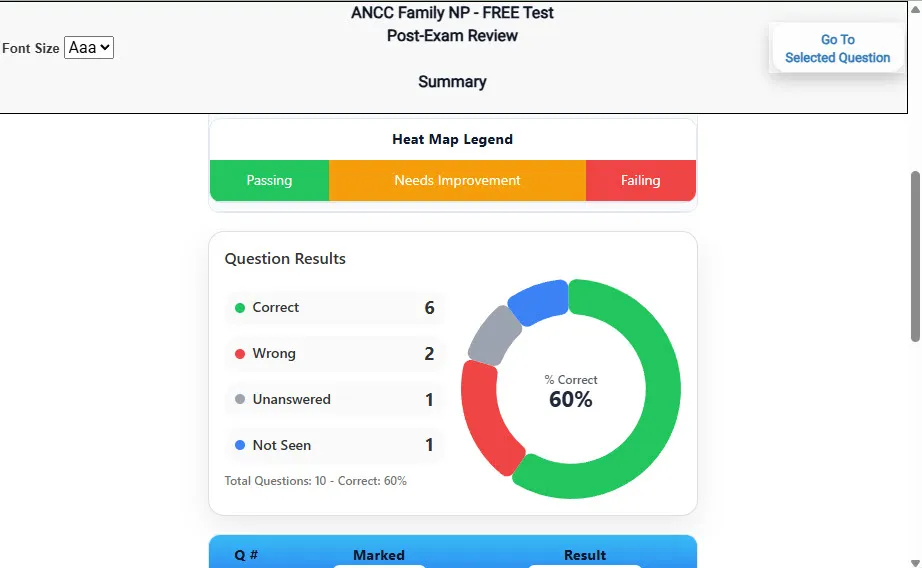
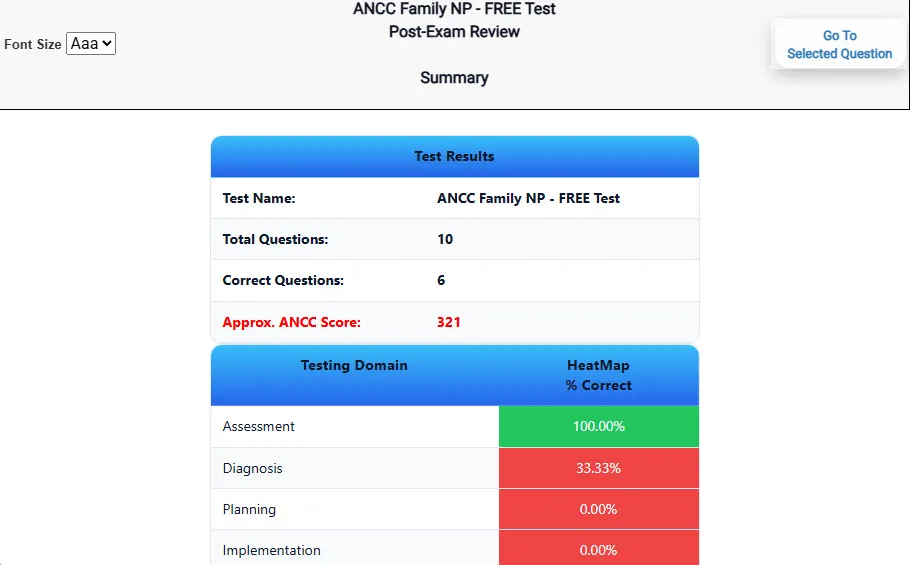
                           Review Summary 1 screen – 
                         Summary with counts for correct/wrong/unanswered and not seen items.
Review Summary 1 Summary with counts for correct/wrong/unanswered and not seen items.

                           Review Summary 2 screen – 
                         Advanced summary with category/domain breakdown and performance insights.
Review Summary 2 Advanced summary with category/domain breakdown and performance insights.

What Each Screen Shows

Answer Question Screen

  • Clean multiple-choice interface with progress bar.
  • Mark for review feature.
  • Matches real test pacing.

Detailed Explanation

  • Correct answer plus rationale.
  • Key concepts and guidelines highlighted.
  • Move between questions to fill knowledge gaps.

Review Summary 1

  • Overall results with total questions and scaled score.
  • Domain heatmap shows strengths and weaknesses.
  • Quick visual feedback on study priorities.

Review Summary 2

  • Chart of correct, wrong, unanswered, not seen.
  • Color-coded results for easy review.
  • Links back to missed items.

Top 10 Reasons to Use Exam Edge for your ORELA Special Education Exam Prep

  1. Focused on the ORELA Special Education Exam

    Our practice tests are built specifically for the ORELA SPED exam — every question mirrors the real topics, format, and difficulty so you're studying exactly what matters.

  2. Real Exam Simulation

    We match the per-question time limits and pressure of the actual ORELA exam, so test day feels familiar and stress-free.

  3. 15 Full Practice Tests & 2,250 Unique Questions

    You'll have more than enough material to master every ORELA SPED concept — no repeats, no fluff.

  4. Lower Cost Than a Retake

    Ordering 5 practice exams costs less than retaking the ORELA Special Education exam after a failure. One low fee could save you both time and money.

  5. Flexible Testing

    Need to step away mid-exam? Pick up right where you left off — with your remaining time intact.

  6. Instant Scoring & Feedback

    See your raw score and an estimated ORELA Special Education score immediately after finishing each practice test.

  7. Detailed Explanations for Every Question

    Review correct and incorrect answers with clear, step-by-step explanations so you truly understand each topic.

  8. Trusted & Accredited

    We're fully accredited by the Better Business Bureau and uphold the highest standards of trust and transparency.

  9. Web-Based & Always Available

    No software to install. Access your ORELA SPED practice exams 24/7 from any computer or mobile device.

  10. Expert Support When You Need It

    Need extra help? Our specialized tutors are highly qualified and ready to support your ORELA exam prep.


Pass the ORELA Special Education Exam with Realistic Practice Tests from Exam Edge

Preparing for your upcoming ORELA Special Education (601) Certification Exam can feel overwhelming — but the right practice makes all the difference. Exam Edge gives you the tools, structure, and confidence to pass on your first try. Our online practice exams are built to match the real ORELA SPED exam in content, format, and difficulty.

  • 📝 15 ORELA Special Education Practice Tests: Access 15 full-length exams with 150 questions each, covering every major ORELA Special Education topic in depth.
  • Instant Online Access: Start practicing right away — no software, no waiting.
  • 🧠 Step-by-Step Explanations: Understand the reasoning behind every correct answer so you can master ORELA SPED exam concepts.
  • 🔄 Retake Each Exam Up to 4 Times: Build knowledge through repetition and track your improvement over time.
  • 🌐 Web-Based & Available 24/7: Study anywhere, anytime, on any device.
  • 🧘 Boost Your Test-Day Confidence: Familiarity with the ORELA format reduces anxiety and helps you perform under pressure.

These ORELA Special Education practice exams are designed to simulate the real testing experience by matching question types, timing, and difficulty level. This approach helps you get comfortable not just with the exam content, but also with the testing environment, so you walk into your exam day focused and confident.


Exam Edge ORELA Reviews


ORELA Special Education Aliases Test Name

Here is a list of alternative names used for this exam.

  • ORELA Special Education
  • ORELA Special Education test
  • ORELA Special Education Certification Test
  • ORELA SPED test
  • ORELA
  • ORELA 601
  • 601 test
  • ORELA Special Education (601)
  • Special Education certification