This is the content of the pop-over!

OAE Prekindergarten (036/037) Practice Tests & Test Prep by Exam Edge


OAE Prekindergarten (Subtests I & II)  product image
(5.0)
Based on 37 Reviews

  • Real Exam Simulation: Timed questions and matching content build comfort for your OAE Prekindergarten test day.
  • Instant, 24/7 Access: Web-based OAE Prekindergarten (Subtests I & II) practice exams with no software needed.
  • Clear Explanations: Step-by-step answers and explanations for your OAE exam to strengthen understanding.
  • Boosted Confidence: Reduces anxiety and improves test-taking skills to ace your OAE Prekindergarten (Subtests I & II) (036/037).

Featured on

OAE Prekindergarten (Subtests I & II) Online Practice Test Bundles

BEST VALUE
15 practice tests

$149.25

$599.25

SAVE $450

Only $9.95 per test!

  • 100% Pass Guarantee
  • 15 online practice tests
  • 100 questions per test
  • Bonus: 100 Flash Cards + Study Guide
  • Instant access
  • Detailed Explanations
  • Practice tests never expire
  • Timed, untimed, or study guide mode
MOST POPULAR
10 practice tests

$99.50

$399.50

SAVE $300

Only $9.95 per test!

  • 10 online practice tests
  • 100 questions per test
  • Bonus: 100 Flash Cards + Study Guide
  • Instant access
  • Detailed Explanations
  • Practice tests never expire
  • Timed, untimed, or study guide mode
5 practice tests

$69.75

$199.75

SAVE $130

Only $13.95 per test!

  • 5 online practice tests
  • 100 questions per test
  • Bonus: 100 Flash Cards
  • Instant access
  • Detailed Explanations
  • Practice tests never expire
  • Timed, untimed, or study guide mode
1 practice test

$39.95

  • 1 online practice test
  • 100 questions per test
  • Instant access
  • Detailed Explanations
  • Practice tests never expire
  • Timed, untimed, or study guide mode
Quick Select
Tap to choose a bundle

** All Prices are in US Dollars (USD) **


OAE Prekindergarten (036/037) Resources

Jump to the section you need most.

Understanding the exact breakdown of the OAE Prekindergarten (Subtests I & II) test will help you know what to expect and how to most effectively prepare. The OAE Prekindergarten (Subtests I & II) has 120 multiple-choice questions and 4 essay questions. The exam will be broken down into the sections below:

OAE Prekindergarten (Subtests I & II) Exam Blueprint
Domain Name % Number of
Questions
Subtest I (Field 036)  
     Professionalism and Building Relationships 42% 25
     Promoting Child Development and Learning 58% 35
Subtest II (Field 037)  
     Teaching and Learning 50% 30
     Building a Meaningful Curriculum 50% 30

OAE Prekindergarten (Subtests I & II) Study Tips by Domain

  • Know Ohio’s early learning standards and how they drive lesson objectives and assessment; red flag: planning activities without explicit, measurable learning targets aligned to standards.
  • Use developmentally appropriate practice (DAP) by matching tasks to typical developmental ranges and individual needs; common trap: pushing “worksheet” academics that ignore play-based, hands-on learning.
  • Plan for universal access using accommodations/modifications (e.g., visuals, assistive tech, alternative response modes); priority rule: provide supports before concluding a child “can’t” meet an objective.
  • Apply valid, ongoing assessment (anecdotal notes, checklists, work samples) to adjust instruction; red flag: relying on a single formal test or grading rather than multiple observations across contexts.
  • Promote safe, inclusive classroom management with clear routines and positive guidance; contraindication: using exclusionary discipline or withholding basic needs (snacks, restroom) as consequences.
  • Integrate language/literacy, math, science, social studies, arts, and physical development through centers and play; common trap: teaching skills in isolation without meaningful context or opportunities for child choice.
  • Follow Ohio’s legal/ethical duties for early childhood settings—mandated reporting, confidentiality, and consent; red flag: delaying a report or promising a child you’ll “keep a secret.”
  • Use two-way, culturally responsive family communication with clear, jargon-free updates; common trap: contacting families only when there is a problem rather than sharing strengths and progress routinely.
  • Build professional partnerships by using agreed roles, shared goals, and documented follow-through with colleagues/therapists; priority rule: align accommodations and services to the IEP/IFSP as written, not informal preferences.
  • Maintain professional boundaries and appropriate digital conduct; red flag: sharing photos, names, or classroom stories on social media without written permission and district policy compliance.
  • Use conflict-resolution practices that protect relationships and student dignity (private, solution-focused, evidence-based); common trap: discussing a child’s behavior with other adults in public areas where it can be overheard.
  • Engage in continuous improvement through reflective practice and required professional learning; threshold cue: document incidents, interventions, and family contacts promptly because “I remember it” is not defensible in compliance reviews.
  • Use developmental milestones as guides, not labels—red flag: making high-stakes decisions from a single observation rather than repeated evidence across settings and times.
  • Plan for the whole child (physical, cognitive, language, social-emotional) and watch for uneven profiles—common trap: assuming strong verbal skills mean strong self-regulation or executive function.
  • Support social-emotional development with explicit routines and co-regulation—priority rule: address safety and emotional regulation before expecting compliance or academic engagement.
  • Differentiate for English learners and children with disabilities using accommodations and modifications appropriately—red flag: giving less rigorous work instead of providing access supports (e.g., visuals, AAC, scaffolded language).
  • Use play as a primary context for learning and assess within authentic activities—common trap: replacing center time with worksheets that don’t reveal functional skills.
  • Partner with families using respectful, strengths-based communication and confidentiality—contraindication: discussing a child’s needs or suspected delays with unauthorized staff or in public areas.
  • Know Ohio’s Learning and Development Standards (birth–5) and how to write measurable objectives; red flag: objectives that name activities (e.g., “do a craft”) instead of observable learning.
  • Use formative assessment (anecdotal notes, checklists, work samples) to adjust instruction; common trap: relying on one-time tests rather than repeated observations across settings and times.
  • Plan developmentally appropriate instruction with play-based, integrated centers; priority rule: match demands to attention span and fine-motor readiness—don’t substitute lengthy worksheets for hands-on practice.
  • Support early literacy (phonological awareness, concepts of print, vocabulary, oral language) through read-alouds and shared writing; red flag: pushing isolated phonics drills without rich language and comprehension talk.
  • Support early math (counting, cardinality, operations, geometry, measurement, patterns) using manipulatives and real contexts; common trap: skipping concrete modeling and moving straight to symbols/worksheets.
  • Differentiate for diverse learners (IEPs, 504s, English learners) using accommodations and scaffolds; contraindication: lowering expectations instead of providing access supports (e.g., visuals, sentence frames, adapted materials).
  • Use intentional teaching cycles (plan → teach → observe → reflect → adjust) and document the adjustment—a common OAE trap is listing activities without stating how evidence from children changes instruction.
  • Differentiate by readiness, language, and learning needs using flexible grouping and multiple entry points; red flag: giving the same task to all children and calling it “individualized” because materials vary.
  • Embed explicit language modeling (open-ended questions, recasts, parallel talk) across routines; priority rule: if children are mostly giving one-word answers, increase wait time and shift to “why/how” prompts.
  • Teach classroom expectations and self-regulation proactively with visuals, practice, and reinforcement; contraindication: relying on punitive consequences without reteaching the behavior and the replacement skill.
  • Integrate play-based learning with clear objectives and teacher facilitation (observe, scaffold, extend); common trap: equating free play with no learning target or missing opportunities to extend vocabulary and concepts.
  • Use formative assessment (anecdotal notes, work samples, checklists) to guide next steps and communicate progress; threshold cue: collect multiple observations over time before making placement or referral recommendations.
  • Align daily plans to Ohio’s Early Learning and Development Standards (ELDS) with clear learning targets and evidence of progress—red flag: writing activities without stating the ELDS area, developmental indicator, or observable outcome.
  • Use intentional, play-based learning centers that connect to a coherent theme or inquiry; common trap: centers that are “cute” but have no purpose, vocabulary, or teacher prompts tied to objectives.
  • Sequence instruction from concrete experiences to representational and then abstract thinking; priority rule: if children can’t show understanding with materials and real experiences, don’t jump to worksheets or seatwork.
  • Differentiate curriculum through scaffolds (visuals, sentence frames, adapted tools, varied entry points) while keeping the same learning goal; red flag: lowering expectations by giving different goals instead of supports.
  • Embed culturally and linguistically responsive materials (books, dramatic play props, community roles) and validate home languages; common trap: only using “multicultural” lessons during holidays rather than throughout units.
  • Plan integrated assessment (checklists, anecdotal notes, work samples) during routines and play to guide next steps; red flag: relying on one-time tests or end-of-unit products instead of ongoing, documented observation.


Built to Fit Into Your Busy Life

Everything you need to prepare with confidence—without wasting a minute.

Three Study Modes

Timed, No Time Limit, or Explanation mode.

Actionable Analytics

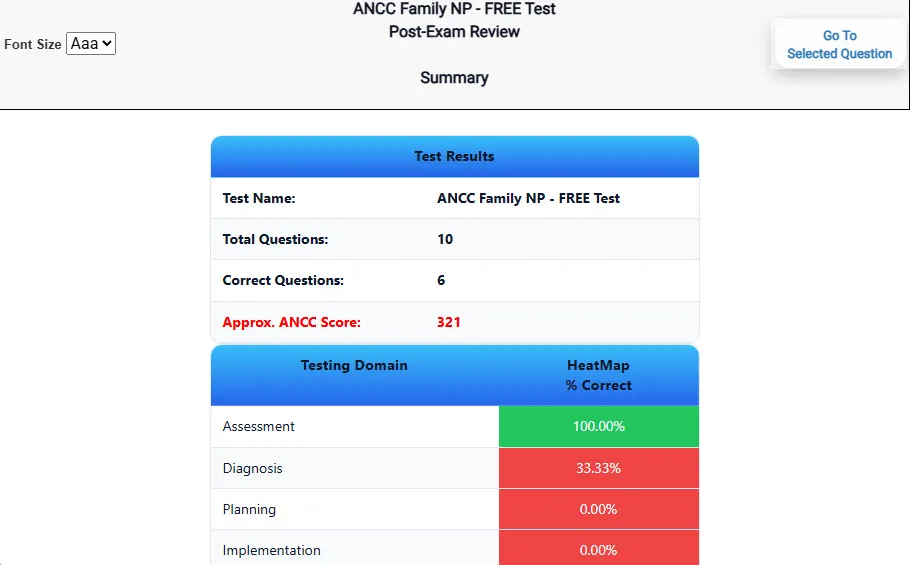
Heatmaps and scaled scores highlight weak areas.

High-Yield Rationales

Concise explanations emphasize key concepts.

Realistic Interface

Matches the feel of the actual exam environment.

Accessible by Design

Clean layout reduces cognitive load.

Anytime, Anywhere

Web-based access 24/7 on any device.
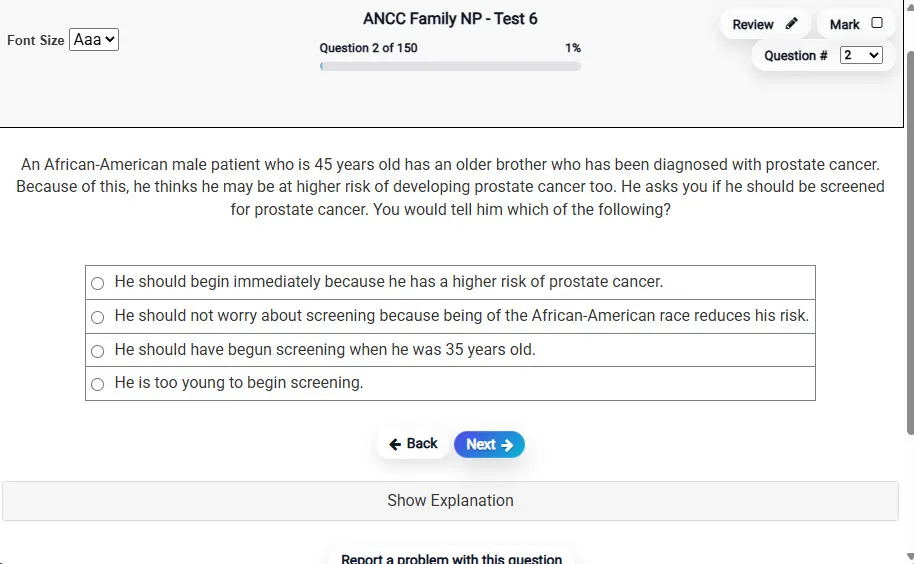
Answering a Question screen – Multiple-choice item view with navigation controls and progress tracker.
Answering a Question Multiple-choice item view with navigation controls and progress tracker.

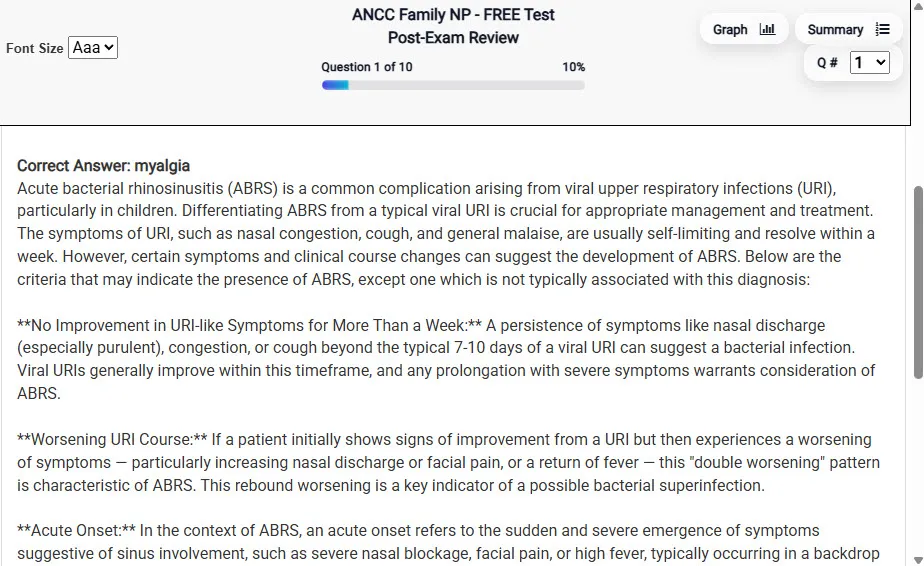
                           Detailed Explanation screen – 
                         Review mode showing chosen answer and rationale and references.
Detailed Explanation Review mode showing chosen answer and rationale and references.

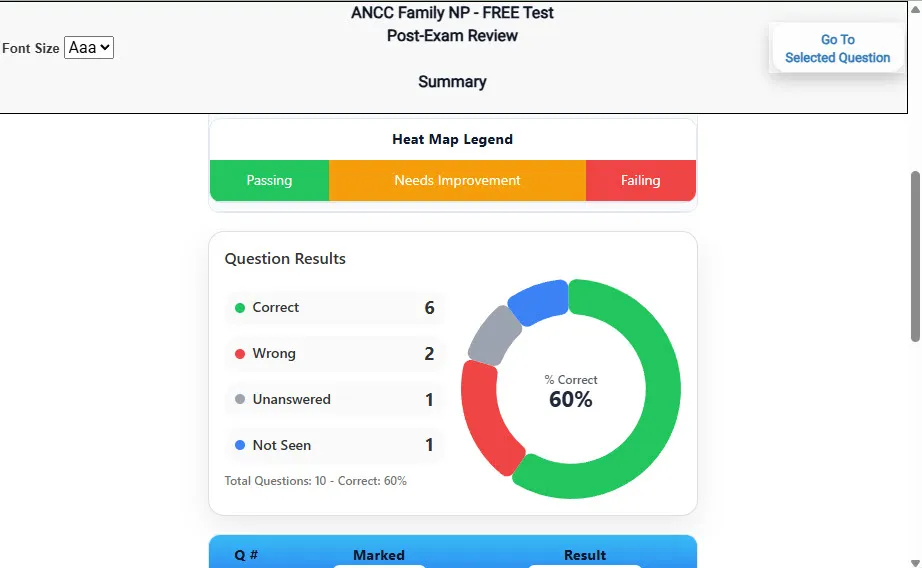
                           Review Summary 1 screen – 
                         Summary with counts for correct/wrong/unanswered and not seen items.
Review Summary 1 Summary with counts for correct/wrong/unanswered and not seen items.

                           Review Summary 2 screen – 
                         Advanced summary with category/domain breakdown and performance insights.
Review Summary 2 Advanced summary with category/domain breakdown and performance insights.

What Each Screen Shows

Answer Question Screen

  • Clean multiple-choice interface with progress bar.
  • Mark for review feature.
  • Matches real test pacing.

Detailed Explanation

  • Correct answer plus rationale.
  • Key concepts and guidelines highlighted.
  • Move between questions to fill knowledge gaps.

Review Summary 1

  • Overall results with total questions and scaled score.
  • Domain heatmap shows strengths and weaknesses.
  • Quick visual feedback on study priorities.

Review Summary 2

  • Chart of correct, wrong, unanswered, not seen.
  • Color-coded results for easy review.
  • Links back to missed items.

Top 10 Reasons to Use Exam Edge for your OAE Prekindergarten (Subtests I & II) Exam Prep

  1. Focused on the OAE Prekindergarten (Subtests I & II) Exam

    Our practice tests are built specifically for the OAE Prekindergarten exam — every question mirrors the real topics, format, and difficulty so you're studying exactly what matters.

  2. Real Exam Simulation

    We match the per-question time limits and pressure of the actual OAE exam, so test day feels familiar and stress-free.

  3. 15 Full Practice Tests & 1,500 Unique Questions

    You'll have more than enough material to master every OAE Prekindergarten concept — no repeats, no fluff.

  4. Lower Cost Than a Retake

    Ordering 5 practice exams costs less than retaking the OAE Prekindergarten (Subtests I & II) exam after a failure. One low fee could save you both time and money.

  5. Flexible Testing

    Need to step away mid-exam? Pick up right where you left off — with your remaining time intact.

  6. Instant Scoring & Feedback

    See your raw score and an estimated OAE Prekindergarten (Subtests I & II) score immediately after finishing each practice test.

  7. Detailed Explanations for Every Question

    Review correct and incorrect answers with clear, step-by-step explanations so you truly understand each topic.

  8. Trusted & Accredited

    We're fully accredited by the Better Business Bureau and uphold the highest standards of trust and transparency.

  9. Web-Based & Always Available

    No software to install. Access your OAE Prekindergarten practice exams 24/7 from any computer or mobile device.

  10. Expert Support When You Need It

    Need extra help? Our specialized tutors are highly qualified and ready to support your OAE exam prep.


Pass the OAE Prekindergarten (Subtests I & II) Exam with Realistic Practice Tests from Exam Edge

Preparing for your upcoming OAE Prekindergarten (Subtests I & II) (036/037) Certification Exam can feel overwhelming — but the right practice makes all the difference. Exam Edge gives you the tools, structure, and confidence to pass on your first try. Our online practice exams are built to match the real OAE Prekindergarten exam in content, format, and difficulty.

  • 📝 15 OAE Prekindergarten (Subtests I & II) Practice Tests: Access 15 full-length exams with 100 questions each, covering every major OAE Prekindergarten (Subtests I & II) topic in depth.
  • Instant Online Access: Start practicing right away — no software, no waiting.
  • 🧠 Step-by-Step Explanations: Understand the reasoning behind every correct answer so you can master OAE Prekindergarten exam concepts.
  • 🔄 Retake Each Exam Up to 4 Times: Build knowledge through repetition and track your improvement over time.
  • 🌐 Web-Based & Available 24/7: Study anywhere, anytime, on any device.
  • 🧘 Boost Your Test-Day Confidence: Familiarity with the OAE format reduces anxiety and helps you perform under pressure.

These OAE Prekindergarten (Subtests I & II) practice exams are designed to simulate the real testing experience by matching question types, timing, and difficulty level. This approach helps you get comfortable not just with the exam content, but also with the testing environment, so you walk into your exam day focused and confident.


Exam Edge OAE Reviews


Today, I took my test and passed with confidence. I took it the first time and failed, but after purchasing this study guide, I was provided with resources that allowed me to take the test and get through it without being nervous. A lot of the questions that were provided in this study guide were si ...
Read More
Stephanie , Ohio

Studied a practice test everyday, and passed my test!

Gracyn, Clinton, Ohio

Great program to study from. Audio and images REALLY boosted my understanding of subjects.

Cherish , NEWARK, OH


OAE Prekindergarten (Subtests I & II) Aliases Test Name

Here is a list of alternative names used for this exam.

  • OAE Prekindergarten (Subtests I & II)
  • OAE Prekindergarten (Subtests I & II) test
  • OAE Prekindergarten (Subtests I & II) Certification Test
  • OAE Prekindergarten test
  • OAE
  • OAE 036/037
  • 036/037 test
  • OAE Prekindergarten (Subtests I & II) (036/037)
  • Prekindergarten (Subtests I & II) certification