This is the content of the pop-over!

Lightning Deal Alert – 12% Off Ends at Midnight!

Strike while the savings are hot! Use promo code FlashSale at checkout for 12% off any Exam Edge test or bundle. Hurry—the clock is ticking!

ILTS TAP Language Arts (400) Practice Tests & Test Prep by Exam Edge


ILTS Test of Academic Proficiency Language Arts  product image
(4.7)
Based on 25 Reviews

  • Real Exam Simulation: Timed questions and matching content build comfort for your ILTS TAP Language Arts test day.
  • Instant, 24/7 Access: Web-based ILTS Test of Academic Proficiency Language Arts practice exams with no software needed.
  • Clear Explanations: Step-by-step answers and explanations for your ILTS exam to strengthen understanding.
  • Boosted Confidence: Reduces anxiety and improves test-taking skills to ace your ILTS Test of Academic Proficiency Language Arts (400).

Featured on

ILTS Test of Academic Proficiency Language Arts Online Practice Test Bundles

BEST VALUE
10 practice tests

$99.50

$399.50

SAVE $300

Only $9.95 per test!

  • 100% Pass Guarantee
  • 10 online practice tests
  • 60 questions + 1 essay per test
  • Bonus: 100 Flash Cards + Study Guide
  • Instant access
  • Detailed Explanations
  • Practice tests never expire
  • Timed, untimed, or study guide mode
5 practice tests

$69.75

$199.75

SAVE $130

Only $13.95 per test!

  • 5 online practice tests
  • 60 questions + 1 essay per test
  • Bonus: 100 Flash Cards + Study Guide
  • Instant access
  • Detailed Explanations
  • Practice tests never expire
  • Timed, untimed, or study guide mode
1 practice test

$39.95

  • 1 online practice test
  • 60 questions + 1 essay per test
  • Instant access
  • Detailed Explanations
  • Practice tests never expire
  • Timed, untimed, or study guide mode
Quick Select
Tap to choose a bundle

** All Prices are in US Dollars (USD) **


ILTS TAP Language Arts (400) Resources

Jump to the section you need most.

Understanding the exact breakdown of the ILTS Test of Academic Proficiency Language Arts test will help you know what to expect and how to most effectively prepare. The ILTS Test of Academic Proficiency Language Arts has multiple-choice questions . The exam will be broken down into the sections below:

ILTS Test of Academic Proficiency Language Arts Exam Blueprint
Domain Name
Language Arts  
     Recognize and apply the standard use of verbs  
     Recognize and apply the standard use of pronouns  
     Recognize and apply the standard use of modifiers
(e.g. - adverbs - adjectives - prepositional phrases).
 
     Understand how language varies according to the
context in which it occurs
 
     Identify standard sentence structure
(e.g. - sentence fragments - run-on sentences).
 
     Identify the standard use of punctuation.  
     Identify the standard use of capitalization  
     Identify the use of standard spelling  
     Demonstrate the ability to prepare a developed composition on a
given topic using language and style appropriate to a given audience - purpose occasion.
 
Writing  
     Understanding the role of purpose and audience in written communications  
     Understanding unity - force - development and organization in writing  
     Understand and Apply editing and revision strategies  

ILTS Test of Academic Proficiency Language Arts Study Tips by Domain

  • Distinguish denotation vs. connotation and explain how word choice shifts tone; red flag: answer choices that treat connotation as “dictionary definition.”
  • Analyze figurative language (metaphor, simile, personification, hyperbole) for its effect on meaning, not just identification; common trap: picking the term without stating the purpose it serves.
  • Recognize how sound and structure devices (alliteration, assonance, rhyme, repetition, parallelism) contribute to emphasis and rhythm; priority rule: tie the device to what idea is being highlighted.
  • Interpret context clues (contrast, example, definition, cause-effect) to determine meaning of unfamiliar words; red flag: choosing a synonym that fits the topic but not the sentence logic.
  • Identify bias, loaded language, and emotional appeals in informational text; common trap: confusing strong tone with credible evidence.
  • Evaluate clarity and precision in language (vague pronouns, ambiguous phrasing, jargon) and select the best revision; red flag: “more complex” wording that reduces readability or changes meaning.
  • Maintain subject–verb agreement, especially with intervening phrases and indefinite pronouns (e.g., “Each of the students is”)—red flag: a plural noun between subject and verb often tricks you into choosing the wrong verb.
  • Use consistent verb tense to match the time frame and sequence—common trap: shifting from past to present within a paragraph without a clear reason or signal.
  • Choose the correct verb form (base, -s, -ing, past, past participle) with auxiliaries—red flag: using “have went” instead of “have gone” or “should of” instead of “should have.”
  • Ensure clear and correct use of helping verbs (be, have, do, modals) for voice and meaning—priority rule: use the passive voice only when the doer is unknown/irrelevant; otherwise prefer active for clarity.
  • Form and punctuate irregular and regular verbs correctly, including past tense and past participles—common trap: confusing “lay/lie” and “raise/rise” (e.g., “He lay down” vs. “He laid the book down”).
  • Use appropriate mood (indicative, imperative, subjunctive) in formal contexts—red flag: in hypotheticals or demands, it’s “if I were” and “I insist that he be,” not “was” or “is.”
  • Ensure every pronoun has a clear, specific antecedent; red flag: a pronoun like “it” or “this” that could refer to more than one noun in the sentence.
  • Match pronouns with antecedents in number and person; common trap: singular indefinites (e.g., “each,” “everyone”) require singular pronouns (often “his or her” or a rewritten plural sentence).
  • Use correct pronoun case (subjective, objective, possessive) based on function; priority rule: remove extra words (e.g., “between you and me”) to hear the correct case.
  • Maintain consistent pronoun point of view; red flag: shifting from “one” to “you” or from “they” to “we” within the same paragraph without a clear reason.
  • Use reflexive and intensive pronouns correctly; common trap: using “myself” or “yourself” as a substitute for “me” or “I” (e.g., “Send it to John and me,” not “John and myself”).
  • Avoid vague, broad, or missing pronoun references in complex sentences; practical cue: when a sentence contains multiple nouns, repeat the noun instead of using a pronoun if clarity is at risk.
  • Place modifiers next to the words they modify; red flag: a dangling intro phrase (e.g., “Walking to class,” followed by an unrelated subject) that makes the meaning illogical.
  • Avoid misplaced “only/just/even”; common trap: moving “only” changes meaning (“She only read the article” vs. “She read only the article”).
  • Use adjectives for nouns and pronouns and adverbs for verbs/adjectives/adverbs; red flag: using an adjective where an adverb is needed (“He runs quick” instead of “quickly”).
  • Watch comparative and superlative forms; priority rule: use “more/most” with many longer adjectives (avoid double comparisons like “more better”).
  • Keep prepositional phrases from creating ambiguity or wordiness; common trap: stacking phrases so the referent is unclear (“the picture of the student on the wall”).
  • Maintain parallel structure in lists and paired constructions; red flag: mixing modifier forms (e.g., “quick, carefully, and with confidence”) instead of matching patterns.
  • Match register to context: informal for peer texts and formal for academic/professional settings—red flag is slang, emojis, or contractions in a formal letter unless the purpose explicitly invites them.
  • Choose diction by audience knowledge level: define or replace jargon for general readers—common trap is assuming the reader knows acronyms or technical terms without explanation.
  • Adapt tone to situation (persuasive, explanatory, critical, empathetic) and keep it consistent—red flag is a sudden shift from objective analysis to sarcastic or overly emotional language.
  • Use Standard English in edited writing and appropriate dialect/colloquialism only when context supports it (e.g., dialogue, quoted speech)—priority rule: don’t “correct” dialect inside quotations when preserving voice is the goal.
  • Adjust sentence length and structure for purpose: concise for instructions and more varied/complex for analysis—common trap is long, multi-clause sentences that obscure meaning in directions or summaries.
  • Respect genre conventions (e.g., email greeting/closing, memo headings, academic thesis/claims)—red flag is missing expected features like a clear subject line or an explicit claim when the context requires one.
  • Spot sentence fragments by checking for a complete independent clause (subject + finite verb) — red flag: a dependent clause starting with “because/when/although” standing alone.
  • Detect run-on sentences by verifying correct boundaries between independent clauses — common trap: joining two complete sentences with only a comma (comma splice).
  • Use coordination correctly: independent clause + comma + FANBOYS + independent clause — priority rule: no comma is needed if the second part isn’t an independent clause.
  • Use semicolons to join closely related independent clauses without a conjunction — red flag: using a semicolon between an independent and a dependent clause.
  • Apply subordination to fix run-ons: add a subordinating conjunction or restructure so only one independent clause remains — common trap: adding a comma alone does not fix a fused sentence.
  • Check for missing or faulty subjects/verbs in compound structures — red flag: a participial phrase (e.g., “Running down the street”) that isn’t attached to a clear subject (dangling opener often reads like a fragment).
  • Use commas correctly with coordinating conjunctions joining two independent clauses; red flag: a comma splice (two full sentences joined by only a comma).
  • Place commas after introductory elements (e.g., prepositional phrases, participial phrases, dependent clauses); common trap: skipping the comma after a long introductory clause makes the sentence hard to parse.
  • Use semicolons to join closely related independent clauses or to separate complex list items; priority rule: don’t use a semicolon unless both sides could stand alone as sentences.
  • Use apostrophes for possession and contractions, not plurals; red flag: “the 1990’s” or “apple’s for sale” is incorrect (should be “1990s” and “apples”).
  • Use quotation marks for direct quotations and place commas/periods inside closing quotation marks in standard American English; common trap: mixing up when to italicize/underline titles versus put them in quotation marks.
  • Use colons to introduce lists or explanations only after an independent clause; red flag: inserting a colon after a verb or preposition (e.g., “including:”) is usually incorrect.
  • Capitalize the first word of every sentence and of direct quotations that form a complete sentence—red flag: a quoted fragment should not be capitalized.
  • Capitalize proper nouns and proper adjectives (e.g., “Illinois,” “Shakespearean”), but not common nouns used generically—trap: capitalizing “state” or “government” when not part of an official name.
  • Capitalize official titles only when they immediately precede a name (e.g., “President Lincoln”) and lowercase when used after or alone—common error: “the President spoke” when not used as a formal title.
  • Capitalize days, months, holidays, languages, and nationalities, but not seasons unless part of a title—threshold cue: “spring semester” is typically lowercase.
  • Capitalize the first and last words in titles and all major words (nouns, pronouns, verbs, adjectives, adverbs, subordinating conjunctions), but not short articles/prepositions/coordinating conjunctions—trap: capitalizing “of,” “and,” or “the” mid-title.
  • In letters and emails, capitalize the pronoun “I” and the first word of a salutation/closing—red flag: casual lowercase openings (e.g., “hi,”) are nonstandard in formal writing.
  • Check for commonly confused spellings and homophones (e.g., “their/there/they’re,” “to/too/two”)—a frequent trap is choosing the right-sounding word with the wrong spelling.
  • Apply spelling rules for i-before-e (with common exceptions like “weird” and “neighbor”)—red flag: assuming the rule is universal.
  • Maintain correct spelling when adding suffixes (e.g., drop final silent e: “make” → “making,” but keep it for “changeable”)—trap: changing the base word incorrectly.
  • Use correct doubling rules with -ing/-ed (e.g., “commit” → “committed,” but “visit” → “visited”)—priority cue: watch stressed final syllables and CVC patterns.
  • Spell plurals and possessives accurately (e.g., “children’s,” “teachers’ lounge,” “it’s/its”)—red flag: adding apostrophes to make simple plurals.
  • Recognize correct spellings of frequently misspelled academic words (e.g., “separate,” “definitely,” “occurrence,” “accommodate”)—trap: phonetic spelling that matches pronunciation but not standard form.
  • Start by locking in purpose, audience, and occasion before drafting; a red flag is a thesis that never answers the prompt’s task verb (e.g., explain vs. argue).
  • Write a clear controlling idea early and keep every paragraph tied to it; common trap: adding “interesting” points that don’ t directly support the main claim.
  • Develop with specific evidence (examples, brief facts, or concrete details) and explain how each supports your point; priority rule: aim for evidence + commentary, not a list of examples.
  • Match tone and diction to the intended reader and situation; red flag: shifting from formal to slangy language (or using text-speak) in an academic or professional occasion.
  • Organize logically with purposeful transitions (cause/effect, comparison, sequence); common trap: relying on “First/Second/Third” without showing clear relationships between ideas.
  • Use introductions and conclusions strategically (context + thesis; synthesis + final emphasis); red flag: ending with new major evidence or a generic “In conclusion, I have shown…” restatement only.
  • Plan quickly around a clear thesis and controlling idea; red flag: a prompt response that summarizes the topic but never takes a position or angle.
  • Organize with purposeful paragraphing (intro with thesis, body with topic sentences, conclusion that reinforces); common trap: a list of points with no logical transitions or escalation of support.
  • Develop with specific evidence (examples, details, brief explanations) tied back to the claim; red flag: vague statements like “everyone knows” or unsupported generalizations.
  • Match tone, diction, and level of formality to the stated audience/purpose; common trap: slipping into casual slang or overly emotional language in an academic task (or vice versa).
  • Revise for unity and coherence before editing for correctness; priority rule: fix meaning/structure first, then sentences, then mechanics to avoid polishing weak content.
  • Proofread for high-impact errors that distract scorers (fragments/run-ons, tense shifts, pronoun reference, comma splices); red flag: repeated pattern errors rather than an occasional mistake.
  • Identify the writer’s primary purpose (to inform, persuade, entertain, explain) and verify every major claim or detail supports it; red flag: paragraphs that shift purpose midstream (e.g., arguing after promising to inform).
  • Match tone and register to the audience’s relationship and expectations (formal vs. conversational, objective vs. personal); common trap: slang, sarcasm, or overly casual phrasing in professional or academic contexts.
  • Adjust content depth for audience knowledge level (define terms for novices, omit basics for experts); priority rule: add context before specialized vocabulary when the audience is unfamiliar.
  • Select evidence and appeals (facts, examples, logic, credibility, emotion) appropriate to the audience; red flag: heavy emotional language where the audience expects data-driven support.
  • Use audience-appropriate organization and cues (headings, transitions, direct thesis) to guide reading; common trap: burying the main point late when the audience needs it upfront (e.g., instructions, letters, memos).
  • Maintain consistent point of view and level of formality for the intended audience throughout; contraindication: abrupt switches between “I/you/we” or formal/informal address that confuse who is being spoken to.
  • Use a clear controlling idea (thesis) that directly answers the prompt; red flag: an opening that is descriptive but makes no arguable claim.
  • Maintain unity by ensuring every paragraph supports the controlling idea; common trap: including a “good” example that doesn’t actually prove the point.
  • Create force with purposeful emphasis (strong verbs, precise diction, strategic sentence variety) without sacrificing clarity; red flag: inflated wording that obscures meaning.
  • Develop ideas with specific evidence (examples, reasons, brief explanation of how the evidence supports the claim); priority rule: don’t list facts—interpret them.
  • Organize logically with a consistent structure (e.g., general-to-specific, problem-solution, compare-contrast) and clear transitions; red flag: abrupt topic shifts or “and another thing” progression.
  • Use an introduction that sets context and a conclusion that synthesizes the main points (not just repeats them); common trap: adding new evidence or a new claim in the final sentences.
  • Revise for focus first: confirm the thesis/controlling idea and delete sentences that don’t support it (red flag: a paragraph that could be moved anywhere without changing meaning).
  • Strengthen organization by checking each paragraph has a clear topic sentence and logical transitions (common trap: listing ideas without showing cause/effect, comparison, or sequence).
  • Develop content with specific evidence and explanation, not just assertions (priority rule: add “why/how” sentences after facts to show the point).
  • Improve clarity by making subjects and verbs explicit and replacing vague references (red flag: repeated “this/it/they” with unclear antecedents).
  • Edit at the sentence level after revising: fix fragments, run-ons, and awkward coordination/subordination (common trap: comma splices created by joining two complete sentences with only a comma).
  • Proofread last for surface errors—spelling, capitalization, punctuation, and consistency—using one-pass checks (threshold cue: if a single error pattern repeats, scan specifically for that pattern across the whole draft).


Built to Fit Into Your Busy Life

Everything you need to prepare with confidence—without wasting a minute.

Three Study Modes

Timed, No Time Limit, or Explanation mode.

Actionable Analytics

Heatmaps and scaled scores highlight weak areas.

High-Yield Rationales

Concise explanations emphasize key concepts.

Realistic Interface

Matches the feel of the actual exam environment.

Accessible by Design

Clean layout reduces cognitive load.

Anytime, Anywhere

Web-based access 24/7 on any device.
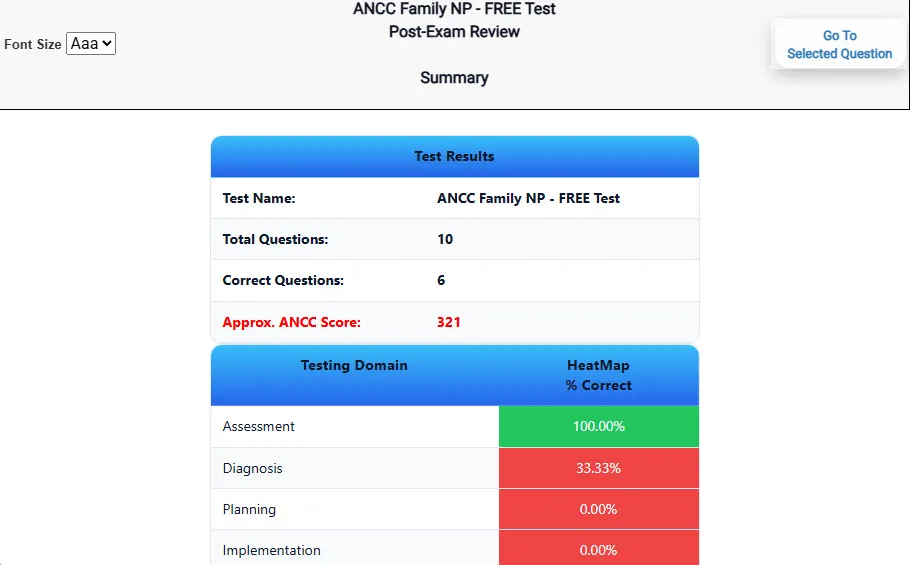
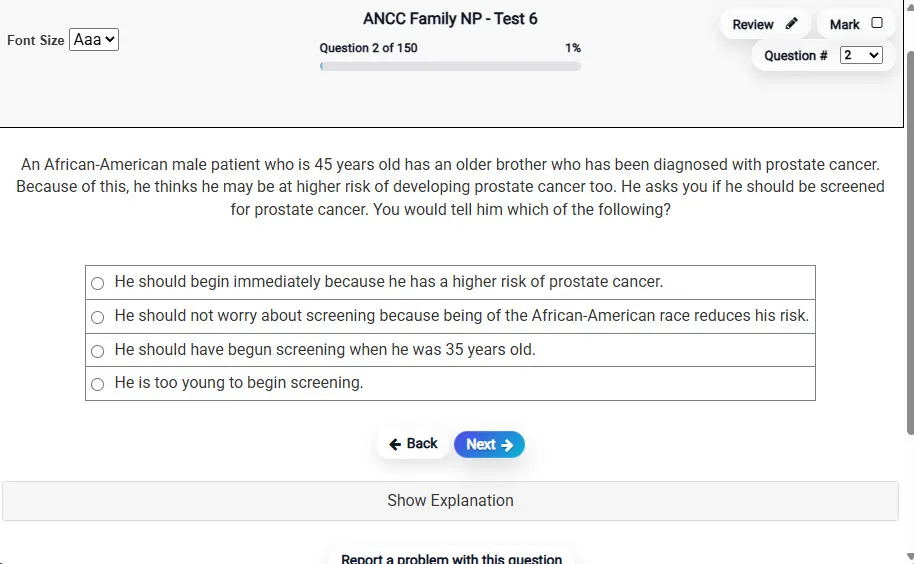
Answering a Question screen – Multiple-choice item view with navigation controls and progress tracker.
Answering a Question Multiple-choice item view with navigation controls and progress tracker.

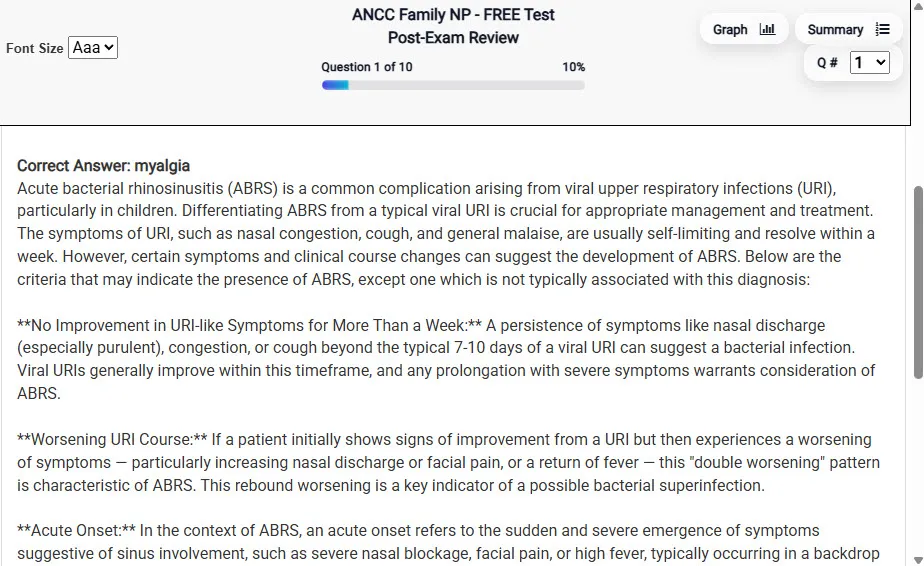
                           Detailed Explanation screen – 
                         Review mode showing chosen answer and rationale and references.
Detailed Explanation Review mode showing chosen answer and rationale and references.

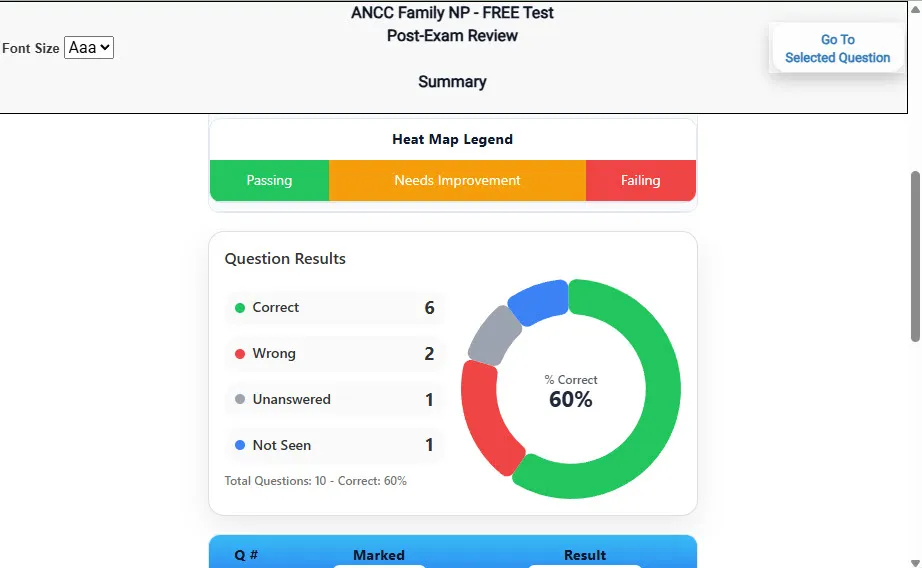
                           Review Summary 1 screen – 
                         Summary with counts for correct/wrong/unanswered and not seen items.
Review Summary 1 Summary with counts for correct/wrong/unanswered and not seen items.

                           Review Summary 2 screen – 
                         Advanced summary with category/domain breakdown and performance insights.
Review Summary 2 Advanced summary with category/domain breakdown and performance insights.

What Each Screen Shows

Answer Question Screen

  • Clean multiple-choice interface with progress bar.
  • Mark for review feature.
  • Matches real test pacing.

Detailed Explanation

  • Correct answer plus rationale.
  • Key concepts and guidelines highlighted.
  • Move between questions to fill knowledge gaps.

Review Summary 1

  • Overall results with total questions and scaled score.
  • Domain heatmap shows strengths and weaknesses.
  • Quick visual feedback on study priorities.

Review Summary 2

  • Chart of correct, wrong, unanswered, not seen.
  • Color-coded results for easy review.
  • Links back to missed items.

Top 10 Reasons to Use Exam Edge for your ILTS Test of Academic Proficiency Language Arts Exam Prep

  1. Focused on the ILTS Test of Academic Proficiency Language Arts Exam

    Our practice tests are built specifically for the ILTS TAP Language Arts exam — every question mirrors the real topics, format, and difficulty so you're studying exactly what matters.

  2. Real Exam Simulation

    We match the per-question time limits and pressure of the actual ILTS exam, so test day feels familiar and stress-free.

  3. 10 Full Practice Tests & 610 Unique Questions

    You'll have more than enough material to master every ILTS TAP Language Arts concept — no repeats, no fluff.

  4. Lower Cost Than a Retake

    Ordering 5 practice exams costs less than retaking the ILTS Test of Academic Proficiency Language Arts exam after a failure. One low fee could save you both time and money.

  5. Flexible Testing

    Need to step away mid-exam? Pick up right where you left off — with your remaining time intact.

  6. Instant Scoring & Feedback

    See your raw score and an estimated ILTS Test of Academic Proficiency Language Arts score immediately after finishing each practice test.

  7. Detailed Explanations for Every Question

    Review correct and incorrect answers with clear, step-by-step explanations so you truly understand each topic.

  8. Trusted & Accredited

    We're fully accredited by the Better Business Bureau and uphold the highest standards of trust and transparency.

  9. Web-Based & Always Available

    No software to install. Access your ILTS TAP Language Arts practice exams 24/7 from any computer or mobile device.

  10. Expert Support When You Need It

    Need extra help? Our specialized tutors are highly qualified and ready to support your ILTS exam prep.


Pass the ILTS Test of Academic Proficiency Language Arts Exam with Realistic Practice Tests from Exam Edge

Preparing for your upcoming ILTS Test of Academic Proficiency Language Arts (400) Certification Exam can feel overwhelming — but the right practice makes all the difference. Exam Edge gives you the tools, structure, and confidence to pass on your first try. Our online practice exams are built to match the real ILTS TAP Language Arts exam in content, format, and difficulty.

  • 📝 10 ILTS Test of Academic Proficiency Language Arts Practice Tests: Access 10 full-length exams with 61 questions each, covering every major ILTS Test of Academic Proficiency Language Arts topic in depth.
  • Instant Online Access: Start practicing right away — no software, no waiting.
  • 🧠 Step-by-Step Explanations: Understand the reasoning behind every correct answer so you can master ILTS TAP Language Arts exam concepts.
  • 🔄 Retake Each Exam Up to 4 Times: Build knowledge through repetition and track your improvement over time.
  • 🌐 Web-Based & Available 24/7: Study anywhere, anytime, on any device.
  • 🧘 Boost Your Test-Day Confidence: Familiarity with the ILTS format reduces anxiety and helps you perform under pressure.

These ILTS Test of Academic Proficiency Language Arts practice exams are designed to simulate the real testing experience by matching question types, timing, and difficulty level. This approach helps you get comfortable not just with the exam content, but also with the testing environment, so you walk into your exam day focused and confident.


Exam Edge ILTS Reviews


I used Exam Edge to help me pass my Science 4-8 TExES exam on my first try! The practice exams look exactly how the real test looked and the timer helped me be a little less nervous. Now I’m using their practice exams to help me prepare to take my Science 7-12 TExES exam. Wish me luck! :)

Shamai , TX

Dear Exam Edge, I recently ordered a five-pack of tests and successfully passed the ILTS Mathematics content area test with a score of 280/300. I found your tests a very effective way of testing my knowledge of the content material on the real test and seeing explanations of each problem. I scored b ...
Read More
Alistair, IL

The practice tests were EXACTLY what I needed! The test explanations for answers were the teaching points I needed to help understand certain subjects. Thank you for your help!

Arnita , South Holland, Illinois

These practice exams really put my mind at ease! I feel confident about taking my test when the current situation is over. EDIT: Yep. Nailed it.

Sean , Silver Spring , MD

Navigating this site is excellent. Thank you

dwaina , chicago, Illinois

These are great exams to help prepare you for the exams. I passed my ILTS Learning Behavior Specialist I (155) exam on the first attempt. The question structure readily prepares you for how the structure will be on the test, multiple choice questions that are relevant to what is needed to know for t ...
Read More
Jugoslav, Cook County, Illinois


ILTS Test of Academic Proficiency Language Arts Aliases Test Name

Here is a list of alternative names used for this exam.

  • ILTS Test of Academic Proficiency Language Arts
  • ILTS Test of Academic Proficiency Language Arts test
  • ILTS Test of Academic Proficiency Language Arts Certification Test
  • ILTS TAP Language Arts test
  • ILTS
  • ILTS 400
  • 400 test
  • ILTS Test of Academic Proficiency Language Arts (400)
  • Test of Academic Proficiency Language Arts certification