This is the content of the pop-over!

ILTS Speech Teaching (153) Practice Tests & Test Prep by Exam Edge


ILTS Speech-Language Pathologist Pathologist Teaching  product image
(5.0)
Based on 17 Reviews

  • Real Exam Simulation: Timed questions and matching content build comfort for your ILTS Speech Teaching test day.
  • Instant, 24/7 Access: Web-based ILTS Speech-Language Pathologist Pathologist Teaching practice exams with no software needed.
  • Clear Explanations: Step-by-step answers and explanations for your ILTS exam to strengthen understanding.
  • Boosted Confidence: Reduces anxiety and improves test-taking skills to ace your ILTS Speech-Language Pathologist Pathologist Teaching (153).

Featured on

ILTS Speech-Language Pathologist Pathologist Teaching Online Practice Test Bundles

BEST VALUE
20 practice tests

$174.00

$799.00

SAVE $625

Only $8.70 per test!

  • 100% Pass Guarantee
  • 20 online practice tests
  • 100 questions per test
  • Bonus: 100 Flash Cards + Study Guide
  • Instant access
  • Detailed Explanations
  • Practice tests never expire
  • Timed, untimed, or study guide mode
MOST POPULAR
10 practice tests

$99.50

$399.50

SAVE $300

Only $9.95 per test!

  • 10 online practice tests
  • 100 questions per test
  • Bonus: 100 Flash Cards + Study Guide
  • Instant access
  • Detailed Explanations
  • Practice tests never expire
  • Timed, untimed, or study guide mode
5 practice tests

$69.75

$199.75

SAVE $130

Only $13.95 per test!

  • 5 online practice tests
  • 100 questions per test
  • Bonus: 100 Flash Cards
  • Instant access
  • Detailed Explanations
  • Practice tests never expire
  • Timed, untimed, or study guide mode
1 practice test

$39.95

  • 1 online practice test
  • 100 questions per test
  • Instant access
  • Detailed Explanations
  • Practice tests never expire
  • Timed, untimed, or study guide mode
Quick Select
Tap to choose a bundle

** All Prices are in US Dollars (USD) **


ILTS Speech Teaching (153) Resources

Jump to the section you need most.

Understanding the exact breakdown of the ILTS Speech-Language Pathologist Pathologist Teaching test will help you know what to expect and how to most effectively prepare. The ILTS Speech-Language Pathologist Pathologist Teaching has multiple-choice questions . The exam will be broken down into the sections below:

ILTS Speech-Language Pathologist Pathologist Teaching Exam Blueprint
Domain Name
Foundations and Characteristics  
Assessing Students and Developing Individualized Education Programs (IEPs)  
Planning and Delivering Instructional Content  
Managing the Learning Environment and Promoting Students' Social Interaction Skills  
Maintaining Effective Communication - Collaboration Professionalism  

ILTS Speech-Language Pathologist Pathologist Teaching Study Tips by Domain

  • Differentiate speech vs. language vs. hearing vs. swallowing/feeding disorders, and remember: articulation is sound production while phonology is sound patterns—mislabeling these is a common ILTS trap.
  • Know developmental norms and variability across ages, but use them as screening guides only—red flag: making an eligibility decision based solely on a milestone chart without data from multiple contexts.
  • Compare major theoretical perspectives (e.g., behaviorist, social-interactionist, information-processing) and link them to intervention implications—priority rule: choose approaches supported by evidence for the target skill and student profile.
  • Recognize cultural/linguistic differences vs. disorder, especially in bilingual/multidialectal speakers—red flag: treating code-switching or dialect features as errors requiring remediation.
  • Understand basic anatomy/physiology for speech and swallowing (respiration, phonation, resonance, articulation) and common etiologies (neurological, structural, developmental)—contraindication: initiating oral-motor or feeding tasks without medical/clinical clearance when aspiration risk is suspected.
  • Apply principles of typical social-communication development (pragmatics, joint attention, narrative, turn-taking) and its impact on learning—common trap: targeting isolated vocabulary/grammar without addressing functional communication demands in classroom routines.
  • Select assessments that are valid for the suspected disorder and linguistically appropriate; red flag: using a single standardized score as the sole basis for eligibility or service minutes.
  • Differentiate language disorder from language difference by analyzing developmental history, exposure, and performance across contexts; common trap: misidentifying bilingual acquisition patterns as impairment.
  • Use a systematic process for data collection (case history, observation, informal measures, standardized tools, work samples) and document consistency; priority rule: converge evidence from multiple sources before concluding impairment.
  • Translate evaluation results into present levels of academic achievement and functional performance (PLAAFP) with measurable baseline data; red flag: PLAAFP statements that describe services instead of student performance.
  • Write IEP goals that are specific, measurable, attainable, relevant, and time-bound with clear criteria and evaluation procedures; common trap: goals like “will improve articulation” without % accuracy, conditions, or timeframe.
  • Align services, accommodations, and progress monitoring to the student’s needs and educational impact; contraindication: recommending therapy targets that do not support access to or progress in the curriculum or functional communication.
  • Write measurable, standards-aligned goals with clear criteria (e.g., “80% accuracy across 3 consecutive sessions”); red flag: goals that list activities (e.g., “will practice”) instead of observable performance.
  • Select intervention approaches that match the disorder profile and evidence base (e.g., phonological vs. articulation vs. language); common trap: treating /r/ distortion with only minimal-pair phonological contrasts when the primary need is motor-based shaping.
  • Plan for generalization from structured practice to classroom routines using multiple exemplars and settings; priority rule: build carryover targets into teacher-led tasks rather than keeping progress confined to the therapy room.
  • Use a consistent data-collection method (trial-by-trial, rubrics, probes) and set probe schedules; red flag: changing measurement procedures midstream, which can make progress data non-comparable for IEP reporting.
  • Differentiate instruction via scaffolds and accommodations (visual supports, AAC, reduced linguistic load) while preserving the communication target; contraindication: overprompting that creates prompt dependency and inflates accuracy.
  • Implement behavior and engagement supports (clear routines, choice, reinforcement tied to communication attempts) to maximize instructional time; common trap: using reinforcement that inadvertently rewards avoidance or off-task speech rather than communicative participation.
  • Set explicit expectations for communication behaviors (e.g., turn-taking, repair strategies) and teach them with visual cues; red flag: assuming social skills will generalize without direct instruction across settings.
  • Use structured practice (peer-mediated activities, scripted roles, cooperative learning) to build pragmatic skills; common trap: over-reliance on 1:1 pull-out when the goal is functional use in natural classrooms.
  • Coordinate environmental supports (preferential seating, noise control, FM/DM systems) to reduce access barriers; priority rule: address listening/access needs before increasing linguistic demands.
  • Implement behavior-support plans that link communication breakdowns to antecedents and teach replacement communication; red flag: treating “noncompliance” without checking for comprehension, sensory load, or AAC access.
  • Promote positive social interaction by matching peers, preparing partners, and embedding opportunities for initiation and maintenance; common trap: counting “participation” when the student is only responding and never initiating.
  • Monitor safety and dignity during group activities (confidentiality, respectful prompting, least intrusive supports); contraindication: prompting that singles out the student or reveals disability-related information to peers.
  • Use family-centered, culturally and linguistically responsive communication; red flag: relying on an interpreter to “explain goals” instead of using the interpreter to accurately convey your message.
  • Collaborate within MTSS/RTI and special education teams by defining roles, timelines, and decision rules; common trap: providing pull-out services without documenting how they align with team-agreed data and classroom impact.
  • Maintain confidentiality under IDEA/FERPA and district policy—share only on a legitimate educational interest basis; red flag: discussing a student’s case in hallways, staff rooms, or unsecured email.
  • Write clear, defensible documentation (session notes, progress reports, Medicaid logs if applicable) with objective data; common trap: using vague statements like “making progress” without measures tied to goals.
  • Provide consultation/coaching to general educators and related service providers with actionable strategies; priority rule: recommendations must be feasible in the classroom routine, not dependent on specialized materials no one else has.
  • Demonstrate ethical practice and professional boundaries (ASHA Code principles as commonly tested) including conflict-of-interest avoidance; red flag: accepting gifts/services that could be perceived as influencing eligibility, placement, or service decisions.


Built to Fit Into Your Busy Life

Everything you need to prepare with confidence—without wasting a minute.

Three Study Modes

Timed, No Time Limit, or Explanation mode.

Actionable Analytics

Heatmaps and scaled scores highlight weak areas.

High-Yield Rationales

Concise explanations emphasize key concepts.

Realistic Interface

Matches the feel of the actual exam environment.

Accessible by Design

Clean layout reduces cognitive load.

Anytime, Anywhere

Web-based access 24/7 on any device.
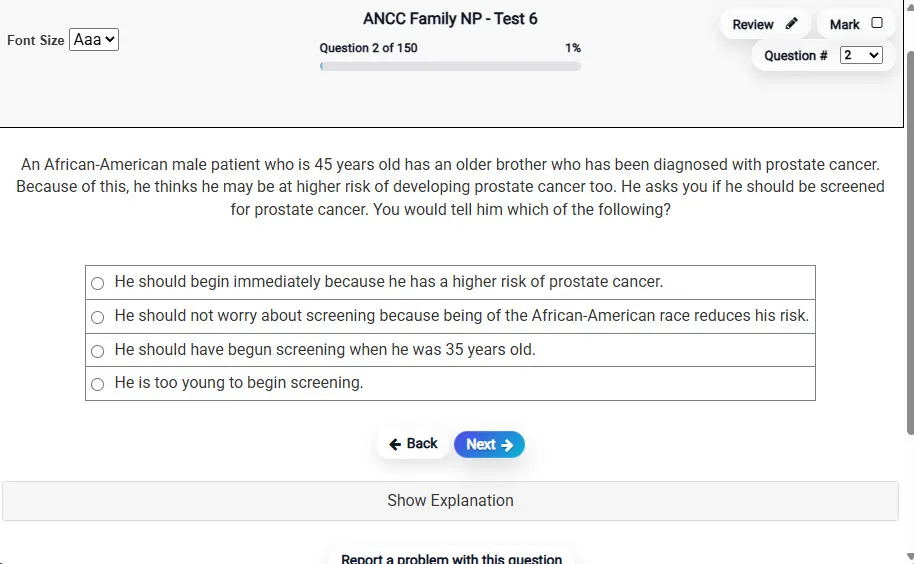
Answering a Question screen – Multiple-choice item view with navigation controls and progress tracker.
Answering a Question Multiple-choice item view with navigation controls and progress tracker.

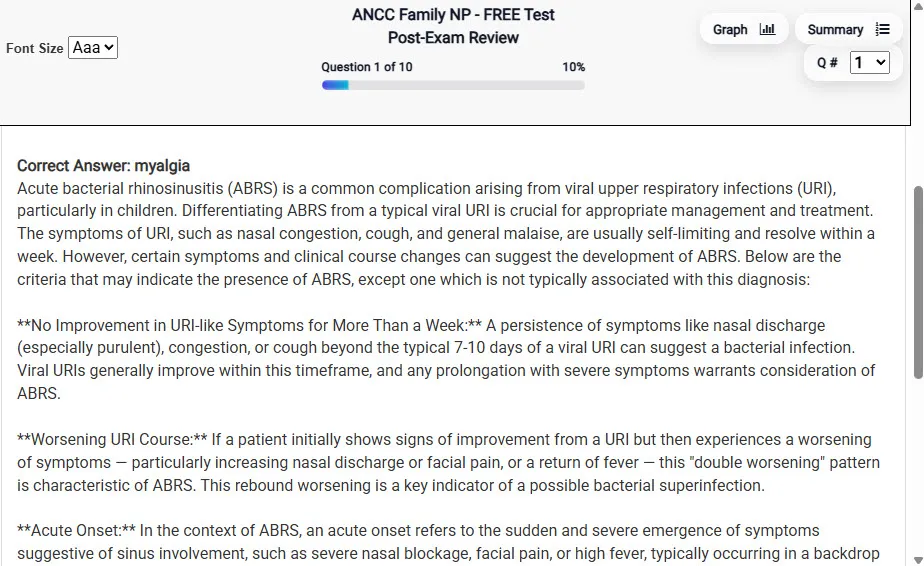
                           Detailed Explanation screen – 
                         Review mode showing chosen answer and rationale and references.
Detailed Explanation Review mode showing chosen answer and rationale and references.

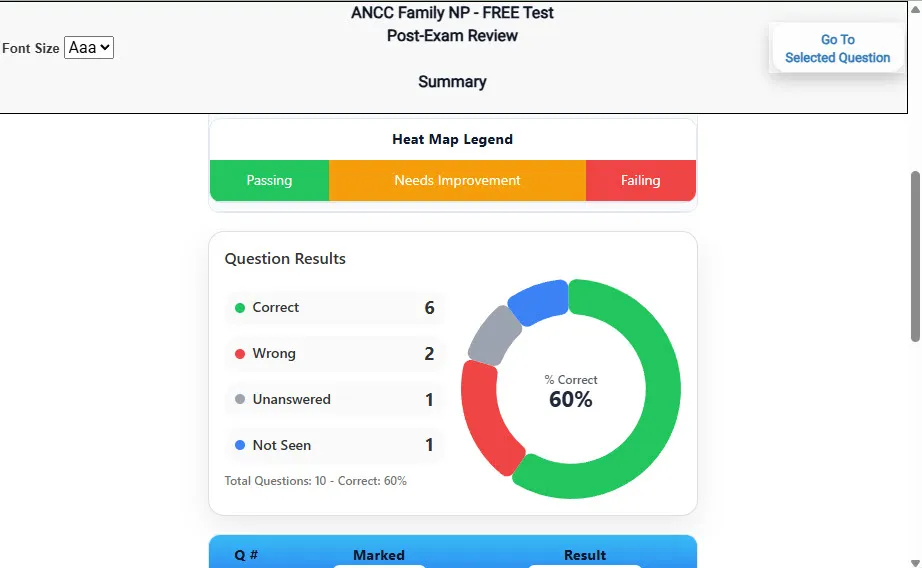
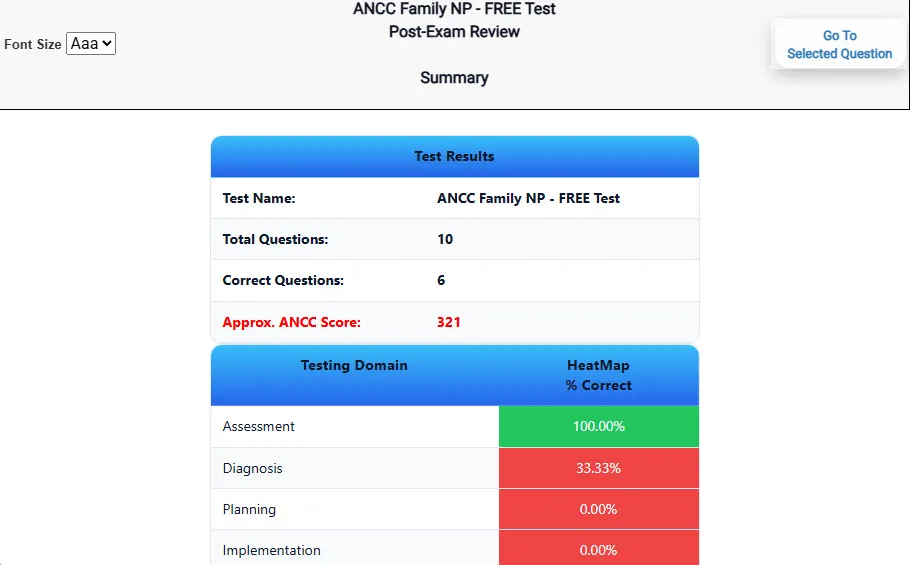
                           Review Summary 1 screen – 
                         Summary with counts for correct/wrong/unanswered and not seen items.
Review Summary 1 Summary with counts for correct/wrong/unanswered and not seen items.

                           Review Summary 2 screen – 
                         Advanced summary with category/domain breakdown and performance insights.
Review Summary 2 Advanced summary with category/domain breakdown and performance insights.

What Each Screen Shows

Answer Question Screen

  • Clean multiple-choice interface with progress bar.
  • Mark for review feature.
  • Matches real test pacing.

Detailed Explanation

  • Correct answer plus rationale.
  • Key concepts and guidelines highlighted.
  • Move between questions to fill knowledge gaps.

Review Summary 1

  • Overall results with total questions and scaled score.
  • Domain heatmap shows strengths and weaknesses.
  • Quick visual feedback on study priorities.

Review Summary 2

  • Chart of correct, wrong, unanswered, not seen.
  • Color-coded results for easy review.
  • Links back to missed items.

Top 10 Reasons to Use Exam Edge for your ILTS Speech-Language Pathologist Pathologist Teaching Exam Prep

  1. Focused on the ILTS Speech-Language Pathologist Pathologist Teaching Exam

    Our practice tests are built specifically for the ILTS Speech Teaching exam — every question mirrors the real topics, format, and difficulty so you're studying exactly what matters.

  2. Real Exam Simulation

    We match the per-question time limits and pressure of the actual ILTS exam, so test day feels familiar and stress-free.

  3. 20 Full Practice Tests & 2,000 Unique Questions

    You'll have more than enough material to master every ILTS Speech Teaching concept — no repeats, no fluff.

  4. Lower Cost Than a Retake

    Ordering 5 practice exams costs less than retaking the ILTS Speech-Language Pathologist Pathologist Teaching exam after a failure. One low fee could save you both time and money.

  5. Flexible Testing

    Need to step away mid-exam? Pick up right where you left off — with your remaining time intact.

  6. Instant Scoring & Feedback

    See your raw score and an estimated ILTS Speech-Language Pathologist Pathologist Teaching score immediately after finishing each practice test.

  7. Detailed Explanations for Every Question

    Review correct and incorrect answers with clear, step-by-step explanations so you truly understand each topic.

  8. Trusted & Accredited

    We're fully accredited by the Better Business Bureau and uphold the highest standards of trust and transparency.

  9. Web-Based & Always Available

    No software to install. Access your ILTS Speech Teaching practice exams 24/7 from any computer or mobile device.

  10. Expert Support When You Need It

    Need extra help? Our specialized tutors are highly qualified and ready to support your ILTS exam prep.


Pass the ILTS Speech-Language Pathologist Pathologist Teaching Exam with Realistic Practice Tests from Exam Edge

Preparing for your upcoming ILTS Speech-Language Pathologist Pathologist Teaching (153) Certification Exam can feel overwhelming — but the right practice makes all the difference. Exam Edge gives you the tools, structure, and confidence to pass on your first try. Our online practice exams are built to match the real ILTS Speech Teaching exam in content, format, and difficulty.

  • 📝 20 ILTS Speech-Language Pathologist Pathologist Teaching Practice Tests: Access 20 full-length exams with 100 questions each, covering every major ILTS Speech-Language Pathologist Pathologist Teaching topic in depth.
  • Instant Online Access: Start practicing right away — no software, no waiting.
  • 🧠 Step-by-Step Explanations: Understand the reasoning behind every correct answer so you can master ILTS Speech Teaching exam concepts.
  • 🔄 Retake Each Exam Up to 4 Times: Build knowledge through repetition and track your improvement over time.
  • 🌐 Web-Based & Available 24/7: Study anywhere, anytime, on any device.
  • 🧘 Boost Your Test-Day Confidence: Familiarity with the ILTS format reduces anxiety and helps you perform under pressure.

These ILTS Speech-Language Pathologist Pathologist Teaching practice exams are designed to simulate the real testing experience by matching question types, timing, and difficulty level. This approach helps you get comfortable not just with the exam content, but also with the testing environment, so you walk into your exam day focused and confident.

Exam Edge ILTS Reviews


Dear Exam Edge, I recently ordered a five-pack of tests and successfully passed the ILTS Mathematics content area test with a score of 280/300. I found your tests a very effective way of testing my knowledge of the content material on the real test and seeing explanations of each problem. I scored b ...
Read More
Alistair, IL

Navigating this site is excellent. Thank you

dwaina , chicago, Illinois

The practice tests were EXACTLY what I needed! The test explanations for answers were the teaching points I needed to help understand certain subjects. Thank you for your help!

Arnita , South Holland, Illinois

These practice exams really put my mind at ease! I feel confident about taking my test when the current situation is over. EDIT: Yep. Nailed it.

Sean , Silver Spring , MD

I used Exam Edge to help me pass my Science 4-8 TExES exam on my first try! The practice exams look exactly how the real test looked and the timer helped me be a little less nervous. Now I’m using their practice exams to help me prepare to take my Science 7-12 TExES exam. Wish me luck! :)

Shamai , TX

These are great exams to help prepare you for the exams. I passed my ILTS Learning Behavior Specialist I (155) exam on the first attempt. The question structure readily prepares you for how the structure will be on the test, multiple choice questions that are relevant to what is needed to know for t ...
Read More
Jugoslav, Cook County, Illinois


ILTS Speech-Language Pathologist Pathologist Teaching Aliases Test Name

Here is a list of alternative names used for this exam.

  • ILTS Speech-Language Pathologist Pathologist Teaching
  • ILTS Speech-Language Pathologist Pathologist Teaching test
  • ILTS Speech-Language Pathologist Pathologist Teaching Certification Test
  • ILTS Speech Teaching test
  • ILTS
  • ILTS 153
  • 153 test
  • ILTS Speech-Language Pathologist Pathologist Teaching (153)
  • Speech-Language Pathologist Pathologist Teaching certification