This is the content of the pop-over!

Lightning Deal Alert – 12% Off Ends at Midnight!

Strike while the savings are hot! Use promo code FlashSale at checkout for 12% off any Exam Edge test or bundle. Hurry—the clock is ticking!

APA FPC Test Prep & Practice Questions


APA Fundamental Payroll Certification (FPC) product image
(5.0)
Based on 32 Reviews

  • Real Exam Simulation: Timed questions and matching content build comfort for your APA Fundamental Payroll Certification test day.
  • Instant, 24/7 Access: Web-based APA Fundamental Payroll Certification (FPC) practice exams with no software needed.
  • Clear Explanations: Step-by-step answers and explanations for your APA exam to strengthen understanding.
  • Boosted Confidence: Reduces anxiety and improves test-taking skills to ace your APA Fundamental Payroll Certification (FPC) (FPC).

Featured on

APA Fundamental Payroll Certification (FPC) Online Practice Test Bundles

BEST VALUE
5 practice tests

$69.75

$199.75

SAVE $130

Only $13.95 per test!

  • 100% Pass Guarantee
  • 5 online practice tests
  • 125 questions per test
  • Bonus: 100 Flash Cards + Study Guide
  • Instant access
  • Detailed Explanations
  • Practice tests never expire
  • Timed, untimed, or study guide mode
1 practice test

$39.95

  • 1 online practice test
  • 125 questions per test
  • Instant access
  • Detailed Explanations
  • Practice tests never expire
  • Timed, untimed, or study guide mode
Quick Select
Tap to choose a bundle

** All Prices are in US Dollars (USD) **


APA Fundamental Payroll Certification (FPC) Resources

Jump to the section you need most.

Understanding the exact breakdown of the APA Fundamental Payroll Certification (FPC) test will help you know what to expect and how to most effectively prepare. The APA Fundamental Payroll Certification (FPC) has 125 multiple-choice questions . The exam will be broken down into the sections below:

APA Fundamental Payroll Certification (FPC) Exam Blueprint
Domain Name % Number of
Questions
Core Payroll Concepts 29% 36
     Worker Status  
     Fair Labor Standards Act  
     Employment Taxes  
     Employee Benefits  
     Employee/Employer Forms  
     Professional Responsibility  
     Methods and Timing of Pay  
Compliance/Research and Resources. 17% 21
     Escheatment  
     Legislative and Regulatory Requirements  
     Reporting  
     Record Retention  
     Penalties  
     Global  
Calculation of the Paycheck 24% 30
     Compensation/Benefits  
     Fringe Benefits  
     Involuntary Deductions/Taxes  
     Voluntary Deductions  
     Employer Taxes and Contributions  
     Total Payroll  
Payroll Process and Supporting Systems and Administration. 07% 9
     Maintain Master File Components  
     Concepts and Functionalities  
     Business Continuity Plan  
Payroll Administration and Management 07% 9
     Policies and Procedures  
     Intradepartmental Agreements  
     Customer Service and Communication  
Audits 08% 10
     Internal Controls  
     Payroll System Controls  
     Accounting System Controls  
     Audit Policies and Procedures  
Accounting 08% 10
     Financial Reporting  
     Accounting Principles  
     Payroll Journal Entry  
     Account Reconciliation  

APA Fundamental Payroll Certification (FPC) Study Tips by Domain

  • Differentiate employee vs. independent contractor vs. statutory worker using behavioral/financial/relationship factors; red flag: treating a long-term, company-controlled worker with set hours as a contractor.
  • Apply FLSA basics for nonexempt pay (minimum wage, overtime, regular rate) and identify exemptions; common trap: excluding nondiscretionary bonuses or shift differentials from the regular rate when computing overtime.
  • Understand pay types and earnings codes (regular, overtime, bonus, commission, fringe, supplemental) and how they drive taxation; priority rule: classify the earning correctly before calculating withholdings.
  • Track payroll time and leave balances (hours worked, paid/unpaid time, PTO, sick, FMLA) with defined approval controls; red flag: manual timecard edits without audit trail or supervisor sign-off.
  • Know pretax vs. after-tax deductions (e.g., Section 125, retirement, garnishments) and their effect on FIT, FICA, and FUTA; common trap: assuming all retirement deductions reduce FICA when many do not.
  • Maintain core employee/payroll records (Form W-4, I-9, direct deposit authorization, pay rate changes) with retention and confidentiality in mind; red flag: processing pay changes without documented authorization or effective date.
  • Know the hierarchy for resolving conflicts: federal law overrides state/local, and contracts/CBAs can only add employee-friendly terms; red flag: applying “company policy” when it contradicts statute.
  • When classifying workers, use IRS common-law factors and keep signed forms on file (e.g., Form W-4, Form I-9) with required retention; common trap: treating a contractor like an employee for payroll tax convenience.
  • Apply wage-and-hour rules correctly (FLSA) including overtime calculations and required pay statements where applicable; red flag: excluding nondiscretionary bonuses from the regular rate.
  • Follow federal tax deposit and filing schedules (e.g., Form 941/944, FUTA) and reconcile to liabilities; priority rule: missed deposit deadlines can trigger escalating penalties even if the return is timely.
  • Use authoritative resources efficiently (IRS publications, SSA guidance, DOL, state agencies) and document your research trail; common trap: relying on vendor blogs instead of primary source citations.
  • Protect employee data per privacy/security expectations (access controls, least privilege, breach response) and comply with record-retention requirements; red flag: emailing unencrypted files containing SSNs or bank details.
  • Compute gross pay correctly by pay basis (hourly, salary, piece rate) and handle overtime using the correct workweek rule; red flag: applying a daily overtime concept where FLSA workweek overtime is required.
  • Identify taxable wages per IRS rules and exclude pre-tax items properly (e.g., cafeteria plan deductions) before calculating FIT; common trap: treating a deduction as pre-tax for all taxes when it may be pre-tax only for FIT, not FICA.
  • Calculate FIT using Form W-4 inputs and the correct withholding method (wage bracket vs. percentage) for the pay period; priority rule: use the current-year W-4 and IRS tables—do not mix legacy and current rules.
  • Calculate FICA (Social Security and Medicare) accurately, including Additional Medicare Tax withholding when wages exceed the IRS threshold; red flag: failing to withhold Additional Medicare based on employer-paid wages alone (no spousal income consideration).
  • Handle involuntary and voluntary deductions in the proper order and within limits; common trap: garnishing more than allowed by federal CCPA limits or ignoring higher state protections.
  • Arrive at net pay by reconciling gross-to-net, ensuring rounding and timing align with policy and statute; red flag: negative net checks or off-cycle checks that omit required taxes/deductions.
  • Map the payroll cycle end-to-end (inputs → gross-to-net → funding → filings → GL) and document cutoffs; red flag: off-cycle checks processed outside the normal approval/workflow controls.
  • Use strong time and attendance controls (supervisor approval, edits tracked, audit trail) before payroll runs; common trap: accepting manual timesheet changes without documented authorization.
  • Maintain master data with segregation of duties (hire/term, pay rate, bank, tax setup) and require dual verification for changes; red flag: employees who can change their own pay or direct deposit.
  • Run pre-process validations (reasonableness checks, exception reports, negative net pay rules) and require sign-off prior to finalizing; priority rule: investigate large variances vs. prior period before releasing ACH.
  • Support payments and distribution with secure ACH/wire controls (prenotes, account validation, positive pay where applicable) and clear reversal procedures; common trap: reissuing stale-dated checks without confirming stop payment and escheat timing.
  • Apply records retention and confidentiality standards across systems (SSNs, I-9/W-4 data, pay statements) with least-privilege access; red flag: shared logins or unrestricted report exports containing PII.
  • Define payroll policies (pay frequencies, rounding, timekeeping cutoffs, pay statements) and apply them consistently; red flag: ad hoc exceptions without written approval create audit and wage/hour exposure.
  • Maintain employee master data (SSN, address, tax withholding, direct deposit, garnishments) with controlled updates; common trap: processing changes from informal emails without verification or effective-date tracking.
  • Administer pay types and benefits (bonuses, PTO, differentials, pre-tax vs after-tax deductions) with documented eligibility rules; priority rule: confirm taxable treatment before paying to avoid costly gross-up corrections.
  • Manage third-party payments (benefit carriers, retirement, garnishment agencies) and reconcile to payroll registers; red flag: remittances not tied to a control total and due date increase penalties and participant harm.
  • Use segregation of duties and access controls (who can add employees, change rates, release ACH) to prevent fraud; common trap: one person creating employees and approving payment files (“ghost employee” risk).
  • Apply record retention and confidentiality (payroll records, I-9/W-4, direct deposit data) per policy and legal requirements; red flag: storing PII in unsecured shared drives or sending files unencrypted violates data-protection expectations.
  • Know audit types and who triggers them (internal, external, government)—priority rule: respond within stated deadlines and route notices to a single owner to avoid missed-day penalties.
  • Maintain audit-ready source documents (I-9s, W-4s, timesheets, pay registers, tax filings)—red flag: missing or altered time records can broaden the scope from sampling to full-population testing.
  • Reconcile payroll to tax deposits and filings (e.g., quarter totals to annual totals)—common trap: ignoring late or reversed payments creates “out-of-balance” variances auditors will press to explain.
  • Validate wage and tax bases (taxable vs. nontaxable, supplemental wage handling, benefit imputed income)—threshold cue: crossing annual wage limits (e.g., Social Security wage base) demands precise cutoff calculations.
  • Test controls and segregation of duties (setup, approval, processing, distribution)—red flag: one person with end-to-end access (add employee + change rate + release payment) is an audit finding even if no errors are found.
  • Document findings and remediation with clear timelines—priority rule: correct root causes (system configuration, policy gaps, training) and keep evidence of correction, not just the adjustment entry.
  • Map payroll entries correctly: gross wages and employer taxes hit expense, while withholdings and employee deductions post to liabilities; red flag — treating withholdings as expenses inflates costs.
  • Reconcile payroll to the general ledger each period (register → GL → cash disbursements) and investigate variances immediately; common trap — net pay matching cash does not prove liabilities are correct.
  • Differentiate employee vs. employer tax accounting: employee FIT/SS/Medicare are liabilities, employer FICA/FUTA/SUTA are expenses plus liabilities; priority rule — employer taxes should never reduce employee net pay.
  • Accrue payroll when earned but unpaid, including related employer taxes and benefits, and reverse or true-up next period; red flag — month-end cutoffs missing a payroll can materially understate liabilities.
  • Handle third-party payments (garnishments, benefits, retirement) as liabilities until remitted and track by vendor/subledger; common trap — lumping all deductions into one account obscures late or missed remittances.
  • Know required payroll record retention and support for entries (registers, tax filings, W-2/W-3, EFTPS confirmations); red flag — posting journal entries without source documents is an audit failure point.


Built to Fit Into Your Busy Life

Everything you need to prepare with confidence—without wasting a minute.

Three Study Modes

Timed, No Time Limit, or Explanation mode.

Actionable Analytics

Heatmaps and scaled scores highlight weak areas.

High-Yield Rationales

Concise explanations emphasize key concepts.

Realistic Interface

Matches the feel of the actual exam environment.

Accessible by Design

Clean layout reduces cognitive load.

Anytime, Anywhere

Web-based access 24/7 on any device.
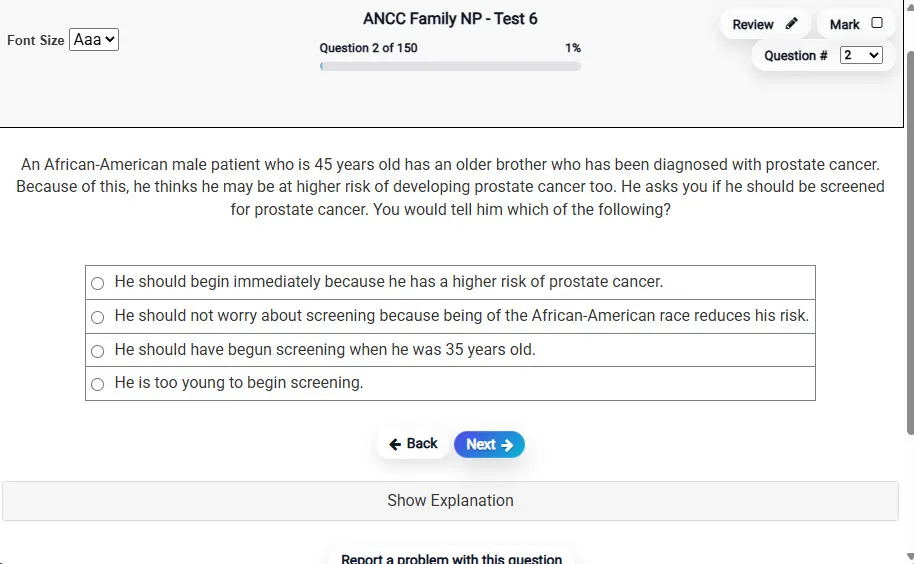
Answering a Question screen – Multiple-choice item view with navigation controls and progress tracker.
Answering a Question Multiple-choice item view with navigation controls and progress tracker.

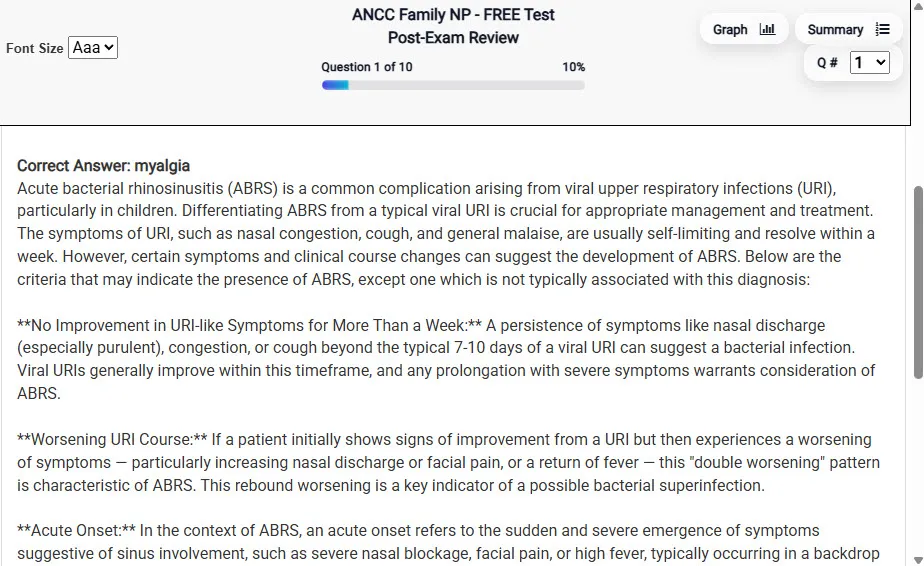
                           Detailed Explanation screen – 
                         Review mode showing chosen answer and rationale and references.
Detailed Explanation Review mode showing chosen answer and rationale and references.

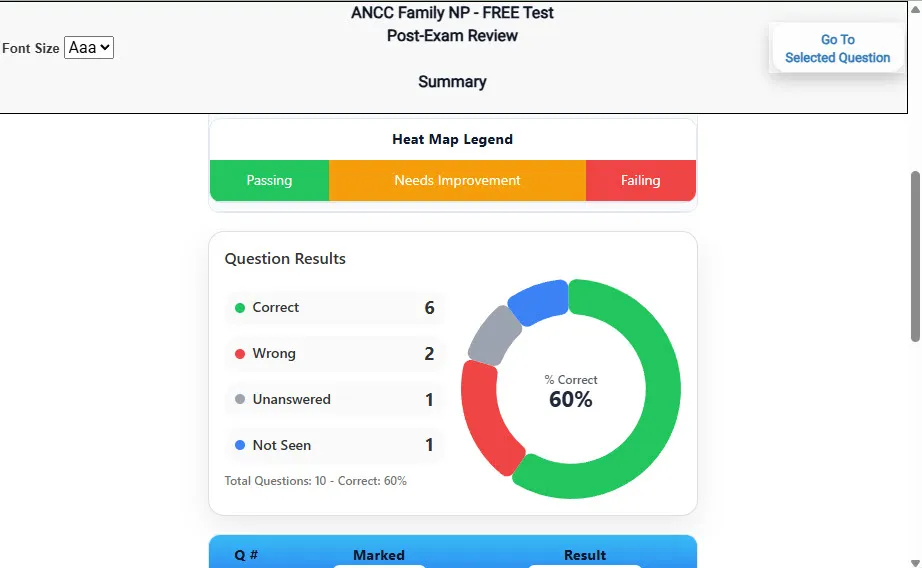
                           Review Summary 1 screen – 
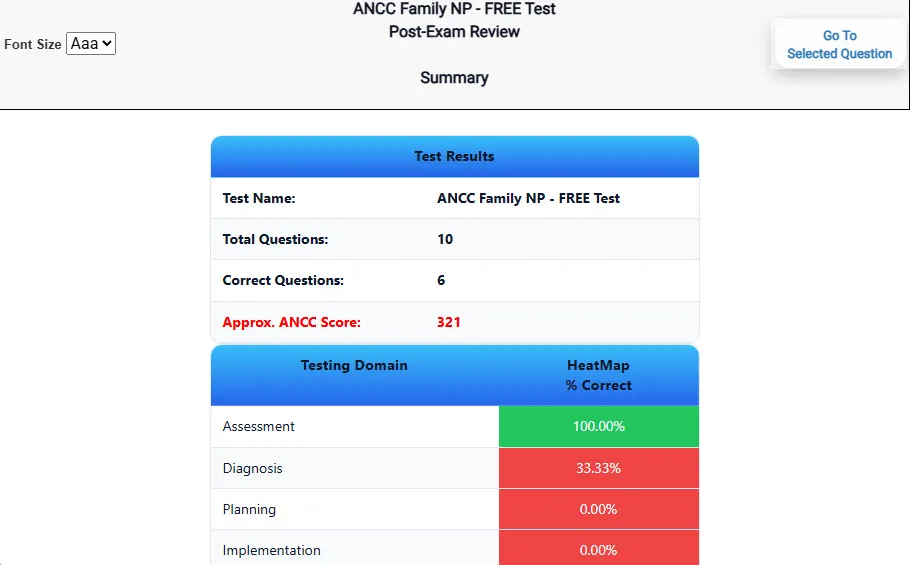
                         Summary with counts for correct/wrong/unanswered and not seen items.
Review Summary 1 Summary with counts for correct/wrong/unanswered and not seen items.

                           Review Summary 2 screen – 
                         Advanced summary with category/domain breakdown and performance insights.
Review Summary 2 Advanced summary with category/domain breakdown and performance insights.

What Each Screen Shows

Answer Question Screen

  • Clean multiple-choice interface with progress bar.
  • Mark for review feature.
  • Matches real test pacing.

Detailed Explanation

  • Correct answer plus rationale.
  • Key concepts and guidelines highlighted.
  • Move between questions to fill knowledge gaps.

Review Summary 1

  • Overall results with total questions and scaled score.
  • Domain heatmap shows strengths and weaknesses.
  • Quick visual feedback on study priorities.

Review Summary 2

  • Chart of correct, wrong, unanswered, not seen.
  • Color-coded results for easy review.
  • Links back to missed items.

Top 10 Reasons to Use Exam Edge for your APA Fundamental Payroll Certification (FPC) Exam Prep

  1. Focused on the APA Fundamental Payroll Certification (FPC) Exam

    Our practice tests are built specifically for the APA Fundamental Payroll Certification exam — every question mirrors the real topics, format, and difficulty so you're studying exactly what matters.

  2. Real Exam Simulation

    We match the per-question time limits and pressure of the actual APA exam, so test day feels familiar and stress-free.

  3. 5 Full Practice Tests & 625 Unique Questions

    You'll have more than enough material to master every APA Fundamental Payroll Certification concept — no repeats, no fluff.

  4. Lower Cost Than a Retake

    Ordering 5 practice exams costs less than retaking the APA Fundamental Payroll Certification (FPC) exam after a failure. One low fee could save you both time and money.

  5. Flexible Testing

    Need to step away mid-exam? Pick up right where you left off — with your remaining time intact.

  6. Instant Scoring & Feedback

    See your raw score and an estimated APA Fundamental Payroll Certification (FPC) score immediately after finishing each practice test.

  7. Detailed Explanations for Every Question

    Review correct and incorrect answers with clear, step-by-step explanations so you truly understand each topic.

  8. Trusted & Accredited

    We're fully accredited by the Better Business Bureau and uphold the highest standards of trust and transparency.

  9. Web-Based & Always Available

    No software to install. Access your APA Fundamental Payroll Certification practice exams 24/7 from any computer or mobile device.

  10. Expert Support When You Need It

    Need extra help? Our specialized tutors are highly qualified and ready to support your APA exam prep.


Pass the APA Fundamental Payroll Certification (FPC) Exam with Realistic Practice Tests from Exam Edge

Preparing for your upcoming APA Fundamental Payroll Certification (FPC) (FPC) Certification Exam can feel overwhelming — but the right practice makes all the difference. Exam Edge gives you the tools, structure, and confidence to pass on your first try. Our online practice exams are built to match the real APA Fundamental Payroll Certification exam in content, format, and difficulty.

  • 📝 5 APA Fundamental Payroll Certification (FPC) Practice Tests: Access 5 full-length exams with 125 questions each, covering every major APA Fundamental Payroll Certification (FPC) topic in depth.
  • Instant Online Access: Start practicing right away — no software, no waiting.
  • 🧠 Step-by-Step Explanations: Understand the reasoning behind every correct answer so you can master APA Fundamental Payroll Certification exam concepts.
  • 🔄 Retake Each Exam Up to 4 Times: Build knowledge through repetition and track your improvement over time.
  • 🌐 Web-Based & Available 24/7: Study anywhere, anytime, on any device.
  • 🧘 Boost Your Test-Day Confidence: Familiarity with the APA format reduces anxiety and helps you perform under pressure.

These APA Fundamental Payroll Certification (FPC) practice exams are designed to simulate the real testing experience by matching question types, timing, and difficulty level. This approach helps you get comfortable not just with the exam content, but also with the testing environment, so you walk into your exam day focused and confident.


Exam Edge APA Reviews


APA Fundamental Payroll Certification (FPC) Aliases Test Name

Here is a list of alternative names used for this exam.

  • APA Fundamental Payroll Certification (FPC)
  • APA Fundamental Payroll Certification (FPC) test
  • APA Fundamental Payroll Certification (FPC) Certification Test
  • APA Fundamental Payroll Certification test
  • APA
  • APA FPC
  • FPC test
  • APA Fundamental Payroll Certification (FPC) (FPC)
  • Fundamental Payroll Certification (FPC) certification