This is the content of the pop-over!

Lightning Deal Alert – 12% Off Ends at Midnight!

Strike while the savings are hot! Use promo code FlashSale at checkout for 12% off any Exam Edge test or bundle. Hurry—the clock is ticking!

Praxis Core Combined (5752) Practice Tests & Test Prep by Exam Edge


Praxis Core Academic Skills for Educators Combined  product image
(4.9)
Based on 20 Reviews

  • Real Exam Simulation: Timed questions and matching content build comfort for your Praxis Core Combined test day.
  • Instant, 24/7 Access: Web-based Praxis Core Academic Skills for Educators Combined practice exams with no software needed.
  • Clear Explanations: Step-by-step answers and explanations for your Praxis exam to strengthen understanding.
  • Boosted Confidence: Reduces anxiety and improves test-taking skills to ace your Praxis Core Academic Skills for Educators Combined (5752).

Featured on

Praxis Core Academic Skills for Educators Combined Online Practice Test Bundles

BEST VALUE
20 practice tests

$174.00

$799.00

SAVE $625

Only $8.70 per test!

  • 100% Pass Guarantee
  • 20 online practice tests
  • 153 questions + 1 essay per test
  • Bonus: 100 Flash Cards + Study Guide
  • Instant access
  • Detailed Explanations
  • Practice tests never expire
  • Timed, untimed, or study guide mode
MOST POPULAR
10 practice tests

$99.50

$399.50

SAVE $300

Only $9.95 per test!

  • 10 online practice tests
  • 153 questions + 1 essay per test
  • Bonus: 100 Flash Cards + Study Guide
  • Instant access
  • Detailed Explanations
  • Practice tests never expire
  • Timed, untimed, or study guide mode
5 practice tests

$69.75

$199.75

SAVE $130

Only $13.95 per test!

  • 5 online practice tests
  • 153 questions + 1 essay per test
  • Bonus: 100 Flash Cards
  • Instant access
  • Detailed Explanations
  • Practice tests never expire
  • Timed, untimed, or study guide mode
1 practice test

$39.95

  • 1 online practice test
  • 153 questions + 1 essay per test
  • Instant access
  • Detailed Explanations
  • Practice tests never expire
  • Timed, untimed, or study guide mode
Quick Select
Tap to choose a bundle

** All Prices are in US Dollars (USD) **


Praxis Core Combined (5752) Resources

Jump to the section you need most.

Understanding the exact breakdown of the Praxis Core Academic Skills for Educators Combined test will help you know what to expect and how to most effectively prepare. The Praxis Core Academic Skills for Educators Combined has multiple-choice questions . The exam will be broken down into the sections below:

Praxis Core Academic Skills for Educators Combined Exam Blueprint
Domain Name % Number of
Questions
Math  
     Number and Quantity 30% 15
     Algebra and Functions 30% 15
     Geometry 20% 10
     Statistics and Probability 20% 10
Reading  
     Key Ideas and Details 35% 18
     Craft - Structure and language Skills 30% 15
     Integration of Knowledge and Ideas 35% 18
Writing  
     Text Types - Purposes Production 60% 31
     Language and Research Skills for Writing 40% 20

Praxis Core Academic Skills for Educators Combined Study Tips by Domain

  • Prioritize accuracy before speed: if you can’t verify each step, use estimation to sanity-check (red flag: an answer wildly outside a reasonable range).
  • Translate words to equations carefully—define variables and units first (common trap: mixing units like minutes vs. hours or inches vs. feet).
  • For algebraic expressions, watch sign errors and distribution across parentheses (red flag: changing the sign when moving terms without balancing both sides).
  • Use fraction/decimal/percent conversions consistently and simplify early to avoid arithmetic blowups (common trap: forgetting percent means “per 100”).
  • On geometry items, draw a labeled diagram and rely only on given facts (red flag: assuming figures are to scale or angles are equal because they look equal).
  • For data and probability questions, identify what the question is asking (mean/median, independent/dependent, conditional) before computing (common trap: using the wrong denominator or ignoring “given that” wording).
  • Convert among fractions, decimals, and percents accurately; red flag: forgetting to move the decimal two places for percent (e.g., 0.045 = 4.5%).
  • Use ratio and proportion reasoning (including unit rates) to solve word problems; common trap: setting up the proportion backward and getting a reciprocal answer.
  • Apply properties of exponents and roots to simplify expressions and evaluate powers; priority rule: negative exponents mean reciprocals (e.g., a−2 = 1/a2).
  • Interpret and compute with signed numbers and absolute value on a number line; red flag: mixing up subtraction and a negative sign (e.g., 6 − (−3) increases).
  • Solve percent increase/decrease and discount/tax problems using the correct base; common trap: using the new amount as the base instead of the original.
  • Estimate and check reasonableness with rounding and order of magnitude; priority rule: if an estimate is far from the exact result, re-check place value and decimal placement.
  • Rearrange linear equations and formulas correctly (solve for a variable) — red flag: forgetting to distribute a negative or dividing only one term instead of the entire side.
  • Interpret slope and intercept in context (rate of change and starting value) — common trap: swapping slope and intercept when given a word problem or table.
  • Work with function notation (evaluate f(x), find inputs from outputs, compare f(a) vs f(b)) — cue: keep track of parentheses when substituting to avoid order-of-operations errors.
  • Identify and use common function forms (linear, quadratic, exponential) from graphs/tables — priority rule: constant differences suggest linear; constant ratios suggest exponential.
  • Solve systems of equations (substitution/elimination) and interpret the solution as an intersection point — red flag: multiplying an equation for elimination but not multiplying every term.
  • Simplify and solve expressions/equations with exponents and radicals using exponent rules — contraindication: do not assume (a+b)2=a2+b2 or √a+√b=√(a+b).
  • Know triangle rules: interior angles sum to 180° and exterior angle equals sum of the two remote interior angles; red flag—mixing up which angles are “remote” vs adjacent.
  • Use similarity (AA, SAS, SSS) to set up proportional sides and solve for scale factors; common trap—writing proportions with mismatched corresponding sides.
  • Apply the Pythagorean Theorem and its converse for right triangles, including distance in the coordinate plane; priority rule—check for a right angle before using \(a^2+b^2=c^2\).
  • Master area and perimeter of rectangles, triangles, and circles, plus volume of prisms/cylinders; threshold cue—use \(\pi r^2\) for area vs \(2\pi r\) for circumference (don’t swap).
  • Coordinate geometry essentials: slope, midpoint, and equation of a line to prove parallel/perpendicular; red flag—perpendicular slopes multiply to \(-1\) (not \(1\)).
  • Angle relationships with parallel lines cut by a transversal (corresponding, alternate interior, same-side interior); common trap—assuming lines are parallel without it being stated or marked.
  • For mean/median/mode, check for outliers first—Praxis often makes the mean misleading when one value is extreme (red flag: a single very large or very small data point).
  • Distinguish population vs. sample standard deviation conceptually: variability increases when data spread out, and adding a constant shifts the mean but does not change the spread (common trap: assuming shifting all values changes standard deviation).
  • Use proportional reasoning for probability: “and” typically means multiply after checking independence, while “or” requires avoiding double-counting (priority rule: use P(A or B)=P(A)+P(B)−P(A and B)).
  • When reading graphs (histograms, box plots, scatterplots), extract what the display actually shows—don’t infer hidden values (red flag: treating a box plot as if it gives exact data points rather than quartiles/median).
  • For counting problems, decide whether order matters before computing: permutations for ordered arrangements vs. combinations for selections (common trap: using nCr when the question describes ranked positions).
  • Inferences from samples must match the sampling method—random samples support generalization, convenience samples don’t (red flag: a conclusion about a whole population drawn from a biased or self-selected survey).
  • Prioritize questions asking for the passage’s central idea by summarizing each paragraph in 3–5 words first; red flag: answers that are true details but don’t capture the overall point.
  • For inference items, require a direct textual anchor (quote or specific line reference) for your choice; common trap: picking what seems reasonable based on outside knowledge rather than what the passage supports.
  • When asked about tone or attitude, base it on diction and connotation across multiple sentences, not a single vivid word; red flag: extreme choices (e.g., “furious,” “ecstatic”) without strong evidence.
  • For function questions (why a sentence/paragraph is included), identify what it does (introduces claim, provides example, qualifies, counters); common trap: restating content instead of the role it plays.
  • On vocabulary-in-context, test each option in the original sentence and check nearby context for contrast or cause-effect; red flag: selecting the most common definition when the passage signals a specialized meaning.
  • For argument/evidence questions, match claims to the strongest, most relevant support and watch for scope shifts; priority rule: prefer evidence that directly answers the claim’s exact wording rather than loosely related facts.
  • Identify the central idea by tracking what the author returns to most often; red flag: choosing a broad topic (“education”) instead of the specific claim (“funding should follow student need”).
  • Support answers with the best explicit evidence from the passage; common trap: selecting a true statement that isn’t actually stated or supported in the referenced lines.
  • Make inferences that are the most conservative conclusion from the text; priority rule: pick what must be true, not what could be true.
  • Summarize key ideas without adding opinions or minor details; red flag: a “summary” that includes a single vivid example or new information not in the passage.
  • Analyze relationships among events, ideas, and individuals by noting cause/effect and compare/contrast signals; common trap: reversing causation because two facts appear near each other.
  • Determine the meaning and impact of words/phrases in context; red flag: defaulting to a familiar definition when the surrounding sentences clearly narrow the meaning.
  • Identify how an author’s word choice shapes tone and meaning; red flag: choosing a synonym that changes connotation (e.g., “assert” vs. “claim”).
  • Analyze sentence structure (simple/compound/complex) for emphasis and pacing; common trap: assuming longer sentences are always more formal or more important.
  • Determine the function of a specific phrase, clause, or sentence within a paragraph (definition, contrast, example, concession); cue: if it starts with “however,” expect a shift or limitation.
  • Use context to infer meanings of figurative language, idioms, and technical terms; red flag: interpreting idioms literally or ignoring surrounding qualifiers.
  • Assess how transitions and text features (headings, punctuation, parallelism) guide relationships among ideas; priority rule: track contrast/causal signals (“although,” “therefore”) before answering.
  • Evaluate point of view and rhetorical choices (e.g., loaded language, understatement, repetition) for their effect on the reader; common trap: picking an effect that isn’t supported by a quoted detail.
  • Answer “integration” questions by stating the claim first, then choosing the option that uses evidence from multiple parts of the passage(s)—red flag: choices that cite only one detail when the prompt asks for synthesis.
  • When comparing two texts, track point of view, purpose, and tone, and select the option that aligns on all three—common trap: picking a choice that matches topic but not purpose.
  • For argument evaluation, identify premises vs. conclusion and test whether the evidence is relevant and sufficient—priority rule: prefer choices that address the argument’s main claim, not side details.
  • With charts/graphs paired to text, verify units, labels, and time frames before interpreting—threshold check: if the scale is nonzero or uneven, be cautious about “largest increase” claims.
  • Distinguish between what is explicitly supported vs. what would require outside knowledge—red flag: options that sound “reasonable” but are not stated or implied by the given sources.
  • For author’s reasoning, watch for common flaws (overgeneralization, false cause, weak analogy) and select the best critique or support—common trap: confusing a counterexample with proof that the entire claim is false.
  • Plan for 30 minutes per essay and reserve the last 3–5 minutes to proofread; a common trap is losing easy points from avoidable grammar/punctuation errors.
  • Write a clear thesis in the first paragraph and keep every body paragraph tied back to it; red flag: paragraphs that summarize sources or ideas without explaining how they support the claim.
  • Use an obvious organizational pattern (e.g., problem–solution or claim–reasons–evidence) and include transitions; priority rule: coherence matters more than fancy vocabulary.
  • Support points with specific evidence (examples, brief quotations, or paraphrases) and explain it; common trap: dropping evidence with no commentary (“quote-and-run”).
  • Maintain consistent tone and formal style, avoiding slang and vague language; red flag: shifts in point of view (you/one/we) or tense within the same argument.
  • Vary sentence structure but keep it readable, and check subject–verb agreement and pronoun antecedents; high-frequency mistake: comma splices/run-ons instead of using a period or semicolon.
  • Write informative/explanatory pieces with a clear thesis and logically ordered paragraphs; red flag: paragraphs that list facts without explaining how they support the main point.
  • Write argumentative pieces that state a defensible claim and address counterclaims; common trap: “two-sided” essays that summarize both views but never take a position.
  • Match purpose and audience by choosing an appropriate tone and level of formality; priority rule: avoid slang, contractions, and vague pronouns in formal academic prompts.
  • Use targeted evidence (facts, examples, quotations) and explain its relevance; red flag: dropping a quote or statistic with no commentary (“quote dump”).
  • Maintain coherence with transitions and consistent verb tense/point of view; common trap: shifting from “you” to “we” to “they” or changing tense mid-paragraph.
  • Conclude by reinforcing the central idea and its implications rather than introducing new reasons; red flag: a last sentence that adds a brand-new argument or major detail.
  • Use correct grammar and usage: ensure subject–verb and pronoun–antecedent agreement (watch indefinite pronouns like “each” → singular).
  • Maintain consistent verb tense and point of view within a passage; a common trap is shifting from past to present or from “students” to “you” mid-paragraph.
  • Choose precise, standard English diction and avoid unnecessary wordiness; red flag: inflated phrases (“due to the fact that”) when “because” works.
  • Punctuate for clarity: use commas after introductory clauses, with nonessential appositives, and before coordinating conjunctions joining independent clauses; trap: comma splices and fused sentences.
  • Use research ethically: paraphrase meaningfully and cite sources when using others’ ideas; priority rule: quoting doesn’t replace citation and patchwriting is still plagiarism.
  • Evaluate source quality and relevance: prefer current, authoritative, unbiased sources aligned to the claim; red flag: relying on anonymous websites, outdated statistics, or evidence that doesn’t directly support the thesis.


Built to Fit Into Your Busy Life

Everything you need to prepare with confidence—without wasting a minute.

Three Study Modes

Timed, No Time Limit, or Explanation mode.

Actionable Analytics

Heatmaps and scaled scores highlight weak areas.

High-Yield Rationales

Concise explanations emphasize key concepts.

Realistic Interface

Matches the feel of the actual exam environment.

Accessible by Design

Clean layout reduces cognitive load.

Anytime, Anywhere

Web-based access 24/7 on any device.
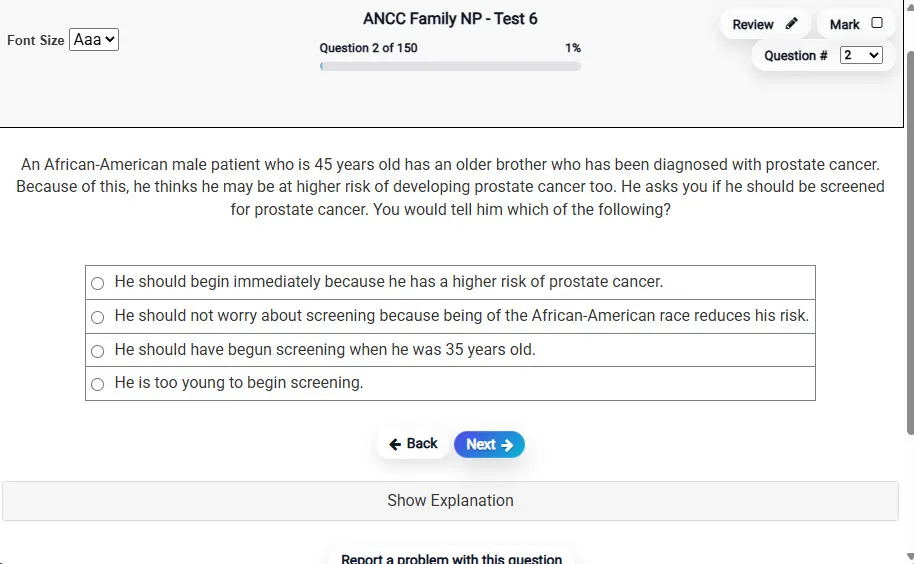
Answering a Question screen – Multiple-choice item view with navigation controls and progress tracker.
Answering a Question Multiple-choice item view with navigation controls and progress tracker.

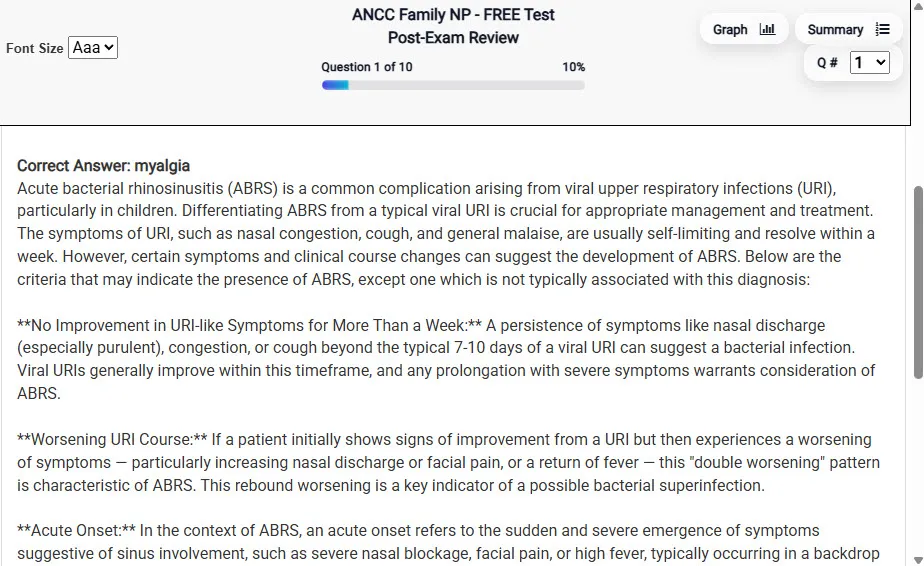
                           Detailed Explanation screen – 
                         Review mode showing chosen answer and rationale and references.
Detailed Explanation Review mode showing chosen answer and rationale and references.

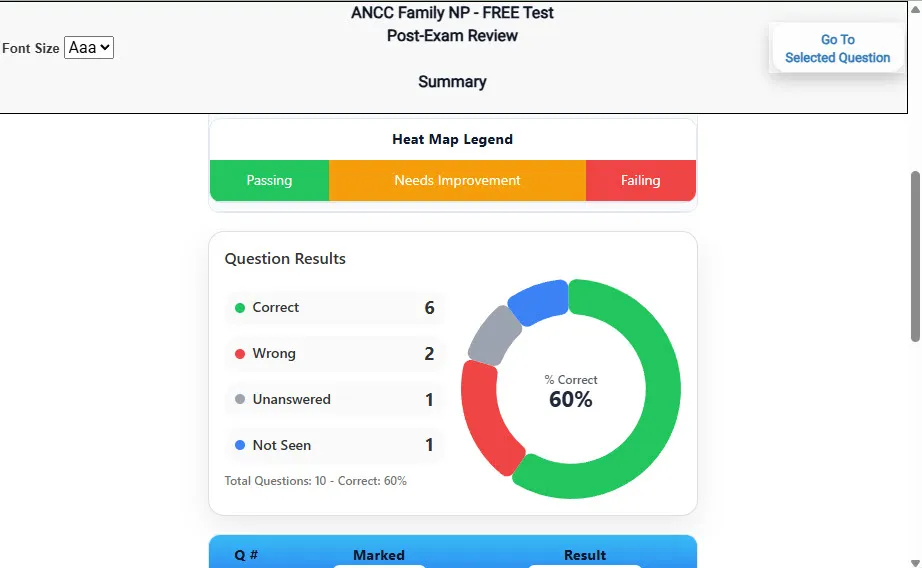
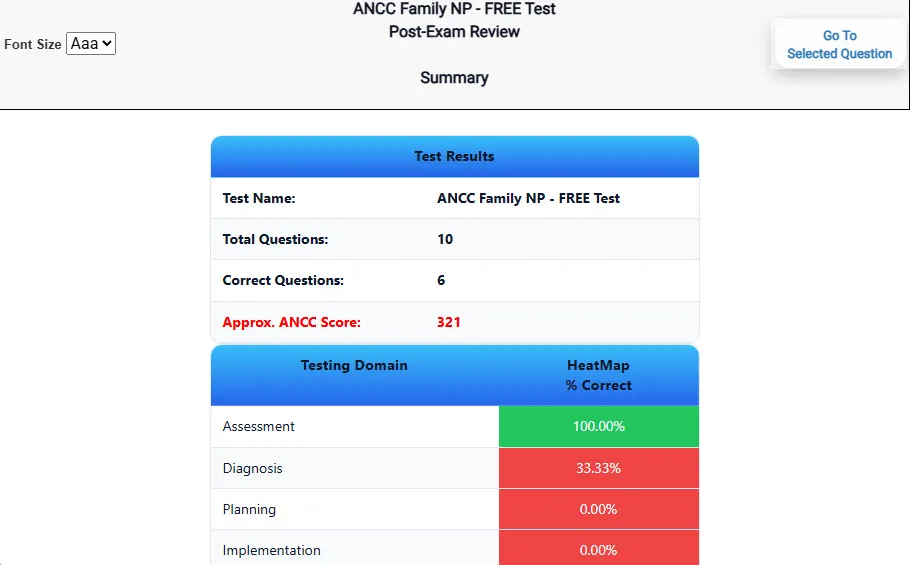
                           Review Summary 1 screen – 
                         Summary with counts for correct/wrong/unanswered and not seen items.
Review Summary 1 Summary with counts for correct/wrong/unanswered and not seen items.

                           Review Summary 2 screen – 
                         Advanced summary with category/domain breakdown and performance insights.
Review Summary 2 Advanced summary with category/domain breakdown and performance insights.

What Each Screen Shows

Answer Question Screen

  • Clean multiple-choice interface with progress bar.
  • Mark for review feature.
  • Matches real test pacing.

Detailed Explanation

  • Correct answer plus rationale.
  • Key concepts and guidelines highlighted.
  • Move between questions to fill knowledge gaps.

Review Summary 1

  • Overall results with total questions and scaled score.
  • Domain heatmap shows strengths and weaknesses.
  • Quick visual feedback on study priorities.

Review Summary 2

  • Chart of correct, wrong, unanswered, not seen.
  • Color-coded results for easy review.
  • Links back to missed items.

Top 10 Reasons to Use Exam Edge for your Praxis Core Academic Skills for Educators Combined Exam Prep

  1. Focused on the Praxis Core Academic Skills for Educators Combined Exam

    Our practice tests are built specifically for the Praxis Core Combined exam — every question mirrors the real topics, format, and difficulty so you're studying exactly what matters.

  2. Real Exam Simulation

    We match the per-question time limits and pressure of the actual Praxis exam, so test day feels familiar and stress-free.

  3. 20 Full Practice Tests & 3,080 Unique Questions

    You'll have more than enough material to master every Praxis Core Combined concept — no repeats, no fluff.

  4. Lower Cost Than a Retake

    Ordering 5 practice exams costs less than retaking the Praxis Core Academic Skills for Educators Combined exam after a failure. One low fee could save you both time and money.

  5. Flexible Testing

    Need to step away mid-exam? Pick up right where you left off — with your remaining time intact.

  6. Instant Scoring & Feedback

    See your raw score and an estimated Praxis Core Academic Skills for Educators Combined score immediately after finishing each practice test.

  7. Detailed Explanations for Every Question

    Review correct and incorrect answers with clear, step-by-step explanations so you truly understand each topic.

  8. Trusted & Accredited

    We're fully accredited by the Better Business Bureau and uphold the highest standards of trust and transparency.

  9. Web-Based & Always Available

    No software to install. Access your Praxis Core Combined practice exams 24/7 from any computer or mobile device.

  10. Expert Support When You Need It

    Need extra help? Our specialized tutors are highly qualified and ready to support your Praxis exam prep.


Pass the Praxis Core Academic Skills for Educators Combined Exam with Realistic Practice Tests from Exam Edge

Preparing for your upcoming Praxis Core Academic Skills for Educators Combined (5752) Certification Exam can feel overwhelming — but the right practice makes all the difference. Exam Edge gives you the tools, structure, and confidence to pass on your first try. Our online practice exams are built to match the real Praxis Core Combined exam in content, format, and difficulty.

  • 📝 20 Praxis Core Academic Skills for Educators Combined Practice Tests: Access 20 full-length exams with 154 questions each, covering every major Praxis Core Academic Skills for Educators Combined topic in depth.
  • Instant Online Access: Start practicing right away — no software, no waiting.
  • 🧠 Step-by-Step Explanations: Understand the reasoning behind every correct answer so you can master Praxis Core Combined exam concepts.
  • 🔄 Retake Each Exam Up to 4 Times: Build knowledge through repetition and track your improvement over time.
  • 🌐 Web-Based & Available 24/7: Study anywhere, anytime, on any device.
  • 🧘 Boost Your Test-Day Confidence: Familiarity with the Praxis format reduces anxiety and helps you perform under pressure.

These Praxis Core Academic Skills for Educators Combined practice exams are designed to simulate the real testing experience by matching question types, timing, and difficulty level. This approach helps you get comfortable not just with the exam content, but also with the testing environment, so you walk into your exam day focused and confident.

Exam Edge Praxis Reviews


Some site links and pop ups aren't accessible.

April , Silver Spring , MD

I failed the Praxis Math test five times before I found your site. After taking all your practice tests, on my next attempt I passed by five points! I can honestly say this site is the reason I passed. Thank you!!!

Nikki P, Tennessee

Just wanted to say thanks for helping me pass the Praxis I Reading! Your practice tests and especially your explanations are great. They gave me the confidence I needed! Now I can student teach this fall. I'm so glad I found PraxisReading.com!

Denise C, Florida

Thank you so much. I just received my results in the mail. I scored a 179 and passed the Praxis I Writing! I'll never have to worry about retaking this test again! PraxisWriting.com is great. I told all my friends about this site.

Susan K, Virginia

I failed the Parapro test four times before I found your site. After taking all your practice tests, on my next attempt I passed by seven points! I can honestly say that this site is the reason I passed. Thank you!!!

Rebecca S, Texas

Hi! Just returned from taking my Praxis computerized and am happy to say that I passed with a 175. The last time I took the test I missed by 1 point. Your tests definitely made the difference for me! The set up was so similar to the test and the types of questions were also similar that I felt ve ...
Read More
Brad Y, Pennsylvania


Praxis Core Academic Skills for Educators Combined Aliases Test Name

Here is a list of alternative names used for this exam.

  • Praxis Core Academic Skills for Educators Combined
  • Praxis Core Academic Skills for Educators Combined test
  • Praxis Core Academic Skills for Educators Combined Certification Test
  • Praxis Core Combined test
  • Praxis
  • Praxis 5752
  • 5752 test
  • Praxis Core Academic Skills for Educators Combined (5752)
  • Core Academic Skills for Educators Combined certification