This is the content of the pop-over!

CTCE Reading Specialist (008) Practice Tests & Test Prep by Exam Edge


CTCE Reading Specialist  product image
(4.7)
Based on 17 Reviews

  • Real Exam Simulation: Timed questions and matching content build comfort for your CTCE Reading Specialist test day.
  • Instant, 24/7 Access: Web-based CTCE Reading Specialist practice exams with no software needed.
  • Clear Explanations: Step-by-step answers and explanations for your CTCE exam to strengthen understanding.
  • Boosted Confidence: Reduces anxiety and improves test-taking skills to ace your CTCE Reading Specialist (802).

Featured on

CTCE Reading Specialist Online Practice Test Bundles

BEST VALUE
15 practice tests

$149.25

$599.25

SAVE $450

Only $9.95 per test!

  • 100% Pass Guarantee
  • 15 online practice tests
  • 100 questions + 2 essays per test
  • Bonus: 100 Flash Cards + Study Guide
  • Instant access
  • Detailed Explanations
  • Practice tests never expire
  • Timed, untimed, or study guide mode
MOST POPULAR
10 practice tests

$99.50

$399.50

SAVE $300

Only $9.95 per test!

  • 10 online practice tests
  • 100 questions + 2 essays per test
  • Bonus: 100 Flash Cards + Study Guide
  • Instant access
  • Detailed Explanations
  • Practice tests never expire
  • Timed, untimed, or study guide mode
5 practice tests

$69.75

$199.75

SAVE $130

Only $13.95 per test!

  • 5 online practice tests
  • 100 questions + 2 essays per test
  • Bonus: 100 Flash Cards
  • Instant access
  • Detailed Explanations
  • Practice tests never expire
  • Timed, untimed, or study guide mode
1 practice test

$39.95

  • 1 online practice test
  • 100 questions + 2 essays per test
  • Instant access
  • Detailed Explanations
  • Practice tests never expire
  • Timed, untimed, or study guide mode
Quick Select
Tap to choose a bundle

** All Prices are in US Dollars (USD) **


CTCE Reading Specialist (802) Resources

Jump to the section you need most.

Understanding the exact breakdown of the CTCE Reading Specialist test will help you know what to expect and how to most effectively prepare. The CTCE Reading Specialist has 100 multiple-choice questions and 2 essay questions. The exam will be broken down into the sections below:

CTCE Reading Specialist Exam Blueprint
Domain Name % Number of
Questions
Foundations of Reading Development 20% 20
Development of Reading Comprehension 30% 30
Writing and Language Development 20% 20
Assessment and Instruction 15% 15
Professional Knowledge & Leadership 15% 15
Constructed Response Section  

CTCE Reading Specialist Study Tips by Domain

  • Screen phonological/phonemic awareness early (e.g., blending/segmenting) before phonics—red flag: a student can name letters but cannot orally segment CVC words.
  • Teach phonics systematically from consistent short vowels and common consonant patterns to more complex mappings; common trap: relying on “guessing from pictures/context” instead of grapheme–phoneme decoding.
  • Build orthographic mapping by connecting sounds, spellings, and meanings (dictation + word reading); red flag: accurate sounding-out without retaining the word for automatic recognition.
  • Strengthen fluency through repeated reading with accuracy first, then rate and prosody; priority rule: do not push speed when errors exceed roughly 5% (accuracy <95%).
  • Develop vocabulary with explicit instruction in morphology (roots, prefixes, suffixes) and multiple exposures; common trap: teaching definitions only once without using words in varied contexts.
  • Address language foundations (syntax, semantics, discourse) alongside decoding; red flag: students decode adequately but comprehension breaks down on complex sentences or unfamiliar academic language.
  • Teach and assess comprehension as an interaction of reader, text, task, and context—red flag: treating comprehension as a single score rather than checking specific processes (e.g., inference, synthesis, monitoring).
  • Explicitly model metacognitive strategies (predict, question, clarify, summarize) with gradual release; common trap: asking students to “use the strategy” without think-alouds and success criteria.
  • Build academic language and knowledge (vocabulary, morphology, background knowledge) before and during reading; priority rule: preteach only high-utility, text-critical terms to avoid over-preteaching.
  • Use text structures (cause/effect, compare/contrast, problem/solution) and graphic organizers to support recall and synthesis; red flag: mismatching the organizer to the text structure.
  • Plan scaffolds for complex texts (chunking, guiding questions, repeated reading with a purpose) while maintaining grade-level meaning; common trap: simplifying the text so much that students don’t practice making inferences.
  • Check comprehension with targeted questions and evidence-based responses (literal, inferential, evaluative) and require citations; red flag: accepting opinions without text evidence or confusing fluency with comprehension.
  • Differentiate stages of writing development (emergent ? conventional) and match instruction accordingly; red flag: expecting paragraph structure before students control sentence formation and spelling patterns.
  • Teach the writing process (plan–draft–revise–edit–publish) with explicit models and checklists; common trap: grading first drafts as final products without requiring revision based on feedback.
  • Strengthen sentence skills (syntax, sentence combining, varied structures) to improve clarity and fluency; priority rule: target meaning first—avoid correcting every mechanical error when comprehension is at risk.
  • Build spelling and word study through phoneme–grapheme mapping, morphology (roots/affixes), and orthographic patterns; red flag: relying on weekly memorization lists without pattern generalization to new words.
  • Integrate grammar, usage, and mechanics instruction into authentic writing with brief, focused mini-lessons; common trap: isolated worksheets that don’t transfer to students’ own writing.
  • Use valid writing assessments (rubrics, anchor papers, conferencing notes) to set measurable goals; threshold cue: ensure prompts, scoring criteria, and accommodations align so you’re measuring writing—not handwriting speed or language load.
  • Use multiple measures (screeners, diagnostics, progress monitoring) to confirm need before intervention; red flag: making placement decisions from a single benchmark score.
  • Match assessment type to purpose (universal screening for risk, diagnostic for skill breakdown, formative for next-step teaching); common trap: using a diagnostic tool as a quick screener.
  • Interpret data by looking at patterns across subskills (phonological awareness, decoding, fluency, vocabulary, comprehension) and error analyses; cue: if accuracy is high but rate is low, prioritize fluency over decoding.
  • Plan instruction with an explicit, systematic sequence and sufficient practice opportunities; red flag: assigning independent leveled reading to students who cannot accurately decode the text.
  • Monitor response to intervention with frequent, brief measures and decision rules (e.g., trend line below aim line over several data points triggers change); common trap: waiting for the end of a unit to adjust instruction.
  • Ensure assessment accommodations preserve the construct (e.g., extended time for decoding tasks is different from reading aloud a reading test); contraindication: providing supports that invalidate interpretation of reading ability.
  • Apply federal and state requirements in literacy services (e.g., IDEA, Section 504, EL policies) and document decisions; red flag: providing an intervention plan without a clear progress-monitoring record.
  • Use data teams/RTI or MTSS cycles to select and intensify interventions with fidelity; common trap: changing programs too quickly before confirming implementation fidelity and adequate instructional minutes.
  • Coach teachers with a clear observation focus (e.g., explicit instruction, feedback, text selection) and a measurable goal; priority rule: tie coaching to student outcome data, not personal teaching style preferences.
  • Lead equitable literacy initiatives by auditing access to core instruction, materials, and advanced coursework; red flag: subgroup gaps explained only by “motivation” without examining opportunity-to-learn factors.
  • Communicate with families and colleagues using strengths-based, jargon-free language and interpreters when needed; contraindication: discussing eligibility or disability labels without consent and confidentiality safeguards.
  • Evaluate and adopt literacy curricula and assessments using evidence of effectiveness, alignment, and usability; common trap: choosing a program based on testimonials rather than independent research and local data fit.
  • Answer every part of the prompt and label sections clearly; a common trap is writing a strong response that omits one required component (e.g., analysis, recommendation, or justification).
  • Cite specific evidence from the provided student work/data (quote, error pattern, score point, or example); red flag: making claims like “needs phonics” without pointing to an observable feature.
  • Write recommendations that are instructionally actionable (who/what/how often/for how long); priority rule: avoid vague plans such as “provide more practice” with no routine or measurable target.
  • Align each recommendation to the identified need and explain the link; common trap: proposing comprehension strategies when the evidence shows a decoding/fluency breakdown as the primary barrier.
  • Use accurate literacy terminology (e.g., phonemic awareness, morphology, text structure, fluency) and apply it correctly; red flag: confusing phonological awareness with phonics or misusing “running record” terms.
  • Include a brief progress-monitoring plan tied to the skill focus (measure, frequency, criterion); threshold cue: specify what growth would look like (e.g., accuracy/words-correct-per-minute/retell rubric level) rather than “monitor progress.”


Built to Fit Into Your Busy Life

Everything you need to prepare with confidence—without wasting a minute.

Three Study Modes

Timed, No Time Limit, or Explanation mode.

Actionable Analytics

Heatmaps and scaled scores highlight weak areas.

High-Yield Rationales

Concise explanations emphasize key concepts.

Realistic Interface

Matches the feel of the actual exam environment.

Accessible by Design

Clean layout reduces cognitive load.

Anytime, Anywhere

Web-based access 24/7 on any device.
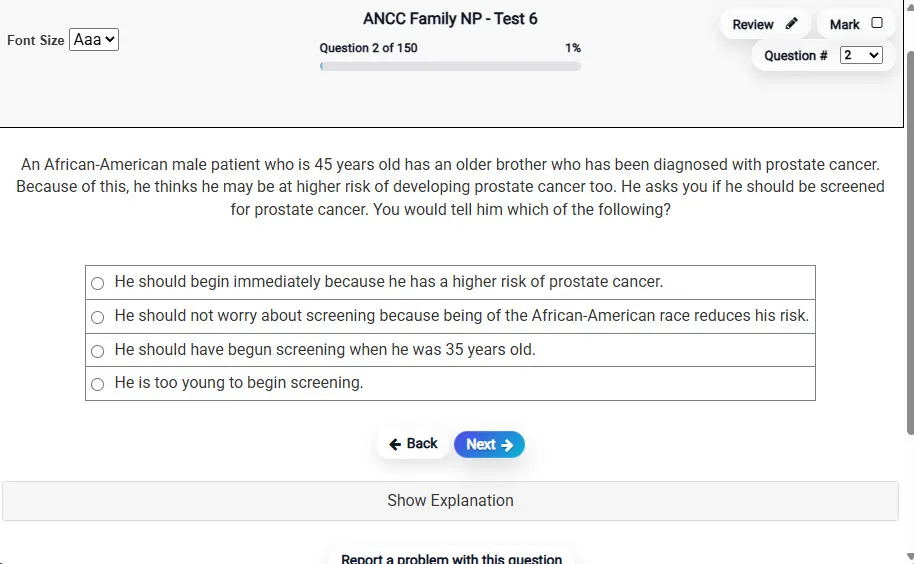
Answering a Question screen – Multiple-choice item view with navigation controls and progress tracker.
Answering a Question Multiple-choice item view with navigation controls and progress tracker.

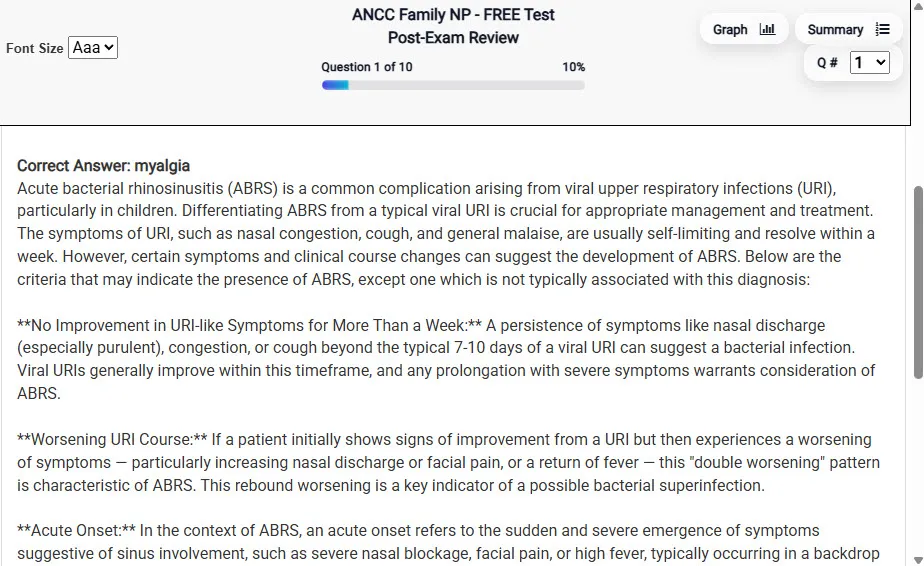
                           Detailed Explanation screen – 
                         Review mode showing chosen answer and rationale and references.
Detailed Explanation Review mode showing chosen answer and rationale and references.

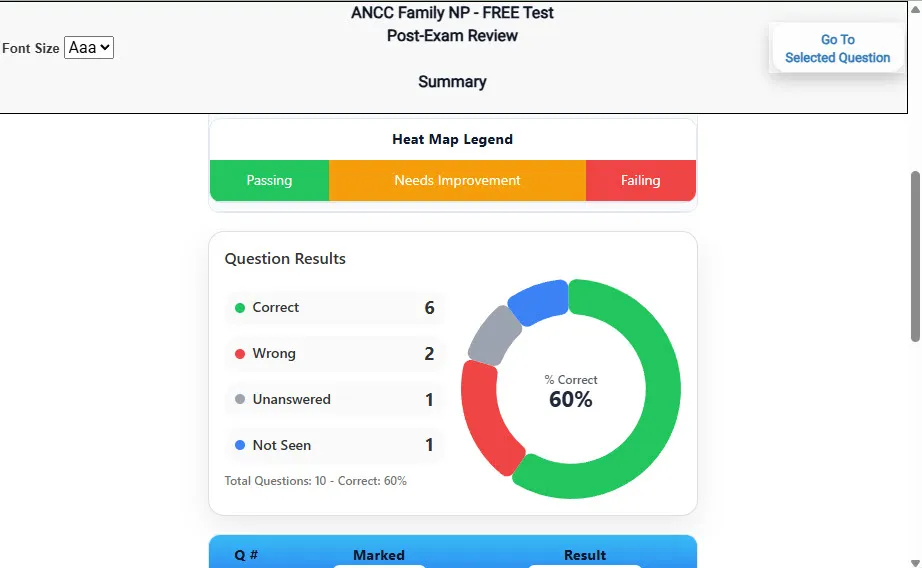
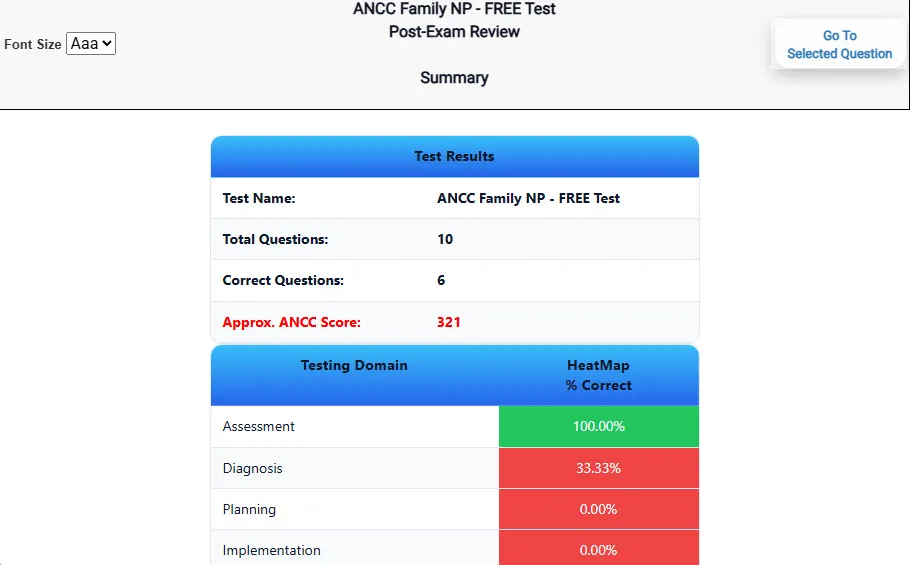
                           Review Summary 1 screen – 
                         Summary with counts for correct/wrong/unanswered and not seen items.
Review Summary 1 Summary with counts for correct/wrong/unanswered and not seen items.

                           Review Summary 2 screen – 
                         Advanced summary with category/domain breakdown and performance insights.
Review Summary 2 Advanced summary with category/domain breakdown and performance insights.

What Each Screen Shows

Answer Question Screen

  • Clean multiple-choice interface with progress bar.
  • Mark for review feature.
  • Matches real test pacing.

Detailed Explanation

  • Correct answer plus rationale.
  • Key concepts and guidelines highlighted.
  • Move between questions to fill knowledge gaps.

Review Summary 1

  • Overall results with total questions and scaled score.
  • Domain heatmap shows strengths and weaknesses.
  • Quick visual feedback on study priorities.

Review Summary 2

  • Chart of correct, wrong, unanswered, not seen.
  • Color-coded results for easy review.
  • Links back to missed items.

Top 10 Reasons to Use Exam Edge for your CTCE Reading Specialist Exam Prep

  1. Focused on the CTCE Reading Specialist Exam

    Our practice tests are built specifically for the CTCE Reading Specialist exam — every question mirrors the real topics, format, and difficulty so you're studying exactly what matters.

  2. Real Exam Simulation

    We match the per-question time limits and pressure of the actual CTCE exam, so test day feels familiar and stress-free.

  3. 15 Full Practice Tests & 1,530 Unique Questions

    You'll have more than enough material to master every CTCE Reading Specialist concept — no repeats, no fluff.

  4. Lower Cost Than a Retake

    Ordering 5 practice exams costs less than retaking the CTCE Reading Specialist exam after a failure. One low fee could save you both time and money.

  5. Flexible Testing

    Need to step away mid-exam? Pick up right where you left off — with your remaining time intact.

  6. Instant Scoring & Feedback

    See your raw score and an estimated CTCE Reading Specialist score immediately after finishing each practice test.

  7. Detailed Explanations for Every Question

    Review correct and incorrect answers with clear, step-by-step explanations so you truly understand each topic.

  8. Trusted & Accredited

    We're fully accredited by the Better Business Bureau and uphold the highest standards of trust and transparency.

  9. Web-Based & Always Available

    No software to install. Access your CTCE Reading Specialist practice exams 24/7 from any computer or mobile device.

  10. Expert Support When You Need It

    Need extra help? Our specialized tutors are highly qualified and ready to support your CTCE exam prep.


Pass the CTCE Reading Specialist Exam with Realistic Practice Tests from Exam Edge

Preparing for your upcoming CTCE Reading Specialist (802) Certification Exam can feel overwhelming — but the right practice makes all the difference. Exam Edge gives you the tools, structure, and confidence to pass on your first try. Our online practice exams are built to match the real CTCE Reading Specialist exam in content, format, and difficulty.

  • 📝 15 CTCE Reading Specialist Practice Tests: Access 15 full-length exams with 102 questions each, covering every major CTCE Reading Specialist topic in depth.
  • Instant Online Access: Start practicing right away — no software, no waiting.
  • 🧠 Step-by-Step Explanations: Understand the reasoning behind every correct answer so you can master CTCE Reading Specialist exam concepts.
  • 🔄 Retake Each Exam Up to 4 Times: Build knowledge through repetition and track your improvement over time.
  • 🌐 Web-Based & Available 24/7: Study anywhere, anytime, on any device.
  • 🧘 Boost Your Test-Day Confidence: Familiarity with the CTCE format reduces anxiety and helps you perform under pressure.

These CTCE Reading Specialist practice exams are designed to simulate the real testing experience by matching question types, timing, and difficulty level. This approach helps you get comfortable not just with the exam content, but also with the testing environment, so you walk into your exam day focused and confident.


Exam Edge CTCE Reviews


CTCE Reading Specialist Aliases Test Name

Here is a list of alternative names used for this exam.

  • CTCE Reading Specialist
  • CTCE Reading Specialist test
  • CTCE Reading Specialist Certification Test
  • CTCE
  • CTCE 802
  • 802 test
  • CTCE Reading Specialist (802)
  • Reading Specialist certification