This is the content of the pop-over!

Lightning Deal Alert – 12% Off Ends at Midnight!

Strike while the savings are hot! Use promo code FlashSale at checkout for 12% off any Exam Edge test or bundle. Hurry—the clock is ticking!

RNCB CRN (CRN) Practice Tests & Test Prep by Exam Edge


RNCB Certified Radiology Nurse product image
(4.8)
Based on 37 Reviews

  • Real Exam Simulation: Timed questions and matching content build comfort for your RNCB CRN test day.
  • Instant, 24/7 Access: Web-based RNCB Certified Radiology Nurse practice exams with no software needed.
  • Clear Explanations: Step-by-step answers and explanations for your RNCB exam to strengthen understanding.
  • Boosted Confidence: Reduces anxiety and improves test-taking skills to ace your RNCB Certified Radiology Nurse (CRN).

Featured on

RNCB Certified Radiology Nurse Online Practice Test Bundles

BEST VALUE
10 practice tests

$99.50

$399.50

SAVE $300

Only $9.95 per test!

  • 100% Pass Guarantee
  • 10 online practice tests
  • 150 questions per test
  • Bonus: 100 Flash Cards + Study Guide
  • Instant access
  • Detailed Explanations
  • Practice tests never expire
  • Timed, untimed, or study guide mode
5 practice tests

$69.75

$199.75

SAVE $130

Only $13.95 per test!

  • 5 online practice tests
  • 150 questions per test
  • Bonus: 100 Flash Cards + Study Guide
  • Instant access
  • Detailed Explanations
  • Practice tests never expire
  • Timed, untimed, or study guide mode
1 practice test

$39.95

  • 1 online practice test
  • 150 questions per test
  • Instant access
  • Detailed Explanations
  • Practice tests never expire
  • Timed, untimed, or study guide mode
Quick Select
Tap to choose a bundle

** All Prices are in US Dollars (USD) **


RNCB CRN (CRN) Resources

Jump to the section you need most.

Understanding the exact breakdown of the RNCB Certified Radiology Nurse test will help you know what to expect and how to most effectively prepare. The RNCB Certified Radiology Nurse has 150 multiple-choice questions . The exam will be broken down into the sections below:

RNCB Certified Radiology Nurse Exam Blueprint
Domain Name % Number of
Questions
Assess patient and plan care 25% 38
Administer - monitor evaluate therapeutic interventions 25% 38
Teach patient and family/Provide a supportive environment 17% 26
Provide a safe environment/Manage emergency situations 25% 38
Participate in QA/CQI - interdisciplinary activities professional practice activities 8% 12

RNCB Certified Radiology Nurse Study Tips by Domain

  • Verify patient identity with two identifiers and confirm the exact procedure/side/site—red flag: any mismatch or missing order clarification requires a hard stop before transport or contrast administration.
  • Complete focused pre-procedure assessment (airway/respiratory status, baseline neuro, pain, vitals, NPO status, pregnancy screening when applicable)—common trap: relying on “patient says NPO” without documenting last oral intake.
  • Screen for contrast risk (prior reaction details, asthma/atopy, renal function trends, metformin use per policy, thyroid disease if iodinated contrast)—priority rule: a past anaphylactoid reaction triggers premedication/alternative imaging planning rather than proceeding routinely.
  • Review anticoagulants/antiplatelets, bleeding history, and required labs for invasive procedures (e.g., platelet count/INR per facility protocol)—red flag: proceeding without confirming the hold plan and lab thresholds is a frequent RNCB safety pitfall.
  • Plan sedation/analgesia needs based on ASA risk indicators, OSA screening, prior sedation response, and current meds—contraindication cue: unstable vitals or inability to maintain airway/positioning warrants escalation and possible anesthesia involvement.
  • Develop an individualized care plan that anticipates positioning limitations, implanted devices (pacemaker/ICD, neurostimulators), allergies (latex/chlorhexidine), and infection risk—common trap: missing MRI safety screening elements for non-communicative or cognitively impaired patients.
  • Verify the “5 rights” plus contrast/medication indication, allergy history (contrast, latex, chlorhexidine), and renal risk before administration; red flag: proceeding with iodinated contrast when prior severe reaction is undocumented or unaddressed.
  • Screen and apply threshold-based precautions (e.g., eGFR/AKI risk, metformin use, anticoagulants for biopsies/lines) and escalate per protocol when criteria are not met; common trap: treating a “normal creatinine” as sufficient without current eGFR or trend.
  • During sedation/analgesia, continuously monitor airway, respirations, SpO2, hemodynamics, and level of consciousness with frequent documentation; priority rule: intervene for hypoventilation/airway obstruction before focusing on hypotension.
  • Administer contrast/therapeutics via reliable access and monitor for infiltration/extravasation and phlebitis; red flag: patient reports burning/tightness or swelling at the site—stop injection and manage per extravasation protocol.
  • Recognize and treat adverse reactions rapidly (contrast reaction, anaphylaxis, opioid/benzodiazepine oversedation) using standing orders and weight-based dosing; common trap: delaying epinephrine in anaphylaxis while trying antihistamines first.
  • Evaluate post-procedure response and complications (bleeding, hematoma, neuro changes, contrast-associated symptoms) and ensure discharge criteria are met (stable vitals, baseline mentation, pain/nausea controlled); red flag: discharging a recently sedated patient without meeting objective recovery scoring and escort requirements.
  • Confirm informed consent and patient understanding using teach-back, especially for contrast, sedation, and biopsy procedures; red flag: language barriers or low health literacy—use qualified interpreters rather than family.
  • Give clear pre-procedure instructions (NPO, medication holds, allergy history, pregnancy screening) tailored to modality; common trap: assuming patients know to disclose metformin use or prior contrast reactions.
  • Provide post-procedure discharge teaching with specific thresholds for when to seek care (e.g., increasing pain, bleeding, fever, dyspnea, neuro changes); priority rule: document the exact return precautions given and the patient’s verbal understanding.
  • Support anxiety and claustrophobia management for MRI/CT with realistic expectations (noise, immobility, duration) and coping options; contraindication cue: do not offer sedation teaching without confirming required ride/home supervision and NPO status.
  • Educate on radiation safety (pregnancy precautions, shielding when appropriate, ALARA basics) without minimizing risk; common trap: giving reassurance that conflicts with policy or skipping pregnancy screening in reproductive-age patients.
  • Maintain a supportive environment by protecting privacy and dignity (exposure control, trauma-informed communication, chaperone use per policy); red flag: a patient expressing past trauma or requesting same-gender staff—escalate early to meet needs.
  • Verify correct patient, procedure, site/side, and contrast/allergy history before transport and again in the imaging suite—red flag: missing two identifiers or undocumented prior contrast reaction requires a hard stop.
  • Confirm IV patency and secure line before power injection; common trap: injecting through a questionable or positional IV increases extravasation risk—stop the injector at first report of pain, swelling, or resistance.
  • Prevent falls and injury by using standardized transfer and positioning precautions (stretcher locked, side rails per policy, straps for MRI/CT table); red flag: sedated, orthostatic, or post-contrast patients should not ambulate unassisted.
  • Be prepared for contrast reactions with immediate access to emergency meds/equipment and a clear escalation plan; priority rule: treat airway/breathing first and escalate rapidly if stridor, hypotension, or altered mental status occurs.
  • Manage sedation-related emergencies with continuous monitoring and readiness to intervene; common trap: delayed recognition of hypoventilation—watch for decreasing respiratory rate/end-tidal CO2 changes and act before oxygen saturation drops.
  • Maintain MRI safety by enforcing screening and zone control; red flag: any unknown implant/metal exposure is a contraindication to entering the magnet room until verified as MR safe/conditional per policy.
  • Use QA/CQI data to target radiology-specific outcomes (e.g., contrast reaction rates, extravasation incidence, specimen labeling errors) and document trend-and-action; red flag: collecting data without a defined corrective action and re-measurement plan.
  • Verify adherence to ALARA and time-out/ID protocols across modalities and report near-misses through the facility system; common trap: assuming the technologist’s checklist replaces the nurse’s independent verification.
  • Participate in interdisciplinary huddles for high-risk cases (renal impairment, anticoagulants, implanted devices, pediatrics) and ensure the plan is communicated to radiologist/anesthesia/IR team; priority rule: clarify responsibility for sedation rescue before starting.
  • Support medication/contrast stewardship by reconciling allergies, prior reactions, and premedication pathways, and escalate variances through pharmacy/medical staff channels; red flag: undocumented “contrast allergy” labels that are actually expected side effects.
  • Contribute to professional practice activities (policy review, competency validation, peer review) with focus on radiology nursing standards; common trap: outdated policies that don’t match current monitoring/reversal agent availability.
  • Promote a Just Culture by reporting adverse events/near misses (e.g., wrong-site, IV infiltration, sedation overshoot) and participating in root-cause analysis; contraindication: coaching staff to avoid reporting to “protect the unit.”


Built to Fit Into Your Busy Life

Everything you need to prepare with confidence—without wasting a minute.

Three Study Modes

Timed, No Time Limit, or Explanation mode.

Actionable Analytics

Heatmaps and scaled scores highlight weak areas.

High-Yield Rationales

Concise explanations emphasize key concepts.

Realistic Interface

Matches the feel of the actual exam environment.

Accessible by Design

Clean layout reduces cognitive load.

Anytime, Anywhere

Web-based access 24/7 on any device.
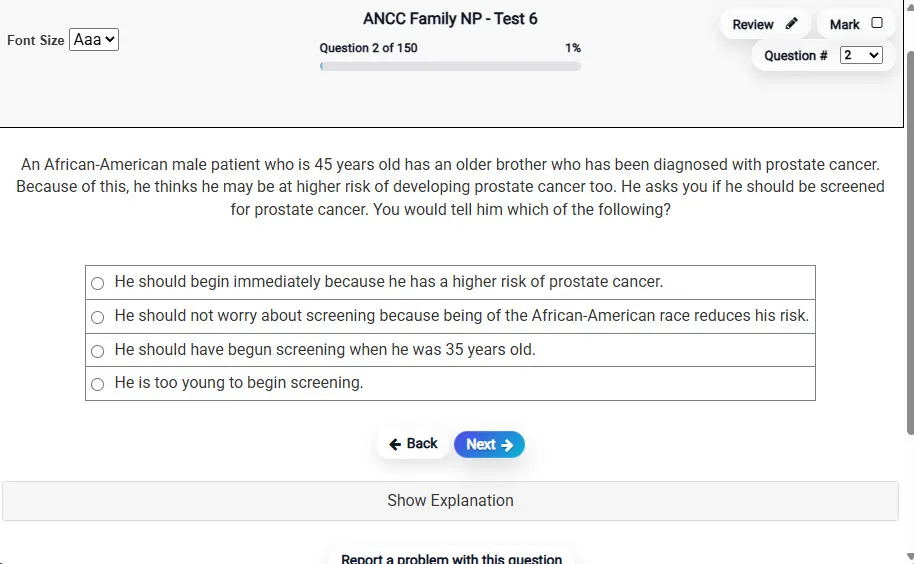
Answering a Question screen – Multiple-choice item view with navigation controls and progress tracker.
Answering a Question Multiple-choice item view with navigation controls and progress tracker.

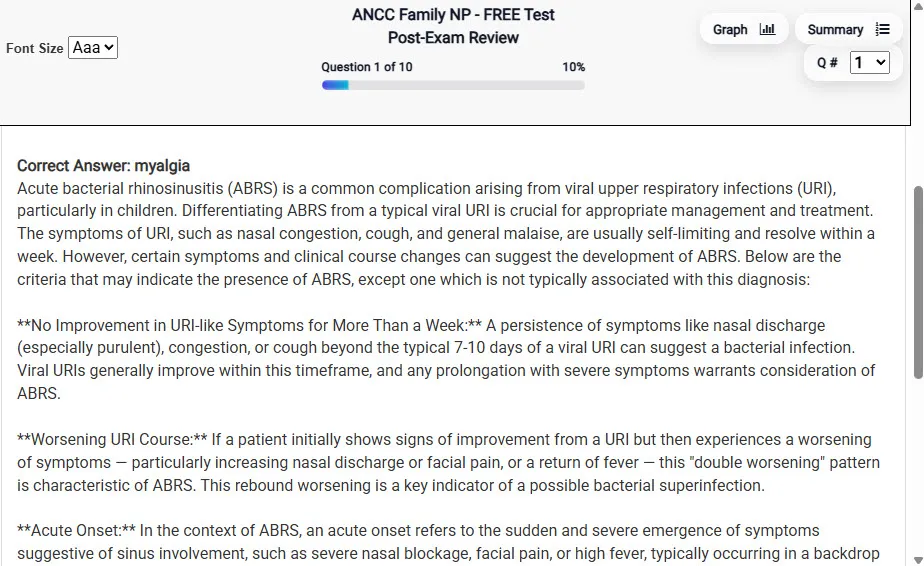
                           Detailed Explanation screen – 
                         Review mode showing chosen answer and rationale and references.
Detailed Explanation Review mode showing chosen answer and rationale and references.

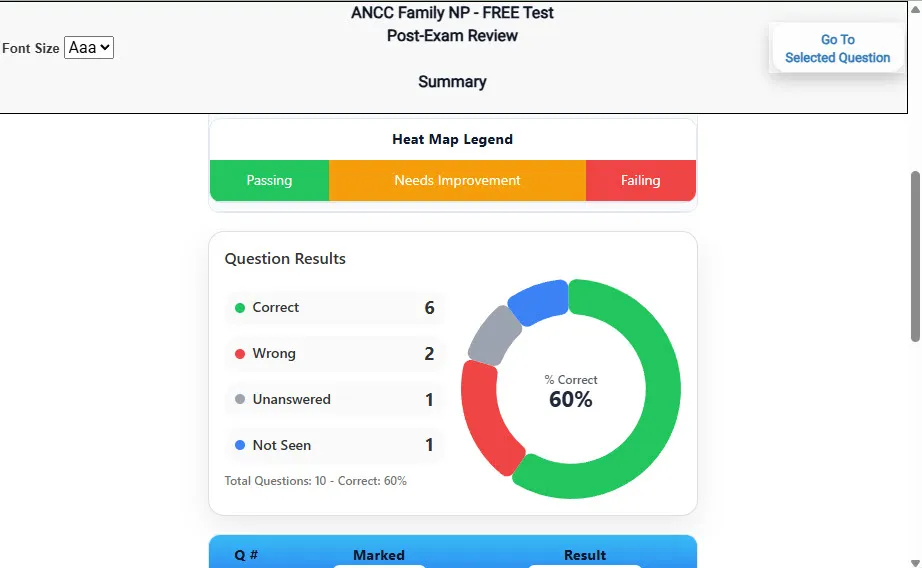
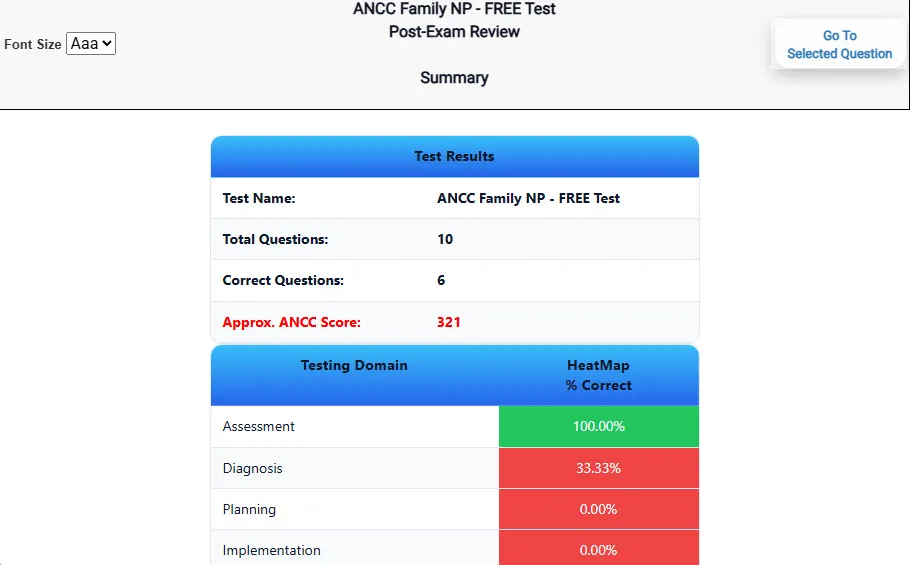
                           Review Summary 1 screen – 
                         Summary with counts for correct/wrong/unanswered and not seen items.
Review Summary 1 Summary with counts for correct/wrong/unanswered and not seen items.

                           Review Summary 2 screen – 
                         Advanced summary with category/domain breakdown and performance insights.
Review Summary 2 Advanced summary with category/domain breakdown and performance insights.

What Each Screen Shows

Answer Question Screen

  • Clean multiple-choice interface with progress bar.
  • Mark for review feature.
  • Matches real test pacing.

Detailed Explanation

  • Correct answer plus rationale.
  • Key concepts and guidelines highlighted.
  • Move between questions to fill knowledge gaps.

Review Summary 1

  • Overall results with total questions and scaled score.
  • Domain heatmap shows strengths and weaknesses.
  • Quick visual feedback on study priorities.

Review Summary 2

  • Chart of correct, wrong, unanswered, not seen.
  • Color-coded results for easy review.
  • Links back to missed items.

Top 10 Reasons to Use Exam Edge for your RNCB Certified Radiology Nurse Exam Prep

  1. Focused on the RNCB Certified Radiology Nurse Exam

    Our practice tests are built specifically for the RNCB CRN exam — every question mirrors the real topics, format, and difficulty so you're studying exactly what matters.

  2. Real Exam Simulation

    We match the per-question time limits and pressure of the actual RNCB exam, so test day feels familiar and stress-free.

  3. 10 Full Practice Tests & 1,500 Unique Questions

    You'll have more than enough material to master every RNCB CRN concept — no repeats, no fluff.

  4. Lower Cost Than a Retake

    Ordering 5 practice exams costs less than retaking the RNCB Certified Radiology Nurse exam after a failure. One low fee could save you both time and money.

  5. Flexible Testing

    Need to step away mid-exam? Pick up right where you left off — with your remaining time intact.

  6. Instant Scoring & Feedback

    See your raw score and an estimated RNCB Certified Radiology Nurse score immediately after finishing each practice test.

  7. Detailed Explanations for Every Question

    Review correct and incorrect answers with clear, step-by-step explanations so you truly understand each topic.

  8. Trusted & Accredited

    We're fully accredited by the Better Business Bureau and uphold the highest standards of trust and transparency.

  9. Web-Based & Always Available

    No software to install. Access your RNCB CRN practice exams 24/7 from any computer or mobile device.

  10. Expert Support When You Need It

    Need extra help? Our specialized tutors are highly qualified and ready to support your RNCB exam prep.


Pass the RNCB Certified Radiology Nurse Exam with Realistic Practice Tests from Exam Edge

Preparing for your upcoming RNCB Certified Radiology Nurse (CRN) Certification Exam can feel overwhelming — but the right practice makes all the difference. Exam Edge gives you the tools, structure, and confidence to pass on your first try. Our online practice exams are built to match the real RNCB CRN exam in content, format, and difficulty.

  • 📝 10 RNCB Certified Radiology Nurse Practice Tests: Access 10 full-length exams with 150 questions each, covering every major RNCB Certified Radiology Nurse topic in depth.
  • Instant Online Access: Start practicing right away — no software, no waiting.
  • 🧠 Step-by-Step Explanations: Understand the reasoning behind every correct answer so you can master RNCB CRN exam concepts.
  • 🔄 Retake Each Exam Up to 4 Times: Build knowledge through repetition and track your improvement over time.
  • 🌐 Web-Based & Available 24/7: Study anywhere, anytime, on any device.
  • 🧘 Boost Your Test-Day Confidence: Familiarity with the RNCB format reduces anxiety and helps you perform under pressure.

These RNCB Certified Radiology Nurse practice exams are designed to simulate the real testing experience by matching question types, timing, and difficulty level. This approach helps you get comfortable not just with the exam content, but also with the testing environment, so you walk into your exam day focused and confident.


Exam Edge RNCB Reviews


RNCB Certified Radiology Nurse Aliases Test Name

Here is a list of alternative names used for this exam.

  • RNCB Certified Radiology Nurse
  • RNCB Certified Radiology Nurse test
  • RNCB Certified Radiology Nurse Certification Test
  • RNCB CRN test
  • RNCB
  • RNCB CRN
  • CRN test
  • RNCB Certified Radiology Nurse (CRN)
  • Certified Radiology Nurse certification