This is the content of the pop-over!

Praxis Teaching Reading Elem Ed (5203) Practice Tests & Test Prep by Exam Edge


Praxis Teaching Reading Elementary Education  product image
(5.0)
Based on 20 Reviews

  • Real Exam Simulation: Timed questions and matching content build comfort for your Praxis Teaching Reading Elem Ed test day.
  • Instant, 24/7 Access: Web-based Praxis Teaching Reading Elementary Education practice exams with no software needed.
  • Clear Explanations: Step-by-step answers and explanations for your Praxis exam to strengthen understanding.
  • Boosted Confidence: Reduces anxiety and improves test-taking skills to ace your Praxis Teaching Reading Elementary Education (5203).

Featured on

Praxis Teaching Reading Elementary Education Online Practice Test Bundles

BEST VALUE
15 practice tests

$149.25

$599.25

SAVE $450

Only $9.95 per test!

  • 100% Pass Guarantee
  • 15 online practice tests
  • 90 questions + 3 essays per test
  • Bonus: 100 Flash Cards + Study Guide
  • Instant access
  • Detailed Explanations
  • Practice tests never expire
  • Timed, untimed, or study guide mode
MOST POPULAR
10 practice tests

$99.50

$399.50

SAVE $300

Only $9.95 per test!

  • 10 online practice tests
  • 90 questions + 3 essays per test
  • Bonus: 100 Flash Cards + Study Guide
  • Instant access
  • Detailed Explanations
  • Practice tests never expire
  • Timed, untimed, or study guide mode
5 practice tests

$69.75

$199.75

SAVE $130

Only $13.95 per test!

  • 5 online practice tests
  • 90 questions + 3 essays per test
  • Bonus: 100 Flash Cards
  • Instant access
  • Detailed Explanations
  • Practice tests never expire
  • Timed, untimed, or study guide mode
1 practice test

$39.95

  • 1 online practice test
  • 90 questions + 3 essays per test
  • Instant access
  • Detailed Explanations
  • Practice tests never expire
  • Timed, untimed, or study guide mode
Quick Select
Tap to choose a bundle

** All Prices are in US Dollars (USD) **


Praxis Teaching Reading Elem Ed (5203) Resources

Jump to the section you need most.

Understanding the exact breakdown of the Praxis Teaching Reading Elementary Education test will help you know what to expect and how to most effectively prepare. The Praxis Teaching Reading Elementary Education has 90 multiple-choice questions and 3 essay questions. The exam will be broken down into the sections below:

Praxis Teaching Reading Elementary Education Exam Blueprint
Domain Name % Number of
Questions
Assessment and Diagnostic Teaching of Reading 27% 24
Reading Development 46% 41
     A. Phonemic Awareness and Oral Language Development  
     B. Phonics and Alphabetic Principle  
     C. Word-Analysis Skills and Vocabulary Development  
     D. Development of Reading Fluency and Reading Comprehension  
     E. Reading Comprehension Strategies Across Text Types  
Writing in Support of Reading 27% 24
     A. Interdependence of Reading and Writing Development  
     B. Reading and Writing as Tools for Inquiry and Research  

Praxis Teaching Reading Elementary Education Study Tips by Domain

  • Use multiple data sources (screeners, diagnostic assessments, progress monitoring, running records) and let the highest-stakes decision come from the most targeted measure—red flag: placing a student solely from one benchmark score.
  • Match the assessment to the question: screening identifies risk, diagnostics identify skill breakdowns, progress monitoring checks growth on a short interval—common trap: giving a full diagnostic when the need is quick monitoring of an intervention.
  • When analyzing a running record, attend to accuracy, self-corrections, and error patterns (meaning/structure/visual) to infer cueing sources—priority rule: error analysis should lead directly to a teachable next step.
  • For phonics/word reading concerns, separate decoding from language comprehension with targeted checks (e.g., nonsense-word reading vs. listening comprehension)—red flag: assuming a comprehension problem when the student can’t accurately decode.
  • Use progress-monitoring data to judge response to intervention (slope/trend over several points) before changing instruction—common trap: reacting to a single low data point or testing too infrequently to see a trend.
  • Ensure assessment accommodations preserve the construct (e.g., extra time vs. reading the passage aloud on a decoding/comprehension test)—contraindication: providing an accommodation that removes the skill being measured.
  • Use developmental stage expectations (emergent → early → transitional → fluent) to interpret behaviors; red flag: treating a student’s reading level as a fixed ability rather than a current performance that shifts with text complexity and supports.
  • Expect oral language (syntax, narrative skill, background knowledge) to drive later comprehension; common trap: focusing only on decoding accuracy while ignoring limited language as the real cause of weak understanding.
  • Track progression from phonological awareness to automatic word recognition; priority rule: if a student is slow/effortful on grade-level text, address automaticity before assuming a comprehension deficit.
  • Recognize that motivation and volume of reading accelerate development; red flag: a capable reader who avoids reading often needs interest-matched texts and choice rather than harder assignments.
  • Use multiple data points (running records, retell, quick phonics/PA checks, timed oral reading) to locate the breakdown; common trap: relying on a single score to plan instruction.
  • Match text selection to instructional purpose (independent vs. instructional vs. read-aloud); threshold cue: if errors are frequent and meaning breaks down, the text is too hard for guided practice and should be stepped down.
  • Phonemic awareness targets sounds (phonemes) in spoken words—not letters; a common trap is giving print-based tasks (e.g., underlining letters) when assessing oral segmenting/blending.
  • Teach a progression (e.g., rhyme/alliteration → onset-rime → phoneme blending/segmenting → manipulation); red flag: students can recite the alphabet but cannot blend /c/ /a/ /t/ into “cat.”
  • Use explicit, brief oral routines (say-it, tap-it, move chips) for segmenting and deletion/substitution; priority rule: start with continuous sounds (/m/, /s/) before stop sounds (/t/, /p/) to reduce cognitive load.
  • Connect oral language (vocabulary, syntax, narrative skills) to later comprehension; red flag: a student reads accurately but cannot retell because weak oral language is limiting meaning-making.
  • Differentiate for multilingual learners by checking phonemes not in the home language (e.g., /th/) and avoiding mislabeling as a disability; common trap: treating accent or limited English vocabulary as poor phonemic awareness without targeted probes.
  • Assess with quick, oral measures (phoneme isolation, blending, segmentation, manipulation) and interpret error patterns; threshold cue: persistent difficulty manipulating phonemes after explicit instruction signals need for intensive small-group intervention.
  • Teach systematic, explicit phonics (sound–symbol correspondences, blending, segmenting) rather than relying on incidental discovery; red flag: students can name letters but can’t decode regular CVC words.
  • Use a scope and sequence that moves from continuous sounds and simple patterns (CVC, CVCC) to complex patterns (digraphs, blends, vowel teams); common trap: introducing multiple new vowel patterns in the same lesson without sufficient cumulative review.
  • Connect phonics to the alphabetic principle by having students map phonemes to graphemes in print (e.g., Elkonin boxes with letters); priority rule: if a student guesses from pictures, require “point and sound” decoding before meaning.
  • Differentiate instruction using error analysis (e.g., confusing /b/ and /d/, short–long vowel confusions, omitting final consonants); cue: repeated miscues on the same grapheme pattern signal reteach, not more practice on new words.
  • Teach syllable types and decoding in longer words (closed, open, silent-e, vowel team, r-controlled, consonant-le) with explicit syllable division strategies; red flag: students read accurately in single-syllable words but fall apart on two-syllable decoding.
  • Address irregular/high-frequency words by teaching the regular parts and the “heart” (unexpected) letters, not whole-word memorization; common trap: overusing flashcards without tying the word to phonics patterns.
  • Teach word analysis explicitly (base words, inflectional endings, derivational morphemes) and verify by meaning and syntax; red flag: students can “sound it out” but misuse the word in context.
  • Prioritize instruction in common Greek/Latin roots, prefixes, and suffixes to unlock academic vocabulary (e.g., re-, un-, -able, -tion); common trap: focusing on “fun” rare affixes instead of high-utility morphemes.
  • Use syllabication patterns (closed, open, vowel-consonant-e, vowel team, r-controlled, consonant-le) to support decoding of multisyllabic words; cue: if a student guesses at long words, teach a consistent “chunk-and-check” routine.
  • Build vocabulary with a tiered approach (Tier 2 general academic words vs. Tier 3 domain-specific terms) and require students to use new words in speaking/writing; priority rule: teach Tier 2 words most broadly to boost comprehension across subjects.
  • Teach multiple-meaning words, figurative language, and context-clue types (definition, example, contrast, inference) with verification in the sentence; red flag: students select a familiar meaning that doesn’t fit the passage.
  • Differentiate for English learners and students with reading difficulties by connecting oral language, visuals, and morphology while avoiding over-reliance on dictionaries; contraindication: assigning “look it up and copy the definition” without guided practice in usage.
  • Build fluency with repeated reading and teacher modeling (accuracy → rate → prosody); red flag: pushing speed when miscues and weak expression show the text is too hard.
  • Select texts at an instructional level (typically ~90–94% word-reading accuracy) to support comprehension; common trap: using frustration-level texts and mistaking decoding breakdowns for comprehension deficits.
  • Teach students to monitor meaning (stop, reread, clarify unknown words, adjust pace) because comprehension is not automatic; red flag: students can retell the first part but cannot explain later ideas or connections.
  • Develop automaticity with high-frequency words and common morphemes to reduce cognitive load; priority rule: if decoding is effortful, comprehension interventions alone usually won’t stick.
  • Use oral reading with feedback (timed or untimed) and track words-correct-per-minute alongside accuracy and prosody; common trap: relying on WCPM only and overlooking high error rates or monotone reading.
  • Strengthen comprehension through explicit instruction in text structure and main idea/supporting details; red flag: students recall isolated facts but cannot state the author’s message or summarize coherently.
  • Teach students to adjust strategies by text type—preview headings/graphics for informational text and track plot/character for narrative; red flag: using the same “one-size-fits-all” worksheet for every genre.
  • Model think-alouds for close reading (annotate, ask/answer questions, infer) and gradually release responsibility; common trap: asking only literal recall questions after reading.
  • Use text structure cues (cause/effect, compare/contrast, problem/solution, sequence) to build and check comprehension; priority rule: require students to cite signal words and match them to the structure.
  • Strengthen comprehension in content-area texts by integrating academic vocabulary, diagrams, and captions; red flag: students ignore visuals and miss key information.
  • Teach evidence-based responses (quote/paraphrase with page/paragraph references) across literary and informational texts; common trap: accepting opinions without text evidence.
  • Support comprehension of diverse and complex texts by pre-teaching essential background only (not the whole story) and using purposeful rereading; contraindication: over-scaffolding that removes productive struggle.
  • Use sentence combining, expansion, and mentor sentences to improve syntactic awareness that supports comprehension; red flag: students can answer literal questions but struggle to paraphrase complex sentences.
  • Build reading vocabulary through writing tasks (e.g., Frayer models, semantic maps, morphology notes) and require use of new words in sentences; common trap: copying dictionary definitions without demonstrating meaning in context.
  • Teach text structures (story grammar, compare/contrast, cause/effect) by having students write in the same structure after reading; priority rule: match the writing frame to the author’s structure before moving to opinion pieces.
  • Use evidence-based writing (short constructed responses with quotations/paraphrases and citations to page/paragraph) to anchor comprehension; red flag: responses with opinions but no textual evidence or inaccurate references.
  • Integrate writing-to-learn routines (quickwrites, exit tickets, summaries, learning logs) immediately after reading chunks; threshold cue: limit to 3–5 minutes to preserve reading time while still checking understanding.
  • Provide explicit feedback focused on meaning first (clarity, coherence, use of evidence) before conventions; common trap: over-correcting spelling/grammar on early drafts, which can reduce risk-taking and obscure comprehension goals.
  • Plan instruction that links decoding/encoding (e.g., map phonemes to graphemes, then write the same patterns) — red flag: teaching phonics only in reading without a parallel spelling application.
  • Use shared mentor texts to model author craft, then have students imitate the structure in writing — common trap: asking for “responses” without explicitly teaching text structure and language features to transfer.
  • Leverage interactive writing (teacher and students co-compose) to connect print concepts, sentence formation, and rereading for meaning — priority rule: require students to reread what they write to check both sense and conventions.
  • Teach revision as comprehension work (clarify ideas, add evidence from the text, adjust organization) — red flag: treating revision as correcting spelling/punctuation only.
  • Use writing-to-learn routines (quickwrites, annotations, summaries) to deepen comprehension across subjects — common trap: grading mechanics heavily on informal writing meant to build understanding.
  • Align assessments by sampling both reading and writing artifacts (running records + writing samples) to infer reciprocal strengths/needs — contraindication: diagnosing comprehension solely from multiple-choice results without corroborating written evidence.
  • Teach an inquiry cycle (question → plan → gather → synthesize → present) with student-friendly checklists; red flag: students “report” facts without a guiding question.
  • Model how to locate and evaluate sources (author, date, evidence, bias) using a simple credibility rubric; common trap: treating a .org or a textbook as automatically reliable.
  • Require note-taking that distinguishes paraphrase, direct quote, and personal thinking (e.g., 3-column notes); priority rule: if students can’t point to the source for a claim, it doesn’t go in the draft.
  • Teach synthesis by having students answer, “How do these sources agree/disagree?” before writing; red flag: one-source summaries pasted together with no comparison.
  • Use writing to deepen reading (annotations, learning logs, claim-evidence-reasoning) during research; common trap: saving all writing for the end, which hides misunderstandings until it’s too late.
  • Address plagiarism and citation early with age-appropriate attribution expectations; threshold cue: any copied phrase longer than a few words needs quotation marks and a source reference.


Built to Fit Into Your Busy Life

Everything you need to prepare with confidence—without wasting a minute.

Three Study Modes

Timed, No Time Limit, or Explanation mode.

Actionable Analytics

Heatmaps and scaled scores highlight weak areas.

High-Yield Rationales

Concise explanations emphasize key concepts.

Realistic Interface

Matches the feel of the actual exam environment.

Accessible by Design

Clean layout reduces cognitive load.

Anytime, Anywhere

Web-based access 24/7 on any device.
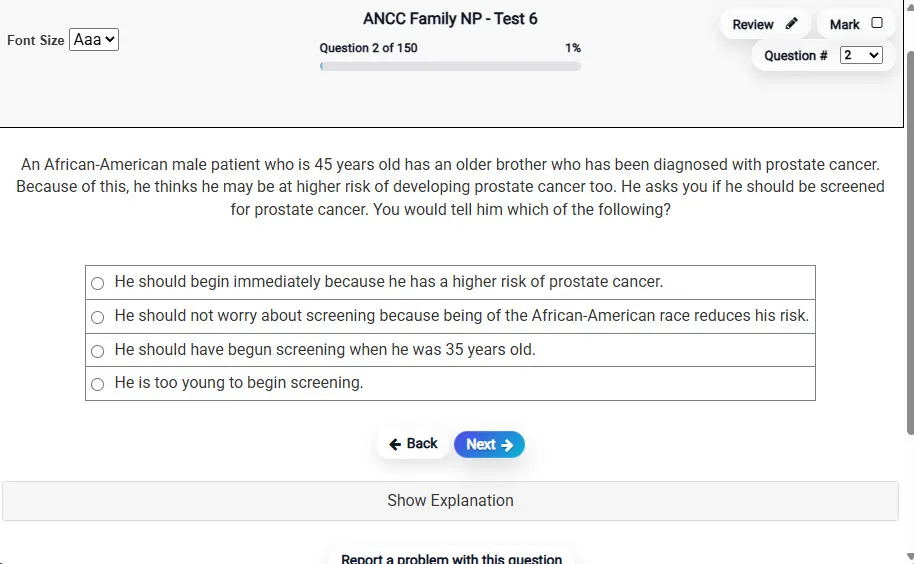
Answering a Question screen – Multiple-choice item view with navigation controls and progress tracker.
Answering a Question Multiple-choice item view with navigation controls and progress tracker.

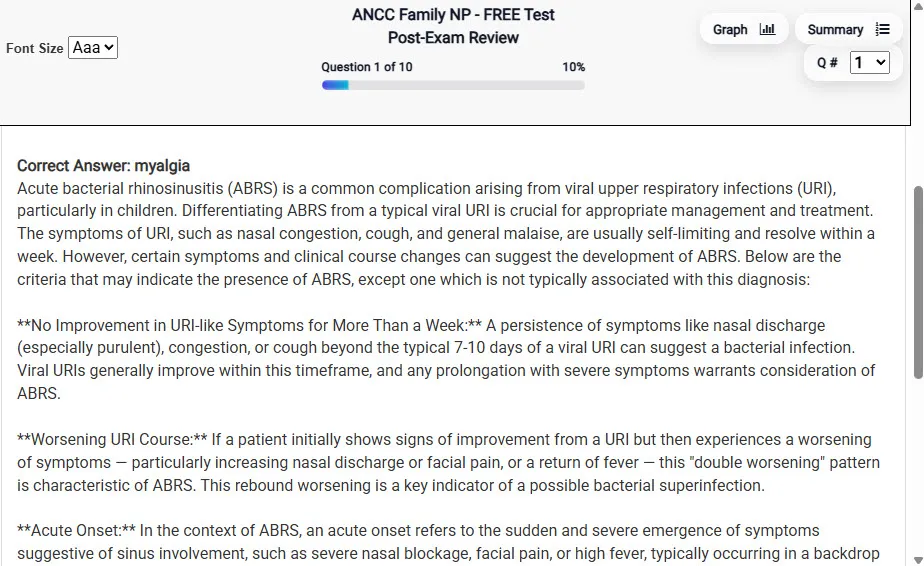
                           Detailed Explanation screen – 
                         Review mode showing chosen answer and rationale and references.
Detailed Explanation Review mode showing chosen answer and rationale and references.

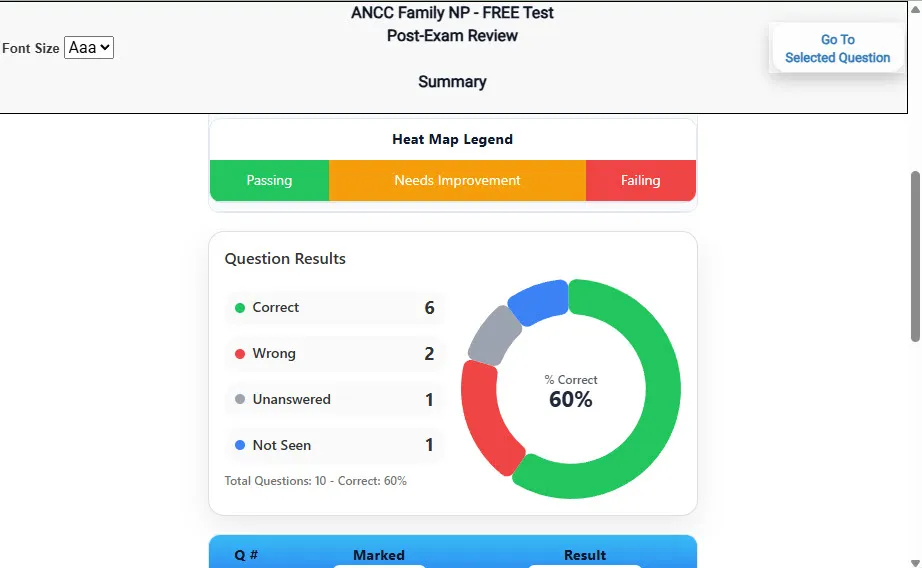
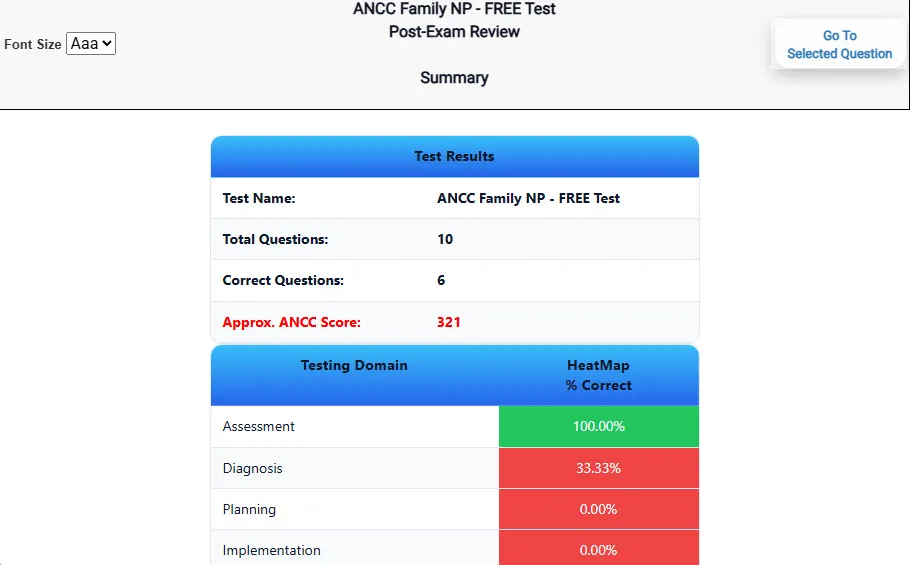
                           Review Summary 1 screen – 
                         Summary with counts for correct/wrong/unanswered and not seen items.
Review Summary 1 Summary with counts for correct/wrong/unanswered and not seen items.

                           Review Summary 2 screen – 
                         Advanced summary with category/domain breakdown and performance insights.
Review Summary 2 Advanced summary with category/domain breakdown and performance insights.

What Each Screen Shows

Answer Question Screen

  • Clean multiple-choice interface with progress bar.
  • Mark for review feature.
  • Matches real test pacing.

Detailed Explanation

  • Correct answer plus rationale.
  • Key concepts and guidelines highlighted.
  • Move between questions to fill knowledge gaps.

Review Summary 1

  • Overall results with total questions and scaled score.
  • Domain heatmap shows strengths and weaknesses.
  • Quick visual feedback on study priorities.

Review Summary 2

  • Chart of correct, wrong, unanswered, not seen.
  • Color-coded results for easy review.
  • Links back to missed items.

Top 10 Reasons to Use Exam Edge for your Praxis Teaching Reading Elementary Education Exam Prep

  1. Focused on the Praxis Teaching Reading Elementary Education Exam

    Our practice tests are built specifically for the Praxis Teaching Reading Elem Ed exam — every question mirrors the real topics, format, and difficulty so you're studying exactly what matters.

  2. Real Exam Simulation

    We match the per-question time limits and pressure of the actual Praxis exam, so test day feels familiar and stress-free.

  3. 15 Full Practice Tests & 1,395 Unique Questions

    You'll have more than enough material to master every Praxis Teaching Reading Elem Ed concept — no repeats, no fluff.

  4. Lower Cost Than a Retake

    Ordering 5 practice exams costs less than retaking the Praxis Teaching Reading Elementary Education exam after a failure. One low fee could save you both time and money.

  5. Flexible Testing

    Need to step away mid-exam? Pick up right where you left off — with your remaining time intact.

  6. Instant Scoring & Feedback

    See your raw score and an estimated Praxis Teaching Reading Elementary Education score immediately after finishing each practice test.

  7. Detailed Explanations for Every Question

    Review correct and incorrect answers with clear, step-by-step explanations so you truly understand each topic.

  8. Trusted & Accredited

    We're fully accredited by the Better Business Bureau and uphold the highest standards of trust and transparency.

  9. Web-Based & Always Available

    No software to install. Access your Praxis Teaching Reading Elem Ed practice exams 24/7 from any computer or mobile device.

  10. Expert Support When You Need It

    Need extra help? Our specialized tutors are highly qualified and ready to support your Praxis exam prep.


Pass the Praxis Teaching Reading Elementary Education Exam with Realistic Practice Tests from Exam Edge

Preparing for your upcoming Praxis Teaching Reading Elementary Education (5203) Certification Exam can feel overwhelming — but the right practice makes all the difference. Exam Edge gives you the tools, structure, and confidence to pass on your first try. Our online practice exams are built to match the real Praxis Teaching Reading Elem Ed exam in content, format, and difficulty.

  • 📝 15 Praxis Teaching Reading Elementary Education Practice Tests: Access 15 full-length exams with 93 questions each, covering every major Praxis Teaching Reading Elementary Education topic in depth.
  • Instant Online Access: Start practicing right away — no software, no waiting.
  • 🧠 Step-by-Step Explanations: Understand the reasoning behind every correct answer so you can master Praxis Teaching Reading Elem Ed exam concepts.
  • 🔄 Retake Each Exam Up to 4 Times: Build knowledge through repetition and track your improvement over time.
  • 🌐 Web-Based & Available 24/7: Study anywhere, anytime, on any device.
  • 🧘 Boost Your Test-Day Confidence: Familiarity with the Praxis format reduces anxiety and helps you perform under pressure.

These Praxis Teaching Reading Elementary Education practice exams are designed to simulate the real testing experience by matching question types, timing, and difficulty level. This approach helps you get comfortable not just with the exam content, but also with the testing environment, so you walk into your exam day focused and confident.


Exam Edge Praxis Reviews


I failed the Praxis Math test five times before I found your site. After taking all your practice tests, on my next attempt I passed by five points! I can honestly say this site is the reason I passed. Thank you!!!

Nikki P, Tennessee

Just wanted to say thanks for helping me pass the Praxis I Reading! Your practice tests and especially your explanations are great. They gave me the confidence I needed! Now I can student teach this fall. I'm so glad I found PraxisReading.com!

Denise C, Florida

Thank you so much. I just received my results in the mail. I scored a 179 and passed the Praxis I Writing! I'll never have to worry about retaking this test again! PraxisWriting.com is great. I told all my friends about this site.

Susan K, Virginia

I failed the Parapro test four times before I found your site. After taking all your practice tests, on my next attempt I passed by seven points! I can honestly say that this site is the reason I passed. Thank you!!!

Rebecca S, Texas

Hi! Just returned from taking my Praxis computerized and am happy to say that I passed with a 175. The last time I took the test I missed by 1 point. Your tests definitely made the difference for me! The set up was so similar to the test and the types of questions were also similar that I felt ve ...
Read More
Brad Y, Pennsylvania

I have taken the math praxis 3 times and wanted to give up. I ordered the bundle of math tests and I passed the math praxis today. Thank you for all the help.

Jacob D, South Carolina


Praxis Teaching Reading Elementary Education Aliases Test Name

Here is a list of alternative names used for this exam.

  • Praxis Teaching Reading Elementary Education
  • Praxis Teaching Reading Elementary Education test
  • Praxis Teaching Reading Elementary Education Certification Test
  • Praxis Teaching Reading Elem Ed test
  • Praxis
  • Praxis 5203
  • 5203 test
  • Praxis Teaching Reading Elementary Education (5203)
  • Teaching Reading Elementary Education certification