This is the content of the pop-over!

Praxis Teaching Reading (5204) Practice Tests & Test Prep by Exam Edge


Praxis Teaching Reading  product image
(5.0)
Based on 34 Reviews

  • Real Exam Simulation: Timed questions and matching content build comfort for your Praxis Teaching Reading test day.
  • Instant, 24/7 Access: Web-based Praxis Teaching Reading practice exams with no software needed.
  • Clear Explanations: Step-by-step answers and explanations for your Praxis exam to strengthen understanding.
  • Boosted Confidence: Reduces anxiety and improves test-taking skills to ace your Praxis Teaching Reading (5204).

Featured on

Praxis Teaching Reading Online Practice Test Bundles

BEST VALUE
15 practice tests

$149.25

$599.25

SAVE $450

Only $9.95 per test!

  • 100% Pass Guarantee
  • 15 online practice tests
  • 90 questions + 2 essays per test
  • Bonus: 100 Flash Cards + Study Guide
  • Instant access
  • Detailed Explanations
  • Practice tests never expire
  • Timed, untimed, or study guide mode
MOST POPULAR
10 practice tests

$99.50

$399.50

SAVE $300

Only $9.95 per test!

  • 10 online practice tests
  • 90 questions + 2 essays per test
  • Bonus: 100 Flash Cards + Study Guide
  • Instant access
  • Detailed Explanations
  • Practice tests never expire
  • Timed, untimed, or study guide mode
5 practice tests

$69.75

$199.75

SAVE $130

Only $13.95 per test!

  • 5 online practice tests
  • 90 questions + 2 essays per test
  • Bonus: 100 Flash Cards
  • Instant access
  • Detailed Explanations
  • Practice tests never expire
  • Timed, untimed, or study guide mode
1 practice test

$39.95

  • 1 online practice test
  • 90 questions + 2 essays per test
  • Instant access
  • Detailed Explanations
  • Practice tests never expire
  • Timed, untimed, or study guide mode
Quick Select
Tap to choose a bundle

** All Prices are in US Dollars (USD) **


Praxis Teaching Reading (5204) Resources

Jump to the section you need most.

Understanding the exact breakdown of the Praxis Teaching Reading test will help you know what to expect and how to most effectively prepare. The Praxis Teaching Reading has 90 multiple-choice questions and 3 essay questions. The exam will be broken down into the sections below:

Praxis Teaching Reading Exam Blueprint
Domain Name % Number of
Questions
Emergent Literacy 12% 11
     A. Oral Language  
     B. Concepts of Print  
Phonological Awareness 12% 11
Alphabetic Principle/Phonics and Word Analysis 12% 11
Comprehension and Fluency 25% 23
Vocabulary 14% 13
Instructional Processes (constructed response) 25% 23
     Curriculum Materials  
     Assessment  
     Instructional Practices  

Praxis Teaching Reading Study Tips by Domain

  • Target emergent literacy skills in a predictable progression (oral language → concepts of print → phonological awareness → alphabet knowledge)—red flag: jumping to worksheets/decoding before children can handle rhymes or syllable play.
  • Use interactive read-alouds to model book handling, directionality, and meaning-making; common trap: turning read-aloud into quizzing that reduces talk time and rich language exposure.
  • Build print awareness intentionally (title/author, left-to-right, return sweep, spaces, words vs. letters)—priority rule: teach it in authentic contexts like shared reading, not isolated drills.
  • Provide daily opportunities for scribbling/drawing/labeling and shared writing to connect speech to print; red flag: correcting invented spelling too early and discouraging risk-taking.
  • Strengthen phonological awareness with oral tasks (rhyme, alliteration, onset-rime, blending/segmenting) before letter work—contraindication: asking students to “sound out” words when the task is purely auditory.
  • Support emergent readers with repeated exposure to high-interest texts and environmental print (logos, signs) while monitoring for overreliance on picture cues—common trap: praising “guessing” without attention to print.
  • Distinguish oral language components—phonology, morphology, syntax, semantics, pragmatics—and tie each to observable classroom behaviors; red flag: confusing phonological awareness (sound structure) with phonics (print-to-sound).
  • Prioritize rich oral interactions (think-alouds, accountable talk, dialogic read-alouds) to build sentence complexity and narrative skill; common trap: asking mostly yes/no questions that limit language output.
  • Use explicit vocabulary instruction orally (multiple exposures, student-friendly definitions, examples/nonexamples) before expecting transfer to reading; red flag: defining a word once and moving on without requiring students to use it in speaking.
  • Support English learners with scaffolds (recasts, sentence frames, visuals) while maintaining grade-level ideas; priority rule: correct meaning and message first, then form—overcorrecting grammar can shut down participation.
  • Monitor for language differences versus possible disorders using patterns across settings and languages; contraindication: referring for special education based solely on accent, dialect, or limited English proficiency.
  • Strengthen listening comprehension as a ceiling for later reading comprehension by teaching students to retell, summarize, and infer from oral texts; red flag: treating listening as passive rather than checking understanding with targeted prompts.
  • Teach book handling and directionality explicitly—front/back cover, title/author, left-to-right and top-to-bottom tracking; red flag: students start on the last page or sweep right-to-left.
  • Differentiate a letter from a word and a sentence using concrete cues (spaces between words, capital letter to period); common trap: students count syllables as words or treat each letter as a word.
  • Model one-to-one word matching during shared reading with a pointer; priority rule: if accuracy breaks down, slow down and re-track rather than speeding up.
  • Teach punctuation and capitalization as meaning cues (question mark changes intonation, quotation marks signal dialogue); red flag: monotone reading that ignores end marks.
  • Build print-to-speech connections by having students locate and reread a known word (e.g., their name) in multiple places; common trap: relying on picture cues instead of checking the print.
  • Assess concepts of print with brief, observable tasks (show me the first word, the last letter, where to start reading); threshold cue: two or more directionality errors indicate a need for targeted print-concept instruction.
  • Phonological awareness is hearing/manipulating sound structures (words, syllables, onsets/rimes, phonemes) — red flag: confusing it with phonics, which links sounds to letters.
  • Use a clear continuum (rhyming → syllable segmentation → onset-rime → phoneme blending/segmenting/manipulation); common trap: jumping straight to phoneme deletion before students can blend/segment.
  • Phoneme segmentation and blending are high-leverage for decoding — priority rule: ensure tasks are oral-only (no print) when the goal is phonological awareness.
  • Know task types and error patterns: blending (/k/ /a/ /t/), segmenting (cat → /k/ /a/ /t/), deleting (smile without /s/), substituting (cat change /k/ to /h/); red flag: student can rhyme but cannot isolate initial/final phonemes.
  • Differentiate phonological vs. phonemic awareness: phonemic awareness is phonemes specifically; common trap: treating syllable clapping as sufficient evidence of phonemic awareness.
  • Instruction should be brief, explicit, and responsive (model → guided practice → quick checks); contraindication: using letter names or spelling during PA drills can mask weak sound awareness.
  • Teach and assess letter–sound correspondences and common spellings (including consonant blends/digraphs); red flag: students who can name letters but cannot produce the sound quickly and accurately.
  • Use explicit phonics sequences from simple to complex (CVC → CCVC/CVCC → vowel teams, r-controlled, diphthongs); common trap: introducing multiple new patterns at once without cumulative review.
  • Apply decoding strategies with continuous blending and targeted practice on high-utility patterns; priority rule: prompt students to “sound and blend” rather than guess from pictures or context.
  • Teach morphology for word analysis (base words, inflectional endings, common prefixes/suffixes) to support multisyllabic decoding; red flag: students stumble on longer words despite strong single-syllable phonics.
  • Address syllable types and syllable division (closed, open, silent-e, vowel team, r-controlled, consonant-le) to read unfamiliar multisyllabic words; common trap: teaching division rules without practicing with real connected text.
  • Include irregular or high-frequency words with mapping to known phonics features (what’s regular vs. “heart” part); contraindication: rote memorization lists that replace phonics instruction.
  • Teach comprehension with an explicit before–during–after routine (activate schema, monitor, summarize); red flag: students can decode accurately but cannot retell or answer text-dependent questions.
  • Use text structure instruction (story grammar, cause/effect, compare/contrast) and graphic organizers; common trap: asking only “favorite part” questions that don’t require evidence from the text.
  • Build inference-making by linking clues in the text with background knowledge; priority rule: require students to cite the sentence/phrase that supports the inference.
  • Develop fluency through repeated reading with feedback and modeling (accuracy, rate, prosody); red flag: increasing speed without maintaining phrasing and meaning.
  • Match fluency support to need—use choral/echo reading for confidence and assisted reading for accuracy; contraindication: round-robin reading, which reduces practice time and can increase anxiety.
  • Assess comprehension and fluency with multiple measures (retell/rubric, oral reading accuracy, prosody, words correct per minute); common trap: relying on one score (e.g., WCPM) as a stand-in for comprehension.
  • Teach multiple-meaning words and figurative language explicitly; red flag: students can define a word in isolation but misinterpret it in context.
  • Use morphology (prefixes, suffixes, roots) to unlock academic vocabulary; common trap: teaching word parts as definitions without checking that the meaning fits the sentence.
  • Plan rich, repeated exposures (read-aloud, discussion, writing) and require use of new words; priority rule: 6–10 meaningful encounters typically beats one-time memorization.
  • Select words strategically (Tier 2 high-utility over rare Tier 3 unless essential to a topic); red flag: spending heavy time on low-frequency words that won’t transfer across texts.
  • Teach context-clue strategies (definition, example, contrast) but verify with reference tools; common trap: guessing from vague context and reinforcing an incorrect meaning.
  • Differentiate for multilingual learners and students with language delays using visuals, cognates carefully, and student-friendly explanations; contraindication: relying on dictionary definitions alone when they contain unfamiliar words.
  • Start by stating a measurable objective aligned to the standard and the text demand (e.g., inferencing, decoding pattern); red flag: describing activities without an explicit skill target.
  • Use the gradual release model (I Do–We Do–You Do) with a brief teacher think-aloud; common trap: moving to independent practice before students demonstrate success in guided practice.
  • Plan for differentiation using data (running record errors, phonics screen, comprehension checks) and name what you’ll change (text level, scaffold, grouping); priority rule: match support to the error pattern, not the label (e.g., “struggling reader”).
  • Include purposeful questioning and prompts (literal → inferential → evaluative) and require evidence from the text; red flag: asking only yes/no questions or accepting answers without citing words/phrases.
  • Embed formative assessment during the lesson (quick retell, word list, exit ticket) and state how results will adjust next instruction; common trap: listing an assessment without saying what decision it informs.
  • Specify feedback and correction routines (model, prompt, re-read/retry, confirm) to maintain accuracy and meaning; contraindication: over-cueing (telling the word) instead of prompting strategies (sound it out, check meaning, re-read).
  • Evaluate whether materials align to grade-level standards and evidence-based reading components; red flag: a program that promises “balanced literacy” but provides little explicit phonics or decoding instruction.
  • Check scope-and-sequence coherence across units (skills build from easier to harder); common trap: using leveled texts as the main driver of instruction instead of a planned progression of skills.
  • Confirm text complexity, genre variety, and cultural/linguistic relevance are intentional; priority rule: do not substitute all readings with student-choice texts if it reduces access to complex, content-rich texts.
  • Inspect assessments and practice tasks embedded in materials for validity; red flag: “comprehension” questions that are mostly opinion prompts and don’t require evidence from the text.
  • Verify differentiation supports are actionable (scaffolds, intervention/extension, ELL supports) without lowering expectations; contraindication: simplifying the text as the only support rather than providing structured scaffolds.
  • Review usability and implementation supports (teacher guidance, routines, pacing, manipulatives/decodables); common trap: adopting materials with strong student pages but minimal teacher directions for explicit modeling and corrective feedback.
  • Use multiple measures aligned to the reading construct (e.g., phonemic awareness vs. comprehension); red flag: interpreting a single oral reading score as “overall reading ability.”
  • Screeners are for risk identification, not diagnosis; priority rule: confirm concerns with diagnostic assessment before selecting interventions.
  • Progress monitoring should be brief, frequent, and sensitive to small growth; common trap: changing tools every time, which breaks trend-line comparisons.
  • Analyze errors, not just totals (miscue patterns, decoding vs. language comprehension); red flag: reteaching “phonics” when errors show limited vocabulary/background knowledge.
  • Ensure assessment accommodations preserve the skill being measured; contraindication: reading text aloud on a decoding test because it invalidates the construct.
  • Communicate results using criterion-referenced interpretation (benchmarks, mastery) rather than only norm-referenced ranks; common trap: treating percentile as “percent correct.”
  • Use explicit, systematic instruction with a clear “I do–We do–You do” sequence; red flag: skipping guided practice and assuming independent work will “stick.”
  • Differentiate by data (skill, text level, language needs) rather than by a fixed reading “group”; common trap: keeping students in the same group after progress shows they need a different skill focus.
  • Build daily opportunities for reading, writing, speaking, and listening around the same objective; priority rule: align tasks to the target skill, not to a fun activity that doesn’t measure it.
  • Teach and model strategies (e.g., decoding routines, comprehension fix-up, annotation) and require students to verbalize steps; red flag: telling students to “use context” as the main plan for unknown words.
  • Use corrective feedback that is immediate and specific (state the error, model, then have the student retry); common trap: overpraising effort without requiring an accurate, independent response.
  • Increase text complexity and task demand gradually with scaffolds (sentence frames, chunking, rereading, partner reading) and then remove supports; contraindication: permanent scaffolds that prevent students from doing the work independently.


Built to Fit Into Your Busy Life

Everything you need to prepare with confidence—without wasting a minute.

Three Study Modes

Timed, No Time Limit, or Explanation mode.

Actionable Analytics

Heatmaps and scaled scores highlight weak areas.

High-Yield Rationales

Concise explanations emphasize key concepts.

Realistic Interface

Matches the feel of the actual exam environment.

Accessible by Design

Clean layout reduces cognitive load.

Anytime, Anywhere

Web-based access 24/7 on any device.
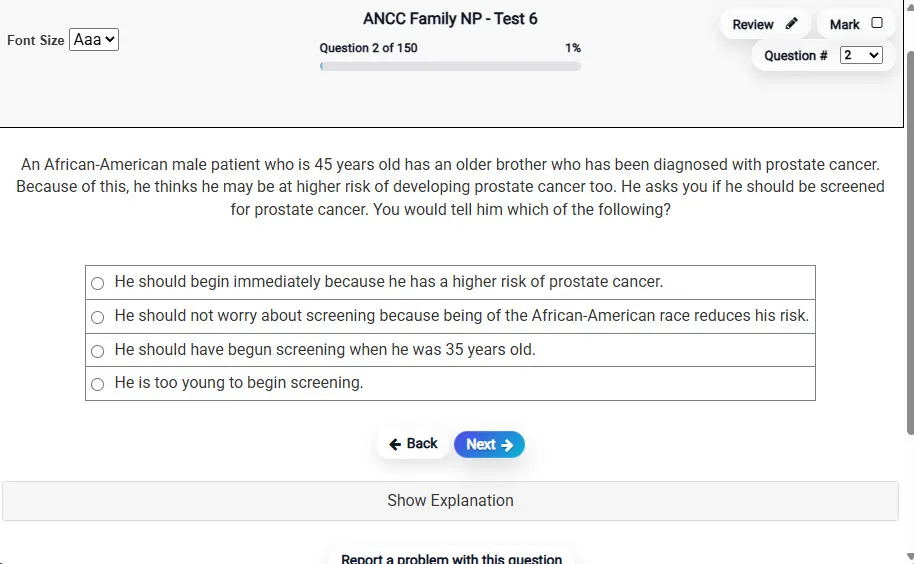
Answering a Question screen – Multiple-choice item view with navigation controls and progress tracker.
Answering a Question Multiple-choice item view with navigation controls and progress tracker.

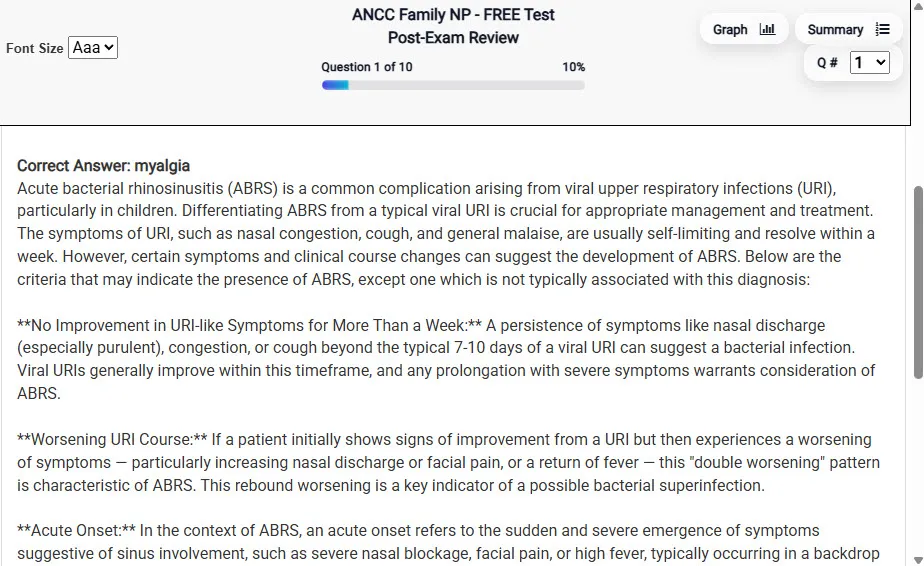
                           Detailed Explanation screen – 
                         Review mode showing chosen answer and rationale and references.
Detailed Explanation Review mode showing chosen answer and rationale and references.

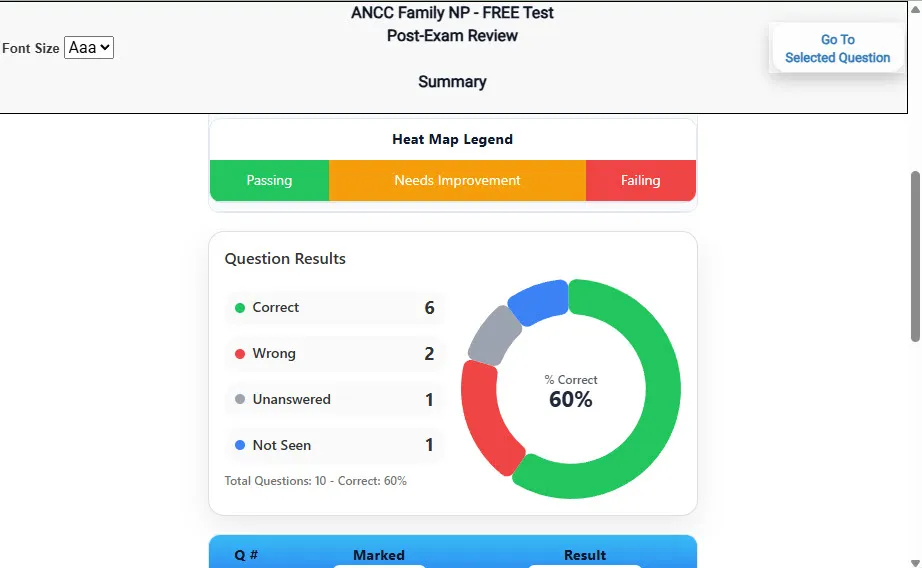
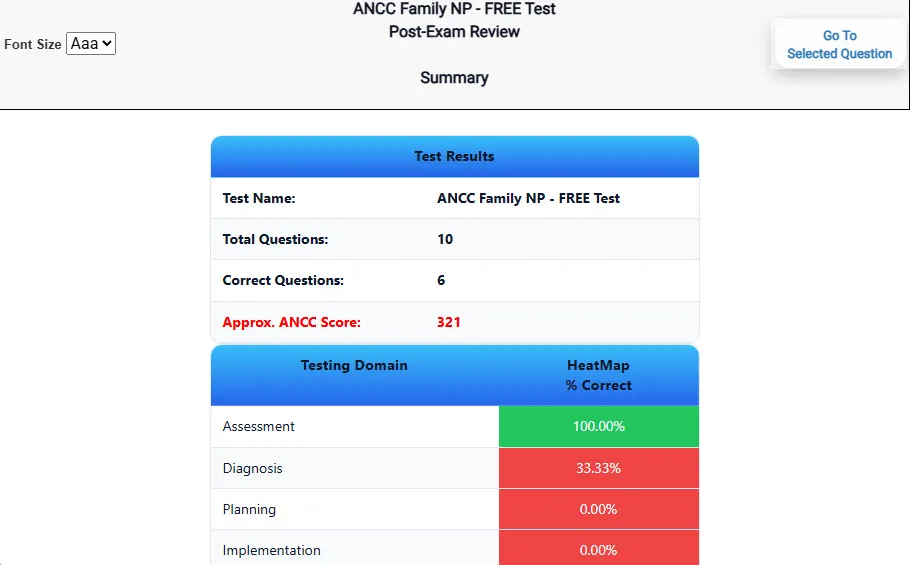
                           Review Summary 1 screen – 
                         Summary with counts for correct/wrong/unanswered and not seen items.
Review Summary 1 Summary with counts for correct/wrong/unanswered and not seen items.

                           Review Summary 2 screen – 
                         Advanced summary with category/domain breakdown and performance insights.
Review Summary 2 Advanced summary with category/domain breakdown and performance insights.

What Each Screen Shows

Answer Question Screen

  • Clean multiple-choice interface with progress bar.
  • Mark for review feature.
  • Matches real test pacing.

Detailed Explanation

  • Correct answer plus rationale.
  • Key concepts and guidelines highlighted.
  • Move between questions to fill knowledge gaps.

Review Summary 1

  • Overall results with total questions and scaled score.
  • Domain heatmap shows strengths and weaknesses.
  • Quick visual feedback on study priorities.

Review Summary 2

  • Chart of correct, wrong, unanswered, not seen.
  • Color-coded results for easy review.
  • Links back to missed items.

Top 10 Reasons to Use Exam Edge for your Praxis Teaching Reading Exam Prep

  1. Focused on the Praxis Teaching Reading Exam

    Our practice tests are built specifically for the Praxis Teaching Reading exam — every question mirrors the real topics, format, and difficulty so you're studying exactly what matters.

  2. Real Exam Simulation

    We match the per-question time limits and pressure of the actual Praxis exam, so test day feels familiar and stress-free.

  3. 15 Full Practice Tests & 1,380 Unique Questions

    You'll have more than enough material to master every Praxis Teaching Reading concept — no repeats, no fluff.

  4. Lower Cost Than a Retake

    Ordering 5 practice exams costs less than retaking the Praxis Teaching Reading exam after a failure. One low fee could save you both time and money.

  5. Flexible Testing

    Need to step away mid-exam? Pick up right where you left off — with your remaining time intact.

  6. Instant Scoring & Feedback

    See your raw score and an estimated Praxis Teaching Reading score immediately after finishing each practice test.

  7. Detailed Explanations for Every Question

    Review correct and incorrect answers with clear, step-by-step explanations so you truly understand each topic.

  8. Trusted & Accredited

    We're fully accredited by the Better Business Bureau and uphold the highest standards of trust and transparency.

  9. Web-Based & Always Available

    No software to install. Access your Praxis Teaching Reading practice exams 24/7 from any computer or mobile device.

  10. Expert Support When You Need It

    Need extra help? Our specialized tutors are highly qualified and ready to support your Praxis exam prep.


Pass the Praxis Teaching Reading Exam with Realistic Practice Tests from Exam Edge

Preparing for your upcoming Praxis Teaching Reading (5204) Certification Exam can feel overwhelming — but the right practice makes all the difference. Exam Edge gives you the tools, structure, and confidence to pass on your first try. Our online practice exams are built to match the real Praxis Teaching Reading exam in content, format, and difficulty.

  • 📝 15 Praxis Teaching Reading Practice Tests: Access 15 full-length exams with 92 questions each, covering every major Praxis Teaching Reading topic in depth.
  • Instant Online Access: Start practicing right away — no software, no waiting.
  • 🧠 Step-by-Step Explanations: Understand the reasoning behind every correct answer so you can master Praxis Teaching Reading exam concepts.
  • 🔄 Retake Each Exam Up to 4 Times: Build knowledge through repetition and track your improvement over time.
  • 🌐 Web-Based & Available 24/7: Study anywhere, anytime, on any device.
  • 🧘 Boost Your Test-Day Confidence: Familiarity with the Praxis format reduces anxiety and helps you perform under pressure.

These Praxis Teaching Reading practice exams are designed to simulate the real testing experience by matching question types, timing, and difficulty level. This approach helps you get comfortable not just with the exam content, but also with the testing environment, so you walk into your exam day focused and confident.


Exam Edge Praxis Reviews


I failed the Praxis Math test five times before I found your site. After taking all your practice tests, on my next attempt I passed by five points! I can honestly say this site is the reason I passed. Thank you!!!

Nikki P, Tennessee

Just wanted to say thanks for helping me pass the Praxis I Reading! Your practice tests and especially your explanations are great. They gave me the confidence I needed! Now I can student teach this fall. I'm so glad I found PraxisReading.com!

Denise C, Florida

Thank you so much. I just received my results in the mail. I scored a 179 and passed the Praxis I Writing! I'll never have to worry about retaking this test again! PraxisWriting.com is great. I told all my friends about this site.

Susan K, Virginia

I failed the Parapro test four times before I found your site. After taking all your practice tests, on my next attempt I passed by seven points! I can honestly say that this site is the reason I passed. Thank you!!!

Rebecca S, Texas

Hi! Just returned from taking my Praxis computerized and am happy to say that I passed with a 175. The last time I took the test I missed by 1 point. Your tests definitely made the difference for me! The set up was so similar to the test and the types of questions were also similar that I felt ve ...
Read More
Brad Y, Pennsylvania

I have taken the math praxis 3 times and wanted to give up. I ordered the bundle of math tests and I passed the math praxis today. Thank you for all the help.

Jacob D, South Carolina


Praxis Teaching Reading Aliases Test Name

Here is a list of alternative names used for this exam.

  • Praxis Teaching Reading
  • Praxis Teaching Reading test
  • Praxis Teaching Reading Certification Test
  • Praxis
  • Praxis 5204
  • 5204 test
  • Praxis Teaching Reading (5204)
  • Teaching Reading certification