This is the content of the pop-over!

Praxis Speech Communication (5221) Practice Tests & Test Prep by Exam Edge


Praxis Speech Communication Content Knowledge  product image
(5.0)
Based on 22 Reviews

  • Real Exam Simulation: Timed questions and matching content build comfort for your Praxis Speech Communication test day.
  • Instant, 24/7 Access: Web-based Praxis Speech Communication Content Knowledge practice exams with no software needed.
  • Clear Explanations: Step-by-step answers and explanations for your Praxis exam to strengthen understanding.
  • Boosted Confidence: Reduces anxiety and improves test-taking skills to ace your Praxis Speech Communication Content Knowledge (5221).

Featured on

Praxis Speech Communication Content Knowledge Online Practice Test Bundles

BEST VALUE
10 practice tests

$99.50

$399.50

SAVE $300

Only $9.95 per test!

  • 100% Pass Guarantee
  • 10 online practice tests
  • 120 questions per test
  • Bonus: 100 Flash Cards + Study Guide
  • Instant access
  • Detailed Explanations
  • Practice tests never expire
  • Timed, untimed, or study guide mode
5 practice tests

$69.75

$199.75

SAVE $130

Only $13.95 per test!

  • 5 online practice tests
  • 120 questions per test
  • Bonus: 100 Flash Cards + Study Guide
  • Instant access
  • Detailed Explanations
  • Practice tests never expire
  • Timed, untimed, or study guide mode
1 practice test

$39.95

  • 1 online practice test
  • 120 questions per test
  • Instant access
  • Detailed Explanations
  • Practice tests never expire
  • Timed, untimed, or study guide mode
Quick Select
Tap to choose a bundle

** All Prices are in US Dollars (USD) **


Praxis Speech Communication (5221) Resources

Jump to the section you need most.

Understanding the exact breakdown of the Praxis Speech Communication Content Knowledge test will help you know what to expect and how to most effectively prepare. The Praxis Speech Communication Content Knowledge has 120 multiple-choice questions . The exam will be broken down into the sections below:

Praxis Speech Communication Content Knowledge Exam Blueprint
Domain Name % Number of
Questions
Communication Fundamentals 11% 13
Interpersonal Communication 13% 16
Group Communication 13% 16
Public Speaking 18% 22
Media and Their Influences 13% 16
Oral Interpretation and Performance Studies 11% 13
Forensics: Competitive Speech and Debate 11% 13
Assessment and Evaluation Issues 10% 12

Praxis Speech Communication Content Knowledge Study Tips by Domain

  • Differentiate key models (linear, interactional, transactional) and identify when “noise” is physical, psychological, semantic, or physiological—red flag: treating feedback as optional in transactional communication.
  • Apply communication competence criteria (appropriateness + effectiveness) across contexts; common trap: assuming “clear” messages are always competent without considering cultural and relational norms.
  • Recognize how verbal meaning works (denotation vs. connotation, abstraction ladders, equivocation) and watch for semantic barriers—priority rule: define key terms before arguing about them.
  • Use foundational nonverbal codes (kinesics, proxemics, haptics, chronemics, paralanguage, appearance, environment) and avoid the single-cue fallacy—red flag: inferring deception from one behavior like eye contact.
  • Explain listening types (discriminative, comprehensive, critical, empathic) and common breakdowns (pseudo-listening, selective listening)—threshold: you should be able to name the listening goal before choosing a response.
  • Connect perception and attribution processes (selection, organization, interpretation; fundamental attribution error) to message interpretation—common trap: over-crediting dispositional causes while ignoring situational constraints.
  • Distinguish relational stages and maintenance behaviors (e.g., self-disclosure, positivity, assurances) and match them to likely outcomes; red flag: assuming more disclosure is always better—timing and reciprocity matter.
  • Apply listening models (attending, paraphrasing, reflecting feelings, asking open questions) to improve accuracy; common trap: jumping to advice-giving before confirming understanding.
  • Recognize nonverbal cues (kinesics, proxemics, haptics, oculesics, vocalics) and how context changes meaning; priority rule: interpret clusters and congruence, not a single gesture.
  • Use conflict management approaches (avoid, accommodate, compete, compromise, collaborate) appropriately; threshold cue: collaborative strategies work best when the relationship and issue are both high-importance.
  • Explain how perception and attribution shape interaction (selective perception, fundamental attribution error, self-serving bias); red flag: attributing others’ behavior to character while excusing your own as “situational.”
  • Address cultural and identity influences (individualism/collectivism, power distance, facework) in message design; common trap: treating high-context and low-context communication norms as “better” rather than situationally effective.
  • Distinguish types of groups (primary/secondary, task/social, committee/virtual) and choose structures that fit the goal; red flag: using “team” for any gathering ignores purpose, norms, and decision authority.
  • Apply functional group communication (e.g., problem analysis → criteria → alternatives → evaluation) to meetings; common trap: jumping to solutions before defining the problem and constraints.
  • Recognize roles and leadership patterns (task/maintenance/self-centered roles; emergent vs. designated leadership) and how they affect outcomes; priority rule: address self-centered roles early to protect participation equity.
  • Use effective decision-making methods (consensus, majority, authority, expert, unanimity) and match them to time/risk; red flag: claiming “consensus” when dissent was silenced or not solicited.
  • Identify and reduce groupthink and conformity pressures (illusion of unanimity, self-censorship, mindguards); practical cue: assign a devil’s advocate and solicit independent input before discussion to counter premature agreement.
  • Manage conflict and power dynamics with appropriate strategies (avoid/accommodate/compete/compromise/collaborate) and clear agendas; common trap: treating relational conflict as a content dispute instead of reframing needs, face, and norms.
  • Organize speeches with a clear thesis and signposted main points (e.g., preview–body–review); red flag: multiple “points” that don’t directly support the specific purpose.
  • Match organization to purpose (problem–solution, causal, topical, Monroe’s Motivated Sequence); common trap: choosing a pattern for “variety” rather than for audience needs and claim logic.
  • Adapt to audience (demographics, attitudes, knowledge) and occasion; priority rule: audience analysis should directly change examples, language level, and evidence, not just be mentioned in the intro.
  • Use credible evidence (statistics, testimony, examples) with accurate citation in speech; red flag: unsupported numerical claims or vague source cues like “studies show” without attribution.
  • Employ persuasive strategies ethically (claims, warrants, refutation) and avoid fallacies; common trap: attacking a straw man or overgeneralizing from a single anecdote.
  • Manage delivery (vocal variety, rate, articulation, eye contact, purposeful movement) and support it with well-designed visuals; contraindication: reading slides or using visuals with tiny text/overloaded data.
  • Distinguish media effects models (e.g., cultivation, social learning, agenda-setting, uses-and-gratifications) by what they predict; red flag: confusing agenda-setting (issue salience) with persuasion (attitude change).
  • Identify how media ownership, gatekeeping, and algorithms shape what audiences see; common trap: treating “trending” content as representative of public opinion rather than a platform-curated output.
  • Apply media literacy to evaluate credibility (source, evidence, bias, verification); priority rule: corroborate across independent outlets before accepting claims, especially with anonymous sourcing.
  • Recognize ethical and legal constraints in media (copyright/fair use, privacy, defamation, consent); red flag: assuming “it’s online” equals public-domain or permissible to reuse without attribution.
  • Analyze representation and stereotyping effects (framing, priming, implicit bias) on audience perceptions; common trap: ignoring how repeated portrayals can normalize roles even without explicit endorsement.
  • Compare medium characteristics (print, broadcast, social, streaming) and message design (visual rhetoric, sound, editing) on interpretation; threshold cue: high emotional arousal plus rapid cuts often reduces critical processing and increases heuristic judgments.
  • Differentiate interpretation genres (prose, poetry, drama, duo) by observable performance choices; red flag: using “memorized acting” in an event that requires a script or limited movement.
  • Apply text analysis (theme, POV, tone, imagery, structure) to justify vocal and physical choices; common trap: making character choices that contradict the author’s language or time/place cues.
  • Use vocal variety intentionally (rate, pitch, volume, pausing, articulation) to clarify meaning; priority rule: intelligibility first—don’t sacrifice diction for “emotion.”
  • Establish character(s) with consistent physicality and focal points; red flag: frequent eye contact with the audience when the scene logic requires an offstage/partner focus.
  • Handle cutting and transitions ethically and coherently (maintain plot, author intent, and continuity); common trap: cutting so aggressively that motivation or relationships become unclear.
  • Demonstrate safe, respectful performance practices (content warnings as appropriate, non-stereotyped portrayals, and physical/vocal health); contraindication: sustained yelling or unsafe movement that risks injury or vocal damage.
  • Know standard event formats and time limits (e.g., extemporaneous speaking prep time, interp length, debate speech/cross-exam order)—common trap: giving “good” advice that violates the event rules.
  • Distinguish debate types and core evaluation criteria (policy: plan/solvency/advantages; LD: value/value-criterion; PF: audience-friendly clash)—red flag: judging LD like policy by over-weighting pure cost-benefit absent the framework.
  • Prioritize argument construction (claim–warrant–impact) and evidence standards (source credibility, accurate quoting, citation norms)—contraindication: card clipping/misquotation is a high-risk ethics violation even if the argument is strong.
  • Apply flow and refutation skills (signposting, line-by-line, weighing, turns, counterplans, kritik basics) with a priority rule: extend only what you want evaluated—common trap: new arguments in rebuttals when the format prohibits them.
  • Understand delivery and persuasion expectations by event (clarity and adaptation vs speed; speaker points tied to organization, ethos, and responsiveness)—red flag: speed that destroys intelligibility generally loses ballots even with superior content.
  • Manage tournament practice and equity (tabroom norms, judge adaptation, disclosure practices, and classroom coaching ethics)—priority rule: fairness and student safety policies override competitive goals when conflicts arise.
  • Align assessments to stated learning outcomes (e.g., informative vs. persuasive speaking) and use criterion-referenced rubrics; red flag: grading “effort” or “confidence” without observable criteria.
  • Prioritize reliability through clear descriptors and rater calibration (anchor samples, norming); common trap: changing standards mid-semester or using different criteria for different students.
  • Support validity by sampling the full construct (content, organization, delivery, audience adaptation) rather than one element; red flag: a single speech score used to infer overall communication competence.
  • Use formative feedback that is specific, timely, and actionable (e.g., 1–2 target behaviors for the next speech); common trap: vague comments like “be more engaging” with no behavioral direction.
  • Address fairness and accessibility (transparent rubrics, accommodations, bias-aware prompts); priority rule: do not penalize accent, dialect, or disability-related differences unless the objective explicitly targets standard pronunciation.
  • Apply basic assessment statistics and grading practices responsibly (weighting, cut scores, interrater checks); red flag: averaging incomparable tasks (e.g., impromptu + researched speech) without clear weighting rationale.


Built to Fit Into Your Busy Life

Everything you need to prepare with confidence—without wasting a minute.

Three Study Modes

Timed, No Time Limit, or Explanation mode.

Actionable Analytics

Heatmaps and scaled scores highlight weak areas.

High-Yield Rationales

Concise explanations emphasize key concepts.

Realistic Interface

Matches the feel of the actual exam environment.

Accessible by Design

Clean layout reduces cognitive load.

Anytime, Anywhere

Web-based access 24/7 on any device.
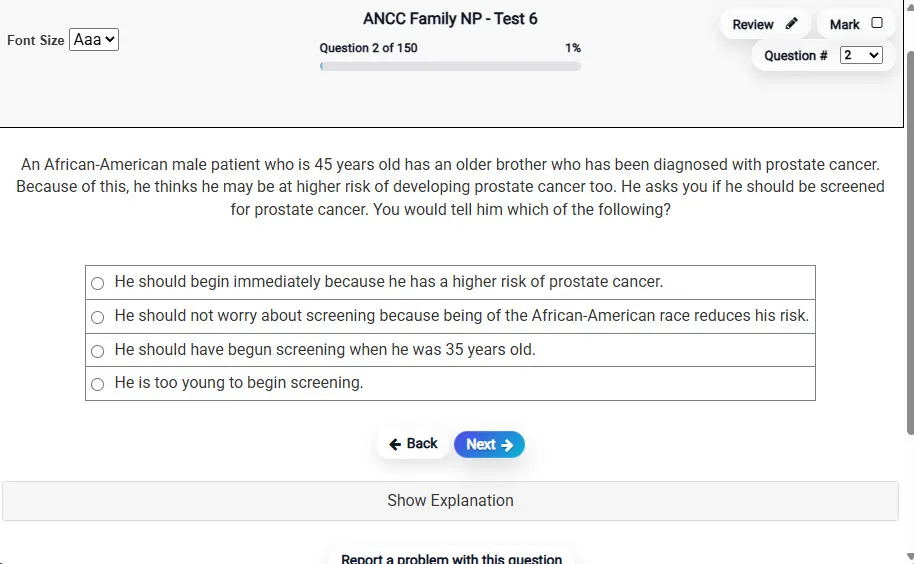
Answering a Question screen – Multiple-choice item view with navigation controls and progress tracker.
Answering a Question Multiple-choice item view with navigation controls and progress tracker.

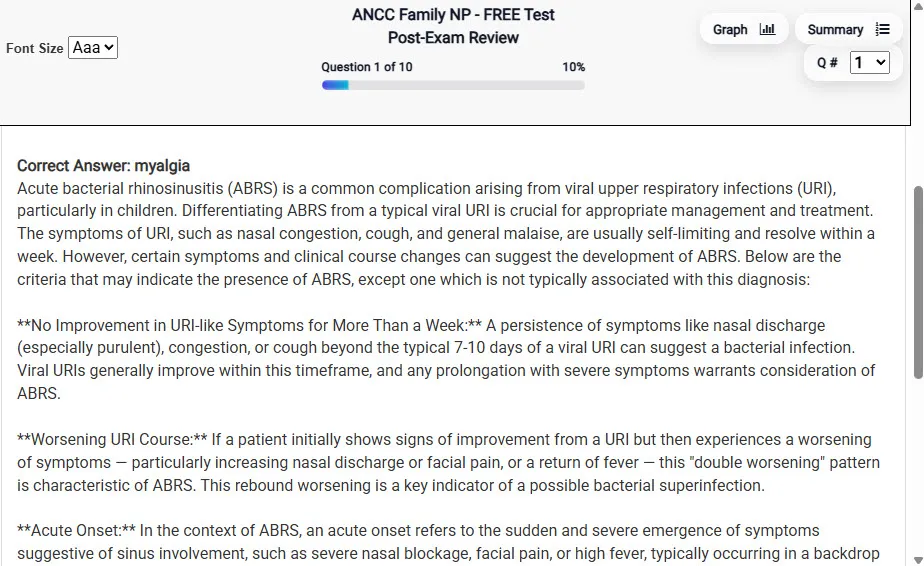
                           Detailed Explanation screen – 
                         Review mode showing chosen answer and rationale and references.
Detailed Explanation Review mode showing chosen answer and rationale and references.

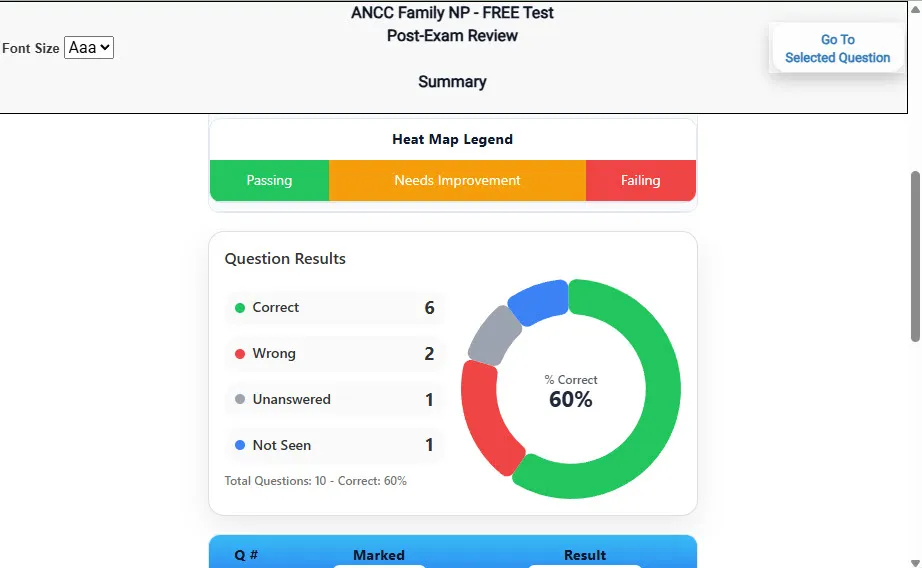
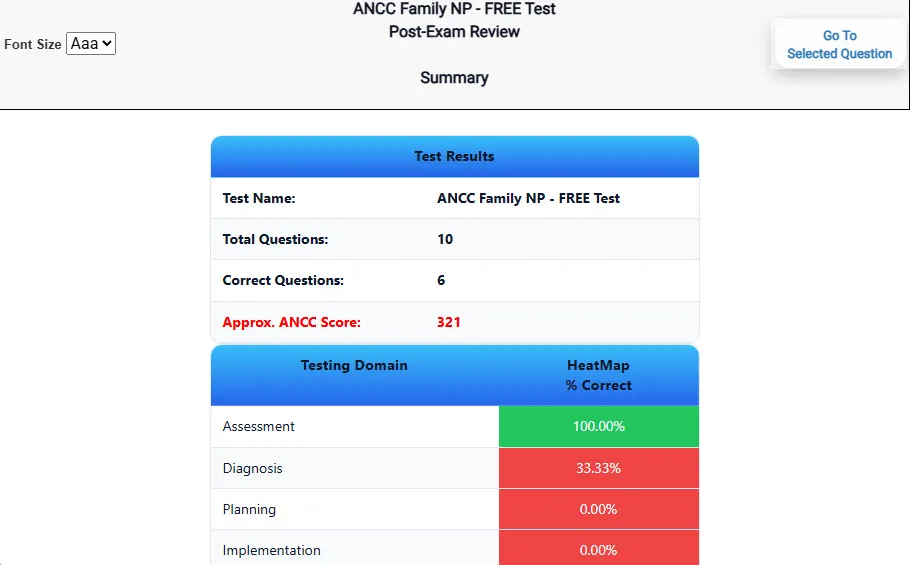
                           Review Summary 1 screen – 
                         Summary with counts for correct/wrong/unanswered and not seen items.
Review Summary 1 Summary with counts for correct/wrong/unanswered and not seen items.

                           Review Summary 2 screen – 
                         Advanced summary with category/domain breakdown and performance insights.
Review Summary 2 Advanced summary with category/domain breakdown and performance insights.

What Each Screen Shows

Answer Question Screen

  • Clean multiple-choice interface with progress bar.
  • Mark for review feature.
  • Matches real test pacing.

Detailed Explanation

  • Correct answer plus rationale.
  • Key concepts and guidelines highlighted.
  • Move between questions to fill knowledge gaps.

Review Summary 1

  • Overall results with total questions and scaled score.
  • Domain heatmap shows strengths and weaknesses.
  • Quick visual feedback on study priorities.

Review Summary 2

  • Chart of correct, wrong, unanswered, not seen.
  • Color-coded results for easy review.
  • Links back to missed items.

Top 10 Reasons to Use Exam Edge for your Praxis Speech Communication Content Knowledge Exam Prep

  1. Focused on the Praxis Speech Communication Content Knowledge Exam

    Our practice tests are built specifically for the Praxis Speech Communication exam — every question mirrors the real topics, format, and difficulty so you're studying exactly what matters.

  2. Real Exam Simulation

    We match the per-question time limits and pressure of the actual Praxis exam, so test day feels familiar and stress-free.

  3. 10 Full Practice Tests & 1,200 Unique Questions

    You'll have more than enough material to master every Praxis Speech Communication concept — no repeats, no fluff.

  4. Lower Cost Than a Retake

    Ordering 5 practice exams costs less than retaking the Praxis Speech Communication Content Knowledge exam after a failure. One low fee could save you both time and money.

  5. Flexible Testing

    Need to step away mid-exam? Pick up right where you left off — with your remaining time intact.

  6. Instant Scoring & Feedback

    See your raw score and an estimated Praxis Speech Communication Content Knowledge score immediately after finishing each practice test.

  7. Detailed Explanations for Every Question

    Review correct and incorrect answers with clear, step-by-step explanations so you truly understand each topic.

  8. Trusted & Accredited

    We're fully accredited by the Better Business Bureau and uphold the highest standards of trust and transparency.

  9. Web-Based & Always Available

    No software to install. Access your Praxis Speech Communication practice exams 24/7 from any computer or mobile device.

  10. Expert Support When You Need It

    Need extra help? Our specialized tutors are highly qualified and ready to support your Praxis exam prep.


Pass the Praxis Speech Communication Content Knowledge Exam with Realistic Practice Tests from Exam Edge

Preparing for your upcoming Praxis Speech Communication Content Knowledge (5221) Certification Exam can feel overwhelming — but the right practice makes all the difference. Exam Edge gives you the tools, structure, and confidence to pass on your first try. Our online practice exams are built to match the real Praxis Speech Communication exam in content, format, and difficulty.

  • 📝 10 Praxis Speech Communication Content Knowledge Practice Tests: Access 10 full-length exams with 120 questions each, covering every major Praxis Speech Communication Content Knowledge topic in depth.
  • Instant Online Access: Start practicing right away — no software, no waiting.
  • 🧠 Step-by-Step Explanations: Understand the reasoning behind every correct answer so you can master Praxis Speech Communication exam concepts.
  • 🔄 Retake Each Exam Up to 4 Times: Build knowledge through repetition and track your improvement over time.
  • 🌐 Web-Based & Available 24/7: Study anywhere, anytime, on any device.
  • 🧘 Boost Your Test-Day Confidence: Familiarity with the Praxis format reduces anxiety and helps you perform under pressure.

These Praxis Speech Communication Content Knowledge practice exams are designed to simulate the real testing experience by matching question types, timing, and difficulty level. This approach helps you get comfortable not just with the exam content, but also with the testing environment, so you walk into your exam day focused and confident.

Exam Edge Praxis Reviews


I failed the Praxis Math test five times before I found your site. After taking all your practice tests, on my next attempt I passed by five points! I can honestly say this site is the reason I passed. Thank you!!!

Nikki P, Tennessee

Just wanted to say thanks for helping me pass the Praxis I Reading! Your practice tests and especially your explanations are great. They gave me the confidence I needed! Now I can student teach this fall. I'm so glad I found PraxisReading.com!

Denise C, Florida

Thank you so much. I just received my results in the mail. I scored a 179 and passed the Praxis I Writing! I'll never have to worry about retaking this test again! PraxisWriting.com is great. I told all my friends about this site.

Susan K, Virginia

I failed the Parapro test four times before I found your site. After taking all your practice tests, on my next attempt I passed by seven points! I can honestly say that this site is the reason I passed. Thank you!!!

Rebecca S, Texas

Hi! Just returned from taking my Praxis computerized and am happy to say that I passed with a 175. The last time I took the test I missed by 1 point. Your tests definitely made the difference for me! The set up was so similar to the test and the types of questions were also similar that I felt ve ...
Read More
Brad Y, Pennsylvania

I have taken the math praxis 3 times and wanted to give up. I ordered the bundle of math tests and I passed the math praxis today. Thank you for all the help.

Jacob D, South Carolina


Praxis Speech Communication Content Knowledge Aliases Test Name

Here is a list of alternative names used for this exam.

  • Praxis Speech Communication Content Knowledge
  • Praxis Speech Communication Content Knowledge test
  • Praxis Speech Communication Content Knowledge Certification Test
  • Praxis Speech Communication test
  • Praxis
  • Praxis 5221
  • 5221 test
  • Praxis Speech Communication Content Knowledge (5221)
  • Speech Communication Content Knowledge certification