This is the content of the pop-over!

Praxis Social Studies Content and Interpretation (5086) Practice Tests & Test Prep by Exam Edge


Praxis Social Studies Content and Interpretation  product image
(5.0)
Based on 32 Reviews

  • Real Exam Simulation: Timed questions and matching content build comfort for your Praxis Social Studies Content and Interpretation test day.
  • Instant, 24/7 Access: Web-based Praxis Social Studies Content and Interpretation practice exams with no software needed.
  • Clear Explanations: Step-by-step answers and explanations for your Praxis exam to strengthen understanding.
  • Boosted Confidence: Reduces anxiety and improves test-taking skills to ace your Praxis Social Studies Content and Interpretation (5086).

Featured on

Praxis Social Studies Content and Interpretation Online Practice Test Bundles

BEST VALUE
20 practice tests

$174.00

$799.00

SAVE $625

Only $8.70 per test!

  • 100% Pass Guarantee
  • 20 online practice tests
  • 90 questions + 3 essays per test
  • Bonus: 100 Flash Cards + Study Guide
  • Instant access
  • Detailed Explanations
  • Practice tests never expire
  • Timed, untimed, or study guide mode
MOST POPULAR
10 practice tests

$99.50

$399.50

SAVE $300

Only $9.95 per test!

  • 10 online practice tests
  • 90 questions + 3 essays per test
  • Bonus: 100 Flash Cards + Study Guide
  • Instant access
  • Detailed Explanations
  • Practice tests never expire
  • Timed, untimed, or study guide mode
5 practice tests

$69.75

$199.75

SAVE $130

Only $13.95 per test!

  • 5 online practice tests
  • 90 questions + 3 essays per test
  • Bonus: 100 Flash Cards
  • Instant access
  • Detailed Explanations
  • Practice tests never expire
  • Timed, untimed, or study guide mode
1 practice test

$39.95

  • 1 online practice test
  • 90 questions + 3 essays per test
  • Instant access
  • Detailed Explanations
  • Practice tests never expire
  • Timed, untimed, or study guide mode
Quick Select
Tap to choose a bundle

** All Prices are in US Dollars (USD) **


Praxis Social Studies Content and Interpretation (5086) Resources

Jump to the section you need most.

Understanding the exact breakdown of the Praxis Social Studies Content and Interpretation test will help you know what to expect and how to most effectively prepare. The Praxis Social Studies Content and Interpretation has 90 multiple-choice questions and 3 essay questions. The exam will be broken down into the sections below:

Praxis Social Studies Content and Interpretation Exam Blueprint
Domain Name % Number of
Questions
United States History 15% 14
World History 15% 14
Government/Civics/Political Science 15% 14
Geography 11% 10
Economics 11% 10
Behavioral Sciences 08% 7
Short Content Essays 25% 23

Praxis Social Studies Content and Interpretation Study Tips by Domain

  • Know major chronological frameworks (colonial → Revolution → Early Republic → Civil War/Reconstruction → industrialization → modern era); red flag: mixing up causes vs. immediate triggers (e.g., long-run sectionalism vs. Fort Sumter).
  • Connect founding documents and debates (Articles, Constitution, Federalist/Anti-Federalist, Bill of Rights) to later conflicts over federalism; common trap: assuming the Constitution instantly resolved state vs. national power disputes.
  • For the Civil War and Reconstruction, distinguish wartime aims (preservation of Union vs. emancipation) from postwar policy (13th–15th Amendments, Reconstruction Acts); priority rule: always tie Reconstruction outcomes to enforcement and backlash (e.g., Black Codes, KKK).
  • Industrialization/Progressive Era: link economic change (corporations, labor, immigration, urbanization) to reform responses (antitrust, regulation, suffrage); red flag: treating Progressive reforms as uniform—they often conflicted (prohibition vs. immigrant political machines).
  • Foreign policy and wars: place doctrines and turning points (Monroe, imperialism, WWI/WWII, Cold War containment) in context of domestic politics; common trap: confusing isolationism (interwar) with noninterventionism (limited scope, not absolute).
  • Civil rights and social movements: compare strategies and federal roles across eras (abolitionism, women’s rights, labor, Civil Rights Movement, Great Society); threshold cue: be able to name at least one key court case and one law per movement (e.g., Brown v. Board, Civil Rights Act of 1964).
  • Build a tight chronology of major eras (classical → post-classical → early modern → modern) and anchor each with 2–3 turning points; common trap: knowing isolated facts but missing cause-and-effect sequencing.
  • Compare core belief systems (Hinduism, Buddhism, Judaism, Christianity, Islam, Confucianism) by origins, diffusion routes, and political impact; red flag: mixing up monotheism vs. polytheism or confusing sects/time periods.
  • Trace trade networks (Silk Roads, Indian Ocean, Trans-Saharan, Atlantic) and what they moved (goods, people, disease, ideas); priority rule: always link exchange to state formation, urbanization, and cultural syncretism.
  • Analyze state-building and legitimacy (bureaucracy, law codes, taxation, military tech) across regions; common trap: attributing success only to “great leaders” while ignoring institutions and geography.
  • For imperialism and decolonization, distinguish motives (economic, strategic, ideological) from outcomes (resource extraction, borders, nationalism); red flag: treating African/Asian resistance as uniform rather than region- and time-specific.
  • For the 20th century, connect World Wars, revolutions, and the Cold War to changing ideologies and economic systems; threshold cue: when asked “most important cause,” pick the factor that best explains multiple downstream effects, not the nearest trigger.
  • Separate “enumerated” federal powers (Article I, Section 8) from reserved state powers (10th Amendment)—red flag: questions that treat the police power as primarily federal.
  • Use the Constitution’s structure to identify limits: separation of powers plus checks and balances—common trap is calling judicial review an explicit power rather than one established in Marbury v. Madison.
  • Know federalism conflict rules: Supremacy Clause preemption (express, field, conflict) beats state law—priority cue: if Congress clearly occupies the field, state regulation is likely invalid.
  • Match civil liberties to the right amendment and level of scrutiny—red flag: treating all classifications the same (strict scrutiny for race/national origin; intermediate for sex; rational basis for most others).
  • Track civil rights and voting protections: 14th Amendment equal protection and due process, 15th/19th/24th/26th voting expansions—common trap: confusing civil liberties (limits on government) with civil rights (equal treatment/access).
  • In elections and institutions, distinguish the roles of parties, primaries/caucuses, and the Electoral College—threshold cue: a candidate needs a majority of electoral votes (currently 270 of 538) or the House decides under the 12th Amendment.
  • Use the five themes (location, place, human–environment interaction, movement, region) to structure answers; red flag: confusing absolute location (latitude/longitude) with relative location (site/situation).
  • Read maps like a checklist (scale, legend, projection, direction) before interpreting data; common trap: ignoring projection distortion when comparing size, distance, or direction (e.g., Mercator vs. equal-area).
  • Apply population models carefully (DTM stages, push/pull migration, population pyramids); priority rule: link the pyramid shape to growth rate and dependency ratio rather than just naming the country type.
  • For climate/biomes, tie temperature and precipitation patterns to latitude, elevation, ocean currents, and rain shadows; red flag: treating weather events as climate trends without long-term data.
  • In cultural/political geography, distinguish nation vs. state and boundary types (natural, geometric, cultural); common trap: labeling every internal autonomy movement as “secession” instead of devolution or irredentism.
  • When analyzing urban and economic space (central place theory, Von Thünen, core–periphery), state the underlying assumptions; contraindication: applying models without checking for real-world violations like transportation corridors, globalization, or zoning.
  • Use supply-and-demand shifts correctly: a change in price moves along the curve, while nonprice factors (income, tastes, input costs, technology) shift it—common trap is calling a movement a shift.
  • Distinguish elasticity types and interpretation: demand is elastic when |%ΔQ| > |%ΔP|, and total revenue moves opposite price in that case—red flag is forgetting the absolute value or mixing up inelastic vs elastic.
  • Identify market failures and targeted fixes: negative externalities justify taxes/regulation, positive externalities justify subsidies, and public goods (nonrival, nonexcludable) create free-rider problems—common trap is calling any government program a “public good.”
  • Compare market structures with profit-max rules: perfectly competitive firms set P = MC, monopolists set MR = MC with P > MC, and oligopolies may act strategically—priority rule is to use marginal analysis, not average cost, to pick output.
  • Read macro indicators and policy levers: GDP (nominal vs real), inflation, unemployment (frictional/structural/cyclical), and the Fed’s tools (open-market operations, reserve requirement, discount rate)—common trap is assuming printing money always lowers interest rates without considering inflation expectations.
  • Apply basic trade and finance logic: comparative advantage drives gains from trade even if one side has absolute advantage, while exchange rates affect net exports and capital flows—red flag is confusing depreciation/appreciation with which currency becomes “cheaper.”
  • Differentiate research designs: experiments manipulate an independent variable with a control group to infer causation, while surveys/observations mostly show correlation—red flag if a question claims causation from a correlational study.
  • Know core social psychology concepts (conformity, obedience, groupthink, diffusion of responsibility) and match them to scenarios—common trap is confusing groupthink (bad decision-making in cohesive groups) with simple conformity (matching group behavior).
  • Apply learning and cognition theories: classical vs. operant conditioning, reinforcement vs. punishment, and observational learning—priority rule: reinforcement increases behavior, punishment decreases it (don’t mix up negative reinforcement with punishment).
  • Use major sociology lenses appropriately (functionalism, conflict theory, symbolic interactionism) and identify what each emphasizes—red flag if an answer ignores power/inequality when the prompt centers on stratification or resource control.
  • Interpret demographic measures (birth rate, death rate, infant mortality, life expectancy, dependency ratio) and population models—threshold cue: high infant mortality typically signals limited health care/sanitation, not simply high population density.
  • Recognize culture concepts (norms, values, mores, folkways, ethnocentrism, cultural relativism) in classroom/community examples—common trap is treating mores (strong moral rules) as interchangeable with folkways (everyday etiquette).
  • Open with a defensible thesis that answers the prompt directly (cause, compare, evaluate) and previews 2–3 points; red flag: a thesis that merely restates the question without an argument.
  • Use specific evidence (named law, event, document, leader, date range) tied to each claim; common trap: vague references like “people wanted freedom” with no concrete example.
  • Prioritize historical thinking skills—causation, comparison, change/continuity, and context—and explicitly signal them with phrases like “in the context of” or “this led to”; red flag: a fact list with no analysis.
  • Address the prompt’s scope and constraints (time period, region, “most significant,” “to what extent”) and rank factors when asked; priority rule: if the prompt implies evaluation, include a judgment plus a brief counterpoint.
  • Organize in tight paragraphs (claim → evidence → explanation) with clear transitions; common trap: switching time periods mid-paragraph and losing chronology.
  • Budget time for a quick proofread and add one sentence that links back to the thesis in the conclusion; red flag: introducing new evidence in the last line instead of synthesizing.


Built to Fit Into Your Busy Life

Everything you need to prepare with confidence—without wasting a minute.

Three Study Modes

Timed, No Time Limit, or Explanation mode.

Actionable Analytics

Heatmaps and scaled scores highlight weak areas.

High-Yield Rationales

Concise explanations emphasize key concepts.

Realistic Interface

Matches the feel of the actual exam environment.

Accessible by Design

Clean layout reduces cognitive load.

Anytime, Anywhere

Web-based access 24/7 on any device.
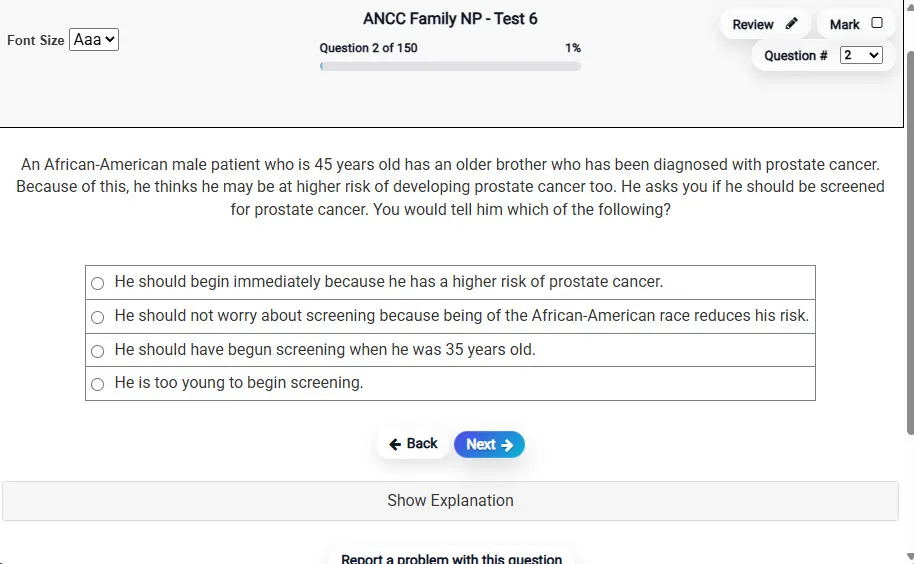
Answering a Question screen – Multiple-choice item view with navigation controls and progress tracker.
Answering a Question Multiple-choice item view with navigation controls and progress tracker.

                           Detailed Explanation screen – 
                         Review mode showing chosen answer and rationale and references.
Detailed Explanation Review mode showing chosen answer and rationale and references.

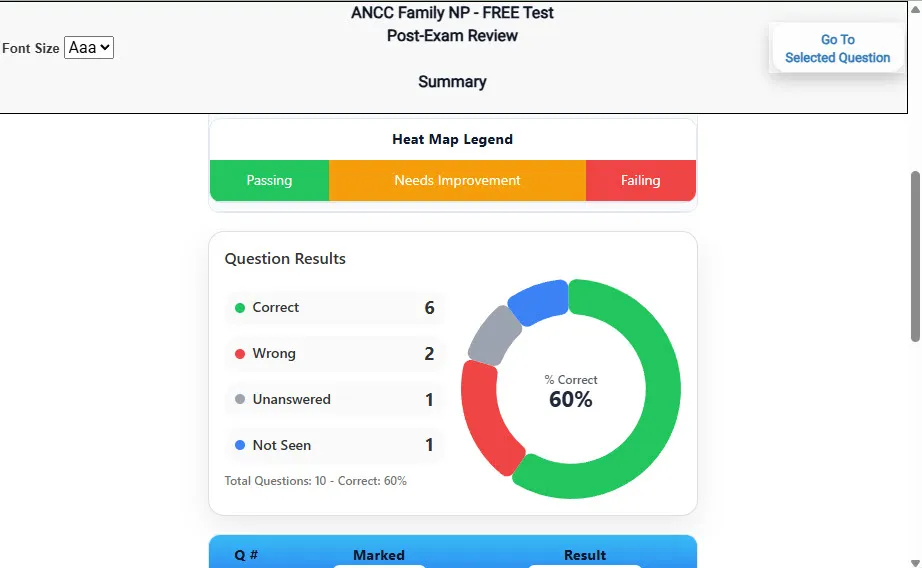
                           Review Summary 1 screen – 
                         Summary with counts for correct/wrong/unanswered and not seen items.
Review Summary 1 Summary with counts for correct/wrong/unanswered and not seen items.

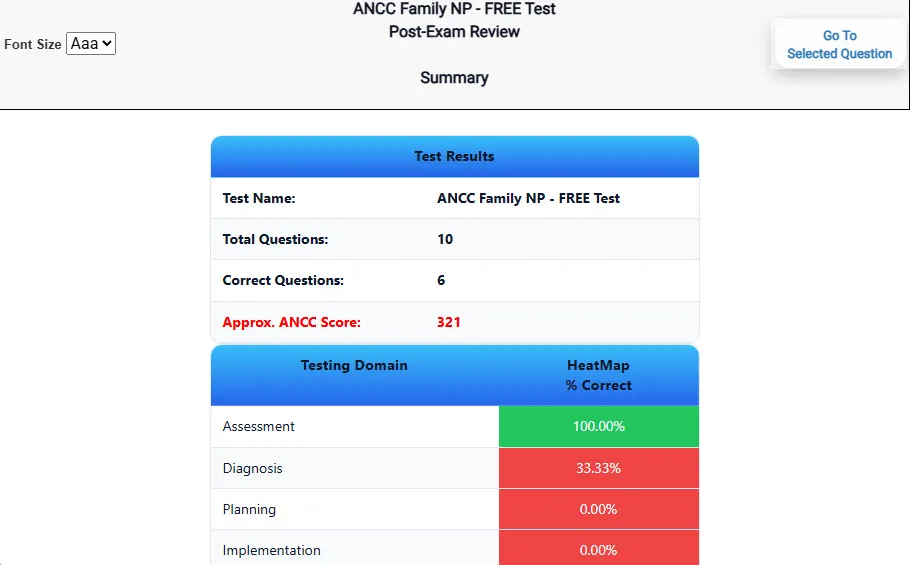
                           Review Summary 2 screen – 
                         Advanced summary with category/domain breakdown and performance insights.
Review Summary 2 Advanced summary with category/domain breakdown and performance insights.

What Each Screen Shows

Answer Question Screen

  • Clean multiple-choice interface with progress bar.
  • Mark for review feature.
  • Matches real test pacing.

Detailed Explanation

  • Correct answer plus rationale.
  • Key concepts and guidelines highlighted.
  • Move between questions to fill knowledge gaps.

Review Summary 1

  • Overall results with total questions and scaled score.
  • Domain heatmap shows strengths and weaknesses.
  • Quick visual feedback on study priorities.

Review Summary 2

  • Chart of correct, wrong, unanswered, not seen.
  • Color-coded results for easy review.
  • Links back to missed items.

Top 10 Reasons to Use Exam Edge for your Praxis Social Studies Content and Interpretation Exam Prep

  1. Focused on the Praxis Social Studies Content and Interpretation Exam

    Our practice tests are built specifically for the Praxis Social Studies Content and Interpretation exam — every question mirrors the real topics, format, and difficulty so you're studying exactly what matters.

  2. Real Exam Simulation

    We match the per-question time limits and pressure of the actual Praxis exam, so test day feels familiar and stress-free.

  3. 20 Full Practice Tests & 1,860 Unique Questions

    You'll have more than enough material to master every Praxis Social Studies Content and Interpretation concept — no repeats, no fluff.

  4. Lower Cost Than a Retake

    Ordering 5 practice exams costs less than retaking the Praxis Social Studies Content and Interpretation exam after a failure. One low fee could save you both time and money.

  5. Flexible Testing

    Need to step away mid-exam? Pick up right where you left off — with your remaining time intact.

  6. Instant Scoring & Feedback

    See your raw score and an estimated Praxis Social Studies Content and Interpretation score immediately after finishing each practice test.

  7. Detailed Explanations for Every Question

    Review correct and incorrect answers with clear, step-by-step explanations so you truly understand each topic.

  8. Trusted & Accredited

    We're fully accredited by the Better Business Bureau and uphold the highest standards of trust and transparency.

  9. Web-Based & Always Available

    No software to install. Access your Praxis Social Studies Content and Interpretation practice exams 24/7 from any computer or mobile device.

  10. Expert Support When You Need It

    Need extra help? Our specialized tutors are highly qualified and ready to support your Praxis exam prep.


Pass the Praxis Social Studies Content and Interpretation Exam with Realistic Practice Tests from Exam Edge

Preparing for your upcoming Praxis Social Studies Content and Interpretation (5086) Certification Exam can feel overwhelming — but the right practice makes all the difference. Exam Edge gives you the tools, structure, and confidence to pass on your first try. Our online practice exams are built to match the real Praxis Social Studies Content and Interpretation exam in content, format, and difficulty.

  • 📝 20 Praxis Social Studies Content and Interpretation Practice Tests: Access 20 full-length exams with 93 questions each, covering every major Praxis Social Studies Content and Interpretation topic in depth.
  • Instant Online Access: Start practicing right away — no software, no waiting.
  • 🧠 Step-by-Step Explanations: Understand the reasoning behind every correct answer so you can master Praxis Social Studies Content and Interpretation exam concepts.
  • 🔄 Retake Each Exam Up to 4 Times: Build knowledge through repetition and track your improvement over time.
  • 🌐 Web-Based & Available 24/7: Study anywhere, anytime, on any device.
  • 🧘 Boost Your Test-Day Confidence: Familiarity with the Praxis format reduces anxiety and helps you perform under pressure.

These Praxis Social Studies Content and Interpretation practice exams are designed to simulate the real testing experience by matching question types, timing, and difficulty level. This approach helps you get comfortable not just with the exam content, but also with the testing environment, so you walk into your exam day focused and confident.


Exam Edge Praxis Reviews


I was extremely concerned about passing my secondary education test for social studies. I had been out of teaching for 15 years. My BA was in psychology and I did not have the background in many of the other areas. I purchased the 10 pack of tests and it was well worth it. I not only passed - I got ...
Read More
Donna, NH

I failed the Praxis Math test five times before I found your site. After taking all your practice tests, on my next attempt I passed by five points! I can honestly say this site is the reason I passed. Thank you!!!

Nikki P, Tennessee

Just wanted to say thanks for helping me pass the Praxis I Reading! Your practice tests and especially your explanations are great. They gave me the confidence I needed! Now I can student teach this fall. I'm so glad I found PraxisReading.com!

Denise C, Florida

Thank you so much. I just received my results in the mail. I scored a 179 and passed the Praxis I Writing! I'll never have to worry about retaking this test again! PraxisWriting.com is great. I told all my friends about this site.

Susan K, Virginia

I failed the Parapro test four times before I found your site. After taking all your practice tests, on my next attempt I passed by seven points! I can honestly say that this site is the reason I passed. Thank you!!!

Rebecca S, Texas

Hi! Just returned from taking my Praxis computerized and am happy to say that I passed with a 175. The last time I took the test I missed by 1 point. Your tests definitely made the difference for me! The set up was so similar to the test and the types of questions were also similar that I felt ve ...
Read More
Brad Y, Pennsylvania


Praxis Social Studies Content and Interpretation Aliases Test Name

Here is a list of alternative names used for this exam.

  • Praxis Social Studies Content and Interpretation
  • Praxis Social Studies Content and Interpretation test
  • Praxis Social Studies Content and Interpretation Certification Test
  • Praxis
  • Praxis 5086
  • 5086 test
  • Praxis Social Studies Content and Interpretation (5086)
  • Social Studies Content and Interpretation certification