This is the content of the pop-over!

Praxis Social Studies (5081) Practice Tests & Test Prep by Exam Edge


Praxis Social Studies Content Knowledge  product image
(5.0)
Based on 17 Reviews

  • Real Exam Simulation: Timed questions and matching content build comfort for your Praxis Social Studies test day.
  • Instant, 24/7 Access: Web-based Praxis Social Studies Content Knowledge practice exams with no software needed.
  • Clear Explanations: Step-by-step answers and explanations for your Praxis exam to strengthen understanding.
  • Boosted Confidence: Reduces anxiety and improves test-taking skills to ace your Praxis Social Studies Content Knowledge (5081).

Featured on

Praxis Social Studies Content Knowledge Online Practice Test Bundles

BEST VALUE
20 practice tests

$174.00

$799.00

SAVE $625

Only $8.70 per test!

  • 100% Pass Guarantee
  • 20 online practice tests
  • 130 questions per test
  • Bonus: 100 Flash Cards + Study Guide
  • Instant access
  • Detailed Explanations
  • Practice tests never expire
  • Timed, untimed, or study guide mode
MOST POPULAR
10 practice tests

$99.50

$399.50

SAVE $300

Only $9.95 per test!

  • 10 online practice tests
  • 130 questions per test
  • Bonus: 100 Flash Cards + Study Guide
  • Instant access
  • Detailed Explanations
  • Practice tests never expire
  • Timed, untimed, or study guide mode
5 practice tests

$69.75

$199.75

SAVE $130

Only $13.95 per test!

  • 5 online practice tests
  • 130 questions per test
  • Bonus: 100 Flash Cards
  • Instant access
  • Detailed Explanations
  • Practice tests never expire
  • Timed, untimed, or study guide mode
1 practice test

$39.95

  • 1 online practice test
  • 130 questions per test
  • Instant access
  • Detailed Explanations
  • Practice tests never expire
  • Timed, untimed, or study guide mode
MOST FLEXIBLE
Question Bank

As low as $59.95

650 Questions

Choose 1, 3, 6, or 12 months
A second login is required.

  • Exam Edge content in a powerful question bank
  • Customize Tests
  • Multiple Test & Flash Card Modes
  • Track performance over time
  • Instant access
  • Detailed Explanations
Quick Select
Tap to choose a bundle

** All Prices are in US Dollars (USD) **


Praxis Social Studies (5081) Resources

Jump to the section you need most.

Understanding the exact breakdown of the Praxis Social Studies Content Knowledge test will help you know what to expect and how to most effectively prepare. The Praxis Social Studies Content Knowledge has 130 multiple-choice questions . The exam will be broken down into the sections below:

Praxis Social Studies Content Knowledge Exam Blueprint
Domain Name % Number of
Questions
United States History 22% 29
World History 22% 29
Government/Civics/Political Science 16% 21
Geography 15% 20
Economics 15% 20
Behavioral Sciences 10% 13

Praxis Social Studies Content Knowledge Study Tips by Domain

  • Track major eras and turning points (Colonial/Founding, antebellum, Civil War/Reconstruction, industrialization/Progressive, WWI/WWII, Cold War, post-1970) and always connect cause → effect; red flag: memorizing dates without explaining significance.
  • Know core constitutional developments (Federalists vs. Anti-Federalists, Marbury v. Madison, federalism, civil liberties expansion) and how they shaped political conflict; common trap: confusing amendments that expand rights with those that limit government power.
  • Reconstruction details matter—13th/14th/15th Amendments, Black Codes, Compromise of 1877, and rise of Jim Crow; priority rule: if a question asks about “unfinished” Reconstruction, look for federal retreat and Southern resistance.
  • Industrialization and labor: big business, monopolies, immigration/urbanization, unions, and reform responses (Sherman Antitrust, Progressivism); red flag: assuming all regulation began with the New Deal rather than earlier Progressive-era reforms.
  • Foreign policy themes (isolationism vs. intervention, imperialism, WWI neutrality shift, WWII mobilization, Cold War containment) and key doctrines; common trap: mixing Truman Doctrine/Marshall Plan (Europe) with later Vietnam-era escalation rationales.
  • Civil rights and social movements: Brown v. Board, Civil Rights Act (1964), Voting Rights Act (1965), and later movements (women’s, Latino, LGBTQ+) with policy impacts; priority cue: if the prompt centers on voting access, the best anchor is the VRA and subsequent enforcement/limitations.
  • Use periodization anchors (e.g., Neolithic Revolution, Classical era, Post–Classical, Early Modern, Industrial/Imperial, Contemporary) to place events in context; red flag: answering with a correct fact in the wrong era.
  • Compare major belief systems (Hinduism, Buddhism, Judaism, Christianity, Islam, Confucianism, Daoism) by core ideas and diffusion routes; common trap: mixing up origins vs. where a religion later became dominant.
  • Track state-building patterns (empires, feudal systems, nation-states) and legitimacy claims (divine right, mandate, law codes); priority rule: link political structure to how rulers extracted taxes/labor.
  • Connect trade networks (Silk Roads, Indian Ocean, Trans-Saharan, Atlantic) to technology and disease transmission; red flag: treating exchange as only goods and ignoring demographic/ecological impacts.
  • Explain industrialization and imperialism with both push factors (resources, markets) and pull factors (strategic routes, prestige); common trap: describing imperialism as inevitable without citing specific economic/political motives.
  • For 20th-century conflicts (World Wars, decolonization, Cold War), distinguish underlying causes from triggers and outcomes; threshold cue: identify alliances/ideologies and at least one concrete consequence (border change, regime change, new international body).
  • Distinguish powers: enumerated vs reserved vs concurrent; red flag—calling education a federal enumerated power instead of a state reserved power (10th Amendment).
  • Know checks and balances with concrete examples; common trap—confusing judicial review (Marbury v. Madison) with veto power (executive) or impeachment power (legislative).
  • Apply constitutional tests and standards (strict scrutiny, intermediate, rational basis); priority rule—content-based speech restrictions and most suspect classifications trigger strict scrutiny.
  • Separate civil liberties from civil rights; red flag—mixing up the Bill of Rights (limits government) with equal protection/anti-discrimination protections tied to the 14th Amendment and later statutes.
  • Compare electoral systems and institutions (Electoral College, primaries/caucuses, gerrymandering); common trap—assuming the popular vote determines the presidency rather than state electoral votes.
  • Explain federalism and intergovernmental tools (categorical vs block grants, mandates, devolution); red flag—forgetting that federal funding often comes with conditions and can shape state policy.
  • Distinguish absolute vs. relative location and use latitude/longitude accurately; red flag: mixing up latitude (N/S) with longitude (E/W) or misreading hemispheres.
  • Interpret map scale (ratio, verbal, graphic) to convert distance/area; common trap: forgetting to keep units consistent when scaling (miles vs. kilometers).
  • Use and critique map projections (Mercator, Robinson, Peters) for distortion trade-offs; priority rule: if the task is area comparison, avoid Mercator’s misleading size.
  • Analyze spatial patterns with core concepts (site vs. situation, diffusion, cultural landscape); red flag: describing patterns without linking them to a spatial process (e.g., contagious vs. hierarchical diffusion).
  • Read physical systems—plates, climate (Köppen), biomes, watersheds—and relate them to hazards; contraindication: assuming climate zones follow only latitude without considering elevation and ocean currents.
  • Evaluate human–environment interaction (resources, urbanization, migration, sustainability) using push/pull and regional effects; common trap: treating population density as the same as population distribution or growth rate.
  • Use opportunity cost and comparative advantage to predict specialization and trade gains; red flag: confusing comparative advantage (lower opportunity cost) with absolute advantage (higher output).
  • Apply supply-and-demand shifts (not “movement along”) when a determinant changes; common trap: saying price changes shift curves instead of causing movement along the curve.
  • Interpret elasticities (price, income, cross-price) to predict total revenue and complements/substitutes; cue: inelastic demand means price up → total revenue up.
  • Distinguish fiscal vs. monetary policy tools and likely effects on inflation, unemployment, and interest rates; red flag: mixing up the Fed’s open-market operations with Congress’s taxing/spending decisions.
  • Read key macro indicators (GDP, CPI/inflation, unemployment types) and connect to business cycles; priority rule: focus on real (inflation-adjusted) vs. nominal measures when comparing over time.
  • Analyze market failures and government responses (externalities, public goods, information asymmetry); common trap: treating all government intervention as efficient despite deadweight loss or unintended incentives.
  • Distinguish major psychological perspectives (behaviorism, cognitive, psychoanalytic, humanistic) by what counts as evidence; red flag: confusing correlation with causation in research findings.
  • Know core sociology concepts (socialization agents, norms, roles, stratification, deviance) and apply them to scenarios; common trap: treating culture as static rather than dynamic and contested.
  • Use research methods vocabulary (hypothesis, operational definition, sampling, reliability/validity, bias) to evaluate studies; priority rule: if a measure isn’t operationalized, you can’t test the claim.
  • Interpret basic data displays (tables, graphs, central tendency, variability) in social science contexts; threshold cue: outliers can skew the mean—check median/mode before concluding.
  • Compare major social theories (functionalism, conflict theory, symbolic interactionism) and match them to explanations of institutions; red flag: assuming one theory explains all levels (micro vs. macro) equally well.
  • Understand political and economic behavior through behavioral science lenses (public opinion formation, group dynamics, conformity/obedience); contraindication: avoid attributing group outcomes solely to individual traits (fundamental attribution error).


Built to Fit Into Your Busy Life

Everything you need to prepare with confidence—without wasting a minute.

Three Study Modes

Timed, No Time Limit, or Explanation mode.

Actionable Analytics

Heatmaps and scaled scores highlight weak areas.

High-Yield Rationales

Concise explanations emphasize key concepts.

Realistic Interface

Matches the feel of the actual exam environment.

Accessible by Design

Clean layout reduces cognitive load.

Anytime, Anywhere

Web-based access 24/7 on any device.
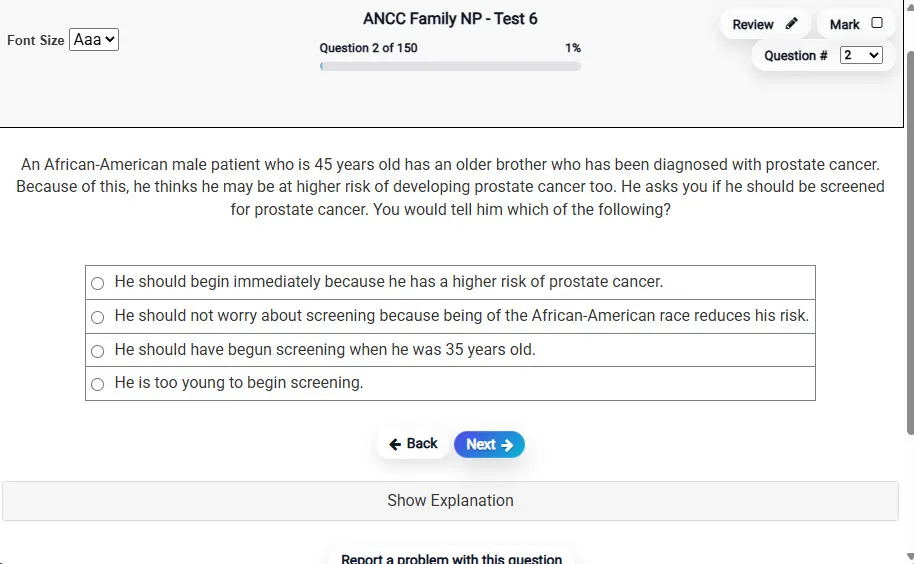
Answering a Question screen – Multiple-choice item view with navigation controls and progress tracker.
Answering a Question Multiple-choice item view with navigation controls and progress tracker.

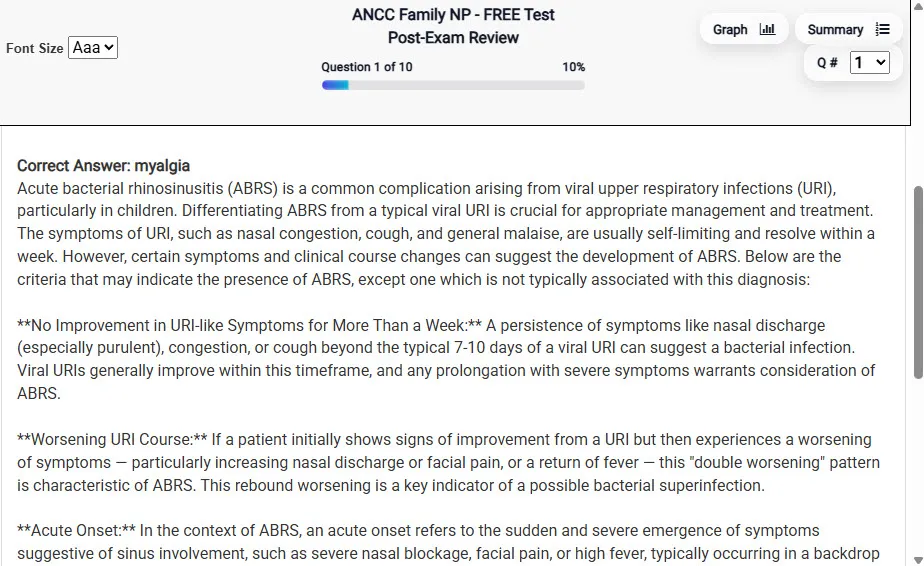
                           Detailed Explanation screen – 
                         Review mode showing chosen answer and rationale and references.
Detailed Explanation Review mode showing chosen answer and rationale and references.

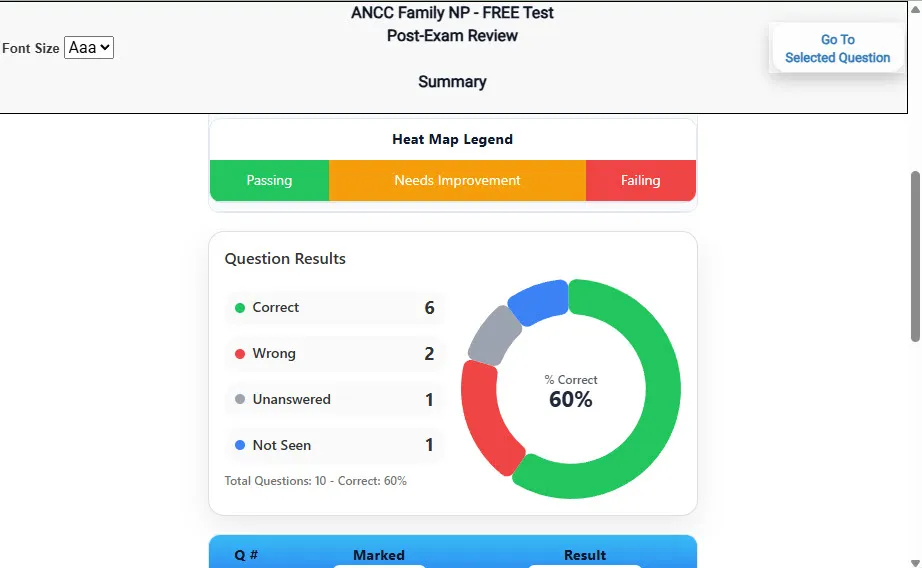
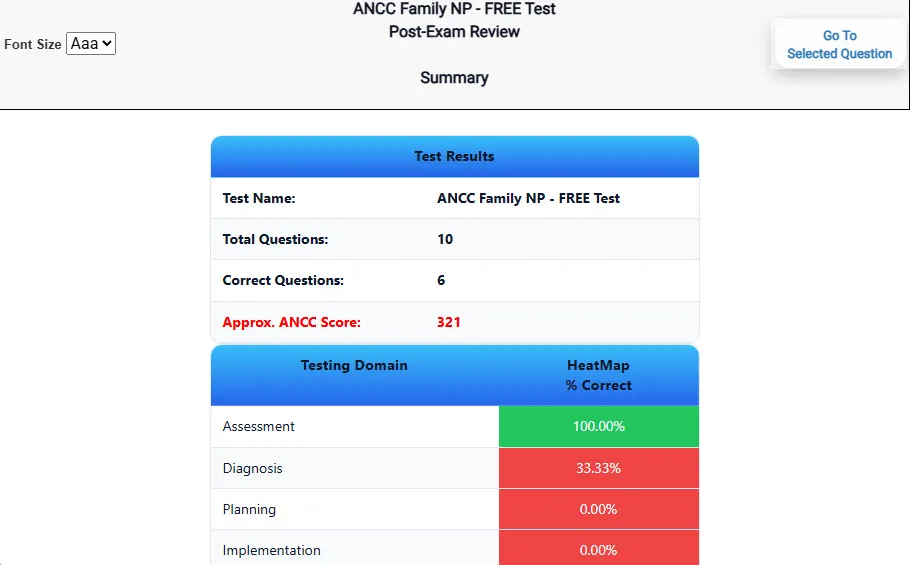
                           Review Summary 1 screen – 
                         Summary with counts for correct/wrong/unanswered and not seen items.
Review Summary 1 Summary with counts for correct/wrong/unanswered and not seen items.

                           Review Summary 2 screen – 
                         Advanced summary with category/domain breakdown and performance insights.
Review Summary 2 Advanced summary with category/domain breakdown and performance insights.

What Each Screen Shows

Answer Question Screen

  • Clean multiple-choice interface with progress bar.
  • Mark for review feature.
  • Matches real test pacing.

Detailed Explanation

  • Correct answer plus rationale.
  • Key concepts and guidelines highlighted.
  • Move between questions to fill knowledge gaps.

Review Summary 1

  • Overall results with total questions and scaled score.
  • Domain heatmap shows strengths and weaknesses.
  • Quick visual feedback on study priorities.

Review Summary 2

  • Chart of correct, wrong, unanswered, not seen.
  • Color-coded results for easy review.
  • Links back to missed items.

Top 10 Reasons to Use Exam Edge for your Praxis Social Studies Content Knowledge Exam Prep

  1. Focused on the Praxis Social Studies Content Knowledge Exam

    Our practice tests are built specifically for the Praxis Social Studies exam — every question mirrors the real topics, format, and difficulty so you're studying exactly what matters.

  2. Real Exam Simulation

    We match the per-question time limits and pressure of the actual Praxis exam, so test day feels familiar and stress-free.

  3. 20 Full Practice Tests & 2,600 Unique Questions

    You'll have more than enough material to master every Praxis Social Studies concept — no repeats, no fluff.

  4. Lower Cost Than a Retake

    Ordering 5 practice exams costs less than retaking the Praxis Social Studies Content Knowledge exam after a failure. One low fee could save you both time and money.

  5. Flexible Testing

    Need to step away mid-exam? Pick up right where you left off — with your remaining time intact.

  6. Instant Scoring & Feedback

    See your raw score and an estimated Praxis Social Studies Content Knowledge score immediately after finishing each practice test.

  7. Detailed Explanations for Every Question

    Review correct and incorrect answers with clear, step-by-step explanations so you truly understand each topic.

  8. Trusted & Accredited

    We're fully accredited by the Better Business Bureau and uphold the highest standards of trust and transparency.

  9. Web-Based & Always Available

    No software to install. Access your Praxis Social Studies practice exams 24/7 from any computer or mobile device.

  10. Expert Support When You Need It

    Need extra help? Our specialized tutors are highly qualified and ready to support your Praxis exam prep.


Pass the Praxis Social Studies Content Knowledge Exam with Realistic Practice Tests from Exam Edge

Preparing for your upcoming Praxis Social Studies Content Knowledge (5081) Certification Exam can feel overwhelming — but the right practice makes all the difference. Exam Edge gives you the tools, structure, and confidence to pass on your first try. Our online practice exams are built to match the real Praxis Social Studies exam in content, format, and difficulty.

  • 📝 20 Praxis Social Studies Content Knowledge Practice Tests: Access 20 full-length exams with 130 questions each, covering every major Praxis Social Studies Content Knowledge topic in depth.
  • Instant Online Access: Start practicing right away — no software, no waiting.
  • 🧠 Step-by-Step Explanations: Understand the reasoning behind every correct answer so you can master Praxis Social Studies exam concepts.
  • 🔄 Retake Each Exam Up to 4 Times: Build knowledge through repetition and track your improvement over time.
  • 🌐 Web-Based & Available 24/7: Study anywhere, anytime, on any device.
  • 🧘 Boost Your Test-Day Confidence: Familiarity with the Praxis format reduces anxiety and helps you perform under pressure.

These Praxis Social Studies Content Knowledge practice exams are designed to simulate the real testing experience by matching question types, timing, and difficulty level. This approach helps you get comfortable not just with the exam content, but also with the testing environment, so you walk into your exam day focused and confident.


Exam Edge Praxis Reviews


I finally passed the Praxis II Social Studies test (and by 9 points)!!! After failing 4 times I thought I'd never pass! I wish I found your site sooner. I plan to tell everyone about your website! Once again, I thank you.

Brenda R, Pennsylvania

Thank you for helping me pass the Praxis II Social Studies test! Your website was one of the few resources that really helped me out. I don't think I would have passed without your practice tests. I needed a 158 and I scored 172! I would recommend this site to anyone. Thanks again!

Eric J, South Carolina

Just wanted to say I passed! I took all of your practice tests and passed on my first try! You tests were very realistic and really helped prepare me. I told all of my friends in education about your site. Thank you.

Brendon L, Virginia

Thank you so much! It’s hard to describe the agony we experienced watching our daughter struggle with passing the Praxis II Social Studies test. It’s hard to imagine that a student, who was on the Dean’s list, struggling with passing a standardized test - it’s no secret ...
Read More
Wisconsin, Mark N

When I started studying for the Praxis II social studies test I felt like I was studying for Jeopardy This website helped me focus on exactly what I did and did not know. I needed a 162 to pass and when I got my score I thought it was a mistake because I got a 179!! Thank you so much!!!!

Jessica S, Virginia

I found your product to be very solid. It think it was more difficult than the actual exam, which is what you want from a practice test. I consistently scored in the high 160's on the practice exams, but scored a whopping 193 on the Praxis. Whoa, I guess your product works. Take the time to prac ...
Read More
Thomas , Connecticut


Praxis Social Studies Content Knowledge Aliases Test Name

Here is a list of alternative names used for this exam.

  • Praxis Social Studies Content Knowledge
  • Praxis Social Studies Content Knowledge test
  • Praxis Social Studies Content Knowledge Certification Test
  • Praxis Social Studies test
  • Praxis
  • Praxis 5081
  • 5081 test
  • Praxis Social Studies Content Knowledge (5081)
  • Social Studies Content Knowledge certification