This is the content of the pop-over!

Praxis Psychology (5391) Practice Tests & Test Prep by Exam Edge


Praxis Psychology  product image
(5.0)
Based on 32 Reviews

  • Real Exam Simulation: Timed questions and matching content build comfort for your Praxis Psychology test day.
  • Instant, 24/7 Access: Web-based Praxis Psychology practice exams with no software needed.
  • Clear Explanations: Step-by-step answers and explanations for your Praxis exam to strengthen understanding.
  • Boosted Confidence: Reduces anxiety and improves test-taking skills to ace your Praxis Psychology (5391).

Featured on

Praxis Psychology Online Practice Test Bundles

BEST VALUE
5 practice tests

$69.75

$199.75

SAVE $130

Only $13.95 per test!

  • 100% Pass Guarantee
  • 5 online practice tests
  • 120 questions per test
  • Bonus: 100 Flash Cards + Study Guide
  • Instant access
  • Detailed Explanations
  • Practice tests never expire
  • Timed, untimed, or study guide mode
1 practice test

$39.95

  • 1 online practice test
  • 120 questions per test
  • Instant access
  • Detailed Explanations
  • Practice tests never expire
  • Timed, untimed, or study guide mode
Quick Select
Tap to choose a bundle

** All Prices are in US Dollars (USD) **


Praxis Psychology (5391) Resources

Jump to the section you need most.

Understanding the exact breakdown of the Praxis Psychology test will help you know what to expect and how to most effectively prepare. The Praxis Psychology has 120 multiple-choice questions . The exam will be broken down into the sections below:

Praxis Psychology Exam Blueprint
Domain Name % Number of
Questions
Methods - Approaches - Ethics Assessment 17% 20
Biopsychology - Sensation and Perception States of Consciousness 16% 19
Life Span Development and Individual Differences 12% 14
Learning - Memory Cognition 16% 19
Personality - Social Psychology - Motivation and Emotion Stress 23% 28
Psychological Disorders and Treatment 16% 19

Praxis Psychology Study Tips by Domain

  • Distinguish major research designs (experimental, quasi-experimental, correlational) and what they allow—red flag: claiming causation from correlational data or ignoring confounds such as selection effects.
  • Know descriptive vs inferential statistics (mean/median, variance/SD, correlation, t-test/ANOVA, p-values/Type I & II errors)—common trap: treating statistical significance as practical significance or forgetting that p < .05 doesn’t prove a hypothesis.
  • Apply psychometrics: reliability (test–retest, interrater, internal consistency) vs validity (content, criterion, construct)—priority rule: a test cannot be valid for a use if it is not sufficiently reliable.
  • Interpret assessment results (norm-referenced vs criterion-referenced, standard scores, percentiles) and measurement error—red flag: confusing percentiles with percent correct or over-interpreting small score differences within the confidence interval.
  • Handle ethics and research protections (informed consent, deception/debriefing, confidentiality, risk/benefit) with clear limits—contraindication: breaking confidentiality except for imminent harm, abuse reporting obligations, or court order.
  • Select appropriate approaches and methods (behavioral, cognitive, psychodynamic, humanistic, biological) based on the question and evidence—common trap: matching the method to a favored theory rather than the operational definition and the population.
  • Know neuron basics (action potentials, synapses, neurotransmitters) and that myelin increases conduction speed; red flag: mixing up excitatory vs inhibitory effects (e.g., glutamate vs GABA).
  • Map major brain areas to hallmark functions (frontal lobe—executive control, hippocampus—memory consolidation, amygdala—fear) and watch the trap of swapping Broca’s (production) with Wernicke’s (comprehension).
  • Sensation vs perception: sensation is transduction, perception is interpretation; common Praxis trap is confusing absolute threshold (detection) with difference threshold/JND (discrimination).
  • Vision essentials: rods (low light) vs cones (color/acuity) and opponent-process vs trichromatic theories; cue: color afterimages point to opponent-process mechanisms.
  • Audition essentials: frequency maps to pitch and amplitude to loudness; priority rule: damage to hair cells in the cochlea is a typical cause of sensorineural hearing loss.
  • States of consciousness: sleep stages (NREM vs REM), circadian rhythms, and psychoactive drug classes; red flag: assuming REM is “deepest sleep”—it’s vivid dreaming with high cortical activity and muscle atonia.
  • Know major developmental theories (Piaget, Vygotsky, Erikson, Kohlberg) and the key stage-to-task match; red flag: confusing conservation (concrete operational) with object permanence (sensorimotor).
  • Distinguish attachment styles (secure, avoidant, resistant, disorganized) and typical assessment (Strange Situation); trap: assuming attachment is fixed rather than probabilistic and shaped by caregiving consistency.
  • Separate temperament from personality and map common dimensions (e.g., reactivity, self-regulation); priority rule: interpret “goodness of fit” as environment–child match, not a child deficit.
  • Use basic genetics concepts (heritability, gene–environment interaction, reaction range) appropriately; red flag: treating high heritability as meaning a trait is unchangeable.
  • Understand aging patterns (fluid vs crystallized intelligence, sensory decline, processing speed) and what tends to remain stable; trap: overgeneralizing dementia signs to normal aging.
  • Apply individual-differences frameworks (Big Five, locus of control, self-efficacy) to predict behavior across contexts; contraindication: making dispositional conclusions without considering situational constraints.
  • Differentiate learning types: classical conditioning (US/UR/CS/CR) vs. operant conditioning (reinforcement/punishment) vs. observational learning; red flag—confusing negative reinforcement (removes aversive stimulus) with punishment (adds/removes to decrease behavior).
  • Know reinforcement schedules (FR, VR, FI, VI) and typical response patterns; priority rule—variable ratio schedules produce high, steady responding and are most resistant to extinction.
  • Apply principles of encoding, storage, and retrieval across sensory, working, and long-term memory; common trap—mixing up proactive interference (old disrupts new) with retroactive interference (new disrupts old).
  • Recognize effective memory strategies (chunking, elaborative rehearsal, mnemonics, spacing effect, testing effect); cue—cramming boosts short-term performance but increases rapid forgetting compared with distributed practice.
  • Distinguish declarative (episodic/semantic) from nondeclarative/procedural memory and key brain links; red flag—hippocampal damage typically impairs forming new declarative memories while leaving procedural learning relatively intact.
  • Use core cognition concepts (schemas, concept formation, problem-solving, heuristics, biases); common trap—availability heuristic is judging likelihood by ease of recall, whereas representativeness is judging by similarity to a prototype (often ignoring base rates).
  • Distinguish major trait models (Big Five, Eysenck, temperament) from psychodynamic and humanistic views; red flag: items that treat traits as fully deterministic rather than probabilistic tendencies.
  • Know classic social psychology effects (fundamental attribution error, self-serving bias, halo effect, cognitive dissonance); common trap: confusing actor–observer bias with fundamental attribution error on vignette questions.
  • Apply core social influence principles (conformity, obedience, compliance techniques like foot-in-the-door and door-in-the-face); priority rule: identify the situational pressure first before attributing behavior to personality.
  • Differentiate motivation theories (drive reduction, incentive, expectancy-value, self-determination, goal-setting) and emotion theories (James–Lange, Cannon–Bard, Schachter–Singer); red flag: assuming arousal always precedes appraisal or always follows it.
  • Recognize stress models (Selye’s GAS, Lazarus transactional appraisal, allostatic load) and health links; threshold cue: chronic, uncontrollable stress is more likely to produce wear-and-tear than brief, controllable stressors.
  • Match coping styles to outcomes (problem-focused vs emotion-focused, avoidance, social support) and defense mechanisms; common trap: labeling emotion-focused coping as “maladaptive” even when the stressor is uncontrollable.
  • Differentiate normal variation vs disorder by requiring clinically significant distress/impairment and ruling out substances/medical causes—red flag: diagnosing from a single symptom without functional impact.
  • Know hallmark clusters and common confusions (e.g., PTSD requires trauma exposure + re-experiencing/avoidance/hyperarousal; OCD obsessions/compulsions vs OCPD perfectionism)—trap: mixing panic attacks with generalized anxiety.
  • Identify psychotic disorders: schizophrenia needs ≥2 core symptoms with functional decline and duration criteria; mood disorders with psychotic features track mood episodes—priority rule: consider bipolar disorder before labeling schizophrenia when mood symptoms are prominent.
  • Match evidence-based treatments to disorders: CBT/exposure for anxiety and OCD, behavioral activation/CBT or interpersonal therapy for depression, antipsychotics for schizophrenia, mood stabilizers for bipolar—contraindication: avoid antidepressant monotherapy in bipolar I due to mania risk.
  • Use risk and safety priorities: assess suicidal ideation, intent, plan, means, and past attempts; high-risk cases need immediate safety planning and possible emergency referral—red flag: access to lethal means with stated intent.
  • Know treatment process essentials: informed consent, confidentiality limits, and documentation; coordinate care and monitor response/side effects with measurement-based tools—common trap: ignoring comorbidity (e.g., substance use) that can mimic or worsen symptoms.


Built to Fit Into Your Busy Life

Everything you need to prepare with confidence—without wasting a minute.

Three Study Modes

Timed, No Time Limit, or Explanation mode.

Actionable Analytics

Heatmaps and scaled scores highlight weak areas.

High-Yield Rationales

Concise explanations emphasize key concepts.

Realistic Interface

Matches the feel of the actual exam environment.

Accessible by Design

Clean layout reduces cognitive load.

Anytime, Anywhere

Web-based access 24/7 on any device.
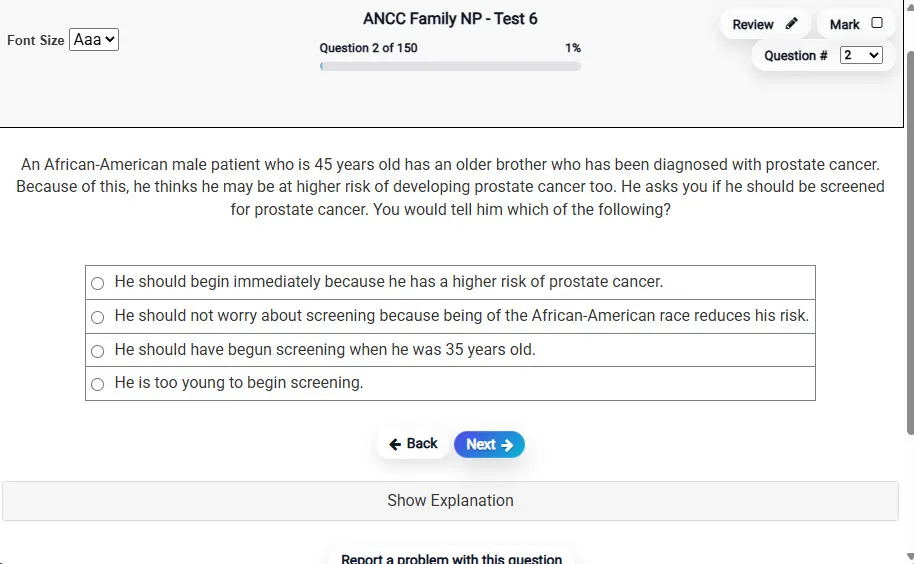
Answering a Question screen – Multiple-choice item view with navigation controls and progress tracker.
Answering a Question Multiple-choice item view with navigation controls and progress tracker.

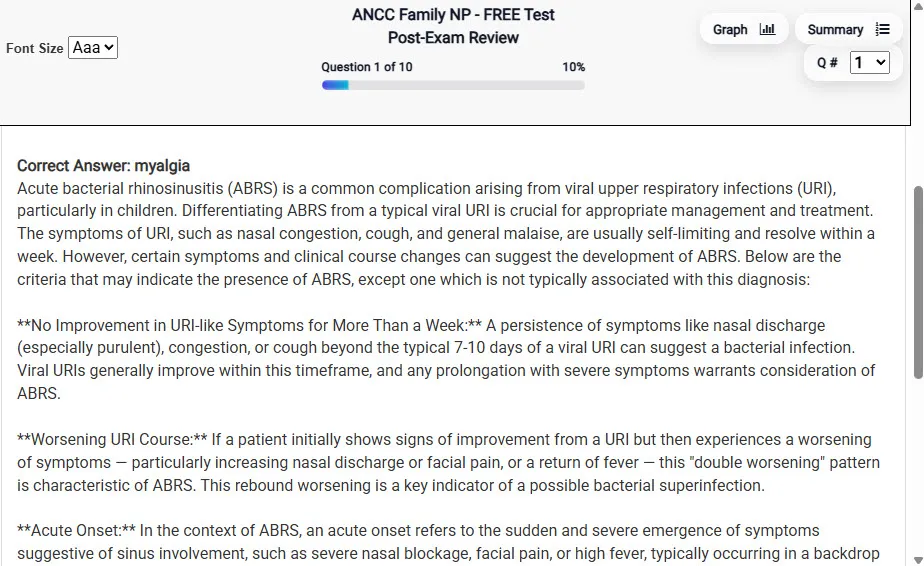
                           Detailed Explanation screen – 
                         Review mode showing chosen answer and rationale and references.
Detailed Explanation Review mode showing chosen answer and rationale and references.

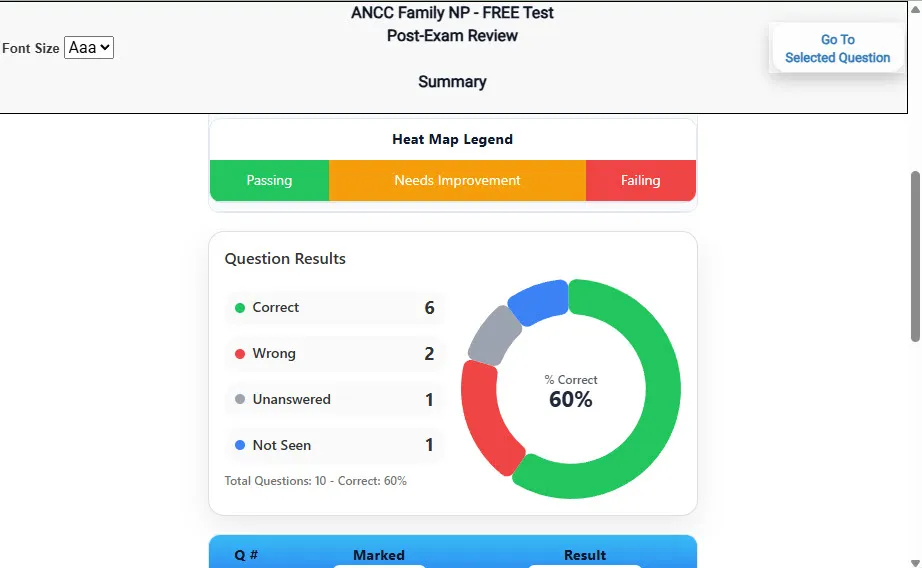
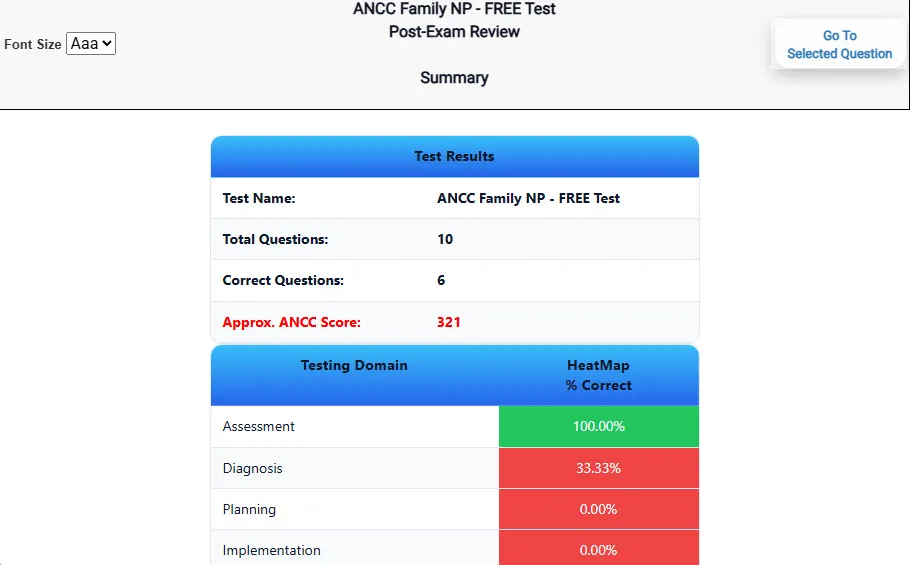
                           Review Summary 1 screen – 
                         Summary with counts for correct/wrong/unanswered and not seen items.
Review Summary 1 Summary with counts for correct/wrong/unanswered and not seen items.

                           Review Summary 2 screen – 
                         Advanced summary with category/domain breakdown and performance insights.
Review Summary 2 Advanced summary with category/domain breakdown and performance insights.

What Each Screen Shows

Answer Question Screen

  • Clean multiple-choice interface with progress bar.
  • Mark for review feature.
  • Matches real test pacing.

Detailed Explanation

  • Correct answer plus rationale.
  • Key concepts and guidelines highlighted.
  • Move between questions to fill knowledge gaps.

Review Summary 1

  • Overall results with total questions and scaled score.
  • Domain heatmap shows strengths and weaknesses.
  • Quick visual feedback on study priorities.

Review Summary 2

  • Chart of correct, wrong, unanswered, not seen.
  • Color-coded results for easy review.
  • Links back to missed items.

Top 10 Reasons to Use Exam Edge for your Praxis Psychology Exam Prep

  1. Focused on the Praxis Psychology Exam

    Our practice tests are built specifically for the Praxis Psychology exam — every question mirrors the real topics, format, and difficulty so you're studying exactly what matters.

  2. Real Exam Simulation

    We match the per-question time limits and pressure of the actual Praxis exam, so test day feels familiar and stress-free.

  3. 5 Full Practice Tests & 600 Unique Questions

    You'll have more than enough material to master every Praxis Psychology concept — no repeats, no fluff.

  4. Lower Cost Than a Retake

    Ordering 5 practice exams costs less than retaking the Praxis Psychology exam after a failure. One low fee could save you both time and money.

  5. Flexible Testing

    Need to step away mid-exam? Pick up right where you left off — with your remaining time intact.

  6. Instant Scoring & Feedback

    See your raw score and an estimated Praxis Psychology score immediately after finishing each practice test.

  7. Detailed Explanations for Every Question

    Review correct and incorrect answers with clear, step-by-step explanations so you truly understand each topic.

  8. Trusted & Accredited

    We're fully accredited by the Better Business Bureau and uphold the highest standards of trust and transparency.

  9. Web-Based & Always Available

    No software to install. Access your Praxis Psychology practice exams 24/7 from any computer or mobile device.

  10. Expert Support When You Need It

    Need extra help? Our specialized tutors are highly qualified and ready to support your Praxis exam prep.


Pass the Praxis Psychology Exam with Realistic Practice Tests from Exam Edge

Preparing for your upcoming Praxis Psychology (5391) Certification Exam can feel overwhelming — but the right practice makes all the difference. Exam Edge gives you the tools, structure, and confidence to pass on your first try. Our online practice exams are built to match the real Praxis Psychology exam in content, format, and difficulty.

  • 📝 5 Praxis Psychology Practice Tests: Access 5 full-length exams with 120 questions each, covering every major Praxis Psychology topic in depth.
  • Instant Online Access: Start practicing right away — no software, no waiting.
  • 🧠 Step-by-Step Explanations: Understand the reasoning behind every correct answer so you can master Praxis Psychology exam concepts.
  • 🔄 Retake Each Exam Up to 4 Times: Build knowledge through repetition and track your improvement over time.
  • 🌐 Web-Based & Available 24/7: Study anywhere, anytime, on any device.
  • 🧘 Boost Your Test-Day Confidence: Familiarity with the Praxis format reduces anxiety and helps you perform under pressure.

These Praxis Psychology practice exams are designed to simulate the real testing experience by matching question types, timing, and difficulty level. This approach helps you get comfortable not just with the exam content, but also with the testing environment, so you walk into your exam day focused and confident.


Exam Edge Praxis Reviews


I failed the Praxis Math test five times before I found your site. After taking all your practice tests, on my next attempt I passed by five points! I can honestly say this site is the reason I passed. Thank you!!!

Nikki P, Tennessee

Just wanted to say thanks for helping me pass the Praxis I Reading! Your practice tests and especially your explanations are great. They gave me the confidence I needed! Now I can student teach this fall. I'm so glad I found PraxisReading.com!

Denise C, Florida

Thank you so much. I just received my results in the mail. I scored a 179 and passed the Praxis I Writing! I'll never have to worry about retaking this test again! PraxisWriting.com is great. I told all my friends about this site.

Susan K, Virginia

I failed the Parapro test four times before I found your site. After taking all your practice tests, on my next attempt I passed by seven points! I can honestly say that this site is the reason I passed. Thank you!!!

Rebecca S, Texas

Hi! Just returned from taking my Praxis computerized and am happy to say that I passed with a 175. The last time I took the test I missed by 1 point. Your tests definitely made the difference for me! The set up was so similar to the test and the types of questions were also similar that I felt ve ...
Read More
Brad Y, Pennsylvania

I have taken the math praxis 3 times and wanted to give up. I ordered the bundle of math tests and I passed the math praxis today. Thank you for all the help.

Jacob D, South Carolina


Praxis Psychology Aliases Test Name

Here is a list of alternative names used for this exam.

  • Praxis Psychology
  • Praxis Psychology test
  • Praxis Psychology Certification Test
  • Praxis
  • Praxis 5391
  • 5391 test
  • Praxis Psychology (5391)
  • Psychology certification