This is the content of the pop-over!

Praxis Pre-Kindergarten Education (5531) Practice Tests & Test Prep by Exam Edge


Praxis Pre-Kindergarten Education  product image
(5.0)
Based on 22 Reviews

  • Real Exam Simulation: Timed questions and matching content build comfort for your Praxis Pre-Kindergarten Education test day.
  • Instant, 24/7 Access: Web-based Praxis Pre-Kindergarten Education practice exams with no software needed.
  • Clear Explanations: Step-by-step answers and explanations for your Praxis exam to strengthen understanding.
  • Boosted Confidence: Reduces anxiety and improves test-taking skills to ace your Praxis Pre-Kindergarten Education (5531).

Featured on

Praxis Pre-Kindergarten Education Online Practice Test Bundles

BEST VALUE
10 practice tests

$99.50

$399.50

SAVE $300

Only $9.95 per test!

  • 100% Pass Guarantee
  • 10 online practice tests
  • 100 questions per test
  • Bonus: 100 Flash Cards + Study Guide
  • Instant access
  • Detailed Explanations
  • Practice tests never expire
  • Timed, untimed, or study guide mode
5 practice tests

$69.75

$199.75

SAVE $130

Only $13.95 per test!

  • 5 online practice tests
  • 100 questions per test
  • Bonus: 100 Flash Cards + Study Guide
  • Instant access
  • Detailed Explanations
  • Practice tests never expire
  • Timed, untimed, or study guide mode
1 practice test

$39.95

  • 1 online practice test
  • 100 questions per test
  • Instant access
  • Detailed Explanations
  • Practice tests never expire
  • Timed, untimed, or study guide mode
Quick Select
Tap to choose a bundle

** All Prices are in US Dollars (USD) **


Praxis Pre-Kindergarten Education (5531) Resources

Jump to the section you need most.

Understanding the exact breakdown of the Praxis Pre-Kindergarten Education test will help you know what to expect and how to most effectively prepare. The Praxis Pre-Kindergarten Education has 100 multiple-choice questions . The exam will be broken down into the sections below:

Praxis Pre-Kindergarten Education Exam Blueprint
Domain Name % Number of
Questions
Early Childhood Development 17% 17
Teaching and Supporting Diverse Children 14% 14
Creating a Developmentally Appropriate Learning Environment 20% 20
Teaching and Learning Instructional Process Content Knowledge Assessment 25% 25
Professionalism - Family Community 24% 24

Praxis Pre-Kindergarten Education Study Tips by Domain

  • Use typical developmental sequences (e.g., object permanence, symbolic play, emergent literacy) to plan experiences, but treat age ranges as guides—red flag if expectations rely on chronological age alone.
  • Monitor physical development and health factors (sleep, nutrition, vision/hearing, fine-motor strength) because they drive learning access—common trap: labeling a child “off-task” when fatigue or sensory needs are the root cause.
  • Support language development with responsive, back-and-forth interaction and rich oral language routines; prioritize comprehension and pragmatics before pushing perfect articulation—red flag if instruction is mostly teacher talk with few child turns.
  • Promote social-emotional growth through co-regulation, consistent routines, and explicit emotion/behavior coaching—priority rule: teach skills first, then apply consequences (don’t skip directly to punishment).
  • Align cognitive development activities with how young children think (concrete, hands-on, play-based exploration of cause/effect, classification, number sense)—common trap: overusing worksheets that demand abstract reasoning.
  • Identify when to refer for additional support by watching for persistent, cross-setting delays or regression (e.g., loss of language/social skills) over time—threshold cue: concerns lasting several weeks with limited response to classroom supports warrant documentation and follow-up.
  • Use culturally responsive materials and interactions (e.g., children’s names, home languages, family structures) and avoid “single story” representations—red flag: only one culture/holiday is highlighted all year.
  • Differentiate by offering multiple ways to access and show learning (visuals, manipulatives, movement, oral responses) rather than lowering expectations—common trap: giving less rigorous tasks instead of scaffolded support.
  • Apply a strengths-based lens for multilingual learners: model language in context, use gestures/pictures, and allow wait time—priority rule: do not equate limited English with limited cognition.
  • Use inclusive behavior supports (clear routines, explicit teaching of skills, reinforcement) and interpret behavior through developmental/cultural context—red flag: relying on punishment or exclusion for predictable skill deficits.
  • For children with disabilities/IFSPs/IEPs, implement accommodations and modifications as written and document what was provided—common trap: substituting informal “help” for mandated supports.
  • Partner with families respectfully and consistently (two-way communication, interpreters when needed, shared goals) while maintaining confidentiality—red flag: discussing a child’s needs with other families or staff without a need-to-know.
  • Design the room around predictable routines and clear traffic flow (defined centers, labeled bins, visual schedule) so children can self-manage; red flag: crowded pathways or inaccessible materials that increase conflict and waiting.
  • Use developmentally appropriate guidance (teach expectations, model, redirect, reinforce) before consequences; common trap: relying on punishment or “time-out” without teaching the replacement behavior.
  • Balance child-initiated and teacher-guided experiences, keeping whole-group time brief and interactive; priority rule: if more than a few children are disengaged, shift to small-group or hands-on learning.
  • Plan for safety and health daily (active supervision, sanitation routines, allergy/medical plans, safe equipment checks); red flag: leaving children unattended even “for a moment” during transitions.
  • Support social-emotional climate with explicit SEL routines (feelings vocabulary, problem-solving steps, calm-down space) and consistent responses; common trap: inconsistent enforcement of rules across staff or settings.
  • Adapt the environment to reduce barriers (multiple ways to access materials, quiet space, sensory tools, assistive supports) while maintaining high expectations; contraindication: removing a child from centers repeatedly instead of adjusting the setting or supports.
  • Plan instruction with clear, measurable objectives aligned to standards and developmental progressions; red flag: objectives like “students will understand” without an observable behavior or criterion for success.
  • Use a gradual release model (model → guided practice → independent practice) for new skills; common trap: moving to independent work before children demonstrate readiness during guided practice.
  • Select and scaffold content with concrete, hands-on materials (manipulatives, visuals, real objects) before abstract symbols; priority rule: if children can’t explain with materials, don’t rush to worksheets.
  • Embed language and literacy across the day (interactive read-alouds, phonological awareness, print concepts, purposeful writing); red flag: focusing only on letter naming while neglecting oral language and comprehension.
  • Use ongoing formative assessment (anecdotal notes, checklists, work samples, performance tasks) to adjust instruction; common trap: grading behavior/compliance instead of evidence of learning.
  • Differentiate using flexible grouping, varied modalities, and targeted interventions/enrichment; contraindication: one-size-fits-all pacing that ignores data showing children need re-teaching or extension.
  • Follow mandated reporter duties exactly (immediate verbal report + timely written report per policy)—red flag: trying to “investigate” or waiting for more proof before reporting.
  • Maintain confidentiality under FERPA-like expectations: share only with staff who have a legitimate educational interest—common trap: discussing a child in hallways, email chains, or with other parents.
  • Use family-centered communication that is two-way and culturally responsive (ask about routines, goals, and home language)—priority rule: start with strengths before concerns to avoid a defensive conference.
  • Document objectively and contemporaneously (dates, direct quotes, observable behaviors)—red flag: writing subjective labels like “lazy” or “bad parent” instead of specific evidence.
  • Handle conflicts ethically by using the chain of command and professional boundaries—common trap: accepting large gifts, texting from personal accounts, or posting classroom content that reveals identities.
  • Partner with community services (screenings, health, early intervention) using informed consent and clear referral steps—contraindication: promising a diagnosis or services rather than explaining the referral process and next actions.


Built to Fit Into Your Busy Life

Everything you need to prepare with confidence—without wasting a minute.

Three Study Modes

Timed, No Time Limit, or Explanation mode.

Actionable Analytics

Heatmaps and scaled scores highlight weak areas.

High-Yield Rationales

Concise explanations emphasize key concepts.

Realistic Interface

Matches the feel of the actual exam environment.

Accessible by Design

Clean layout reduces cognitive load.

Anytime, Anywhere

Web-based access 24/7 on any device.
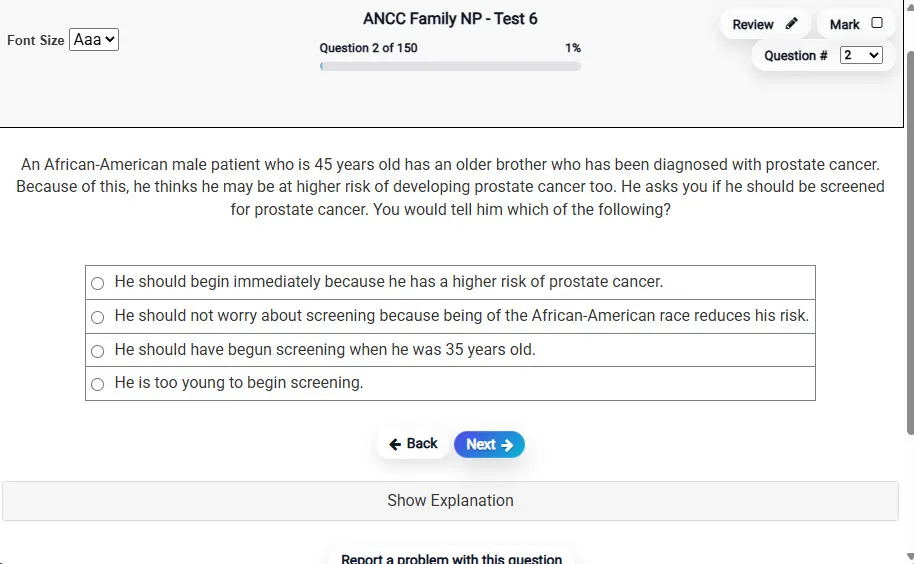
Answering a Question screen – Multiple-choice item view with navigation controls and progress tracker.
Answering a Question Multiple-choice item view with navigation controls and progress tracker.

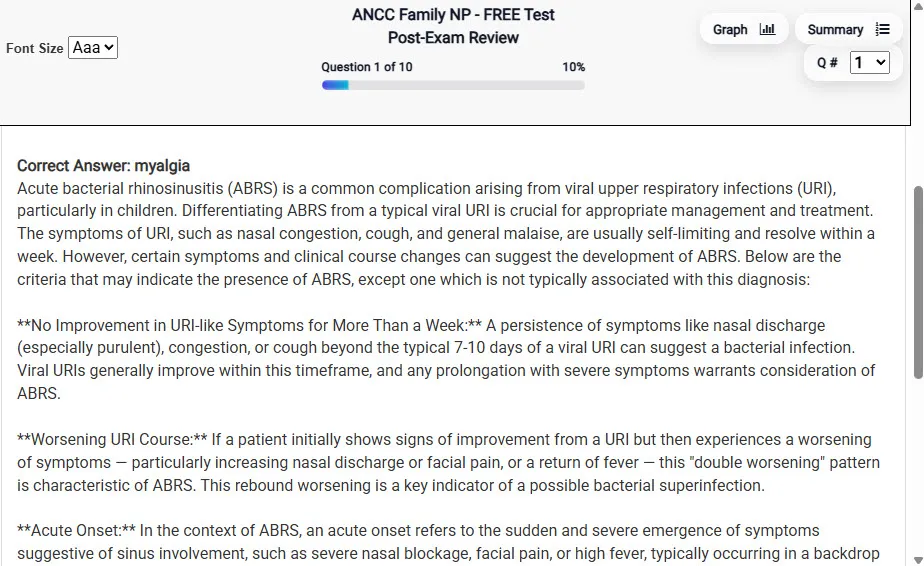
                           Detailed Explanation screen – 
                         Review mode showing chosen answer and rationale and references.
Detailed Explanation Review mode showing chosen answer and rationale and references.

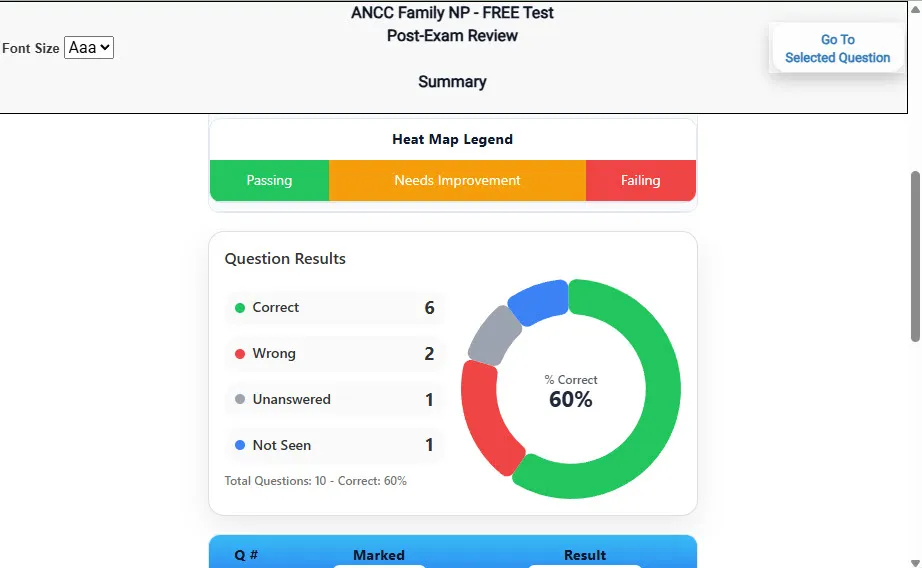
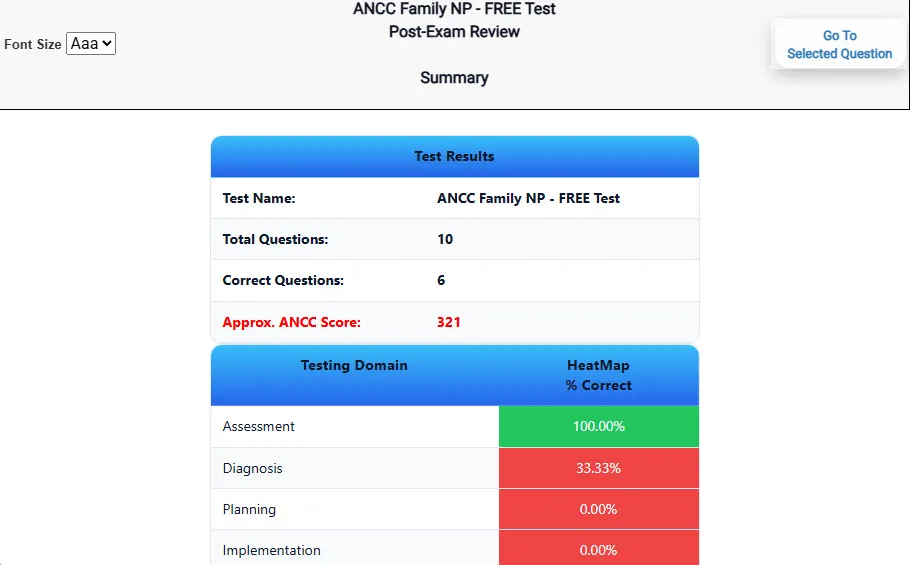
                           Review Summary 1 screen – 
                         Summary with counts for correct/wrong/unanswered and not seen items.
Review Summary 1 Summary with counts for correct/wrong/unanswered and not seen items.

                           Review Summary 2 screen – 
                         Advanced summary with category/domain breakdown and performance insights.
Review Summary 2 Advanced summary with category/domain breakdown and performance insights.

What Each Screen Shows

Answer Question Screen

  • Clean multiple-choice interface with progress bar.
  • Mark for review feature.
  • Matches real test pacing.

Detailed Explanation

  • Correct answer plus rationale.
  • Key concepts and guidelines highlighted.
  • Move between questions to fill knowledge gaps.

Review Summary 1

  • Overall results with total questions and scaled score.
  • Domain heatmap shows strengths and weaknesses.
  • Quick visual feedback on study priorities.

Review Summary 2

  • Chart of correct, wrong, unanswered, not seen.
  • Color-coded results for easy review.
  • Links back to missed items.

Top 10 Reasons to Use Exam Edge for your Praxis Pre-Kindergarten Education Exam Prep

  1. Focused on the Praxis Pre-Kindergarten Education Exam

    Our practice tests are built specifically for the Praxis Pre-Kindergarten Education exam — every question mirrors the real topics, format, and difficulty so you're studying exactly what matters.

  2. Real Exam Simulation

    We match the per-question time limits and pressure of the actual Praxis exam, so test day feels familiar and stress-free.

  3. 10 Full Practice Tests & 1,000 Unique Questions

    You'll have more than enough material to master every Praxis Pre-Kindergarten Education concept — no repeats, no fluff.

  4. Lower Cost Than a Retake

    Ordering 5 practice exams costs less than retaking the Praxis Pre-Kindergarten Education exam after a failure. One low fee could save you both time and money.

  5. Flexible Testing

    Need to step away mid-exam? Pick up right where you left off — with your remaining time intact.

  6. Instant Scoring & Feedback

    See your raw score and an estimated Praxis Pre-Kindergarten Education score immediately after finishing each practice test.

  7. Detailed Explanations for Every Question

    Review correct and incorrect answers with clear, step-by-step explanations so you truly understand each topic.

  8. Trusted & Accredited

    We're fully accredited by the Better Business Bureau and uphold the highest standards of trust and transparency.

  9. Web-Based & Always Available

    No software to install. Access your Praxis Pre-Kindergarten Education practice exams 24/7 from any computer or mobile device.

  10. Expert Support When You Need It

    Need extra help? Our specialized tutors are highly qualified and ready to support your Praxis exam prep.


Pass the Praxis Pre-Kindergarten Education Exam with Realistic Practice Tests from Exam Edge

Preparing for your upcoming Praxis Pre-Kindergarten Education (5531) Certification Exam can feel overwhelming — but the right practice makes all the difference. Exam Edge gives you the tools, structure, and confidence to pass on your first try. Our online practice exams are built to match the real Praxis Pre-Kindergarten Education exam in content, format, and difficulty.

  • 📝 10 Praxis Pre-Kindergarten Education Practice Tests: Access 10 full-length exams with 100 questions each, covering every major Praxis Pre-Kindergarten Education topic in depth.
  • Instant Online Access: Start practicing right away — no software, no waiting.
  • 🧠 Step-by-Step Explanations: Understand the reasoning behind every correct answer so you can master Praxis Pre-Kindergarten Education exam concepts.
  • 🔄 Retake Each Exam Up to 4 Times: Build knowledge through repetition and track your improvement over time.
  • 🌐 Web-Based & Available 24/7: Study anywhere, anytime, on any device.
  • 🧘 Boost Your Test-Day Confidence: Familiarity with the Praxis format reduces anxiety and helps you perform under pressure.

These Praxis Pre-Kindergarten Education practice exams are designed to simulate the real testing experience by matching question types, timing, and difficulty level. This approach helps you get comfortable not just with the exam content, but also with the testing environment, so you walk into your exam day focused and confident.


Exam Edge Praxis Reviews


I failed the Praxis Math test five times before I found your site. After taking all your practice tests, on my next attempt I passed by five points! I can honestly say this site is the reason I passed. Thank you!!!

Nikki P, Tennessee

Just wanted to say thanks for helping me pass the Praxis I Reading! Your practice tests and especially your explanations are great. They gave me the confidence I needed! Now I can student teach this fall. I'm so glad I found PraxisReading.com!

Denise C, Florida

Thank you so much. I just received my results in the mail. I scored a 179 and passed the Praxis I Writing! I'll never have to worry about retaking this test again! PraxisWriting.com is great. I told all my friends about this site.

Susan K, Virginia

I failed the Parapro test four times before I found your site. After taking all your practice tests, on my next attempt I passed by seven points! I can honestly say that this site is the reason I passed. Thank you!!!

Rebecca S, Texas

Hi! Just returned from taking my Praxis computerized and am happy to say that I passed with a 175. The last time I took the test I missed by 1 point. Your tests definitely made the difference for me! The set up was so similar to the test and the types of questions were also similar that I felt ve ...
Read More
Brad Y, Pennsylvania

I have taken the math praxis 3 times and wanted to give up. I ordered the bundle of math tests and I passed the math praxis today. Thank you for all the help.

Jacob D, South Carolina


Praxis Pre-Kindergarten Education Aliases Test Name

Here is a list of alternative names used for this exam.

  • Praxis Pre-Kindergarten Education
  • Praxis Pre-Kindergarten Education test
  • Praxis Pre-Kindergarten Education Certification Test
  • Praxis
  • Praxis 5531
  • 5531 test
  • Praxis Pre-Kindergarten Education (5531)
  • Pre-Kindergarten Education certification